Top 10 AI Voice Agent Companies in India 2026: Pricing, Features, Pros, Cons & Expert Ratings
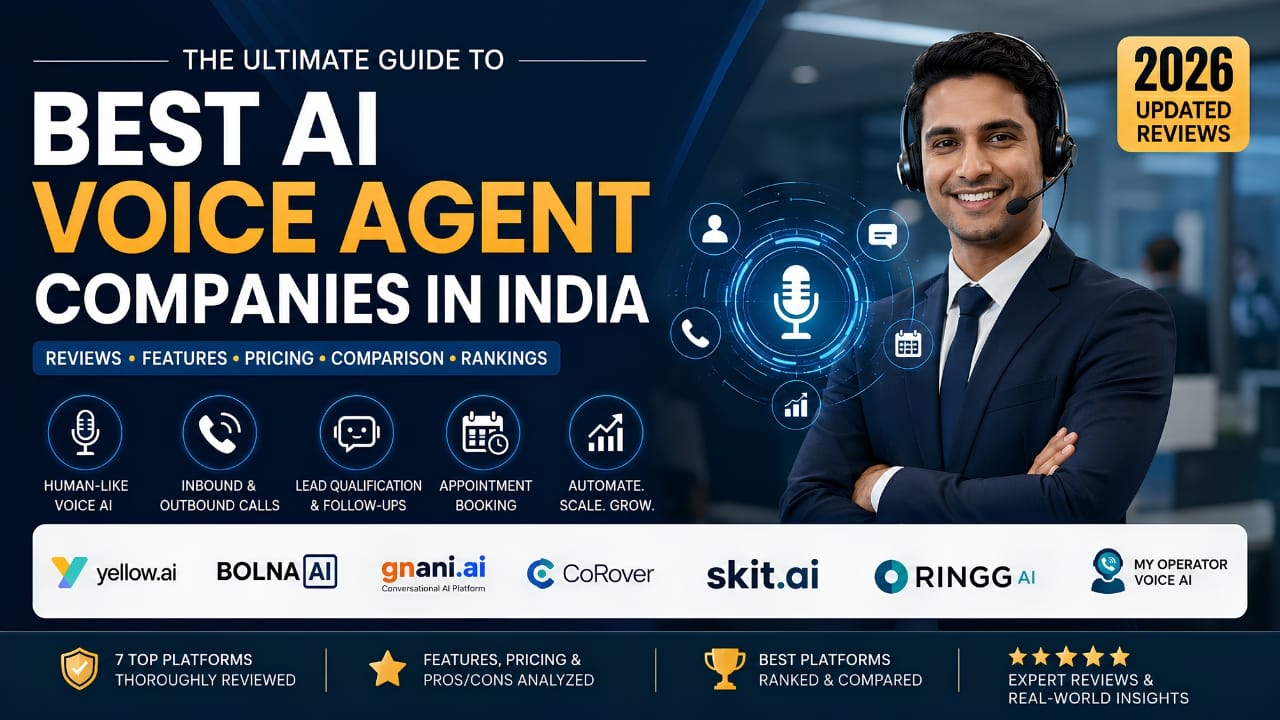

Section 1: Why AI Voice Agents Are Taking Over Business Communication in India
The Beginning of a Massive Shift
If you had told most business owners just a few years ago that artificial intelligence would soon be answering customer calls, qualifying leads, booking appointments, following up with prospects, handling customer support inquiries, and even conducting sales conversations, many would have dismissed the idea as science fiction.
Yet here we are in 2026.
Artificial Intelligence has rapidly moved from being a futuristic concept to becoming an essential business tool. Among all the AI innovations currently transforming businesses, AI Voice Agents are emerging as one of the most disruptive and impactful technologies.
Across India, businesses of all sizes are beginning to rethink how they communicate with customers. Traditional call centers, human receptionists, telecallers, appointment setters, and support teams are no longer the only options available.
A new category has emerged.
AI Voice Agents.
These intelligent systems can speak naturally, understand customer responses, answer questions, qualify prospects, schedule appointments, transfer calls, and perform many of the repetitive communication tasks that previously required human employees.
The implications are enormous.
Whether you are a coach, consultant, trainer, healthcare provider, educational institution, real estate company, local business, agency, startup, or enterprise organization, AI Voice Agents have the potential to dramatically transform the way you engage with prospects and customers.
In this comprehensive review guide, I will analyze the leading AI Voice Agent companies operating in India and compare their features, pricing, strengths, weaknesses, and overall value.
However, before we dive into individual platforms, it is important to understand why AI Voice Agents are becoming so popular and why businesses are adopting them at such a rapid pace.
The Communication Problem Most Businesses Face
Communication is the lifeblood of every business.
No matter what product or service you sell, growth ultimately depends on conversations.
A lead submits a form.
Someone books a consultation.
A prospect requests information.
A customer needs support.
An existing client requires follow-up.
Every one of these situations involves communication.
Historically, businesses relied on human teams to handle these interactions.
While human communication remains extremely valuable, it comes with several challenges.
Employees require salaries.
They require training.
They require supervision.
They require management.
They take breaks.
They have working hours.
They may forget scripts.
They may deliver inconsistent experiences.
They may resign unexpectedly.
As businesses grow, these challenges multiply.
Many organizations eventually reach a point where communication becomes a bottleneck.
Leads begin slipping through the cracks.
Follow-ups become inconsistent.
Response times increase.
Customer satisfaction declines.
Opportunities are lost.
This is where AI Voice Agents begin to attract attention.
The Rise of Instant Expectations
Today's customers expect speed.
They do not want to wait hours or days for a response.
They want answers immediately.
Consider your own behavior.
When you fill out a form online, how long are you willing to wait before receiving a response?
Most people expect communication within minutes.
Some expect it within seconds.
This shift has fundamentally changed customer expectations.
Businesses that respond quickly often win.
Businesses that respond slowly often lose.
AI Voice Agents are uniquely positioned to address this challenge because they can respond instantly.
They do not sleep.
They do not take holidays.
They do not require lunch breaks.
They are available twenty-four hours a day, seven days a week.
For many businesses, this alone creates significant competitive advantages.
Why India Is Becoming a Major AI Voice Agent Market
India represents one of the most exciting markets for AI Voice Agents.
Several factors contribute to this trend.
First, India has one of the world's largest populations of mobile phone users.
Voice communication remains deeply embedded in everyday business operations.
Second, Indian consumers are comfortable speaking in multiple languages.
Many people naturally switch between English, Hindi, and regional languages during conversations.
This creates opportunities for multilingual AI systems.
Third, India's startup ecosystem is rapidly embracing automation.
Businesses are constantly looking for ways to increase efficiency while controlling costs.
AI Voice Agents fit perfectly into this objective.
Fourth, digital adoption has accelerated dramatically across the country.
More businesses now operate online.
More leads are generated digitally.
More customer interactions happen through technology-driven channels.
As a result, demand for scalable communication solutions continues to rise.
The Economics Behind AI Voice Agents
One of the primary reasons businesses explore AI Voice Agents is economics.
Consider a simple example.
Suppose a company generates hundreds or thousands of inquiries every month.
Traditionally, handling these inquiries might require multiple employees.
The costs quickly add up.
Recruitment.
Training.
Salaries.
Benefits.
Management.
Infrastructure.
Office space.
Technology.
Now compare this to an AI Voice Agent that can handle large volumes of conversations simultaneously.
The financial equation becomes extremely attractive.
This does not necessarily mean AI replaces humans entirely.
In many cases, the most effective model combines AI and human teams.
AI handles repetitive tasks.
Humans handle complex situations.
The result is often greater efficiency and improved customer experiences.
The Evolution from IVR to Intelligent Conversations
Many people mistakenly assume AI Voice Agents are simply advanced IVR systems.
They are not.
Traditional IVR systems typically force callers through rigid menus.
Press 1 for sales.
Press 2 for support.
Press 3 for billing.
Customers often find these experiences frustrating.
AI Voice Agents represent a significant leap forward.
Instead of navigating menus, callers can simply speak naturally.
The AI listens.
The AI understands.
The AI responds.
The conversation feels significantly more human.
This shift from menu-driven interactions to conversational experiences is one of the major reasons AI Voice Agents are gaining momentum.
The Growing Demand for Lead Qualification
Lead generation is important.
Lead qualification is even more important.
Many businesses spend substantial budgets generating leads but struggle to determine which leads deserve immediate attention.
Sales teams frequently waste time speaking with unqualified prospects.
AI Voice Agents can help solve this problem.
They can ask qualification questions.
They can collect information.
They can identify buying intent.
They can prioritize high-quality opportunities.
This allows human sales professionals to focus on conversations that are most likely to result in revenue.
For businesses seeking growth, this capability is particularly attractive.
Appointment Booking at Scale
Appointment scheduling is another area where AI Voice Agents are creating significant value.
Whether you operate a coaching business, medical practice, consulting firm, educational institution, or service company, appointments drive revenue.
Yet scheduling appointments manually consumes time and resources.
AI Voice Agents can automate much of this process.
They can check availability.
They can schedule meetings.
They can send reminders.
They can confirm attendance.
They can reduce no-shows.
These seemingly simple improvements often generate measurable business impact.
Customer Support Without Endless Waiting
Customer support is one of the most common applications for AI Voice Agents.
Many customers contact businesses seeking answers to routine questions.
Business hours.
Pricing information.
Appointment details.
Order status.
Basic troubleshooting.
These inquiries are repetitive.
AI Voice Agents excel at handling such scenarios.
By automating common interactions, businesses can improve response times while allowing human support teams to focus on more complex issues.
This creates benefits for both customers and organizations.
The Rise of Conversational Commerce
The future of business communication is increasingly conversational.
People prefer conversations over forms.
People prefer discussions over complicated interfaces.
People want personalized interactions.
AI Voice Agents support this trend by making technology feel more human.
Instead of navigating websites, customers can simply speak.
Instead of reading lengthy instructions, they can ask questions.
Instead of waiting for callbacks, they can receive immediate assistance.
This shift toward conversational experiences is likely to accelerate in the coming years.
Opportunities for Coaches, Consultants, and Experts
As someone deeply involved in the coaching and consulting industry, I find this category particularly fascinating.
Many coaches and consultants struggle with lead management.
They generate inquiries through social media, webinars, YouTube content, advertising campaigns, and referrals.
However, consistent follow-up often becomes challenging.
AI Voice Agents offer a potential solution.
They can contact leads quickly.
They can answer common questions.
They can explain offers.
They can qualify prospects.
They can schedule strategy sessions.
For knowledge-based businesses, these capabilities can dramatically improve operational efficiency.
Opportunities for Small Businesses
One of the most exciting developments is that AI Voice Agents are no longer limited to large enterprises.
Small businesses can now access technology that was previously available only to major organizations.
Local clinics.
Educational institutes.
Real estate agencies.
Service providers.
Retail businesses.
Professional firms.
Many of these organizations can now deploy sophisticated communication systems without building large call center operations.
This democratization of technology is creating new opportunities across the business landscape.
The Future Is Still Being Written
Although AI Voice Agents have already made impressive progress, the industry is still evolving rapidly.
Voice quality continues to improve.
Language understanding continues to improve.
Integrations continue to improve.
Customization continues to improve.
Every few months, new capabilities emerge.
The platforms that lead today may not necessarily lead tomorrow.
Competition is intense.
Innovation is accelerating.
This makes it more important than ever for buyers to conduct thorough research before selecting a platform.
What This Guide Will Help You Discover
Choosing an AI Voice Agent platform is not a decision that should be made lightly.
Different platforms serve different audiences.
Some focus on enterprises.
Some focus on startups.
Some excel in multilingual support.
Some excel in integrations.
Some offer stronger pricing.
Some offer stronger deployment support.
The purpose of this guide is to help you navigate this rapidly evolving landscape.
Over the next sections, we will examine the leading AI Voice Agent companies in India, evaluate their strengths and weaknesses, compare their pricing structures, analyze their features, and determine which platforms are best suited for different business scenarios.
By the end of this review, you should have a much clearer understanding of the AI Voice Agent ecosystem and be better equipped to choose the solution that aligns with your goals, budget, and business requirements.
The age of AI-powered business communication is no longer approaching.
It has already arrived.
The question is no longer whether AI Voice Agents will influence the future of customer communication.
The question is which platforms are most likely to help your business thrive in that future.
Section 2: What Is an AI Voice Agent and How Does It Actually Work?
Understanding AI Voice Agents Beyond the Hype
Artificial Intelligence is one of the most discussed technologies in today's business world. Everywhere you look, companies are talking about automation, AI assistants, AI agents, AI chatbots, and AI-powered customer support.
However, among all these innovations, one category is attracting exceptional attention from businesses across India:
AI Voice Agents.
The reason is simple.
Human beings naturally communicate through voice.
For thousands of years, conversations have been the primary way people exchange information, build relationships, solve problems, and make purchasing decisions.
Even in today's digital world, voice remains incredibly powerful.
A phone conversation can often accomplish more in five minutes than dozens of emails or text messages.
Businesses understand this.
Customers understand this.
Sales professionals understand this.
Now artificial intelligence is beginning to understand it as well.
This is why AI Voice Agents are becoming one of the fastest-growing categories in business automation.
Before evaluating various AI Voice Agent companies, it is important to understand exactly what an AI Voice Agent is, how it works, what technologies power it, and why it has become such a significant business tool.
What Is an AI Voice Agent?
An AI Voice Agent is an artificial intelligence system capable of having spoken conversations with human beings.
Unlike traditional software, an AI Voice Agent can:
Listen to spoken language
Understand what a person is saying
Interpret intent
Generate intelligent responses
Speak naturally
Continue a conversation
Handle follow-up questions
Perform tasks during the conversation
In simple words, an AI Voice Agent is a digital employee that communicates through voice.
It can answer incoming calls.
It can make outgoing calls.
It can qualify leads.
It can schedule appointments.
It can answer frequently asked questions.
It can collect information.
It can transfer calls when needed.
It can even handle sales conversations.
The most advanced systems can perform many of these tasks without human intervention.
AI Voice Agents vs Traditional Call Centers
To understand the value of AI Voice Agents, let us compare them with traditional call center operations.
Traditional Call Center:
Human agents required
Limited working hours
Requires training
Requires supervision
Employee turnover issues
Inconsistent customer experience
Higher operational costs
AI Voice Agent:
Available 24/7
No breaks
Consistent communication
Instant responses
Scalable operations
Lower operational overhead
Simultaneous conversations
This comparison explains why businesses are exploring Voice AI solutions so aggressively.
However, AI Voice Agents are not necessarily replacing humans.
In many successful implementations, AI and human teams work together.
AI handles repetitive interactions.
Humans handle complex decision-making.
This hybrid model often delivers the best results.
The Four Core Technologies Behind Every AI Voice Agent
Most people see only the conversation.
Behind that conversation lies an impressive technology stack.
Every AI Voice Agent typically relies on four major components.
1. Speech Recognition
The first step is listening.
When a customer speaks, the system must convert spoken words into text.
This process is called Speech Recognition or Speech-to-Text.
For example:
Customer says:
"Hello, I would like to know more about your coaching program."
The AI system converts the voice into text.
Now the system can process the information.
Accuracy is extremely important here.
If the AI misunderstands the customer's words, the entire conversation may become ineffective.
This is why speech recognition quality is one of the most important evaluation criteria when reviewing AI Voice Agent platforms.
2. Natural Language Understanding
Once speech is converted into text, the system must determine what the person actually means.
This is called Natural Language Understanding.
Consider these examples:
"I want information."
"I need details."
"Can you explain your program?"
All three statements express similar intent.
A good AI Voice Agent recognizes this.
Instead of focusing only on words, it understands meaning.
This capability allows conversations to feel natural rather than robotic.
3. Large Language Models
This is the brain of the AI Voice Agent.
Large Language Models are responsible for generating responses.
These systems analyze:
Customer intent
Context
Previous conversation history
Business instructions
Knowledge bases
The AI then decides how to respond.
Modern language models are dramatically more capable than earlier conversational systems.
This improvement is one of the primary reasons Voice AI has advanced so rapidly.
4. Text-to-Speech Technology
Once the response is generated, the AI must speak.
Text-to-Speech systems convert written responses into natural-sounding audio.
For example:
Generated response:
"Thank you for your interest. I'd be happy to explain our program."
The Text-to-Speech system converts this sentence into spoken language.
Voice quality varies significantly between providers.
Some voices sound robotic.
Others sound remarkably human.
This is one of the major factors we will analyze later in this guide.
What Happens During an AI Voice Conversation?
Most people hear only the final conversation.
Behind the scenes, multiple technologies work together within seconds.
The process typically follows this sequence:
Step 1:
Customer speaks.
Step 2:
Speech Recognition converts voice into text.
Step 3:
Language Understanding identifies intent.
Step 4:
The AI analyzes context.
Step 5:
The language model generates a response.
Step 6:
Text-to-Speech converts the response into audio.
Step 7:
The customer hears the answer.
All of this happens in real time.
Modern systems can complete this process surprisingly quickly.
Incoming AI Calls
Many businesses use AI Voice Agents for incoming calls.
Examples include:
Customer support
Appointment scheduling
Lead inquiries
Business information
Order tracking
Service requests
When customers call, the AI answers immediately and begins assisting them.
This reduces waiting times and improves customer experiences.
Outgoing AI Calls
AI Voice Agents are also used for outbound calling.
Examples include:
Lead qualification
Appointment reminders
Customer follow-ups
Survey collection
Renewal reminders
Sales outreach
This capability is especially attractive for businesses generating large volumes of leads.
Instead of manually calling every prospect, AI can conduct initial conversations and identify qualified opportunities.
AI Voice Agents for Sales
One of the most exciting applications involves sales conversations.
Consider a coaching business.
Hundreds of people may express interest.
However, only a small percentage may be serious prospects.
AI Voice Agents can:
Ask qualifying questions
Understand goals
Determine budget ranges
Identify challenges
Schedule appointments
Provide basic information
This helps sales teams focus their time more effectively.
AI Voice Agents for Customer Support
Customer support represents another major use case.
Common support requests often involve repetitive questions.
Examples:
Business hours
Pricing details
Program information
Appointment status
Basic troubleshooting
AI Voice Agents can answer many of these questions instantly.
This improves efficiency while reducing support workloads.
AI Voice Agents for Appointment Booking
Scheduling is often surprisingly expensive for businesses.
Staff members spend considerable time coordinating appointments.
AI Voice Agents can automate much of this process.
They can:
Check availability
Schedule meetings
Confirm appointments
Send reminders
Reschedule sessions
Reduce no-shows
For industries such as healthcare, coaching, education, and consulting, this can create substantial value.
Multilingual Voice AI in India
India presents unique opportunities and challenges.
Customers frequently switch between:
English
Hindi
Hinglish
Regional languages
A successful AI Voice Agent must handle these transitions smoothly.
For example:
"Hello, mujhe pricing ke baare mein information chahiye."
This combines English and Hindi.
Many Indian consumers communicate this way naturally.
Therefore, multilingual support is becoming a critical competitive advantage.
Why Voice AI Is Different from Chatbots
Many people confuse Voice AI with chatbots.
Although related, they are not the same.
Chatbots primarily operate through text.
Voice Agents operate through speech.
Voice communication introduces additional challenges:
Accent recognition
Speech interruptions
Pronunciation variations
Background noise
Natural pacing
Emotional tone
As a result, Voice AI is often more complex than chatbot technology.
Can AI Voice Agents Sound Human?
This is one of the most common questions.
The answer depends on the platform.
Some systems still sound noticeably robotic.
Others can sound surprisingly natural.
Several factors influence perceived human-likeness:
Voice quality
Response speed
Conversation flow
Context awareness
Emotion handling
Interruption management
The best platforms combine all these elements effectively.
The Importance of Knowledge Bases
An AI Voice Agent is only as intelligent as the information available to it.
Most platforms allow businesses to upload:
FAQs
Product information
Service details
Pricing information
Policies
Training documents
Knowledge bases
The AI then uses this information during conversations.
This allows responses to remain accurate and relevant.
For businesses evaluating AI Voice Agent providers, knowledge management capabilities are extremely important.
Common Limitations of AI Voice Agents
Although impressive, AI Voice Agents are not perfect.
Current limitations may include:
Complex reasoning challenges
Highly emotional conversations
Industry-specific compliance requirements
Unexpected conversation paths
Incomplete knowledge bases
Poor configuration
Voice quality variations
Businesses should understand these limitations before deployment.
Realistic expectations lead to better outcomes.
The Future of AI Voice Agents
The technology is improving rapidly.
Future developments are likely to include:
More natural voices
Better emotional intelligence
Improved multilingual support
Deeper CRM integrations
Greater personalization
Enhanced business workflows
Better memory capabilities
Advanced analytics
The AI Voice Agent industry today resembles the early days of cloud software.
Adoption is increasing.
Competition is intensifying.
Innovation is accelerating.
The platforms that successfully combine intelligence, reliability, affordability, and ease of deployment are likely to dominate the market.
Why Understanding the Technology Matters
Many buyers choose platforms based solely on pricing.
This is a mistake.
A cheaper platform may have weaker speech recognition.
A more expensive platform may offer superior voice quality.
Another platform may excel at integrations.
Another may be strongest in multilingual support.
Understanding how AI Voice Agents actually work helps buyers evaluate platforms more intelligently.
As we move into the next section, we will examine exactly how this review was conducted, the criteria used to evaluate providers, and the rating framework used to rank the leading AI Voice Agent companies operating in India today.
Section 3: How We Evaluated and Rated AI Voice Agent Companies in India
Not All AI Voice Agents Are Created Equal
One of the biggest mistakes businesses make when selecting an AI Voice Agent platform is assuming that all providers offer roughly the same capabilities.
At first glance, many platforms appear similar.
Almost every company claims to provide:
Human-like AI conversations
Lead qualification
Appointment booking
Customer support automation
Voice AI technology
CRM integrations
Business automation
The marketing often sounds nearly identical.
However, once you begin evaluating platforms seriously, major differences quickly emerge.
Some AI Voice Agents sound incredibly natural.
Others sound robotic.
Some handle Hindi and Hinglish exceptionally well.
Others struggle with multilingual conversations.
Some are ideal for coaches and small businesses.
Others are designed primarily for banks, enterprises, and large contact centers.
Some offer excellent value for money.
Others become surprisingly expensive once deployment and usage costs are included.
This is exactly why I decided to create this comprehensive review guide.
Instead of relying on marketing claims, I wanted to examine the leading AI Voice Agent companies operating in India through a practical business lens.
The goal is simple:
Help business owners, coaches, consultants, educators, agencies, startups, and enterprises make informed decisions.
To accomplish this, we needed a structured evaluation methodology.
Why Most Online Reviews Are Not Reliable
Before discussing our framework, it is important to understand a problem that exists throughout the software review industry.
Many reviews are not actually reviews.
They are advertisements disguised as reviews.
The writer has never used the platform.
The reviewer simply repeats information from the company website.
No critical analysis is performed.
No meaningful comparisons are made.
No weaknesses are discussed.
No buyer guidance is provided.
The result is content that helps neither readers nor businesses.
A proper review should answer difficult questions such as:
Which platform offers the best voice quality?
Which platform provides the best value?
Which platform is easiest to deploy?
Which platform is best for coaches?
Which platform is best for enterprises?
Which platform supports Hindi and Hinglish most effectively?
Which platform scales efficiently?
Which platform offers the strongest integrations?
These are the questions that actually matter.
Therefore, our evaluation framework focuses on practical business outcomes rather than marketing promises.
Our Rating Philosophy
The purpose of this guide is not to declare a single winner.
Different businesses have different needs.
A platform that is perfect for a large enterprise may be completely unsuitable for a solo coach.
Similarly, a platform that works brilliantly for appointment scheduling may not be ideal for complex customer support operations.
Therefore, our evaluation philosophy is based on fit rather than hype.
We focus on determining:
Who should use a platform
Who should avoid a platform
Where it excels
Where it struggles
Whether the pricing is justified
Whether the value matches the investment
This approach produces recommendations that are far more useful than simple rankings.
The 10 Core Evaluation Categories
To create fair comparisons, every AI Voice Agent provider was evaluated across ten major categories.
Each category contributes to the final score.
Let us examine them individually.
Category 1: Voice Quality
Weight: Extremely High
Voice quality is often the first thing customers notice.
Even the most advanced AI becomes frustrating if it sounds unnatural.
When evaluating voice quality, we consider:
Naturalness
Clarity
Pronunciation
Speech pacing
Emotional tone
Human-likeness
Conversation smoothness
Interruption handling
Voice quality is one of the most important differentiators in the Voice AI industry.
A poor voice experience can damage trust instantly.
A great voice experience can significantly improve engagement.
Category 2: Conversation Intelligence
Weight: Extremely High
Many platforms can speak.
Far fewer can hold meaningful conversations.
Conversation intelligence measures:
Context awareness
Intent recognition
Follow-up handling
Question answering
Memory within conversations
Adaptability
Natural dialogue flow
The difference between a scripted bot and a true AI Voice Agent becomes very obvious in this category.
Category 3: Hindi and Hinglish Support
Weight: Very High
India is unique.
Many customers naturally switch between languages during conversations.
Examples:
"Can you tell me pricing?"
"Appointment kab available hai?"
"Mujhe details WhatsApp kar dijiye."
This communication style is extremely common.
Therefore, we carefully evaluate:
Hindi understanding
Hinglish understanding
Mixed-language conversations
Accent recognition
Regional language support
Multilingual flexibility
For many Indian businesses, this category is more important than advanced enterprise features.
Category 4: Features and Capabilities
Weight: High
Features determine what businesses can actually accomplish.
We evaluate:
Inbound calling
Outbound calling
Lead qualification
Appointment booking
Call transfers
Knowledge base integration
CRM connectivity
Analytics
Automation workflows
Reporting
API capabilities
Scalability options
A platform may have excellent voice quality but still lack essential business functionality.
Therefore, feature evaluation remains critical.
Category 5: Ease of Deployment
Weight: High
A powerful platform is useless if implementation becomes a nightmare.
Many business owners underestimate deployment complexity.
Some platforms can be operational within hours.
Others may require weeks of setup.
We evaluate:
Onboarding process
Documentation quality
Technical complexity
Configuration effort
Learning curve
Training requirements
Support availability
The easier a platform is to deploy, the faster businesses can generate value.
Category 6: Integrations and Ecosystem
Weight: High
Modern businesses rely on multiple systems.
CRM platforms
WhatsApp tools
Scheduling software
Marketing automation systems
Sales pipelines
Customer databases
Voice AI must integrate effectively with these tools.
Therefore, we evaluate:
CRM integrations
API flexibility
Webhook support
Workflow automation
Third-party connectivity
Business ecosystem compatibility
Platforms with strong integration capabilities often deliver significantly greater long-term value.
Category 7: Pricing and Value for Money
Weight: Very High
Pricing alone is not enough.
Value matters more.
Many buyers focus exclusively on cost.
This often leads to poor decisions.
A cheaper platform may require expensive customization.
A premium platform may reduce operational costs significantly.
Therefore, we evaluate:
Monthly costs
Usage costs
Per-minute pricing
Setup costs
Deployment costs
Enterprise costs
Hidden charges
Overall value delivered
The goal is to determine whether the investment is justified.
Category 8: Scalability
Weight: High
Business needs evolve.
A platform suitable for 100 monthly calls may struggle at 100,000 monthly calls.
We evaluate:
Traffic handling
Concurrent calls
Enterprise readiness
Growth flexibility
Infrastructure strength
Reliability under load
Scalability becomes particularly important for rapidly growing organizations.
Category 9: Customer Support and Service
Weight: Medium to High
Technology inevitably raises questions.
Businesses require support.
The quality of support often determines long-term satisfaction.
We evaluate:
Response times
Knowledge quality
Technical expertise
Documentation
Onboarding assistance
Implementation support
Customer success programs
Many businesses underestimate the importance of support until something goes wrong.
Category 10: Overall Business Impact
Weight: Highest
Ultimately, business outcomes matter most.
We evaluate:
Lead conversion potential
Appointment booking effectiveness
Customer experience improvements
Operational efficiency gains
Revenue impact potential
Time savings
Resource optimization
Return on investment
A platform may excel technically but still fail to create meaningful business results.
This category ensures practical outcomes remain the primary focus.
Our Five-Star Rating System
To simplify comparisons, each platform receives ratings across major categories.
★★★★★ Exceptional
★★★★☆ Very Strong
★★★☆☆ Average
★★☆☆☆ Below Average
★☆☆☆☆ Weak
These ratings are designed to help readers quickly identify strengths and weaknesses.
However, detailed analysis remains far more important than raw scores.
Different Businesses Require Different Winners
One of the most important principles of this review is recognizing that different businesses need different solutions.
For example:
A coach may prioritize:
Ease of use
Lead qualification
Appointment booking
Affordable pricing
A large bank may prioritize:
Security
Scalability
Compliance
Enterprise integrations
A healthcare organization may prioritize:
Appointment management
Customer support
Reliability
A real estate company may prioritize:
Lead nurturing
Follow-up automation
Outbound calling
Therefore, we will provide category-specific recommendations rather than pretending one platform is universally superior.
The Major Companies Included in This Review
This guide evaluates many of the most recognized AI Voice Agent companies serving the Indian market.
These include platforms focused on:
Enterprise AI
Voice automation
Contact center automation
Lead qualification
Appointment scheduling
Sales conversations
Multilingual support
Business communication
Some providers focus on startups.
Some focus on enterprises.
Some specialize in voice.
Others offer broader conversational AI ecosystems.
The next section will introduce the leading AI Voice Agent companies in India and provide an initial ranking overview before we begin our deep-dive analysis of each category.
By the end of this review, you will have a far clearer understanding of which platforms deserve serious consideration and which solutions are best suited to your specific business goals.
Section 4: Top AI Voice Agent Companies in India – Rankings, Ratings, Market Positioning and Complete Overview
The Indian AI Voice Agent Market Has Entered a New Era
Just a few years ago, finding an AI Voice Agent company in India was difficult.
Most businesses either relied on traditional call centers, IVR systems, human telecallers, or expensive enterprise software that was inaccessible to small and medium-sized businesses.
Today, the landscape looks dramatically different.
Artificial Intelligence has evolved rapidly.
Speech recognition has improved.
Large Language Models have become significantly more capable.
Voice synthesis has become more natural.
Cloud infrastructure has become more affordable.
As a result, a growing number of companies are now offering AI Voice Agent solutions tailored for Indian businesses.
Some focus on startups.
Some focus on large enterprises.
Some specialize in multilingual support.
Some emphasize customer support.
Some prioritize sales automation.
Some position themselves as complete conversational AI ecosystems.
This growing competition is excellent news for buyers.
More competition generally leads to:
Better products
More innovation
Better support
Better pricing
Faster development
Greater specialization
However, it also creates confusion.
Many businesses struggle to determine which platform is best suited for their specific requirements.
This section provides an overview of the most significant AI Voice Agent providers currently serving the Indian market.
Later sections will analyze each category in far greater detail.
Understanding Our Rankings
Before reviewing individual companies, it is important to understand something.
This is not a simple "best company wins" ranking.
The AI Voice Agent industry is still evolving.
Different platforms excel in different areas.
For example:
A platform may offer outstanding voice quality but higher pricing.
Another may offer excellent value but fewer enterprise features.
Another may be ideal for banks but excessive for coaches.
Therefore, these rankings should be viewed as starting points rather than final conclusions.
The deeper analysis comes later.
Our Preliminary Top AI Voice Agent Rankings
Based on market presence, capabilities, innovation, voice technology, scalability, and overall business potential, the current shortlist includes:
These rankings will continue to evolve as the market matures.
1. Bolna AI
Market Position
Bolna AI has quickly become one of the most talked-about AI Voice Agent companies in India.
Its growth has been driven by a strong focus on conversational AI, voice automation, and practical business applications.
Unlike some enterprise-heavy platforms, Bolna AI has attracted attention from startups, growing businesses, and technology-driven organizations looking for scalable voice automation.
Strengths
Key strengths include:
Modern AI architecture
Strong focus on Voice AI
Indian language support
Developer-friendly environment
Scalable infrastructure
Competitive pricing models
Bolna AI has gained significant attention because it positions itself closer to modern AI-native platforms rather than traditional enterprise software providers.
Potential Limitations
Some organizations may require:
More enterprise-focused governance
Specialized compliance features
Industry-specific solutions
However, for many businesses, Bolna AI represents one of the strongest emerging options available today.
Preliminary Rating
Voice Quality: ★★★★☆
Conversation Intelligence: ★★★★☆
Pricing: ★★★★★
Ease of Deployment: ★★★★☆
Scalability: ★★★★☆
Overall Rating: 9.0/10
2. Yellow.ai
Market Position
Yellow.ai is one of the most established names in the Indian conversational AI ecosystem.
Unlike some voice-first competitors, Yellow.ai offers a broader platform that combines:
Voice AI
Chatbots
Customer support automation
Enterprise workflows
Omnichannel communication
This makes it particularly attractive for large organizations seeking comprehensive conversational automation.
Strengths
Major strengths include:
Enterprise-grade capabilities
Strong brand reputation
Large customer base
Extensive integrations
Omnichannel support
Mature infrastructure
Many enterprises view Yellow.ai as a strategic platform rather than merely a Voice AI provider.
Potential Limitations
Challenges may include:
Higher implementation costs
More complex deployment
Longer onboarding cycles
Enterprise-oriented pricing
For smaller businesses, these factors can become significant considerations.
Preliminary Rating
Voice Quality: ★★★★☆
Conversation Intelligence: ★★★★★
Pricing: ★★★☆☆
Ease of Deployment: ★★★☆☆
Scalability: ★★★★★
Overall Rating: 9.1/10
3. Gnani AI
Market Position
Gnani AI has established itself as a serious player in the Voice AI and speech technology space.
The company is particularly known for its speech recognition expertise and enterprise-grade voice solutions.
Many financial institutions and large organizations have explored Voice AI technologies similar to those offered by Gnani AI.
Strengths
Key strengths include:
Speech technology expertise
Strong voice processing capabilities
Enterprise readiness
Contact center applications
Multilingual support
Organizations requiring sophisticated voice infrastructure often consider platforms like Gnani AI.
Potential Limitations
Potential challenges include:
Enterprise-focused approach
Custom pricing
Longer implementation cycles
Less attractive for small businesses
Preliminary Rating
Voice Quality: ★★★★☆
Conversation Intelligence: ★★★★☆
Pricing: ★★★☆☆
Ease of Deployment: ★★★☆☆
Scalability: ★★★★★
Overall Rating: 8.8/10
4. CoRover
Market Position
CoRover has become widely recognized for conversational AI applications across multiple industries.
The platform supports:
Voice interactions
Chat interactions
Enterprise automation
Government projects
Customer engagement systems
Its visibility has increased significantly as organizations seek AI-powered communication tools.
Strengths
Notable strengths include:
Multi-channel capabilities
Large-scale deployments
Enterprise orientation
Strong Indian market presence
Potential Limitations
Potential concerns include:
Complexity for smaller businesses
Enterprise implementation processes
Customized pricing structures
Preliminary Rating
Voice Quality: ★★★★☆
Conversation Intelligence: ★★★★☆
Pricing: ★★★☆☆
Ease of Deployment: ★★★☆☆
Scalability: ★★★★★
Overall Rating: 8.7/10
5. Skit.ai
Market Position
Skit.ai has developed a strong reputation within industries such as banking, financial services, and customer service automation.
The platform focuses heavily on voice automation and customer interaction workflows.
Strengths
Key strengths include:
Voice automation expertise
Banking use cases
Customer service workflows
Enterprise-grade infrastructure
Potential Limitations
Potential limitations include:
Enterprise orientation
Less focus on small businesses
Higher implementation requirements
Preliminary Rating
Voice Quality: ★★★★☆
Conversation Intelligence: ★★★★☆
Pricing: ★★★☆☆
Ease of Deployment: ★★★☆☆
Scalability: ★★★★★
Overall Rating: 8.6/10
6. Ringg AI
Market Position
Ringg AI has attracted attention among businesses seeking AI-powered calling solutions without enterprise-level complexity.
It aims to provide accessible Voice AI capabilities to a broader range of organizations.
Strengths
Notable strengths include:
Simpler deployment
Accessibility
Voice automation
Business communication focus
Potential Limitations
Potential challenges include:
Smaller ecosystem
Less enterprise maturity
Fewer advanced capabilities
Preliminary Rating
Voice Quality: ★★★★☆
Conversation Intelligence: ★★★☆☆
Pricing: ★★★★☆
Ease of Deployment: ★★★★☆
Scalability: ★★★☆☆
Overall Rating: 8.2/10
7. MyOperator Voice AI
Market Position
MyOperator is already known throughout India for cloud telephony services.
Its expansion into Voice AI positions it as a familiar choice for many businesses.
Strengths
Major strengths include:
Existing telephony infrastructure
Business communication expertise
Familiar brand recognition
Strong SMB presence
Potential Limitations
Potential concerns include:
Voice AI maturity
Feature depth
Enterprise sophistication
Preliminary Rating
Voice Quality: ★★★☆☆
Conversation Intelligence: ★★★☆☆
Pricing: ★★★★☆
Ease of Deployment: ★★★★☆
Scalability: ★★★★☆
Overall Rating: 8.0/10
Emerging AI Voice Agent Startups
One of the most exciting developments in the Indian market is the rapid emergence of new Voice AI startups.
These companies are experimenting with:
AI sales agents
Appointment booking systems
Customer support automation
Multilingual voice agents
Industry-specific solutions
Some of today's emerging startups could become tomorrow's market leaders.
This is a category worth monitoring closely.
Best AI Voice Agent by Business Type
Based on our preliminary evaluation:
Best for Coaches and Consultants
Bolna AI
Best for Enterprises
Best for Banking and Financial Services
Gnani AI
Best for Customer Support Automation
Best for Voice Technology
Gnani AI
Best for Value for Money
Bolna AI
Best for SMBs
Bolna AI
Best for Telephony Integration
MyOperator Voice AI
Initial Ranking Scorecard
Yellow.ai — 9.1/10
Bolna AI — 9.0/10
Gnani AI — 8.8/10
CoRover — 8.7/10
Skit.ai — 8.6/10
Ringg AI — 8.2/10
MyOperator Voice AI — 8.0/10
Important Note Before We Go Deeper
These rankings are preliminary.
The next several sections will evaluate:
Voice quality
Human-likeness
Hinglish support
Feature depth
Pricing
Deployment experience
Integrations
Real-world use cases
As we dive deeper into those categories, readers will discover that the "best" platform often depends entirely on the specific business objective.
A coach may choose one platform.
A hospital may choose another.
A bank may choose another.
A startup may choose another.
The real goal is not finding the highest-rated platform.
The real goal is finding the right platform for your business.
In the next section, we will conduct one of the most important analyses in this entire guide: determining which AI Voice Agent actually sounds the most human and delivers the best conversational experience.
Section 5: Voice Quality Review – Which AI Voice Agent Sounds Most Human?
The One Factor That Can Make or Break an AI Voice Agent
Imagine this scenario.
A potential customer submits a lead form.
Your AI Voice Agent calls them within thirty seconds.
The prospect answers.
Within the first five seconds, they immediately realize they are speaking to a machine.
Their interest drops.
Their engagement drops.
Their trust drops.
Many simply hang up.
Now imagine a different scenario.
The AI speaks naturally.
The pacing feels human.
The responses are contextual.
The voice sounds warm and conversational.
The prospect continues talking.
The conversation lasts longer.
Information gets exchanged.
Appointments get booked.
Leads get qualified.
The outcome is completely different.
This is why voice quality is arguably the single most important factor in determining whether an AI Voice Agent succeeds or fails.
A platform can have amazing features.
It can have powerful integrations.
It can have advanced analytics.
But if the voice sounds robotic, customer adoption often suffers.
Voice quality is the front door of the entire AI experience.
Everything begins there.
That is why this section may be one of the most important parts of this entire review.
Why Voice Quality Matters More Than Most Businesses Realize
Most businesses initially focus on:
Pricing
Features
Integrations
Automation capabilities
These factors are important.
However, customers never see most of them.
What customers experience is the conversation.
If the conversation feels awkward, everything else becomes less valuable.
People naturally evaluate voices on multiple subconscious levels:
Trustworthiness
Clarity
Confidence
Warmth
Intelligence
Professionalism
This evaluation happens almost instantly.
Often within seconds.
Therefore, voice quality directly influences:
Call completion rates
Engagement rates
Appointment booking rates
Customer satisfaction
Conversion rates
The impact is significant.
The Evolution of AI Voices
To appreciate today's Voice AI technology, it helps to understand how far the industry has progressed.
Early automated systems sounded extremely mechanical.
Sentences felt unnatural.
Pronunciations were awkward.
Speech rhythm was poor.
Conversations felt frustrating.
Most users immediately recognized they were interacting with software.
Modern AI Voice Agents have improved dramatically.
Many now offer:
Natural pauses
Better pronunciation
Emotional expression
Improved pacing
Conversational flow
Human-like intonation
The difference is remarkable.
However, not all platforms have progressed equally.
Some providers still sound noticeably artificial.
Others have achieved surprisingly natural experiences.
The Five Components of Great Voice Quality
When evaluating voice quality, we focus on five major dimensions.
1. Naturalness
Naturalness refers to how human the voice sounds.
Questions include:
Does the voice sound robotic?
Does it sound scripted?
Does it sound realistic?
Does it sound comfortable?
A natural voice creates trust.
An unnatural voice creates resistance.
This is often the first thing customers notice.
2. Speech Rhythm and Pacing
Humans do not speak like machines.
We pause.
We emphasize.
We change speed.
We vary tone.
The best AI Voice Agents mimic these patterns effectively.
Poor pacing makes conversations feel artificial.
Strong pacing makes conversations feel authentic.
3. Pronunciation Accuracy
India presents unique challenges.
Names.
Cities.
Regional words.
Industry terminology.
Hindi expressions.
English terminology.
Hinglish combinations.
A high-quality Voice AI platform must handle all of these effectively.
Mispronunciations reduce professionalism and trust.
4. Emotional Expression
Although AI does not experience emotions, it can simulate emotional expression.
Examples include:
Friendly greetings
Supportive responses
Professional explanations
Appointment confirmations
Follow-up conversations
The best systems sound engaging rather than monotone.
5. Interruption Handling
Human conversations are dynamic.
People interrupt.
They ask follow-up questions.
They change topics.
They clarify statements.
Strong Voice AI systems handle interruptions gracefully.
Weak systems often become confused.
This capability dramatically influences perceived intelligence.
Why India Presents Unique Voice Challenges
Many global Voice AI solutions perform well in English-speaking environments.
India introduces additional complexity.
Customers frequently switch between:
English
Hindi
Hinglish
Regional languages
Within a single conversation.
Example:
"Hello, mujhe coaching program ke baare mein information chahiye."
Then seconds later:
"What is the pricing?"
Then:
"Can you send details on WhatsApp?"
This linguistic flexibility is normal in India.
AI Voice Agents must adapt accordingly.
Platforms that cannot handle multilingual conversations often struggle in the Indian market.
Evaluating Human-Likeness
One of the most frequently asked questions is:
Can AI Voice Agents sound completely human?
The answer is nuanced.
Some platforms come remarkably close.
However, even the best systems still exhibit subtle clues.
Examples may include:
Slightly unusual pauses
Occasional pronunciation issues
Perfect consistency
Predictable pacing
Yet for many business applications, perfection is not necessary.
The goal is not deception.
The goal is effective communication.
The best platforms achieve this successfully.
Bolna AI Voice Quality Review
Bolna AI has earned attention partly because of its focus on conversational experiences.
Strengths include:
Natural conversational flow
Strong responsiveness
Effective multilingual support
Modern AI architecture
Particularly impressive is its ability to maintain relatively smooth interactions during practical business conversations.
For startups, coaches, consultants, and growing businesses, the voice experience feels modern and capable.
Areas for improvement still exist, but overall voice quality is among the strongest in this category.
Voice Quality Rating:
★★★★☆
4.5/5
Yellow.ai Voice Quality Review
Yellow.ai benefits from extensive investment in conversational AI technologies.
The platform performs well in:
Enterprise conversations
Customer support scenarios
Structured workflows
Large-scale deployments
Voice quality is generally strong.
However, because Yellow.ai serves diverse enterprise use cases, some implementations may feel more process-oriented than conversational.
For enterprise applications, this is often acceptable.
Voice Quality Rating:
★★★★☆
4.4/5
Gnani AI Voice Quality Review
Gnani AI's expertise in speech technology becomes apparent in voice-related applications.
Strengths include:
Strong speech recognition
Voice processing capabilities
Enterprise voice infrastructure
The platform demonstrates significant technical maturity.
Organizations prioritizing speech technology often find Gnani AI attractive.
Voice Quality Rating:
★★★★☆
4.4/5
CoRover Voice Quality Review
CoRover delivers solid conversational experiences and performs effectively across multiple communication channels.
Voice quality is generally professional and suitable for enterprise environments.
The platform focuses heavily on practical business applications.
Voice Quality Rating:
★★★★☆
4.2/5
Skit.ai Voice Quality Review
Skit.ai has built substantial expertise around voice automation.
The platform performs particularly well in structured customer interaction scenarios.
Voice quality remains strong, especially in customer support and service-oriented applications.
Voice Quality Rating:
★★★★☆
4.2/5
Ringg AI Voice Quality Review
Ringg AI performs reasonably well for businesses seeking accessible Voice AI solutions.
The voice experience is generally pleasant and functional.
However, compared with category leaders, there may be opportunities for further refinement.
Voice Quality Rating:
★★★★☆
4.0/5
MyOperator Voice AI Review
MyOperator's Voice AI offerings benefit from the company's telecommunications experience.
For SMB-focused applications, the voice experience is generally adequate.
However, some competitors currently demonstrate stronger conversational sophistication.
Voice Quality Rating:
★★★☆☆
3.8/5
Best AI Voice Agents for Hindi
Hindi support is becoming increasingly important.
Businesses targeting Bharat require systems capable of understanding and speaking Hindi naturally.
Top performers include:
Bolna AI
Gnani AI
CoRover
These platforms demonstrate strong multilingual capabilities and are generally better positioned for Indian language applications.
Best AI Voice Agents for Hinglish
Hinglish presents unique challenges because conversations frequently switch between languages.
Example:
"Hello, mujhe details chahiye."
"What is the pricing?"
"Can you book a consultation?"
This style is common throughout India.
Platforms demonstrating stronger flexibility include:
Bolna AI
Gnani AI
These providers appear better equipped for mixed-language interactions.
Best AI Voice Agents for Sales Conversations
Sales conversations require:
Natural pacing
Trust-building
Question handling
Objection management
Context awareness
The strongest performers include:
Bolna AI
Gnani AI
These platforms generally provide the conversational sophistication needed for lead qualification and appointment booking.
Best AI Voice Agents for Customer Support
Customer support environments prioritize:
Accuracy
Consistency
Scalability
Structured conversations
Strong performers include:
These providers demonstrate strong support-focused capabilities.
Voice Quality Scorecard
Platform
Voice Quality Score
Bolna AI
4.5/5
4.4/5
Gnani AI
4.4/5
CoRover
4.2/5
4.2/5
Ringg AI
4.0/5
MyOperator Voice AI
3.8/5
The Hidden Truth About Voice Quality
Many businesses spend weeks comparing features.
They compare integrations.
They compare pricing.
They compare dashboards.
Yet customers never see most of these things.
Customers experience the voice.
They experience the conversation.
They experience the interaction.
That is why voice quality deserves far greater attention during the buying process.
A platform with slightly fewer features but significantly better conversations often delivers superior business outcomes.
Final Verdict on Voice Quality
Based on our evaluation, the current leaders in voice quality for the Indian market appear to be:
Bolna AI
Gnani AI
Each offers strong conversational capabilities, multilingual support, and voice experiences suitable for modern business applications.
However, voice quality alone does not determine the best platform.
Features matter.
Pricing matters.
Deployment matters.
Integrations matter.
Scalability matters.
The next section will explore one of the most important factors for buyers: feature depth and platform capabilities.
Because sounding human is only the beginning.
The real question is:
What can these AI Voice Agents actually do once the conversation starts?
Section 6: Features Comparison – Which AI Voice Agent Offers the Most Powerful Capabilities?
Voice Quality Gets Attention. Features Create Results.
Most businesses initially become fascinated by how human an AI Voice Agent sounds.
That reaction is understandable.
The voice is what people hear.
It is the first impression.
It is the visible part of the technology.
However, once the excitement wears off, a far more important question emerges:
What can the AI actually do?
This is where feature depth becomes critical.
A beautiful voice without meaningful capabilities is like hiring a salesperson who speaks well but cannot answer questions, schedule appointments, qualify prospects, or access important information.
Businesses do not invest in AI Voice Agents simply because they sound impressive.
They invest because they expect outcomes.
Those outcomes may include:
More qualified leads
More appointments
Better customer support
Faster response times
Reduced staffing requirements
Increased efficiency
Better customer experiences
Higher revenue
Achieving those outcomes requires far more than voice quality.
It requires functionality.
This section evaluates the practical capabilities offered by leading AI Voice Agent companies operating in India and determines which platforms provide the strongest business value.
What Businesses Actually Need from an AI Voice Agent
When speaking with business owners, coaches, consultants, agencies, healthcare providers, educational institutions, and enterprise leaders, the same priorities appear repeatedly.
Most organizations want an AI Voice Agent that can:
Answer calls
Make calls
Qualify leads
Book appointments
Answer questions
Transfer calls
Access company knowledge
Integrate with business systems
Generate reports
Automate workflows
Scale efficiently
The problem is that not every platform delivers all these capabilities equally well.
Some providers focus heavily on customer support.
Others emphasize sales.
Some prioritize enterprise automation.
Others target small businesses.
Understanding these differences is essential before making a purchasing decision.
Feature Category 1: Inbound Call Handling
One of the most fundamental Voice AI capabilities is answering incoming calls.
This sounds simple.
In reality, it is surprisingly complex.
A strong inbound AI Voice Agent should be capable of:
Greeting callers
Understanding requests
Answering questions
Collecting information
Providing guidance
Escalating when necessary
Transferring calls
Maintaining context
The best systems make callers feel heard and understood.
Poor systems create frustration.
Leaders in Inbound Call Handling
Strong enterprise-grade inbound experiences.
Excellent for:
Customer support
Service inquiries
Enterprise workflows
Rating: ★★★★★
Gnani AI
Strong voice infrastructure and support capabilities.
Particularly attractive for large organizations.
Rating: ★★★★☆
Bolna AI
Modern conversational experiences with flexible business applications.
Rating: ★★★★☆
Feature Category 2: Outbound Calling
Outbound calling is one of the fastest-growing use cases in Voice AI.
Businesses increasingly want AI systems capable of:
Calling leads
Following up
Qualifying prospects
Scheduling appointments
Sending reminders
Conducting surveys
Renewal outreach
This capability can dramatically improve sales efficiency.
Leaders in Outbound Calling
Bolna AI
One of the strongest platforms for outbound conversational workflows.
Particularly useful for:
Coaches
Agencies
Service businesses
Lead generation campaigns
Rating: ★★★★★
Strong enterprise outbound capabilities.
Rating: ★★★★☆
Ringg AI
Focused on practical calling applications.
Rating: ★★★★☆
Feature Category 3: Lead Qualification
This is where many businesses experience immediate value.
Lead generation is expensive.
Lead qualification determines ROI.
A capable AI Voice Agent should be able to:
Ask questions
Gather information
Identify intent
Assess readiness
Determine fit
Prioritize opportunities
This allows human sales teams to focus on high-value conversations.
Best Platforms for Lead Qualification
Bolna AI
Strong conversational flexibility.
Excellent for business development scenarios.
Rating: ★★★★★
Enterprise-ready qualification workflows.
Rating: ★★★★☆
Gnani AI
Effective for structured qualification processes.
Rating: ★★★★☆
Feature Category 4: Appointment Booking
Appointment scheduling is a surprisingly valuable feature.
Industries that benefit include:
Healthcare
Coaching
Consulting
Education
Real Estate
Professional Services
The ideal AI Voice Agent should:
Check availability
Book appointments
Reschedule appointments
Send confirmations
Reduce no-shows
Synchronize calendars
Best Appointment Booking Platforms
Bolna AI
Strong conversational appointment scheduling.
Rating: ★★★★★
Enterprise scheduling capabilities.
Rating: ★★★★☆
MyOperator Voice AI
Good SMB scheduling functionality.
Rating: ★★★★☆
Feature Category 5: Knowledge Base Integration
A Voice AI system is only as intelligent as the information it can access.
Modern platforms increasingly support:
FAQ databases
Product catalogs
Service documentation
Internal knowledge bases
Training materials
Policy documents
The better the knowledge integration, the better the responses.
Best Knowledge Base Capabilities
Extensive enterprise knowledge management.
Rating: ★★★★★
Bolna AI
Strong AI-native knowledge workflows.
Rating: ★★★★☆
CoRover
Good enterprise information handling.
Rating: ★★★★☆
Feature Category 6: CRM Integrations
CRM integration is essential.
Businesses need customer information to flow seamlessly between systems.
Popular integrations may include:
Salesforce
HubSpot
Zoho
Freshworks
GoHighLevel
Custom CRM platforms
Without CRM connectivity, automation remains incomplete.
CRM Integration Leaders
Exceptional enterprise integration ecosystem.
Rating: ★★★★★
CoRover
Strong integration capabilities.
Rating: ★★★★☆
Bolna AI
Modern API-driven connectivity.
Rating: ★★★★☆
Feature Category 7: WhatsApp Integration
For Indian businesses, WhatsApp is often more important than email.
Many customer journeys include:
Voice call
WhatsApp message
Follow-up conversation
Appointment confirmation
Offer delivery
Platforms that support seamless WhatsApp workflows gain a significant advantage.
Best WhatsApp Integration Capabilities
Comprehensive omnichannel ecosystem.
Rating: ★★★★★
CoRover
Strong multi-channel capabilities.
Rating: ★★★★☆
Bolna AI
Growing conversational automation support.
Rating: ★★★★☆
Feature Category 8: Workflow Automation
Voice conversations are valuable.
Business processes are even more valuable.
Advanced platforms can automate actions such as:
Lead creation
Ticket generation
CRM updates
Appointment scheduling
Notification delivery
Follow-up workflows
Workflow automation often determines long-term ROI.
Workflow Automation Leaders
Enterprise-grade automation capabilities.
Rating: ★★★★★
CoRover
Strong workflow orchestration.
Rating: ★★★★☆
Bolna AI
Modern automation flexibility.
Rating: ★★★★☆
Feature Category 9: Analytics and Reporting
Businesses need visibility.
Questions include:
How many calls occurred?
How many appointments were booked?
How many leads were qualified?
How long were conversations?
What objections appeared most frequently?
Strong analytics transform Voice AI from a communication tool into a business intelligence asset.
Analytics Leaders
Advanced enterprise analytics.
Rating: ★★★★★
Gnani AI
Strong operational reporting.
Rating: ★★★★☆
Bolna AI
Practical business insights.
Rating: ★★★★☆
Feature Category 10: Enterprise Scalability
Large organizations require:
High concurrency
Reliability
Security
Governance
Compliance
Global deployment capability
Not every platform is built for this environment.
Enterprise Scalability Leaders
Rating: ★★★★★
Gnani AI
Rating: ★★★★★
CoRover
Rating: ★★★★★
Best AI Voice Agent by Use Case
Best for Coaches and Consultants
Requirements:
Lead qualification
Appointment booking
Follow-ups
Simple deployment
Affordable scaling
Winner:
Bolna AI
Best for Small Businesses
Requirements:
Ease of use
Practical automation
Affordable pricing
Winner:
Bolna AI
Best for Customer Support
Requirements:
Knowledge bases
Support workflows
Scalability
Winner:
Best for Enterprise Automation
Requirements:
Integrations
Governance
Security
Scale
Winner:
Best for Banking and Financial Services
Requirements:
Voice infrastructure
Reliability
Enterprise readiness
Winner:
Gnani AI
Feature Comparison Scorecard
Platform
Features Score
9.6/10
Bolna AI
9.2/10
Gnani AI
8.9/10
CoRover
8.8/10
8.5/10
Ringg AI
8.2/10
MyOperator Voice AI
8.0/10
The Most Important Lesson About Features
Many buyers make the mistake of comparing feature lists.
Feature lists are useful.
However, outcomes matter more.
A platform with fifty features is not automatically better than a platform with fifteen features.
The real question is:
Does the platform solve your specific problem?
For a coach, appointment booking may matter more than enterprise governance.
For a bank, compliance may matter more than conversational flexibility.
For a hospital, scheduling may matter more than outbound sales automation.
The best platform is not the one with the most features.
The best platform is the one whose features align with your business objectives.
Final Verdict on Features
Based on overall feature depth and business capability:
#1 Yellow.ai
Strongest enterprise feature set.
#2 Bolna AI
Best balance of functionality, flexibility, and accessibility.
#3 Gnani AI
Strong voice-focused enterprise capabilities.
#4 CoRover
Excellent multi-channel business applications.
As we move into the next section, we will examine one of the most important factors influencing buying decisions:
Pricing, deployment costs, hidden expenses, and total cost of ownership.
Because the best AI Voice Agent is not necessarily the most powerful one.
The best AI Voice Agent is often the one that delivers the highest return on investment.
Section 7: Pricing Analysis – Plans, Hidden Costs, Setup Charges, Deployment Fees and Total Cost of Ownership
The Biggest Mistake Buyers Make When Evaluating AI Voice Agents
When most businesses begin researching AI Voice Agents, the first question they ask is:
"How much does it cost?"
At first glance, this seems like the right question.
After all, budgets matter.
Investment decisions matter.
Return on investment matters.
However, after spending significant time analyzing the Indian AI Voice Agent market, I have come to a very important conclusion:
Most businesses ask the wrong pricing question.
Instead of asking:
"How much does it cost?"
They should ask:
"How much will it cost after everything is included?"
Those are very different questions.
The reason is simple.
The AI Voice Agent industry often involves multiple cost layers.
Many providers advertise attractive pricing.
However, the actual cost may include:
Platform fees
Voice charges
AI model costs
Telephony costs
Deployment fees
Integration fees
Training costs
Maintenance costs
Support costs
Customization costs
The result is that a platform that initially appears inexpensive may become surprisingly expensive.
Conversely, a platform that appears expensive may ultimately deliver better value.
That is why this section focuses not only on pricing but on Total Cost of Ownership (TCO).
Because businesses buy outcomes, not software subscriptions.
Understanding AI Voice Agent Pricing Models
Before comparing providers, it is important to understand the common pricing structures used throughout the industry.
Most AI Voice Agent companies operate using one or more of the following models.
Model 1: Per-Minute Pricing
This is becoming increasingly common.
Businesses pay based on conversation duration.
Example:
₹5 per minute
₹10 per minute
₹15 per minute
The more conversations you have, the more you pay.
Advantages:
Low entry barrier
Easy to start
Predictable usage costs
Disadvantages:
Costs increase rapidly at scale
Difficult forecasting for fast-growing businesses
This model is particularly attractive for startups and smaller businesses.
Model 2: Subscription Pricing
Some providers offer monthly subscriptions.
Example:
₹10,000/month
₹25,000/month
₹50,000/month
Benefits:
Predictable budgeting
Easier financial planning
Drawbacks:
Usage limits may apply
Overage charges may exist
Model 3: Enterprise Licensing
Enterprise providers often avoid public pricing entirely.
Instead, they provide customized quotations.
Pricing depends on:
Call volume
Industry
Integrations
Compliance requirements
Number of users
Deployment complexity
Enterprise projects can range from several lakhs to crores annually.
Model 4: Hybrid Pricing
Some providers combine:
Monthly subscription
Plus
Usage charges
Plus
Setup fees
Plus
Customization fees
This model can become difficult to evaluate without careful analysis.
Why Public Pricing Is Rare
One of the challenges facing buyers is the lack of transparent pricing.
Many AI Voice Agent companies do not publish complete pricing information.
The reasons include:
Custom deployments
Variable usage patterns
Enterprise contracts
Competitive positioning
Consultative sales processes
As a result, businesses often need demonstrations and sales conversations before receiving detailed quotations.
While understandable, this creates friction during the buying process.
The Hidden Costs Nobody Talks About
When evaluating Voice AI platforms, hidden costs can be more important than subscription fees.
Many buyers discover this too late.
Let us examine the most common hidden expenses.
Hidden Cost #1: Deployment Charges
Many platforms require implementation support.
Activities may include:
Configuration
Workflow setup
Knowledge base preparation
Call scripting
CRM integration
Testing
Training
These services may cost anywhere from a few thousand rupees to several lakhs.
Deployment fees often surprise first-time buyers.
Hidden Cost #2: Telephony Costs
Voice calls require telecommunications infrastructure.
Depending on the platform, businesses may need:
Phone numbers
SIP providers
Calling credits
Telephony services
These expenses can significantly impact monthly costs.
Hidden Cost #3: AI Model Costs
Many modern Voice AI platforms rely on advanced language models.
These models generate ongoing usage costs.
The more conversations occur, the greater the consumption.
Businesses operating at large scale should carefully analyze these expenses.
Hidden Cost #4: Integration Costs
CRM integration sounds simple.
In reality, it can become expensive.
Especially when:
Custom systems are involved.
Legacy software is involved.
Complex workflows are required.
Businesses should always ask:
"What integration costs should I expect?"
Before committing to a platform.
Hidden Cost #5: Ongoing Maintenance
AI systems are not "set and forget" solutions.
Businesses frequently update:
Knowledge bases
Scripts
Offers
Workflows
Processes
Products
Services
These updates require time and resources.
Maintenance costs should be considered during budgeting.
Pricing Evaluation Framework
To create fair comparisons, I evaluate pricing using four dimensions:
Affordability
Transparency
Scalability
Value Delivered
A cheap platform that performs poorly is not a good value.
An expensive platform that delivers exceptional outcomes may be an excellent investment.
Context matters.
Bolna AI Pricing Analysis
Pricing Philosophy
Bolna AI has gained attention partly because of its relatively accessible pricing structure compared with many enterprise-focused competitors.
The platform is generally positioned to support:
Startups
Growing businesses
Agencies
Coaches
Technology companies
SMBs
This broader accessibility creates significant appeal.
Strengths
Transparent pricing approach.
Lower entry barriers.
Scalable usage-based economics.
Suitable for growing businesses.
Challenges
Costs increase with volume.
Enterprise customization may involve additional charges.
Pricing Rating
★★★★★
9.4/10
Yellow.ai Pricing Analysis
Pricing Philosophy
Yellow.ai primarily targets enterprise organizations.
As a result, pricing often reflects:
Enterprise requirements
Advanced capabilities
Large-scale deployments
Complex integrations
Governance requirements
Strengths
Strong value for large organizations.
Comprehensive platform.
Enterprise-grade capabilities.
Challenges
Higher implementation costs.
Higher deployment complexity.
Less accessible for smaller businesses.
Longer sales cycles.
Pricing Rating
★★★☆☆
8.0/10
Gnani AI Pricing Analysis
Pricing Philosophy
Gnani AI generally operates within the enterprise segment.
Pricing is often customized according to:
Industry
Call volume
Implementation scope
Voice requirements
Support requirements
Strengths
Strong enterprise value.
Voice-focused specialization.
Challenges
Custom pricing.
Less pricing transparency.
Potentially higher deployment investments.
Pricing Rating
★★★★☆
8.5/10
CoRover Pricing Analysis
Pricing Philosophy
CoRover serves large organizations and enterprise deployments.
Pricing structures often reflect:
Scale
Customization
Integration requirements
Support needs
Strengths
Strong enterprise capabilities.
Scalable infrastructure.
Challenges
Custom quotations.
Enterprise buying process.
Complex implementations.
Pricing Rating
★★★★☆
8.4/10
Skit.ai Pricing Analysis
Pricing Philosophy
Skit.ai primarily serves enterprise use cases.
Pricing is generally aligned with:
Financial institutions
Customer service operations
Voice automation deployments
Strengths
Strong enterprise positioning.
Voice automation expertise.
Challenges
Limited transparency.
Higher onboarding requirements.
Enterprise sales process.
Pricing Rating
★★★★☆
8.3/10
Ringg AI Pricing Analysis
Pricing Philosophy
Ringg AI attempts to make Voice AI more accessible to smaller organizations.
This improves affordability and adoption.
Strengths
Accessible pricing.
Practical business use cases.
Lower barriers to entry.
Challenges
May offer fewer enterprise capabilities.
Smaller ecosystem.
Pricing Rating
★★★★☆
8.6/10
MyOperator Voice AI Pricing Analysis
Pricing Philosophy
MyOperator benefits from an existing telecommunications customer base.
Pricing often appeals to:
Small businesses
Growing companies
Service providers
SMBs
Strengths
Familiar pricing models.
Accessible entry points.
Business-friendly positioning.
Challenges
Feature limitations compared with category leaders.
Less advanced Voice AI capabilities.
Pricing Rating
★★★★☆
8.5/10
Total Cost of Ownership Rankings
When considering:
Subscription fees
Usage costs
Deployment
Maintenance
Integrations
Scalability
The overall value picture changes significantly.
Best Value for Money
#1 Bolna AI
Excellent balance of:
Features
Pricing
Scalability
Accessibility
Overall Value Score:
9.4/10
Best Enterprise Value
#1 Yellow.ai
Although expensive, the feature set often justifies investment for large organizations.
Value Score:
9.0/10
Best Mid-Market Value
#1 Ringg AI
Good affordability combined with practical functionality.
Value Score:
8.8/10
Most Budget-Friendly Entry Point
#1 MyOperator Voice AI
Strong SMB accessibility.
Value Score:
8.7/10
Cost Scenarios
Scenario A: Solo Coach
Requirements:
Lead qualification
Appointment booking
Basic automation
Recommended:
Bolna AI
Ringg AI
Avoid over-investing in enterprise platforms.
Scenario B: Growing Agency
Requirements:
Lead management
Appointment booking
CRM integration
Recommended:
Bolna AI
Depending on scale.
Scenario C: Large Enterprise
Requirements:
Governance
Compliance
Scale
Integrations
Recommended:
Gnani AI
CoRover
The Most Important Pricing Lesson
Price and value are not the same thing.
Many businesses choose the cheapest solution.
Then spend months dealing with limitations.
Others invest slightly more and achieve dramatically better results.
The smartest buyers evaluate:
What the platform costs.
What the platform saves.
What the platform enables.
What the platform earns.
Only then can true ROI be calculated.
Final Verdict on Pricing
After evaluating affordability, transparency, scalability, and value:
Best Overall Value
Bolna AI
Best Enterprise Value
Best Mid-Market Value
Ringg AI
Best SMB Value
MyOperator Voice AI
Best Specialized Enterprise Value
Gnani AI
As important as pricing is, money is only one part of the equation.
The next question is equally critical:
How difficult is it to actually deploy these platforms inside a real business?
Because a powerful AI Voice Agent that takes six months to implement may be less valuable than a slightly less powerful solution that can be operational next week.
In the next section, we will analyze deployment experience, onboarding, implementation complexity, technical requirements, integrations, and ease of adoption.
Section 8: Deployment Experience – Setup, Onboarding, Integrations, Learning Curve and Technical Requirements
The Most Underrated Factor in AI Voice Agent Success
Most businesses spend weeks comparing:
Voice quality
Features
Pricing
AI capabilities
Automation workflows
These are important considerations.
However, there is another factor that often determines whether an AI Voice Agent project succeeds or fails:
Deployment.
In fact, after evaluating numerous software platforms over the years, I have observed a consistent pattern.
The best technology does not always win.
The technology that gets implemented successfully wins.
This distinction is critical.
A powerful platform that remains stuck in implementation for months creates little business value.
A slightly less advanced platform that is fully operational within weeks may generate far greater results.
This is why deployment deserves far more attention than it typically receives.
Many businesses underestimate:
Setup complexity
Integration challenges
Workflow design
Knowledge base preparation
Team training
Testing requirements
Then they become frustrated when implementation takes longer than expected.
The reality is simple:
Buying an AI Voice Agent is easy.
Successfully deploying one is where the real work begins.
Why Deployment Matters More Than Features
Imagine two platforms.
Platform A:
Amazing features.
Excellent AI.
Powerful automation.
Complex implementation.
Long onboarding.
Heavy customization.
Platform B:
Strong features.
Very capable AI.
Simpler setup.
Faster deployment.
Easier adoption.
Which platform creates business value faster?
For most organizations, the answer is obvious.
Technology only creates value when it is actively being used.
That is why deployment speed often becomes a competitive advantage.
The Five Stages of AI Voice Agent Deployment
Regardless of provider, most deployments follow a similar process.
Understanding these stages helps businesses prepare realistic expectations.
Stage 1: Discovery and Planning
Before implementation begins, businesses must determine:
What problems need solving?
Which calls should be automated?
What workflows are required?
Which departments are involved?
How will success be measured?
Many implementation challenges originate here.
Poor planning usually leads to poor outcomes.
Strong planning dramatically improves deployment success.
Stage 2: Knowledge Base Preparation
AI Voice Agents require information.
The system must understand:
Products
Services
Pricing
Policies
Processes
Frequently Asked Questions
Many organizations discover their documentation is incomplete.
As a result, knowledge preparation often becomes one of the most time-consuming parts of deployment.
The quality of the AI ultimately depends on the quality of the information provided.
Stage 3: Workflow Design
Next comes workflow design.
Examples include:
Lead qualification flows
Appointment booking flows
Customer support flows
Escalation paths
Follow-up processes
Call routing logic
The better the workflow design, the better the user experience.
This stage often separates successful deployments from disappointing ones.
Stage 4: Integration and Configuration
The AI must connect with business systems.
Common integrations include:
CRM platforms
Calendars
Email systems
Customer databases
Telephony providers
Analytics platforms
This stage varies dramatically depending on platform capabilities.
Stage 5: Testing and Optimization
Many businesses mistakenly believe deployment ends after setup.
In reality, optimization is ongoing.
Successful organizations continuously improve:
Scripts
Knowledge bases
Responses
Workflows
Call handling
Customer experiences
The best AI Voice Agent deployments evolve continuously.
What Makes Deployment Easy?
After evaluating numerous platforms, several factors consistently contribute to smoother implementations.
These include:
Good documentation.
Simple interfaces.
Strong onboarding.
Prebuilt templates.
Responsive support.
Clear workflows.
Flexible integrations.
The absence of these elements often increases deployment complexity.
What Makes Deployment Difficult?
Several common issues increase implementation challenges.
These include:
Poor documentation.
Complex configuration.
Weak support.
Custom development requirements.
Limited integrations.
Insufficient training resources.
Complicated workflows.
Businesses should evaluate these factors carefully before selecting a provider.
Bolna AI Deployment Experience
Deployment Philosophy
Bolna AI has positioned itself as a modern, developer-friendly platform.
Compared with many enterprise-focused solutions, the onboarding experience generally feels more accessible.
This is particularly attractive for:
Startups
Agencies
Coaches
Technology companies
Growing businesses
Strengths
Modern user experience.
Relatively straightforward onboarding.
Good flexibility.
Faster implementation potential.
Suitable for iterative deployment.
Many businesses can begin testing relatively quickly compared with traditional enterprise systems.
Challenges
Advanced use cases may require technical expertise.
Customization complexity increases with scale.
Knowledge preparation remains important.
Deployment Rating
★★★★☆
9.0/10
Yellow.ai Deployment Experience
Deployment Philosophy
Yellow.ai approaches deployment from an enterprise perspective.
The platform supports large organizations with complex requirements.
As a result, implementation often involves:
Planning
Governance
Workflows
Integrations
Stakeholder alignment
This creates a more structured deployment process.
Strengths
Enterprise onboarding capabilities.
Comprehensive implementation support.
Strong documentation.
Robust governance.
Excellent integration ecosystem.
Challenges
Longer implementation cycles.
Higher complexity.
More stakeholder involvement.
Greater resource requirements.
For small businesses, deployment may feel overwhelming.
Deployment Rating
★★★★☆
8.8/10
Gnani AI Deployment Experience
Deployment Philosophy
Gnani AI deployments often focus on enterprise voice infrastructure and customer interaction systems.
Implementations are typically designed around operational requirements.
Strengths
Strong voice expertise.
Enterprise readiness.
Structured onboarding.
Reliable implementation frameworks.
Challenges
Enterprise orientation.
Longer onboarding timelines.
Technical complexity.
Custom deployment requirements.
Deployment Rating
★★★★☆
8.5/10
CoRover Deployment Experience
Deployment Philosophy
CoRover supports large-scale conversational AI implementations.
The platform is often used in environments requiring extensive customization.
Strengths
Strong enterprise support.
Flexible deployment models.
Scalable architecture.
Multi-channel implementations.
Challenges
Complex workflows.
Longer setup periods.
Higher implementation effort.
Deployment Rating
★★★★☆
8.4/10
Skit.ai Deployment Experience
Deployment Philosophy
Skit.ai focuses heavily on voice-driven enterprise applications.
Deployments are often aligned with customer service and financial workflows.
Strengths
Industry-specific expertise.
Structured onboarding.
Enterprise deployment maturity.
Challenges
Less suitable for rapid SMB deployment.
Higher implementation requirements.
Longer approval processes.
Deployment Rating
★★★★☆
8.3/10
Ringg AI Deployment Experience
Deployment Philosophy
Ringg AI generally targets businesses seeking practical Voice AI deployment without excessive complexity.
Strengths
Accessible onboarding.
Lower barriers to entry.
Simplified implementation.
Good SMB suitability.
Challenges
Less enterprise sophistication.
Smaller ecosystem.
Potential scalability considerations.
Deployment Rating
★★★★☆
8.7/10
MyOperator Voice AI Deployment Experience
Deployment Philosophy
MyOperator benefits from years of telecommunications experience.
Many businesses are already familiar with the platform.
This familiarity often simplifies adoption.
Strengths
Easy onboarding.
SMB-friendly setup.
Existing telephony expertise.
Lower implementation complexity.
Challenges
Feature limitations.
Less advanced Voice AI customization.
Fewer enterprise deployment options.
Deployment Rating
★★★★☆
8.8/10
Best Platforms for Non-Technical Users
Many buyers are not developers.
They are:
Coaches
Consultants
Doctors
Educators
Business owners
Real estate professionals
Agency founders
For these users, simplicity matters.
Top choices include:
Bolna AI
MyOperator Voice AI
Ringg AI
These platforms generally offer easier onboarding experiences.
Best Platforms for Enterprises
Large organizations require:
Governance
Security
Scalability
Complex integrations
Operational controls
Top choices include:
These providers demonstrate stronger enterprise deployment maturity.
Best Platforms for Fast Time-to-Value
Time-to-value measures how quickly a business begins benefiting from its investment.
Top performers include:
Bolna AI
Ringg AI
MyOperator Voice AI
These platforms generally allow organizations to move faster.
The Hidden Deployment Cost Most Businesses Ignore
Many buyers focus on software costs.
Few consider organizational readiness.
Questions include:
Do we have documented processes?
Do we have FAQs?
Do we have customer data?
Do we have clear workflows?
Do we have defined goals?
Organizations lacking these foundations often struggle regardless of platform selection.
Technology cannot compensate for operational confusion.
Deployment Scorecard
Platform
Deployment Score
Bolna AI
9.0/10
MyOperator Voice AI
8.8/10
8.8/10
Ringg AI
8.7/10
Gnani AI
8.5/10
CoRover
8.4/10
8.3/10
The Reality of AI Voice Agent Implementation
The companies achieving the greatest success with Voice AI are not necessarily those using the most advanced platforms.
They are the organizations that:
Prepare properly.
Document effectively.
Deploy thoughtfully.
Optimize continuously.
Measure outcomes.
Improve workflows.
Successful AI implementation is not a one-time event.
It is an ongoing process.
The platform matters.
The strategy matters even more.
Final Verdict on Deployment Experience
For businesses seeking rapid implementation and faster results:
Best Overall Deployment Experience
Bolna AI
Best Enterprise Deployment Framework
Best SMB Deployment Experience
MyOperator Voice AI
Best Accessible Implementation
Ringg AI
Best Structured Enterprise Voice Deployment
Gnani AI
At this point in our review, we have analyzed:
Voice Quality
Features
Pricing
Deployment
The next logical question becomes:
Which AI Voice Agent is best for specific industries and business models?
Because the ideal solution for a coach is often very different from the ideal solution for a hospital, real estate company, educational institution, or enterprise organization.
In the next section, we will examine industry-specific use cases and identify which platforms deliver the strongest results for coaches, consultants, trainers, agencies, and knowledge businesses.
Section 9: Best AI Voice Agents for Coaches, Consultants, Trainers, Agencies and Knowledge Businesses
Why This Category Deserves Its Own Section
Most AI Voice Agent reviews focus heavily on enterprise use cases.
They discuss:
Banks
Insurance companies
Large contact centers
Telecom providers
Customer support operations
Those use cases are important.
However, there is another segment experiencing explosive growth.
Knowledge businesses.
This includes:
Coaches
Consultants
Trainers
Experts
Speakers
Educators
Course creators
Agency owners
Mentors
Personal brand builders
In fact, I believe this segment will become one of the fastest-growing adopters of AI Voice Agents over the next few years.
The reason is simple.
Most knowledge businesses struggle with exactly the problems AI Voice Agents are designed to solve.
Lead follow-up.
Appointment booking.
Prospect qualification.
Frequently asked questions.
Sales conversations.
Customer onboarding.
Program information.
Support requests.
These activities consume enormous amounts of time.
Many coaches spend years creating content only to discover that managing leads becomes their biggest bottleneck.
This is where AI Voice Agents become extremely valuable.
The Hidden Problem in Most Coaching Businesses
Let us consider a typical coaching business.
A coach publishes content on:
YouTube
Webinars
Podcasts
Blogs
Ads
Leads begin arriving.
People fill out forms.
People request information.
People join webinars.
People ask questions.
Initially, everything feels exciting.
Then reality arrives.
The coach realizes something important.
Generating leads is easier than managing leads.
Most opportunities are lost because:
Nobody follows up quickly.
Questions remain unanswered.
Appointments are not booked.
Prospects lose interest.
Conversations happen too late.
The result is predictable.
Revenue suffers.
This challenge exists throughout the coaching industry.
Why Speed Matters in Lead Follow-Up
One of the most important discoveries in modern sales is the impact of response time.
Imagine two scenarios.
Scenario A:
A prospect submits a form.
The business responds two days later.
Scenario B:
A prospect submits a form.
The business receives a call within one minute.
Which business is more likely to engage the prospect?
The answer is obvious.
Speed creates advantage.
AI Voice Agents make instant follow-up possible.
They can:
Call immediately.
Ask qualifying questions.
Schedule appointments.
Share information.
Capture intent.
This capability alone can dramatically improve conversion rates.
The Modern Coaching Funnel
Most successful coaching businesses now operate some variation of the following funnel:
Content
Lead Magnet
Registration Form
Follow-Up
Appointment
Enrollment
Client Success
The challenge is that follow-up often becomes inconsistent.
Many coaches attempt to manage everything manually.
As lead volume grows, this becomes difficult.
AI Voice Agents help automate the middle of the funnel.
This is where much of the value is created.
How AI Voice Agents Help Coaches
A properly configured AI Voice Agent can:
Call new leads instantly.
Answer program questions.
Explain offers.
Handle FAQs.
Schedule discovery calls.
Qualify prospects.
Send WhatsApp messages.
Confirm appointments.
Reduce no-shows.
Collect information.
Transfer high-intent prospects.
This transforms operational efficiency.
Instead of spending hours on repetitive conversations, coaches can focus on strategy, content, and client delivery.
The Best AI Voice Agent Features for Coaches
When evaluating platforms for coaching businesses, several features become especially important.
Feature 1: Lead Qualification
Not every lead is a good fit.
The AI should identify:
Goals
Challenges
Experience level
Budget considerations
Readiness to act
This information helps prioritize conversations.
Feature 2: Appointment Booking
A discovery call remains one of the most powerful conversion tools.
The AI should be capable of:
Scheduling appointments.
Confirming availability.
Sending reminders.
Reducing no-shows.
Updating calendars.
Without requiring human involvement.
Feature 3: Program Information Delivery
Many prospects ask similar questions.
Examples include:
What is included?
How long is the program?
What support is available?
Who is it designed for?
What outcomes are possible?
The AI should answer these consistently.
Feature 4: WhatsApp Follow-Up
In India, WhatsApp is often the primary communication channel.
The AI should integrate effectively with WhatsApp workflows.
This capability significantly improves engagement.
Feature 5: CRM Integration
Coaches need visibility.
The AI should update:
Lead records.
Conversation history.
Appointment status.
Qualification information.
This creates operational clarity.
What Coaches Actually Need
One of the biggest mistakes coaching businesses make is purchasing enterprise software.
Many platforms are designed for:
Banks
Insurance companies
Global enterprises
Large support teams
These solutions often exceed the needs of coaches.
The ideal coaching platform should be:
Simple.
Affordable.
Scalable.
Fast to deploy.
Easy to manage.
Strong at conversations.
Strong at follow-up.
Strong at appointment booking.
This dramatically narrows the field.
Bolna AI for Coaches
Why It Stands Out
Bolna AI is one of the most compelling options for coaches and consultants.
The platform combines:
Strong conversational capabilities.
Lead qualification.
Outbound calling.
Scalability.
Modern AI architecture.
For many coaching businesses, these strengths align extremely well with operational requirements.
Ideal For
Business coaches.
Life coaches.
Career coaches.
Digital coaches.
Consultants.
Mentors.
Course creators.
Agency founders.
Personal brands.
Key Advantages
Strong outbound calling.
Lead qualification workflows.
Appointment scheduling.
Relatively accessible pricing.
Modern user experience.
Coach Suitability Score
9.5/10
Yellow.ai for Coaches
Strengths
Yellow.ai offers impressive capabilities.
However, many of its strengths are optimized for larger organizations.
For coaches, the platform may occasionally feel more enterprise-oriented than necessary.
Advantages
Excellent automation.
Strong integrations.
Comprehensive platform.
Scalability.
Challenges
Higher complexity.
Potentially higher costs.
More sophisticated implementation requirements.
Coach Suitability Score
8.5/10
Gnani AI for Coaches
Gnani AI demonstrates strong voice technology capabilities.
However, it is generally better aligned with enterprise applications than typical coaching businesses.
Advantages
Voice expertise.
Strong infrastructure.
Enterprise readiness.
Challenges
Less coaching-focused.
Enterprise orientation.
Potential complexity.
Coach Suitability Score
7.8/10
CoRover for Coaches
CoRover offers extensive conversational capabilities.
However, many coaching businesses may not fully utilize its broader enterprise feature set.
Advantages
Strong conversational infrastructure.
Multi-channel capabilities.
Enterprise support.
Challenges
May exceed typical coaching requirements.
Higher complexity.
Coach Suitability Score
7.7/10
Ringg AI for Coaches
Ringg AI provides an interesting option for coaches seeking accessible Voice AI capabilities.
Advantages
Ease of adoption.
Affordable positioning.
Practical business use cases.
Challenges
Smaller ecosystem.
Less enterprise maturity.
Coach Suitability Score
8.6/10
MyOperator Voice AI for Coaches
MyOperator appeals to many small businesses because of its familiarity and accessibility.
For coaches entering Voice AI for the first time, this can be attractive.
Advantages
Easy onboarding.
SMB-friendly.
Accessible pricing.
Challenges
Less advanced AI capabilities.
Smaller feature set.
Coach Suitability Score
8.2/10
Best AI Voice Agent for Different Coaching Niches
Business Coaches
Winner:
Bolna AI
Career Coaches
Winner:
Bolna AI
Digital Marketing Coaches
Winner:
Bolna AI
Leadership Coaches
Winner:
Executive Coaches
Winner:
High-Ticket Consultants
Winner:
Bolna AI
Course Creators
Winner:
Bolna AI
Agency Owners
Winner:
Bolna AI
How an AI Voice Agent Can Improve Webinar Conversions
Many coaches rely on webinars.
A common workflow looks like this:
Registration
Reminder
Attendance
Follow-Up
Appointment
Enrollment
AI Voice Agents can improve each stage.
Examples:
Calling registrants.
Sending reminders.
Following up after webinars.
Answering questions.
Scheduling appointments.
This creates a more responsive sales process.
AI Voice Agents for High-Ticket Sales
Many coaches sell premium programs.
In these situations, the AI does not replace human sales conversations.
Instead, it improves efficiency.
The AI can:
Qualify leads.
Collect information.
Identify readiness.
Schedule calls.
Prepare advisors.
This creates a stronger enrollment process.
AI Voice Agents for Agency Owners
Agency owners face similar challenges.
Lead inquiries.
Discovery calls.
Proposal requests.
Follow-ups.
Client onboarding.
AI Voice Agents can automate significant portions of this workflow.
For agencies seeking growth, this creates meaningful operational leverage.
The Biggest Mistake Coaches Make
Many coaches assume AI Voice Agents will replace sales.
This is rarely the best approach.
The highest-performing businesses typically use AI for:
Qualification.
Education.
Scheduling.
Follow-up.
Support.
Human experts remain responsible for high-value strategic conversations.
This combination often produces the strongest outcomes.
Coach-Focused Rankings
Platform
Coach Suitability Score
Bolna AI
9.5/10
Ringg AI
8.6/10
8.5/10
MyOperator Voice AI
8.2/10
Gnani AI
7.8/10
CoRover
7.7/10
Final Verdict for Coaches, Consultants and Trainers
After evaluating:
Lead qualification
Appointment booking
Ease of deployment
Pricing
Automation
Scalability
Conversational quality
The strongest overall choice for most coaching businesses is:
#1 Bolna AI
Best balance of:
Features.
Pricing.
Deployment.
Scalability.
Lead management.
Appointment booking.
For larger coaching organizations and enterprises, Yellow.ai remains an attractive option.
However, for most independent coaches, consultants, trainers, experts, and agencies, Bolna AI currently offers the strongest overall fit.
In the next section, we move beyond coaching and examine how AI Voice Agents perform across other industries, including:
Real Estate
Healthcare
Education
Local Businesses
Service Companies
Ecommerce
Financial Services
Because the ideal AI Voice Agent often changes dramatically depending on the industry being served.
Section 10: Best AI Voice Agents for Real Estate, Healthcare, Education, Local Businesses, Ecommerce and Enterprise Organizations
One Industry's Perfect AI Voice Agent Can Be Another Industry's Worst Choice
One of the biggest misconceptions in the AI Voice Agent market is the belief that there is a single "best" platform for everyone.
After studying software markets for years, I have learned something important:
The best technology is usually context-dependent.
A solution that works brilliantly for a real estate company may be completely unsuitable for a healthcare organization.
A platform that excels in appointment scheduling may struggle with complex customer support operations.
A system optimized for enterprise compliance may be excessive for a small business.
This is why industry-specific analysis matters.
Rather than asking:
"Which AI Voice Agent is best?"
Businesses should ask:
"Which AI Voice Agent is best for my industry?"
That question produces far better decisions.
In this section, we will examine how AI Voice Agents are transforming multiple industries and identify which providers appear best positioned for each use case.
AI Voice Agents in Real Estate
Why Real Estate Is a Perfect Fit for Voice AI
Few industries depend on lead follow-up more heavily than real estate.
Consider a typical real estate business.
Leads arrive through:
Property portals.
Google Ads.
Facebook Ads.
Referrals.
Website inquiries.
Walk-ins.
Social media.
The challenge is not generating leads.
The challenge is responding quickly enough.
Many real estate leads disappear because:
Nobody calls.
Calls happen too late.
Follow-up becomes inconsistent.
Information is incomplete.
Opportunities are missed.
This creates a perfect environment for Voice AI.
Real Estate Use Cases
AI Voice Agents can:
Call leads instantly.
Collect property preferences.
Identify budgets.
Schedule site visits.
Answer property questions.
Provide project information.
Follow up automatically.
Nurture cold leads.
Transfer high-intent prospects.
For real estate companies, these capabilities can dramatically improve operational efficiency.
Best AI Voice Agents for Real Estate
Bolna AI
Strong outbound calling capabilities.
Excellent lead qualification.
Flexible workflows.
Real Estate Score:
9.4/10
Strong enterprise automation.
Suitable for large developers.
Real Estate Score:
9.1/10
CoRover
Effective multi-channel engagement.
Real Estate Score:
8.8/10
AI Voice Agents in Healthcare
The Appointment Problem
Healthcare organizations handle enormous numbers of repetitive interactions.
Examples include:
Appointment requests.
Rescheduling requests.
Doctor availability inquiries.
Follow-up reminders.
Patient support.
Most of these interactions follow predictable patterns.
This makes healthcare a strong candidate for Voice AI adoption.
Healthcare Use Cases
Appointment booking.
Appointment reminders.
Patient engagement.
Prescription reminders.
Information requests.
Follow-up communication.
Basic support interactions.
Important Healthcare Considerations
Healthcare requires:
Reliability.
Data protection.
Accuracy.
Compliance.
Patient trust.
These requirements often favor mature platforms.
Best AI Voice Agents for Healthcare
Strong enterprise readiness.
Advanced workflow capabilities.
Healthcare Score:
9.5/10
Gnani AI
Excellent voice infrastructure.
Strong operational capabilities.
Healthcare Score:
9.3/10
CoRover
Scalable healthcare automation.
Healthcare Score:
9.0/10
AI Voice Agents in Education
The Student Inquiry Challenge
Educational institutions receive large volumes of inquiries.
Examples include:
Admissions.
Course information.
Fee details.
Counseling requests.
Enrollment questions.
Support requests.
Managing these interactions manually can become expensive and inefficient.
Education Use Cases
Admission counseling.
Course inquiries.
Enrollment support.
Follow-up communication.
Student engagement.
Appointment scheduling.
Program information.
Best AI Voice Agents for Education
Bolna AI
Strong conversational engagement.
Flexible student workflows.
Education Score:
9.3/10
Enterprise educational environments.
Education Score:
9.2/10
MyOperator Voice AI
Strong accessibility for smaller institutions.
Education Score:
8.7/10
AI Voice Agents for Coaching Institutes
This category deserves special attention.
Many coaching institutes face challenges similar to educational organizations.
Leads arrive continuously.
Questions repeat endlessly.
Admissions require follow-up.
Appointments need scheduling.
Voice AI can automate much of this workload.
Ideal Capabilities
Lead qualification.
Admission counseling.
Course information.
Demo scheduling.
Follow-up reminders.
Enrollment assistance.
Best Platforms
Bolna AI.
Ringg AI.
AI Voice Agents for Local Businesses
Why Local Businesses Need Automation
Local businesses often operate with limited resources.
Examples include:
Clinics.
Salons.
Gyms.
Repair services.
Professional firms.
Local retailers.
Many cannot afford large support teams.
Yet customer expectations continue increasing.
Voice AI offers an attractive solution.
Local Business Use Cases
Appointment booking.
Business information.
Customer support.
Lead follow-up.
Service inquiries.
Scheduling assistance.
Best Platforms for Local Businesses
MyOperator Voice AI
Strong SMB suitability.
Local Business Score:
9.0/10
Ringg AI
Accessible implementation.
Local Business Score:
8.9/10
Bolna AI
Scalable growth option.
Local Business Score:
8.8/10
AI Voice Agents for Ecommerce
The Customer Support Opportunity
Ecommerce businesses face unique communication challenges.
Customers frequently ask:
Order status.
Delivery information.
Product details.
Return policies.
Payment questions.
Support inquiries.
Many of these conversations can be automated effectively.
Ecommerce Use Cases
Order tracking.
Support requests.
Cart recovery.
Product information.
Customer engagement.
Follow-up communication.
Best AI Voice Agents for Ecommerce
Excellent omnichannel capabilities.
Ecommerce Score:
9.4/10
CoRover
Strong customer engagement capabilities.
Ecommerce Score:
9.0/10
Bolna AI
Emerging ecommerce flexibility.
Ecommerce Score:
8.8/10
AI Voice Agents for Financial Services
Why Financial Services Demand Reliability
Financial institutions require:
Accuracy.
Security.
Compliance.
Scalability.
Consistency.
These requirements often exceed the needs of many other industries.
Financial Services Use Cases
Customer support.
Collections.
Loan inquiries.
Account assistance.
Appointment scheduling.
Service requests.
Best AI Voice Agents for Financial Services
Gnani AI
Strong voice infrastructure.
Financial Services Score:
9.5/10
Enterprise-ready financial workflows.
Financial Services Score:
9.4/10
Industry expertise.
Financial Services Score:
9.2/10
AI Voice Agents for Large Enterprises
Enterprise Requirements Are Different
Large organizations require:
Governance.
Security.
Compliance.
Scalability.
Auditability.
Advanced integrations.
Workflow orchestration.
Global operations.
Not every platform is designed for these environments.
Best Enterprise Platforms
Enterprise Score:
9.8/10
Gnani AI
Enterprise Score:
9.4/10
CoRover
Enterprise Score:
9.2/10
AI Voice Agents for Startups
Why Startups Need Speed
Startups typically prioritize:
Rapid deployment.
Affordable pricing.
Scalability.
Lead generation.
Operational efficiency.
Complex enterprise features often matter less.
Best Startup Platforms
Bolna AI
Startup Score:
9.7/10
Ringg AI
Startup Score:
9.0/10
MyOperator Voice AI
Startup Score:
8.8/10
Industry Leaderboard
Industry
Recommended Platform
Coaches & Consultants
Bolna AI
Agencies
Bolna AI
Real Estate
Bolna AI
Education
Bolna AI
Startups
Bolna AI
Healthcare
Ecommerce
Large Enterprises
Financial Services
Gnani AI
Local Businesses
MyOperator Voice AI
SMBs
Ringg AI
What This Industry Analysis Reveals
A very interesting pattern emerges.
There is no universal winner.
Different providers dominate different segments.
Bolna AI
Appears strongest in:
Growth-focused businesses.
Coaching.
Consulting.
Agencies.
Real estate.
Education.
Startups.
Appears strongest in:
Healthcare.
Customer support.
Enterprise automation.
Large organizations.
Omnichannel engagement.
Gnani AI
Appears strongest in:
Voice infrastructure.
Financial services.
Enterprise voice applications.
Large-scale operations.
MyOperator Voice AI
Appears strongest in:
Local businesses.
Small organizations.
Accessible implementations.
Ringg AI
Appears strongest in:
SMBs.
Growing businesses.
Practical automation.
Final Verdict on Industry-Specific Recommendations
Businesses should stop asking:
"Which AI Voice Agent is best?"
Instead, ask:
"Which AI Voice Agent is best for my industry, goals, team size, budget, and growth stage?"
That question leads to far better outcomes.
So far, we have examined:
Voice Quality
Features
Pricing
Deployment
Coaching Businesses
Industry Use Cases
However, no review would be complete without discussing weaknesses.
Because every platform has limitations.
Every platform has trade-offs.
Every platform has situations where it performs brilliantly and situations where it struggles.
In the next section, we will take an unfiltered look at the strengths and weaknesses of every major AI Voice Agent provider operating in India.
Section 11: Pros and Cons of Every Major AI Voice Agent Company – The Brutally Honest Analysis
Every AI Voice Agent Has Strengths. Every AI Voice Agent Has Weaknesses.
One of the biggest problems in the software review industry is that many reviews sound like marketing brochures.
Everything is amazing.
Everything is revolutionary.
Every feature is described as groundbreaking.
Every platform is presented as the perfect solution.
Real life does not work that way.
Every platform has trade-offs.
Every platform makes design decisions.
Every company prioritizes certain capabilities while sacrificing others.
That is not necessarily a problem.
In fact, specialization is often a strength.
The problem begins when buyers do not understand those trade-offs.
They purchase a platform expecting it to solve every problem.
Then reality arrives.
Implementation becomes harder than expected.
Features are missing.
Costs increase.
Use cases do not align.
Disappointment follows.
The goal of this section is not to criticize companies.
The goal is to provide clarity.
The more clearly you understand strengths and weaknesses, the more likely you are to choose the right solution.
And the right solution is rarely the same for everyone.
Bolna AI – The Growth-Focused Challenger
What Bolna AI Does Exceptionally Well
If I had to summarize Bolna AI in one sentence, it would be:
Modern, practical Voice AI built for businesses that want results quickly.
Bolna AI has become one of the most interesting companies in the Indian Voice AI ecosystem because it focuses heavily on practical business applications rather than purely enterprise complexity.
The platform appears particularly attractive for:
Coaches
Consultants
Agencies
Startups
Real estate businesses
Educational organizations
Growth-stage companies
One of its strongest advantages is accessibility.
Many Voice AI platforms feel designed primarily for large enterprises.
Bolna AI feels more approachable.
Major Strengths
Strong Lead Qualification
The platform is well suited for businesses that need to:
Call leads
Ask questions
Gather information
Identify buying intent
Route qualified prospects
This capability creates immediate business value.
Faster Time-to-Value
Compared with many enterprise solutions, businesses can often begin generating value more quickly.
This matters enormously.
Technology only creates ROI when it is actually being used.
Startup-Friendly Approach
Many startups struggle with enterprise software complexity.
Bolna AI generally feels more aligned with growth-focused organizations.
Strong Coach and Consultant Fit
This is one area where Bolna AI appears particularly compelling.
Appointment booking.
Lead qualification.
Follow-up automation.
These are exactly the challenges many coaches face.
Weaknesses
No platform is perfect.
Potential limitations may include:
Enterprise Depth
Very large organizations may require governance, compliance, and operational capabilities beyond what many growth-stage businesses need.
Enterprise buyers should evaluate requirements carefully.
Advanced Customization
Highly specialized workflows may require additional technical effort.
Market Maturity
Compared with larger enterprise incumbents, the ecosystem is still evolving.
Overall Verdict
One of the strongest options for:
Coaches
Consultants
Agencies
Startups
SMBs
Overall Score:
9.2/10
Yellow.ai – The Enterprise Powerhouse
What Yellow.ai Does Exceptionally Well
Yellow.ai is one of the most recognizable names in conversational AI.
The company has invested heavily in:
Automation
Omnichannel communication
Customer support
Enterprise infrastructure
As a result, the platform often feels less like a Voice AI tool and more like a comprehensive conversational ecosystem.
Major Strengths
Enterprise Scalability
Few platforms match its ability to support large organizations.
This includes:
Multiple departments
Large support teams
Complex workflows
Large customer bases
Omnichannel Capabilities
Businesses increasingly communicate through:
Voice
WhatsApp
Email
Chat
Social channels
Yellow.ai handles this effectively.
Integration Ecosystem
Strong connectivity creates flexibility.
This becomes increasingly valuable as organizations scale.
Customer Support Applications
Customer service remains one of Yellow.ai's strongest use cases.
Weaknesses
Complexity
The same capabilities that make Yellow.ai powerful can also make it intimidating.
Many small businesses simply do not need this level of sophistication.
Cost
Enterprise capabilities often come with enterprise pricing.
This can create barriers for smaller organizations.
Longer Deployment Cycles
Implementation often requires more planning and coordination.
Overall Verdict
Excellent for:
Enterprises
Large organizations
Customer support operations
Omnichannel automation
Overall Score:
9.3/10
Gnani AI – The Voice Technology Specialist
What Gnani AI Does Exceptionally Well
Gnani AI stands out because of its strong focus on speech and voice technologies.
The company has developed expertise in areas many businesses overlook.
Voice processing.
Speech recognition.
Large-scale voice infrastructure.
These capabilities become especially important in complex environments.
Major Strengths
Voice Expertise
Voice is not simply one feature among many.
It is a core strength.
Financial Services Suitability
Financial institutions often require reliability, accuracy, and operational consistency.
Gnani AI aligns well with these requirements.
Enterprise Readiness
The platform demonstrates strong enterprise characteristics.
Weaknesses
Less SMB-Oriented
Smaller businesses may find alternative platforms easier to adopt.
Custom Sales Process
Pricing and deployment often require deeper engagement.
Complexity
Enterprise solutions naturally introduce complexity.
Overall Verdict
Excellent for:
Financial services
Enterprises
Voice-intensive operations
Overall Score:
8.9/10
CoRover – The Multi-Channel Enterprise Contender
What CoRover Does Exceptionally Well
CoRover has positioned itself as a broad conversational AI platform.
The company's strength lies in its ability to support communication across multiple channels.
Major Strengths
Enterprise Orientation
Strong suitability for large organizations.
Multi-Channel Communication
Businesses increasingly require communication beyond voice.
CoRover supports this effectively.
Large Deployment Capability
The platform demonstrates strong scalability.
Weaknesses
Complexity for Smaller Businesses
Many organizations may never use the full feature set.
Implementation Requirements
Enterprise deployments often require significant planning.
Learning Curve
The platform can feel overwhelming for beginners.
Overall Verdict
Strong choice for:
Enterprises
Government projects
Large organizations
Overall Score:
8.8/10
Skit.ai – The Customer Service Specialist
What Skit.ai Does Exceptionally Well
Skit.ai has developed substantial expertise around voice automation and customer interaction workflows.
This focus creates strengths in specific operational environments.
Major Strengths
Customer Support Applications
Strong suitability for service-oriented interactions.
Financial Services Experience
The platform aligns well with industries requiring structured communication.
Voice Automation Expertise
Specialized focus creates operational strengths.
Weaknesses
Less Appeal for Coaches
Many coaching businesses will not utilize its full capabilities.
Enterprise Orientation
Smaller organizations may find alternatives more practical.
Lower Visibility Among SMBs
The platform is often stronger in enterprise environments.
Overall Verdict
Excellent for:
Customer support
Banking
Financial services
Overall Score:
8.7/10
Ringg AI – The Accessible Growth Option
What Ringg AI Does Exceptionally Well
Ringg AI occupies an interesting position.
The platform attempts to balance accessibility with practical business value.
This creates appeal for organizations that want Voice AI without excessive complexity.
Major Strengths
Ease of Adoption
Businesses can generally get started relatively quickly.
Affordable Positioning
Lower barriers encourage experimentation.
Practical Use Cases
Strong focus on real-world business applications.
Weaknesses
Smaller Ecosystem
Compared with larger competitors.
Enterprise Limitations
Large organizations may require more advanced capabilities.
Scalability Considerations
Growth requirements should be evaluated carefully.
Overall Verdict
Strong choice for:
SMBs
Growing businesses
First-time Voice AI adopters
Overall Score:
8.5/10
MyOperator Voice AI – The Familiar SMB Solution
What MyOperator Does Exceptionally Well
MyOperator benefits from years of experience in business telephony.
This creates familiarity and trust among many Indian businesses.
Major Strengths
Easy Adoption
Many businesses already understand the platform.
SMB Accessibility
Strong suitability for smaller organizations.
Telephony Expertise
Communications infrastructure remains a major advantage.
Weaknesses
Voice AI Sophistication
Some competitors currently offer more advanced AI capabilities.
Feature Depth
Enterprise buyers may require more functionality.
Innovation Pace
The Voice AI category is evolving rapidly.
Overall Verdict
Best suited for:
Small businesses
Local businesses
Service providers
Overall Score:
8.3/10
The Brutally Honest Ranking Table
Platform
Overall Score
9.3/10
Bolna AI
9.2/10
Gnani AI
8.9/10
CoRover
8.8/10
8.7/10
Ringg AI
8.5/10
MyOperator Voice AI
8.3/10
The Most Important Takeaway
After reviewing all these platforms, one conclusion becomes obvious.
There is no perfect AI Voice Agent.
There is only the right AI Voice Agent for a specific situation.
If You Are a Coach
Bolna AI likely deserves serious consideration.
If You Are a Large Enterprise
Yellow.ai becomes extremely attractive.
If You Are a Financial Institution
Gnani AI deserves attention.
If You Are a Local Business
MyOperator Voice AI may offer sufficient capability.
If You Are an SMB
Ringg AI can be compelling.
The smartest buyers focus on alignment rather than rankings.
Because the highest-ranked platform is not always the best platform for your business.
What's Coming Next
So far we have analyzed:
Voice Quality
Features
Pricing
Deployment
Industry Suitability
Strengths and Weaknesses
The next section is where the competition becomes direct.
We will place every major provider side-by-side and compare:
Pricing
Voice Quality
Features
Integrations
Deployment
Scalability
Industry Fit
Value for Money
In other words:
The Ultimate Head-to-Head AI Voice Agent Comparison for India.
Section 12: AI Voice Agent Company vs Company Comparison – The Ultimate Head-to-Head Battle
The Question Every Buyer Eventually Asks
After researching AI Voice Agents for several days, most business owners eventually arrive at the same question:
"Just tell me which one is better."
That sounds simple.
Unfortunately, it is not.
Because comparing AI Voice Agent companies is similar to comparing vehicles.
A luxury sedan.
A pickup truck.
A sports car.
An SUV.
All are vehicles.
All serve different purposes.
The best choice depends on the driver's needs.
The same principle applies to AI Voice Agents.
A coach evaluating platforms has very different priorities compared with a hospital.
A startup has different requirements than a bank.
A real estate company has different goals than a customer support center.
This is why direct comparisons are essential.
Instead of looking at each company individually, this section places the leading AI Voice Agent providers side by side so buyers can understand the differences quickly.
The Companies Compared
For this comparison, we focus on:
These companies represent some of the most visible AI Voice Agent providers currently serving the Indian market.
Overall Comparison Scorecard
Platform
Overall Rating
9.3/10
Bolna AI
9.2/10
Gnani AI
8.9/10
CoRover
8.8/10
8.7/10
Ringg AI
8.5/10
MyOperator Voice AI
8.3/10
At first glance, Yellow.ai appears to hold a slight lead.
However, context matters enormously.
The rest of this section explains why.
Voice Quality Comparison
Voice quality remains one of the most important buying factors.
Customers judge the AI almost immediately.
Strong voice experiences improve trust.
Weak voice experiences reduce engagement.
Voice Quality Rankings
Platform
Voice Score
Bolna AI
9.5/10
9.3/10
Gnani AI
9.2/10
CoRover
8.8/10
8.7/10
Ringg AI
8.5/10
MyOperator Voice AI
8.0/10
Winner
Bolna AI
Why?
Strong conversational flow.
Natural interactions.
Excellent suitability for practical business conversations.
Lead Qualification Comparison
Lead qualification is one of the most profitable Voice AI use cases.
The faster businesses identify serious prospects, the higher the efficiency.
Lead Qualification Rankings
Platform
Score
Bolna AI
9.7/10
9.3/10
Gnani AI
8.8/10
Ringg AI
8.7/10
CoRover
8.5/10
8.4/10
MyOperator Voice AI
8.0/10
Winner
Bolna AI
Particularly attractive for:
Coaches
Consultants
Agencies
Real estate companies
Education businesses
Appointment Booking Comparison
Appointment scheduling is a core requirement for many organizations.
Especially:
Healthcare.
Coaching.
Consulting.
Education.
Professional services.
Appointment Booking Rankings
Platform
Score
Bolna AI
9.6/10
9.2/10
MyOperator Voice AI
8.9/10
Ringg AI
8.8/10
Gnani AI
8.6/10
CoRover
8.5/10
8.3/10
Winner
Bolna AI
Customer Support Comparison
Customer support is where enterprise-focused platforms shine.
These environments require:
Consistency.
Scale.
Knowledge management.
Workflow automation.
Customer Support Rankings
Platform
Score
9.8/10
Gnani AI
9.2/10
CoRover
9.0/10
8.9/10
Bolna AI
8.8/10
Ringg AI
8.2/10
MyOperator Voice AI
8.0/10
Winner
Enterprise Scalability Comparison
Large organizations require:
Security.
Compliance.
Reliability.
Governance.
Global scalability.
Enterprise Rankings
Platform
Score
9.9/10
Gnani AI
9.5/10
CoRover
9.3/10
9.0/10
Bolna AI
8.8/10
Ringg AI
8.0/10
MyOperator Voice AI
7.8/10
Winner
Startup Friendliness Comparison
Startups need:
Fast deployment.
Affordable pricing.
Ease of use.
Scalable growth.
Startup Rankings
Platform
Score
Bolna AI
9.8/10
Ringg AI
9.0/10
MyOperator Voice AI
8.8/10
8.5/10
Gnani AI
8.0/10
CoRover
7.8/10
7.6/10
Winner
Bolna AI
Coach and Consultant Comparison
This category is especially important because coaching businesses are rapidly adopting Voice AI.
Coach Rankings
Platform
Score
Bolna AI
9.5/10
Ringg AI
8.6/10
8.5/10
MyOperator Voice AI
8.2/10
Gnani AI
7.8/10
CoRover
7.7/10
7.5/10
Winner
Bolna AI
Pricing Comparison
Price matters.
However, value matters more.
Still, affordability remains important.
Pricing Rankings
Platform
Score
Bolna AI
9.4/10
Ringg AI
8.8/10
MyOperator Voice AI
8.7/10
Gnani AI
8.5/10
CoRover
8.4/10
8.3/10
8.0/10
Winner
Bolna AI
Deployment Comparison
Implementation speed can dramatically impact ROI.
Deployment Rankings
Platform
Score
Bolna AI
9.0/10
MyOperator Voice AI
8.8/10
8.8/10
Ringg AI
8.7/10
Gnani AI
8.5/10
CoRover
8.4/10
8.3/10
Winner
Bolna AI
Hindi and Hinglish Support Comparison
This category is especially important for Indian businesses.
Hindi/Hinglish Rankings
Platform
Score
Bolna AI
9.5/10
Gnani AI
9.2/10
9.1/10
CoRover
8.8/10
8.4/10
Ringg AI
8.3/10
MyOperator Voice AI
8.0/10
Winner
Bolna AI
Best AI Voice Agent by Business Type
If You Are a Coach
Winner:
Bolna AI
If You Are a Consultant
Winner:
Bolna AI
If You Are an Agency
Winner:
Bolna AI
If You Are a Startup
Winner:
Bolna AI
If You Are a Real Estate Company
Winner:
Bolna AI
If You Are a Healthcare Organization
Winner:
If You Are a Large Enterprise
Winner:
If You Are a Financial Institution
Winner:
Gnani AI
If You Need Customer Support Automation
Winner:
If You Need Affordable Entry-Level Adoption
Winner:
MyOperator Voice AI
The Surprising Discovery from This Comparison
After reviewing all categories, something interesting becomes apparent.
Yellow.ai wins the enterprise battle.
Bolna AI wins the growth-business battle.
Gnani AI wins many voice infrastructure scenarios.
This is important because many buyers automatically assume that the highest-rated enterprise platform is the best platform.
That assumption is often wrong.
For example:
A coach buying an enterprise solution may overpay.
A startup may struggle with complexity.
A local business may never use half the features.
The smartest decision is usually the platform that matches your current stage of growth.
Not necessarily the platform with the most features.
Editor's Awards
Best Overall AI Voice Agent for Businesses
Score: 9.3/10
Best Value for Money
🏆 Bolna AI
Score: 9.4/10
Best AI Voice Agent for Coaches and Consultants
🏆 Bolna AI
Score: 9.5/10
Best Enterprise Platform
Score: 9.9/10
Best Voice Technology Platform
🏆 Gnani AI
Score: 9.2/10
Best Startup Platform
🏆 Bolna AI
Score: 9.8/10
Best SMB Platform
🏆 Ringg AI
Score: 9.0/10
Final Thoughts Before We Move Forward
At this stage of our review, we have compared the leading AI Voice Agent companies across:
Voice Quality
Pricing
Deployment
Features
Coaching Use Cases
Industry Use Cases
Business Types
Value for Money
The next logical question is:
What are actual businesses achieving with these platforms?
Because features and comparisons are useful.
But real-world results are what ultimately matter.
In the next section, we will examine real business applications, implementation examples, success scenarios, ROI opportunities, and practical outcomes that AI Voice Agents are creating across India today.
Section 13: Real-World Applications, Success Scenarios, ROI Analysis and Business Impact of AI Voice Agents
The Question That Matters More Than Features
After spending hours researching AI Voice Agents, comparing platforms, studying pricing, reviewing features, and analyzing deployment requirements, every business owner eventually asks the same question:
"Will this actually help my business?"
This is the most important question in the entire buying process.
Not:
How many features does it have?
How many integrations does it support?
How advanced is the AI?
Those questions matter.
But ultimately, businesses invest in outcomes.
Not technology.
Not dashboards.
Not software.
Not AI.
Outcomes.
Every technology purchase should eventually answer one question:
What business result does it create?
This section focuses entirely on that question.
Rather than discussing technical capabilities, we will examine practical business applications, common implementation scenarios, and the kinds of outcomes organizations are trying to achieve through AI Voice Agent adoption.
Why Businesses Are Investing in Voice AI
When organizations purchase AI Voice Agent solutions, they are usually trying to solve one or more of the following problems.
Problem #1
Leads are not being followed up quickly enough.
Problem #2
Customer support teams are overloaded.
Problem #3
Appointments are not being scheduled efficiently.
Problem #4
Sales teams spend too much time qualifying leads.
Problem #5
Customer communication costs are increasing.
Problem #6
Business growth is creating operational bottlenecks.
These problems exist across industries.
The details vary.
The underlying challenges remain remarkably similar.
Real Estate: The Cost of Slow Follow-Up
Few industries demonstrate the value of Voice AI as clearly as real estate.
Imagine a property developer generating hundreds of leads every month.
Potential buyers inquire about:
Apartments.
Plots.
Commercial spaces.
Investment opportunities.
The challenge is simple.
Not every lead can be contacted immediately by a human sales representative.
As lead volume increases, response times increase.
Opportunities are lost.
Many prospects purchase elsewhere.
How Voice AI Changes the Situation
An AI Voice Agent can:
Call immediately.
Confirm interest.
Identify budget.
Understand location preferences.
Determine buying timelines.
Schedule site visits.
Transfer serious prospects.
This creates a dramatically more efficient lead management process.
The value is not simply automation.
The value is speed.
And in real estate, speed often determines revenue.
Coaching Businesses: The Lead Follow-Up Challenge
Many coaches face a different version of the same problem.
They create:
YouTube videos.
Social media content.
Webinars.
Masterclasses.
Lead magnets.
Advertising campaigns.
Leads begin arriving.
The challenge becomes managing them.
Most coaching businesses lose opportunities because:
Follow-up is inconsistent.
Responses are delayed.
Appointments are not scheduled.
Questions remain unanswered.
Prospects move on.
The Voice AI Opportunity
Imagine this workflow:
A lead submits a form.
Within one minute:
The AI calls.
Introduces itself.
Asks qualification questions.
Explains the offer.
Answers common questions.
Books a strategy session.
Updates the CRM.
This creates a dramatically more professional prospect experience.
For many coaching businesses, this is one of the most compelling use cases for Voice AI.
Healthcare: Appointment Management at Scale
Healthcare organizations handle enormous communication volumes.
Examples include:
Appointment requests.
Rescheduling requests.
Doctor availability inquiries.
Patient reminders.
Follow-up communication.
Manual coordination consumes significant resources.
Voice AI Applications
Appointment scheduling.
Reminder calls.
Patient follow-ups.
Information requests.
Basic support.
Rescheduling.
The result is often improved operational efficiency.
Patients receive faster responses.
Staff workloads decrease.
Scheduling processes become more streamlined.
Education: Admissions and Student Engagement
Educational institutions frequently face repetitive inquiry volumes.
Students ask:
Course details.
Admission requirements.
Fee information.
Class schedules.
Enrollment processes.
Support questions.
The same information may be communicated hundreds or thousands of times.
Voice AI Applications
Admission counseling.
Course information.
Follow-up calls.
Enrollment support.
Appointment scheduling.
Student engagement.
Institutions can provide faster responses while reducing administrative workload.
Local Businesses: Doing More with Smaller Teams
Many local businesses operate with limited staff.
Examples include:
Clinics.
Salons.
Gyms.
Professional firms.
Repair services.
Service providers.
Customer expectations remain high.
However, resources remain limited.
Voice AI can help bridge this gap.
Practical Applications
Appointment booking.
Customer inquiries.
Scheduling.
Follow-ups.
Service reminders.
Basic support.
The value often comes from consistency rather than sophistication.
Customer Support Operations
Customer support remains one of the largest Voice AI opportunities.
Many support interactions involve repetitive questions.
Examples:
Order status.
Business hours.
Account information.
Pricing details.
Service requests.
These conversations consume enormous amounts of staff time.
AI Voice Agent Benefits
Faster responses.
24/7 availability.
Consistent communication.
Reduced workload.
Improved efficiency.
The strongest customer support implementations typically combine AI and human teams.
AI handles routine interactions.
Humans handle complex situations.
The Economics of Voice AI
Many buyers evaluate Voice AI incorrectly.
They compare:
Software cost.
Against
Employee salary.
This comparison is often too simplistic.
The more relevant comparison includes:
Speed.
Availability.
Consistency.
Scalability.
Operational efficiency.
Customer experience.
Lead conversion.
Business growth.
Voice AI creates value across multiple dimensions simultaneously.
ROI Scenario: Coaching Business
Imagine a coaching business generating:
100 leads per month.
Without Voice AI:
40 leads receive delayed follow-up.
Several appointments are missed.
Potential revenue is lost.
With Voice AI:
Immediate follow-up.
Consistent qualification.
Appointment scheduling.
Better engagement.
Even modest improvements in conversion can significantly impact revenue.
The exact results vary.
The principle remains powerful.
ROI Scenario: Real Estate
Consider a developer generating:
500 inquiries per month.
Without automation:
Sales teams become overwhelmed.
Response times increase.
Opportunities decline.
With Voice AI:
Immediate engagement.
Lead prioritization.
Site visit scheduling.
Sales team optimization.
The operational leverage becomes substantial.
ROI Scenario: Healthcare
A healthcare organization may receive:
Hundreds of appointment-related interactions weekly.
Without automation:
Staff spend significant time on scheduling.
With automation:
Many interactions become self-service.
Operational efficiency improves.
Patient experience improves.
The Human + AI Model
One of the biggest misconceptions surrounding Voice AI is the belief that it completely replaces humans.
In many successful deployments, the opposite is true.
The strongest model often combines:
AI
Plus
Human expertise.
Examples:
AI qualifies.
Humans close.
AI schedules.
Humans consult.
AI supports.
Humans solve complex issues.
This hybrid model frequently delivers the best outcomes.
Where Businesses Often Fail
Voice AI implementation does not automatically guarantee success.
Common mistakes include:
Poor knowledge bases.
Weak workflows.
Unclear objectives.
Unrealistic expectations.
Insufficient testing.
Lack of optimization.
Technology alone is not enough.
Execution matters.
What High-Performing Organizations Do Differently
Successful organizations typically:
Define goals clearly.
Prepare information carefully.
Design workflows thoughtfully.
Measure outcomes.
Continuously improve.
Treat Voice AI as an evolving capability rather than a one-time project.
This mindset often produces better results.
Industries Likely to Benefit Most
Based on current market trends, the industries most likely to benefit include:
Coaching and Consulting
Lead qualification.
Appointment booking.
Follow-up automation.
Real Estate
Lead engagement.
Site visit scheduling.
Prospect qualification.
Healthcare
Appointments.
Patient communication.
Scheduling.
Education
Admissions.
Enrollment support.
Student engagement.
Financial Services
Customer support.
Collections.
Service inquiries.
Ecommerce
Order tracking.
Customer support.
Customer engagement.
The Future Business Impact of Voice AI
We are still in the early stages of Voice AI adoption.
Many organizations have not yet deployed these systems.
Others are experimenting.
Some are scaling aggressively.
The technology will continue improving.
Voice quality will improve.
Integrations will improve.
Workflows will improve.
Capabilities will expand.
The businesses that learn how to use these systems effectively may gain significant operational advantages over competitors.
Final Verdict on Real-World Impact
After analyzing the market, one conclusion becomes increasingly clear.
AI Voice Agents are not simply another software category.
They represent a fundamental shift in how businesses communicate.
Not every organization needs Voice AI today.
But many organizations can already benefit from it.
Particularly those that depend heavily on:
Lead generation.
Appointments.
Customer support.
Follow-up communication.
Sales conversations.
The exact platform will vary based on business requirements.
The opportunity itself is becoming difficult to ignore.
And that is perhaps the most important takeaway from this entire review.
The question is no longer whether Voice AI has practical business applications.
The evidence suggests that it does.
The more important question is which platform aligns best with your specific goals, budget, industry, and growth plans.
In the next section, we will answer the most common questions businesses ask before purchasing an AI Voice Agent solution, including concerns about pricing, legality, implementation, security, scalability, multilingual support, and ROI.
Section 13: Real-World Applications, Success Scenarios, ROI Analysis and Business Impact of AI Voice Agents
The Question That Matters More Than Features
After spending hours researching AI Voice Agents, comparing platforms, studying pricing, reviewing features, and analyzing deployment requirements, every business owner eventually asks the same question:
"Will this actually help my business?"
This is the most important question in the entire buying process.
Not:
How many features does it have?
How many integrations does it support?
How advanced is the AI?
Those questions matter.
But ultimately, businesses invest in outcomes.
Not technology.
Not dashboards.
Not software.
Not AI.
Outcomes.
Every technology purchase should eventually answer one question:
What business result does it create?
This section focuses entirely on that question.
Rather than discussing technical capabilities, we will examine practical business applications, common implementation scenarios, and the kinds of outcomes organizations are trying to achieve through AI Voice Agent adoption.
Why Businesses Are Investing in Voice AI
When organizations purchase AI Voice Agent solutions, they are usually trying to solve one or more of the following problems.
Problem #1
Leads are not being followed up quickly enough.
Problem #2
Customer support teams are overloaded.
Problem #3
Appointments are not being scheduled efficiently.
Problem #4
Sales teams spend too much time qualifying leads.
Problem #5
Customer communication costs are increasing.
Problem #6
Business growth is creating operational bottlenecks.
These problems exist across industries.
The details vary.
The underlying challenges remain remarkably similar.
Real Estate: The Cost of Slow Follow-Up
Few industries demonstrate the value of Voice AI as clearly as real estate.
Imagine a property developer generating hundreds of leads every month.
Potential buyers inquire about:
Apartments.
Plots.
Commercial spaces.
Investment opportunities.
The challenge is simple.
Not every lead can be contacted immediately by a human sales representative.
As lead volume increases, response times increase.
Opportunities are lost.
Many prospects purchase elsewhere.
How Voice AI Changes the Situation
An AI Voice Agent can:
Call immediately.
Confirm interest.
Identify budget.
Understand location preferences.
Determine buying timelines.
Schedule site visits.
Transfer serious prospects.
This creates a dramatically more efficient lead management process.
The value is not simply automation.
The value is speed.
And in real estate, speed often determines revenue.
Coaching Businesses: The Lead Follow-Up Challenge
Many coaches face a different version of the same problem.
They create:
YouTube videos.
Social media content.
Webinars.
Masterclasses.
Lead magnets.
Advertising campaigns.
Leads begin arriving.
The challenge becomes managing them.
Most coaching businesses lose opportunities because:
Follow-up is inconsistent.
Responses are delayed.
Appointments are not scheduled.
Questions remain unanswered.
Prospects move on.
The Voice AI Opportunity
Imagine this workflow:
A lead submits a form.
Within one minute:
The AI calls.
Introduces itself.
Asks qualification questions.
Explains the offer.
Answers common questions.
Books a strategy session.
Updates the CRM.
This creates a dramatically more professional prospect experience.
For many coaching businesses, this is one of the most compelling use cases for Voice AI.
Healthcare: Appointment Management at Scale
Healthcare organizations handle enormous communication volumes.
Examples include:
Appointment requests.
Rescheduling requests.
Doctor availability inquiries.
Patient reminders.
Follow-up communication.
Manual coordination consumes significant resources.
Voice AI Applications
Appointment scheduling.
Reminder calls.
Patient follow-ups.
Information requests.
Basic support.
Rescheduling.
The result is often improved operational efficiency.
Patients receive faster responses.
Staff workloads decrease.
Scheduling processes become more streamlined.
Education: Admissions and Student Engagement
Educational institutions frequently face repetitive inquiry volumes.
Students ask:
Course details.
Admission requirements.
Fee information.
Class schedules.
Enrollment processes.
Support questions.
The same information may be communicated hundreds or thousands of times.
Voice AI Applications
Admission counseling.
Course information.
Follow-up calls.
Enrollment support.
Appointment scheduling.
Student engagement.
Institutions can provide faster responses while reducing administrative workload.
Local Businesses: Doing More with Smaller Teams
Many local businesses operate with limited staff.
Examples include:
Clinics.
Salons.
Gyms.
Professional firms.
Repair services.
Service providers.
Customer expectations remain high.
However, resources remain limited.
Voice AI can help bridge this gap.
Practical Applications
Appointment booking.
Customer inquiries.
Scheduling.
Follow-ups.
Service reminders.
Basic support.
The value often comes from consistency rather than sophistication.
Customer Support Operations
Customer support remains one of the largest Voice AI opportunities.
Many support interactions involve repetitive questions.
Examples:
Order status.
Business hours.
Account information.
Pricing details.
Service requests.
These conversations consume enormous amounts of staff time.
AI Voice Agent Benefits
Faster responses.
24/7 availability.
Consistent communication.
Reduced workload.
Improved efficiency.
The strongest customer support implementations typically combine AI and human teams.
AI handles routine interactions.
Humans handle complex situations.
The Economics of Voice AI
Many buyers evaluate Voice AI incorrectly.
They compare:
Software cost.
Against
Employee salary.
This comparison is often too simplistic.
The more relevant comparison includes:
Speed.
Availability.
Consistency.
Scalability.
Operational efficiency.
Customer experience.
Lead conversion.
Business growth.
Voice AI creates value across multiple dimensions simultaneously.
ROI Scenario: Coaching Business
Imagine a coaching business generating:
100 leads per month.
Without Voice AI:
40 leads receive delayed follow-up.
Several appointments are missed.
Potential revenue is lost.
With Voice AI:
Immediate follow-up.
Consistent qualification.
Appointment scheduling.
Better engagement.
Even modest improvements in conversion can significantly impact revenue.
The exact results vary.
The principle remains powerful.
ROI Scenario: Real Estate
Consider a developer generating:
500 inquiries per month.
Without automation:
Sales teams become overwhelmed.
Response times increase.
Opportunities decline.
With Voice AI:
Immediate engagement.
Lead prioritization.
Site visit scheduling.
Sales team optimization.
The operational leverage becomes substantial.
ROI Scenario: Healthcare
A healthcare organization may receive:
Hundreds of appointment-related interactions weekly.
Without automation:
Staff spend significant time on scheduling.
With automation:
Many interactions become self-service.
Operational efficiency improves.
Patient experience improves.
The Human + AI Model
One of the biggest misconceptions surrounding Voice AI is the belief that it completely replaces humans.
In many successful deployments, the opposite is true.
The strongest model often combines:
AI
Plus
Human expertise.
Examples:
AI qualifies.
Humans close.
AI schedules.
Humans consult.
AI supports.
Humans solve complex issues.
This hybrid model frequently delivers the best outcomes.
Where Businesses Often Fail
Voice AI implementation does not automatically guarantee success.
Common mistakes include:
Poor knowledge bases.
Weak workflows.
Unclear objectives.
Unrealistic expectations.
Insufficient testing.
Lack of optimization.
Technology alone is not enough.
Execution matters.
What High-Performing Organizations Do Differently
Successful organizations typically:
Define goals clearly.
Prepare information carefully.
Design workflows thoughtfully.
Measure outcomes.
Continuously improve.
Treat Voice AI as an evolving capability rather than a one-time project.
This mindset often produces better results.
Industries Likely to Benefit Most
Based on current market trends, the industries most likely to benefit include:
Coaching and Consulting
Lead qualification.
Appointment booking.
Follow-up automation.
Real Estate
Lead engagement.
Site visit scheduling.
Prospect qualification.
Healthcare
Appointments.
Patient communication.
Scheduling.
Education
Admissions.
Enrollment support.
Student engagement.
Financial Services
Customer support.
Collections.
Service inquiries.
Ecommerce
Order tracking.
Customer support.
Customer engagement.
The Future Business Impact of Voice AI
We are still in the early stages of Voice AI adoption.
Many organizations have not yet deployed these systems.
Others are experimenting.
Some are scaling aggressively.
The technology will continue improving.
Voice quality will improve.
Integrations will improve.
Workflows will improve.
Capabilities will expand.
The businesses that learn how to use these systems effectively may gain significant operational advantages over competitors.
Final Verdict on Real-World Impact
After analyzing the market, one conclusion becomes increasingly clear.
AI Voice Agents are not simply another software category.
They represent a fundamental shift in how businesses communicate.
Not every organization needs Voice AI today.
But many organizations can already benefit from it.
Particularly those that depend heavily on:
Lead generation.
Appointments.
Customer support.
Follow-up communication.
Sales conversations.
The exact platform will vary based on business requirements.
The opportunity itself is becoming difficult to ignore.
And that is perhaps the most important takeaway from this entire review.
The question is no longer whether Voice AI has practical business applications.
The evidence suggests that it does.
The more important question is which platform aligns best with your specific goals, budget, industry, and growth plans.
In the next section, we will answer the most common questions businesses ask before purchasing an AI Voice Agent solution, including concerns about pricing, legality, implementation, security, scalability, multilingual support, and ROI.
Section 14: Frequently Asked Questions About AI Voice Agents in India
Introduction
By this point in our review, we have covered:
What AI Voice Agents are
How they work
Leading AI Voice Agent companies in India
Features
Pricing
Deployment
Industry-specific recommendations
Real-world applications
ROI considerations
However, buyers still have questions.
In fact, during my research, consultations, discussions with business owners, coaches, consultants, agencies, educators, healthcare providers, and technology professionals, certain questions appeared repeatedly.
This section answers the most common questions businesses ask before investing in an AI Voice Agent.
These answers are intentionally practical and buyer-focused.
General AI Voice Agent Questions
1. What is an AI Voice Agent?
An AI Voice Agent is a software system that can hold spoken conversations with humans using artificial intelligence.
It can answer calls, make calls, qualify leads, schedule appointments, answer questions, and automate communication workflows.
2. How is an AI Voice Agent different from an IVR?
Traditional IVR systems rely on menus.
Press 1.
Press 2.
Press 3.
AI Voice Agents allow natural conversations.
Users simply speak normally.
The AI understands intent and responds accordingly.
3. Can AI Voice Agents sound human?
Modern platforms can sound surprisingly natural.
However, the quality varies significantly between providers.
Some sound nearly human.
Others remain noticeably robotic.
4. Can AI Voice Agents understand Indian accents?
The leading platforms increasingly support Indian accents effectively.
However, performance varies depending on:
Language.
Dialect.
Industry terminology.
Voice quality.
Background noise.
5. Can AI Voice Agents speak Hindi?
Many leading Indian platforms support Hindi.
The quality differs by provider.
Businesses targeting Bharat should evaluate Hindi performance carefully.
6. Can AI Voice Agents understand Hinglish?
Yes.
Several leading platforms now support mixed-language conversations involving both Hindi and English.
This capability is becoming increasingly important in India.
7. Are AI Voice Agents available 24/7?
Yes.
One of their biggest advantages is continuous availability.
They can operate around the clock without breaks.
8. Can AI Voice Agents make outgoing calls?
Yes.
Many businesses use AI Voice Agents for:
Lead qualification.
Appointment reminders.
Follow-up calls.
Customer engagement.
Sales outreach.
9. Can AI Voice Agents answer incoming calls?
Yes.
Inbound customer support is one of the most common applications.
10. Can they transfer calls to humans?
Most advanced platforms support human escalation and call transfers.
Pricing Questions
11. How much does an AI Voice Agent cost in India?
Costs vary widely.
Pricing depends on:
Provider.
Usage volume.
Features.
Deployment requirements.
Customization.
Integrations.
12. Are AI Voice Agents expensive?
Not necessarily.
Some platforms are accessible to startups and SMBs.
Others target enterprises and involve significantly larger investments.
13. What is the cheapest AI Voice Agent in India?
Pricing changes frequently.
However, platforms targeting startups and SMBs generally offer lower entry barriers than enterprise solutions.
14. What hidden costs should buyers consider?
Potential hidden costs include:
Deployment.
Telephony.
Integrations.
AI usage.
Maintenance.
Customization.
Training.
Support.
15. Is pricing usually public?
Many enterprise providers offer custom quotations rather than public pricing.
Business Questions
16. Can AI Voice Agents generate leads?
They typically do not generate leads directly.
However, they can improve lead handling, qualification, and conversion processes.
17. Can AI Voice Agents book appointments?
Yes.
Appointment scheduling is one of the most valuable Voice AI use cases.
18. Can AI Voice Agents replace sales teams?
Usually not.
The strongest deployments often combine AI qualification with human sales expertise.
19. Can AI Voice Agents close deals?
They can support sales processes.
However, high-value transactions often benefit from human involvement.
20. Can AI Voice Agents improve conversion rates?
Many businesses adopt Voice AI specifically to improve response times and lead engagement.
Both factors can influence conversion performance.
Coach and Consultant Questions
21. Are AI Voice Agents useful for coaches?
Yes.
They can assist with:
Lead qualification.
Appointment booking.
Program inquiries.
Follow-up automation.
22. Can coaches automate discovery call scheduling?
Yes.
This is one of the strongest coaching use cases.
23. Can AI Voice Agents explain coaching programs?
Yes.
When connected to a proper knowledge base, they can answer common program questions.
24. Can they follow up after webinars?
Yes.
Many coaches use Voice AI for webinar follow-up workflows.
25. Can they qualify prospects?
Yes.
Lead qualification is one of the most popular Voice AI applications.
Real Estate Questions
26. Are AI Voice Agents useful for real estate companies?
Absolutely.
Real estate is one of the strongest Voice AI use cases.
27. Can AI Voice Agents schedule site visits?
Yes.
Many platforms support appointment scheduling workflows.
28. Can they qualify property buyers?
Yes.
They can gather information regarding:
Budget.
Location preferences.
Timeline.
Property interests.
29. Can they nurture cold leads?
Many platforms support automated follow-up workflows.
30. Can they answer project-related questions?
Yes.
Provided the necessary information is available within the knowledge base.
Healthcare Questions
31. Can AI Voice Agents book medical appointments?
Yes.
Appointment scheduling is a major healthcare application.
32. Can they send appointment reminders?
Yes.
Reminder automation is commonly used.
33. Can they replace receptionists?
They can automate many receptionist tasks.
However, human staff often remain important for complex situations.
34. Are they suitable for hospitals?
Yes.
Several enterprise-focused platforms support healthcare environments.
35. Can they answer patient questions?
They can answer approved informational questions.
Education Questions
36. Can AI Voice Agents help educational institutions?
Yes.
Admissions and student engagement are major use cases.
37. Can they answer course inquiries?
Yes.
Knowledge-base-driven responses are common.
38. Can they support enrollment processes?
Yes.
They can assist with information delivery and scheduling.
39. Can they automate admission follow-ups?
Yes.
Many institutions use Voice AI for admissions engagement.
40. Are they suitable for coaching institutes?
Yes.
Particularly for lead qualification and admissions support.
Technical Questions
41. Do AI Voice Agents require coding?
Not always.
Some platforms offer low-code or no-code deployment options.
42. Can they integrate with CRMs?
Yes.
Most leading platforms support CRM integrations.
43. Which CRM systems are commonly supported?
This varies by provider but often includes major CRM platforms.
44. Can they integrate with WhatsApp?
Many platforms support WhatsApp workflows.
45. Can they connect with calendars?
Yes.
Calendar integration is common for appointment scheduling.
46. Can they send SMS messages?
Some platforms support SMS workflows.
47. Can they access company databases?
Depending on integrations and architecture, yes.
48. Can they update CRM records automatically?
Many platforms support automated updates.
49. Can they trigger workflows?
Yes.
Workflow automation is a major capability.
50. Can they generate reports?
Most platforms offer reporting and analytics capabilities.
Security and Compliance Questions
51. Are AI Voice Agents secure?
Security depends on the provider and deployment architecture.
52. Do they store conversations?
Many platforms store call records and transcripts.
Policies vary.
53. Can conversations be analyzed?
Yes.
Analytics is often a core feature.
54. Are enterprise platforms compliant?
Enterprise-focused providers typically support compliance requirements.
55. Should businesses evaluate security carefully?
Absolutely.
Security should always be part of vendor evaluation.
Platform Selection Questions
56. Which AI Voice Agent is best overall?
The answer depends on business requirements.
There is no universal winner.
57. Which platform is best for coaches?
Based on our review, Bolna AI appears particularly strong for coaching businesses.
58. Which platform is best for enterprises?
Yellow.ai stands out for enterprise environments.
59. Which platform is best for financial services?
Gnani AI demonstrates strong suitability.
60. Which platform is best for local businesses?
MyOperator Voice AI offers strong accessibility.
61. Which platform offers the strongest voice quality?
Based on our evaluation, Bolna AI performs very strongly in this area.
62. Which platform offers the best customer support automation?
Yellow.ai performs exceptionally well.
63. Which platform is easiest to deploy?
Bolna AI and MyOperator Voice AI demonstrate strong deployment accessibility.
64. Which platform offers the best value?
Bolna AI performs strongly in value-for-money evaluations.
65. Which platform scales best?
Yellow.ai excels in enterprise scalability.
Future-Oriented Questions
66. Will AI Voice Agents replace call centers?
They may automate portions of call center operations.
However, human involvement remains important.
67. Will AI Voice Agents replace salespeople?
Not entirely.
The strongest model often combines AI and human expertise.
68. Will Voice AI become more common?
Almost certainly.
Adoption is increasing rapidly.
69. Will Voice AI become more affordable?
Competition and innovation may improve affordability over time.
70. Is now a good time to adopt Voice AI?
For many businesses, yes.
Particularly those handling large communication volumes.
Final FAQ Questions
71. Should startups consider Voice AI?
Yes, especially if lead management is becoming a challenge.
72. Should small businesses adopt Voice AI?
Many can benefit from appointment automation and customer engagement.
73. Should enterprises invest in Voice AI?
Large organizations often have substantial automation opportunities.
74. What is the biggest mistake buyers make?
Choosing a platform based solely on price.
75. What is the smartest buying strategy?
Focus on:
Business goals.
Use cases.
Deployment requirements.
Scalability.
Long-term value.
Not just features.
Final Thoughts on Frequently Asked Questions
The AI Voice Agent market is evolving rapidly.
New capabilities appear constantly.
Platforms improve regularly.
Competition continues intensifying.
For buyers, this creates both opportunity and complexity.
The key is not finding the most popular platform.
The key is finding the platform that aligns most closely with your business objectives.
And that brings us to the most important section of this entire review:
The final rankings, awards, recommendations, buyer guidance, and overall verdict on the best AI Voice Agent companies in India.
Section 15: Final Verdict, Rankings, Awards, Buyer's Guide and Future Outlook – The Ultimate AI Voice Agent Review for India
After Thousands of Words, Hundreds of Comparisons and Dozens of Evaluation Criteria, What Is the Final Verdict?
We have now reached the conclusion of this comprehensive review.
Throughout this guide, we have analyzed:
What AI Voice Agents are
How they work
Leading AI Voice Agent providers in India
Voice quality
Features
Pricing
Deployment
Coaching applications
Industry-specific recommendations
Business use cases
ROI opportunities
Strengths and weaknesses
Comparison scorecards
Frequently asked questions
The goal was never to crown a winner based on marketing.
The goal was to determine which platforms genuinely deserve consideration from Indian businesses in 2026.
After completing this analysis, one thing has become abundantly clear:
AI Voice Agents are no longer experimental technology.
They are rapidly becoming a core business communication layer.
Just as websites became essential.
Just as CRMs became essential.
Just as WhatsApp became essential.
Voice AI is moving in the same direction.
The question is no longer:
"Will AI Voice Agents become important?"
The question is:
"Which platform should I choose?"
This final section answers that question.
The Most Important Conclusion of This Entire Review
Before discussing rankings, let me share the single most important insight from this research.
There is no universal winner.
Different platforms dominate different categories.
Different businesses require different capabilities.
Different industries have different priorities.
Therefore, the smartest buyers focus on alignment rather than popularity.
A coach should not necessarily buy the same platform as a bank.
A startup should not necessarily buy the same platform as a hospital.
A local business should not necessarily buy the same platform as a multinational enterprise.
Context matters.
Always.
Final Overall Rankings
After evaluating all major categories, the final rankings are:
Rank
Platform
Final Score
#1
9.3/10
#2
Bolna AI
9.2/10
#3
Gnani AI
8.9/10
#4
CoRover
8.8/10
#5
8.7/10
#6
Ringg AI
8.5/10
#7
MyOperator Voice AI
8.3/10
At first glance, Yellow.ai claims the highest overall score.
However, that does not automatically make it the best choice for every business.
In fact, many readers may discover that another platform better suits their specific needs.
Editor's Choice Awards
Best Overall AI Voice Agent Platform
🏆 Winner: Yellow.ai
Why?
Because of its:
Enterprise maturity
Omnichannel capabilities
Scalability
Automation ecosystem
Integration depth
For large organizations seeking comprehensive conversational AI infrastructure, Yellow.ai currently stands among the strongest contenders.
Best Value for Money
🏆 Winner: Bolna AI
Why?
Because it delivers:
Strong voice quality
Excellent lead qualification
Practical business workflows
Faster deployment
Startup-friendly accessibility
Without requiring enterprise-level investment.
This combination creates exceptional value.
Best AI Voice Agent for Coaches and Consultants
🏆 Winner: Bolna AI
This category deserves special attention.
Most coaches do not need massive enterprise platforms.
They need:
Lead qualification
Appointment booking
Follow-up automation
Simplicity
Scalability
Bolna AI aligns extremely well with these requirements.
Best AI Voice Agent for Startups
🏆 Winner: Bolna AI
Startups need:
Speed.
Flexibility.
Affordability.
Scalability.
Bolna AI consistently performs strongly across these dimensions.
Best Enterprise AI Voice Platform
🏆 Winner: Yellow.ai
Large organizations require:
Governance.
Security.
Compliance.
Workflow orchestration.
Global scalability.
Yellow.ai excels in these areas.
Best Voice Technology Platform
🏆 Winner: Gnani AI
Gnani AI demonstrates significant strength in:
Speech technologies.
Voice processing.
Enterprise voice infrastructure.
Financial service applications.
Best Customer Support Platform
🏆 Winner: Yellow.ai
Customer support remains one of the strongest use cases for Yellow.ai.
Best AI Voice Agent for Financial Services
🏆 Winner: Gnani AI
Financial institutions often require:
Reliability.
Consistency.
Compliance.
Voice expertise.
Gnani AI aligns well with these priorities.
Best AI Voice Agent for SMBs
🏆 Winner: Ringg AI
Ringg AI performs strongly among:
Growing businesses.
SMBs.
Organizations seeking practical adoption pathways.
Best AI Voice Agent for Local Businesses
🏆 Winner: MyOperator Voice AI
Accessible.
Familiar.
Practical.
Easy to adopt.
Strong fit for many local businesses.
Best Platform by Business Type
Solo Coaches
Recommended:
Bolna AI
Business Coaches
Recommended:
Bolna AI
Digital Coaches
Recommended:
Bolna AI
Consultants
Recommended:
Bolna AI
Agencies
Recommended:
Bolna AI
Real Estate Businesses
Recommended:
Bolna AI
Educational Institutions
Recommended:
Bolna AI
or
Depending on scale.
Healthcare Organizations
Recommended:
Hospitals
Recommended:
Financial Institutions
Recommended:
Gnani AI
Ecommerce Businesses
Recommended:
Large Enterprises
Recommended:
Local Service Businesses
Recommended:
MyOperator Voice AI
Best Platform by Budget
Budget-Conscious Buyers
Recommended:
MyOperator Voice AI
Ringg AI
Mid-Market Buyers
Recommended:
Bolna AI
Enterprise Buyers
Recommended:
Gnani AI
CoRover
Buyer's Decision Framework
One of the biggest mistakes buyers make is focusing on features before clarifying objectives.
Instead, ask these questions:
Question 1
What business problem am I solving?
Lead qualification?
Appointment booking?
Customer support?
Sales automation?
Follow-up communication?
Question 2
What is my business size?
Solo founder?
SMB?
Mid-market?
Enterprise?
Question 3
What volume of conversations should I expect?
Low volume?
Medium volume?
High volume?
Enterprise scale?
Question 4
What level of customization do I need?
Simple workflows?
Advanced integrations?
Complex automation?
Enterprise governance?
Question 5
What budget range am I comfortable with?
Budget determines the practical shortlist.
The Biggest Mistakes Buyers Make
Throughout this research, several common mistakes became apparent.
Mistake #1
Buying based solely on price.
Cheap software can become expensive if it fails to deliver results.
Mistake #2
Buying based solely on features.
Many businesses never use half the features they purchase.
Mistake #3
Ignoring deployment complexity.
Implementation matters.
A lot.
Mistake #4
Underestimating knowledge-base preparation.
The AI can only answer what it knows.
Mistake #5
Expecting AI to replace humans completely.
The best results often come from AI-human collaboration.
My Recommendations for Different Types of Buyers
If You Are a Coach
Choose:
Bolna AI
Reason:
Strong alignment with coaching workflows.
If You Are a Consultant
Choose:
Bolna AI
Reason:
Excellent qualification and scheduling capabilities.
If You Are a Startup
Choose:
Bolna AI
Reason:
Fast time-to-value.
If You Are an Enterprise
Choose:
Reason:
Enterprise-grade infrastructure.
If You Are a Financial Institution
Choose:
Gnani AI
Reason:
Voice specialization.
If You Are a Local Business
Choose:
MyOperator Voice AI
Reason:
Accessibility and simplicity.
What the Future Looks Like
The AI Voice Agent market is still in its early growth phase.
Over the next few years, we are likely to see:
More natural voices.
Better multilingual support.
Lower costs.
More integrations.
Better reasoning.
Improved personalization.
Industry-specific AI agents.
Deeper workflow automation.
In other words:
Today's platforms are impressive.
Tomorrow's platforms will be significantly more capable.
Will AI Voice Agents Become Mainstream?
In my view, yes.
The economic incentives are simply too powerful.
Businesses want:
Faster responses.
Better customer experiences.
Greater efficiency.
Higher scalability.
Lower operational costs.
Voice AI addresses all of these priorities.
Adoption will not happen overnight.
But the direction appears increasingly clear.
The Final Verdict
After analyzing the Indian AI Voice Agent market extensively, my conclusions are straightforward.
Best Overall Enterprise Platform
Best Overall Growth-Business Platform
🥇 Bolna AI
Best Voice Technology Platform
🥇 Gnani AI
Best SMB Platform
🥇 Ringg AI
Best Local Business Platform
🥇 MyOperator Voice AI
Best Value-for-Money Platform
🥇 Bolna AI
Best Platform for Coaches, Consultants and Agencies
🥇 Bolna AI
Best Platform for Healthcare and Enterprise Support
Best Platform for Financial Services
🥇 Gnani AI
Closing Thoughts
AI Voice Agents are no longer a futuristic concept.
They are rapidly becoming a practical business tool.
Some organizations will adopt early.
Others will wait.
Some will experiment.
Others will scale aggressively.
Regardless of timing, one thing is becoming increasingly difficult to ignore:
The future of business communication will be far more conversational, far more automated, and far more intelligent than it is today.
The companies that learn how to leverage Voice AI effectively may gain meaningful advantages in customer engagement, operational efficiency, and business growth.
And that is ultimately what technology should do.
Not impress.
Not entertain.
Not create hype.
Create results.
That is the standard every AI Voice Agent platform should ultimately be judged against.
ABOUT JustBaazaar
Leading Internet Marketing & Local Business Promotion Company Since 2016
JustBaazaar is an online platform that offers a variety of services including local business listings, digital marketing, and SEO (Search Engine Optimization) services. The platform aims to help businesses enhance their online presence, improve their search engine rankings, and reach a broader audience through targeted marketing strategies. JustBaazaar focuses on providing solutions that can help businesses grow by increasing their visibility and accessibility to potential customers.
Some of the key features and services provided by JustBaazaar include:
Local Business Listings: Helps businesses get listed in local directories to improve visibility in local search results.
SEO Services: Offers search engine optimization services to help businesses rank higher on search engines like Google.
Digital Marketing: Provides various digital marketing solutions including social media marketing, content marketing, and pay-per-click advertising.
Website Development: Assists businesses in creating and maintaining websites that are optimized for both user experience and search engine rankings.
Business Reviews and Ratings: Allows customers to leave reviews and ratings for businesses, which can help improve credibility and attract more customers.
JustBaazaar caters primarily to small and medium-sized enterprises (SMEs) looking to enhance their online presence and engage with customers more effectively. By offering a comprehensive suite of digital marketing tools and services, JustBaazaar aims to help businesses succeed in the competitive online marketplace.
Copyright JustBaazaar | By Guruji Sunil Chaudhary | Created with ©systeme.io


