
Geometry Formulas: Complete Guide for Students
What is Geometry? Complete Introduction to Geometry
Geometry
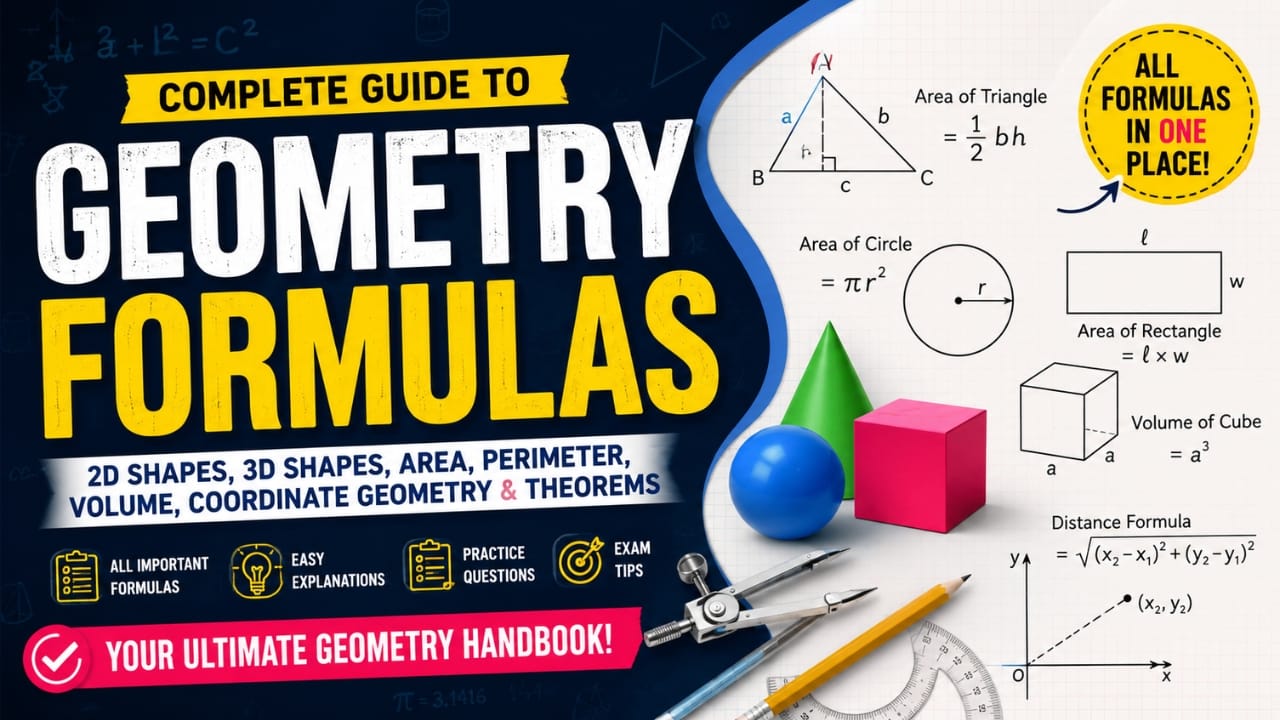
What is Geometry? Complete Introduction to Geometry
Geometry is one of the oldest and most important branches of Mathematics. It helps us understand shapes, sizes, distances, angles, dimensions, and spaces around us. From buildings and roads to mobile phones and computer graphics, Geometry exists everywhere in daily life.
The word Geometry comes from two Greek words:
- Geo meaning Earth
- Metron meaning Measurement
So, Geometry literally means “Measurement of Earth.”
In ancient times, Geometry was mainly used for land measurement, architecture, astronomy, and construction. Today, Geometry has become one of the foundational subjects in Mathematics and Science.
Students preparing for school exams, competitive exams, engineering entrance tests, and higher studies must understand Geometry Formulas properly because Geometry plays a major role in problem-solving and logical thinking.
Understanding Geometry in Simple Words
Geometry is the study of:
- Shapes
- Lines
- Angles
- Dimensions
- Space
- Distance
- Position
- Measurement
Geometry helps us answer practical questions such as:
- What is the area of a room?
- How much paint is needed for a wall?
- What is the shortest distance between two points?
- What is the volume of a water tank?
- How large is a playground?
Without Geometry, modern engineering, architecture, maps, graphics, and construction would not be possible.
Why Geometry is Important for Students
Geometry is not just about memorizing formulas. It develops visualization skills, analytical thinking, and mathematical understanding.
Benefits of Learning Geometry
- Improves logical thinking
- Enhances visualization ability
- Strengthens problem-solving skills
- Builds strong Mathematics foundations
- Helps in competitive exams
- Supports engineering and science studies
Geometry also creates the base for advanced subjects like:
- Trigonometry
- Mensuration
- Coordinate Geometry
- Algebra
- Calculus
- Physics
Students who understand Geometry concepts properly usually perform better in higher Mathematics.
History of Geometry
Geometry has a rich history that dates back thousands of years.
Geometry in Ancient Egypt
The Egyptians used Geometry for measuring agricultural lands after floods of the Nile River. They also used geometric principles to construct pyramids, temples, and roads.
Geometry in Ancient Greece
The Greeks transformed Geometry into a systematic mathematical subject.
The famous mathematician Euclid is known as the:
Father of Geometry
His famous book Elements introduced geometric rules, axioms, and theorems that are still studied today.
Basic Concepts of Geometry
Before learning Geometry Formulas, students must understand some basic geometric concepts.
Point
A point represents an exact location. It has:
- No length
- No width
- No thickness
A point is usually represented using a small dot.
Example: Point A
Line
A line is a straight path extending infinitely in both directions.
Properties of a Line
- Infinite length
- No endpoints
- No thickness
Line Segment
A line segment is a part of a line with two fixed endpoints.
Unlike a line, a line segment has a measurable length.
Ray
A ray has one starting point and extends infinitely in one direction.
Sunlight is a real-life example of rays.
Angle
An angle is formed when two rays meet at a common point.
Angles are measured in degrees.
Types of Angles
| Type of Angle | Degree Measure |
|---|---|
| Acute Angle | Less than 90° |
| Right Angle | Exactly 90° |
| Obtuse Angle | Between 90° and 180° |
| Straight Angle | 180° |
| Reflex Angle | More than 180° |
Plane
A plane is a flat surface extending infinitely in all directions.
Examples of planes include:
- Notebook page
- Whiteboard
- Floor surface
Plane Geometry mainly studies shapes drawn on flat surfaces.
What are Shapes in Geometry?
Shapes are figures formed using lines, curves, and angles.
Geometry mainly studies two categories of shapes:
- 2D Shapes
- 3D Shapes
2D Shapes in Geometry
2D shapes are flat figures having:
- Length
- Width
But they do not have depth or thickness.
Examples of 2D Shapes
- Triangle
- Rectangle
- Square
- Circle
- Rhombus
- Parallelogram
- Trapezium
These shapes are mainly used in Area and Perimeter Formulas.
3D Shapes in Geometry
3D shapes have:
- Length
- Width
- Height
These shapes occupy space.
Examples of 3D Shapes
- Cube
- Cuboid
- Sphere
- Cylinder
- Cone
- Pyramid
3D shapes are used in Volume and Surface Area Formulas.
Branches of Geometry
Geometry has multiple branches that study different mathematical structures.
Plane Geometry
Plane Geometry studies flat two-dimensional shapes like:
- Triangles
- Squares
- Circles
It mainly focuses on:
- Area
- Perimeter
- Angles
Solid Geometry
Solid Geometry studies three-dimensional objects such as:
- Cubes
- Cylinders
- Spheres
It mainly deals with:
- Volume
- Surface Area
Coordinate Geometry
Coordinate Geometry combines Algebra and Geometry.
It studies geometric figures using coordinates on a graph.
Important Coordinate Geometry formulas include:
- Distance Formula
- Midpoint Formula
- Slope Formula
Coordinate Geometry is widely used in:
- GPS systems
- Computer graphics
- Engineering design
Geometry in Daily Life
Geometry exists everywhere around us.
Geometry in Construction
Architects and engineers use Geometry for:
- Building homes
- Designing bridges
- Measuring land
- Creating floor plans
Geometry in Technology
Modern technology heavily depends on Geometry.
It is used in:
- Computer graphics
- Video games
- Animation
- Artificial Intelligence
- Mobile applications
Geometry in Nature
Nature contains many beautiful geometric patterns.
Examples include:
- Honeycomb hexagons
- Snowflakes
- Spider webs
- Flower petals
Importance of Geometry Formulas
Geometry Formulas help students solve problems quickly and accurately.
These formulas are used to calculate:
- Area
- Perimeter
- Volume
- Surface Area
- Distance
- Angles
Without formulas, solving Geometry problems becomes difficult and time-consuming.
Examples of Important Geometry Formulas
Area of Rectangle
Area = Length × Width
Perimeter of Square
Perimeter = 4 × Side
Area of Circle
Area = πr²
Volume of Cube
Volume = Side³
Surface Area of Sphere
Surface Area = 4πr²
Common Symbols Used in Geometry
| Symbol | Meaning |
|---|---|
| π | Pi |
| ∠ | Angle |
| ⊥ | Perpendicular |
| ∥ | Parallel |
| △ | Triangle |
| cm² | Square Centimeter |
| cm³ | Cubic Centimeter |
Best Ways to Learn Geometry Fast
- Understand concepts before memorizing formulas
- Practice diagrams regularly
- Solve numerical questions daily
- Learn formula logic carefully
- Relate Geometry with real-life examples
Conclusion
Geometry is one of the most useful branches of Mathematics. It helps students understand shapes, measurements, dimensions, and spaces in both academics and real life.
From construction and engineering to graphics and Artificial Intelligence, Geometry plays a major role in modern life.
Students who build a strong foundation in Geometry gain confidence in Mathematics and perform better in school exams, competitive exams, and technical careers.
In the next sections of this complete Geometry Formulas guide, we will explore:
- 2D Shape Formulas
- 3D Shape Formulas
- Area and Perimeter Formulas
- Volume and Surface Area Formulas
- Coordinate Geometry Formulas
- Geometry Theorems
- Formula Tables
- Memory Tricks
- Practice Questions
Mastering Geometry Formulas step by step can make Mathematics easier, faster, and more enjoyable for every student.
Importance of Geometry in Mathematics and Real Life
Geometry is one of the most practical and useful branches of Mathematics. It is not limited to textbooks or classrooms. Geometry plays an important role in everyday life, technology, engineering, architecture, science, sports, and even nature.
Students who understand Geometry properly develop stronger logical thinking, visualization skills, and mathematical confidence. Geometry also creates the foundation for advanced subjects like Trigonometry, Mensuration, Algebra, Engineering Mathematics, and Physics.
Why Geometry is Important in Mathematics
Geometry is considered one of the core pillars of Mathematics because it helps students understand space, dimensions, measurements, and relationships between shapes.
Without Geometry, many mathematical concepts become difficult to understand.
Geometry Builds Strong Mathematical Foundations
Geometry teaches students:
- Logical reasoning
- Visualization skills
- Analytical thinking
- Problem-solving methods
- Spatial understanding
These skills are useful in almost every branch of Mathematics.
Geometry Helps in Understanding Shapes and Space
One of the main purposes of Geometry is to help students understand different shapes and how they occupy space.
For example:
- A rectangle helps measure rooms and land
- A circle helps calculate wheels and pipes
- A cube helps calculate storage boxes
- A cylinder helps calculate water tanks
This practical understanding makes Geometry extremely valuable in daily life.
Importance of Geometry in School Education
Geometry is an important subject from primary school to higher education.
Students learn Geometry concepts gradually through:
- Shapes
- Angles
- Lines
- Triangles
- Circles
- Mensuration
- Coordinate Geometry
Geometry develops mathematical maturity and prepares students for advanced learning.
Geometry Improves Logical Thinking
Geometry problems require students to think step by step. Unlike simple arithmetic calculations, Geometry often involves reasoning and visualization.
For example:
- Finding missing angles
- Proving geometric theorems
- Understanding symmetry
- Solving construction problems
These activities improve critical thinking abilities.
Geometry Develops Visualization Skills
Visualization is the ability to mentally imagine shapes, movements, and positions.
Geometry trains the brain to visualize:
- Rotations
- Dimensions
- Patterns
- Distances
- Spatial relationships
Visualization skills are useful in:
- Engineering
- Architecture
- Animation
- Graphic Design
- Computer Science
Importance of Geometry in Competitive Exams
Geometry is one of the most important topics in competitive examinations.
Questions based on Geometry Formulas frequently appear in:
- SSC Exams
- Banking Exams
- Railway Exams
- CAT
- NDA
- JEE
- Olympiads
- State Government Exams
Students with strong Geometry concepts solve questions faster and more accurately.
Geometry in Engineering
Engineering depends heavily on Geometry.
Engineers use Geometry for:
- Designing structures
- Creating machines
- Measuring dimensions
- Planning construction
- Analyzing designs
Types of Engineering Using Geometry
- Civil Engineering
- Mechanical Engineering
- Electrical Engineering
- Computer Engineering
- Aerospace Engineering
Without Geometry, modern engineering would not exist.
Importance of Geometry in Architecture
Architects use Geometry to design:
- Buildings
- Homes
- Bridges
- Temples
- Commercial structures
Geometry helps architects maintain:
- Balance
- Symmetry
- Measurements
- Strength
- Aesthetic beauty
Famous structures around the world are based on geometric principles.
Geometry in Construction
Construction work requires precise measurements and calculations.
Geometry helps builders calculate:
- Area of land
- Wall dimensions
- Floor space
- Volume of concrete
- Roof angles
Construction workers regularly use:
- Triangles
- Rectangles
- Circles
- Angles
- Measurement formulas
Geometry in Technology
Modern technology uses Geometry extensively.
Computer Graphics
Every image, video game, and animation depends on geometric calculations.
Geometry helps create:
- 3D models
- Animations
- Visual effects
- Virtual reality
Artificial Intelligence
AI systems use Geometry for:
- Image recognition
- Computer vision
- Object detection
- Robotics navigation
Mobile Applications
Mobile apps and digital interfaces use Geometry for:
- Screen layouts
- Design structures
- Graphic positioning
- Mapping systems
Geometry in Nature
Nature contains many amazing geometric patterns.
Examples of Geometry in Nature
- Honeycomb hexagons
- Snowflakes
- Spider webs
- Flower petals
- Planetary orbits
- Crystal structures
Scientists use Geometry to understand these natural formations.
Geometry in Sports
Sports players and coaches use Geometry for strategy and performance analysis.
Examples of Geometry in Sports
- Cricket shot angles
- Football passing direction
- Basketball shooting arcs
- Golf trajectories
- Badminton court positioning
Geometry improves precision and movement planning in sports.
Geometry in Navigation and Maps
Navigation systems use Coordinate Geometry to calculate locations and distances.
GPS technology depends on:
- Coordinates
- Distance formulas
- Direction calculations
- Mapping algorithms
Pilots, sailors, drivers, and logistics companies all rely on geometric calculations.
Geometry in Art and Design
Artists and designers use Geometry to create visually balanced and attractive designs.
Geometry in Design Fields
- Graphic Design
- Interior Design
- Fashion Design
- Product Design
- Industrial Design
Patterns, symmetry, and proportions are all based on Geometry.
Geometry in Astronomy and Space Science
Astronomers use Geometry to study:
- Planet movements
- Star positions
- Satellite paths
- Orbital systems
Space scientists use geometric calculations for:
- Rocket trajectories
- Satellite launches
- Spacecraft navigation
Geometry Helps in Daily Life Activities
People unknowingly use Geometry every day.
Daily Life Examples
- Measuring room dimensions
- Buying tiles for flooring
- Calculating paint quantity
- Arranging furniture
- Packing boxes
- Estimating distances
Geometry makes these activities more accurate and efficient.
Career Opportunities Related to Geometry
Students with strong Geometry skills can pursue many career options.
Careers Using Geometry
- Architect
- Engineer
- Graphic Designer
- Animator
- Interior Designer
- Surveyor
- Game Developer
- Mathematician
- Data Scientist
Why Students Should Master Geometry Formulas
Geometry Formulas help students solve problems quickly and accurately.
Important Geometry formulas include:
- Area formulas
- Perimeter formulas
- Volume formulas
- Surface area formulas
- Coordinate Geometry formulas
Memorizing formulas alone is not enough. Students should understand:
- Where formulas come from
- When formulas are used
- How formulas are applied
Best Tips to Learn Geometry Easily
1. Understand Concepts First
Avoid memorizing formulas without understanding them.
2. Draw Diagrams
Geometry becomes easier when students practice drawing figures.
3. Practice Questions Daily
Regular practice improves speed and confidence.
4. Use Real-Life Examples
Connect Geometry concepts with practical situations.
5. Revise Formulas Regularly
Frequent revision improves memory retention.
Conclusion
Geometry is one of the most important and practical branches of Mathematics. It plays a major role in education, science, engineering, architecture, technology, sports, navigation, and daily life.
Learning Geometry helps students improve logical thinking, visualization ability, and mathematical confidence.
From simple shapes to advanced engineering structures, Geometry is present everywhere around us.
Students who master Geometry concepts and Geometry Formulas gain a strong advantage in academics, competitive exams, and future careers.
In the upcoming sections of this complete Geometry Formulas guide, we will explore:
- 2D Shapes Formulas
- 3D Shapes Formulas
- Area Formulas
- Perimeter Formulas
- Volume Formulas
- Surface Area Formulas
- Coordinate Geometry Basics
- Geometry Theorems
- Formula Tables
- Geometry PDF Notes
2D Shapes Geometry Formulas Explained
2D shapes are flat geometric figures that have only two dimensions:
- Length
- Width
They do not have thickness or depth. These shapes are also known as Plane Shapes because they exist on a flat surface.
2D Geometry is one of the most important topics in Mathematics because it forms the foundation for:
- Area calculations
- Perimeter calculations
- Mensuration
- Coordinate Geometry
- Engineering Mathematics
Students preparing for school exams and competitive exams must understand all important 2D Shapes Geometry Formulas clearly.
What are 2D Shapes?
2D shapes are figures drawn on a plane surface. These shapes have:
- Length
- Width
But they do not have:
- Height
- Thickness
Examples of 2D Shapes
- Triangle
- Rectangle
- Square
- Circle
- Parallelogram
- Rhombus
- Trapezium
- Polygon
Important Terms Related to 2D Shapes
Area
Area is the amount of space covered inside a shape.
Area is measured in:
- cm²
- m²
- km²
Perimeter
Perimeter is the total boundary length of a shape.
Perimeter is measured in:
- cm
- m
- km
Diagonal
A diagonal is a line joining opposite corners of a shape.
Radius
The radius is the distance from the center of a circle to its boundary.
Diameter
The diameter is a straight line passing through the center of a circle.
Formula:
Diameter = 2 × Radius
Triangle Formulas
A triangle is a three-sided polygon.
Types of Triangles
- Equilateral Triangle
- Isosceles Triangle
- Scalene Triangle
- Right-Angled Triangle
Area of Triangle Formula
Area = 1/2 × Base × Height
Example
If base = 10 cm and height = 6 cm
Area = 1/2 × 10 × 6
Area = 30 cm²
Perimeter of Triangle Formula
Perimeter = a + b + c
Where:
- a = first side
- b = second side
- c = third side
Heron’s Formula
Heron’s Formula is used when all three sides are known.
Area = √[s(s − a)(s − b)(s − c)]
Where:
s = (a + b + c)/2
Equilateral Triangle Formula
Area = (√3 / 4) × side²
Perimeter = 3 × side
Rectangle Formulas
A rectangle is a four-sided shape where opposite sides are equal and all angles are 90°.
Area of Rectangle Formula
Area = Length × Width
Example
If length = 12 cm and width = 5 cm
Area = 12 × 5
Area = 60 cm²
Perimeter of Rectangle Formula
Perimeter = 2(Length + Width)
Diagonal of Rectangle Formula
Diagonal = √(Length² + Width²)
Square Formulas
A square is a four-sided shape where all sides are equal and all angles are 90°.
Area of Square Formula
Area = Side²
Example
If side = 8 cm
Area = 8²
Area = 64 cm²
Perimeter of Square Formula
Perimeter = 4 × Side
Diagonal of Square Formula
Diagonal = Side × √2
Circle Formulas
A circle is a round shape where all points on the boundary are equally distant from the center.
Area of Circle Formula
Area = πr²
Where:
- π = 3.14159
- r = radius
Example
If radius = 7 cm
Area = π × 7²
Area = 154 cm² approximately
Circumference of Circle Formula
Circumference = 2πr
Diameter Formula
Diameter = 2 × Radius
Parallelogram Formulas
A parallelogram is a four-sided figure where opposite sides are parallel and equal.
Area of Parallelogram Formula
Area = Base × Height
Perimeter of Parallelogram Formula
Perimeter = 2(a + b)
Rhombus Formulas
A rhombus is a four-sided shape where all sides are equal.
Area of Rhombus Formula
Area = (1/2) × d₁ × d₂
Where:
- d₁ = first diagonal
- d₂ = second diagonal
Perimeter of Rhombus Formula
Perimeter = 4 × Side
Trapezium Formulas
A trapezium is a quadrilateral with one pair of parallel sides.
Area of Trapezium Formula
Area = 1/2 × (a + b) × Height
Where:
- a = first parallel side
- b = second parallel side
Perimeter of Trapezium Formula
Perimeter = Sum of all sides
Polygon Formulas
A polygon is a closed figure made using straight lines.
Examples of Polygons
- Pentagon
- Hexagon
- Heptagon
- Octagon
Perimeter of Polygon Formula
Perimeter = Number of sides × Length of one side
Sum of Interior Angles Formula
Sum of Interior Angles = (n − 2) × 180°
Where:
n = number of sides
Important 2D Shapes Formula Table
| Shape | Area Formula | Perimeter Formula |
|---|---|---|
| Triangle | 1/2 × Base × Height | a + b + c |
| Rectangle | Length × Width | 2(Length + Width) |
| Square | Side² | 4 × Side |
| Circle | πr² | 2πr |
| Parallelogram | Base × Height | 2(a + b) |
| Rhombus | (1/2) × d₁ × d₂ | 4 × Side |
| Trapezium | 1/2 × (a + b) × Height | Sum of all sides |
Real-Life Applications of 2D Shapes
2D shapes are used everywhere in daily life.
Examples
- Rectangle used in doors and screens
- Circle used in wheels and clocks
- Triangle used in bridges and roof structures
- Square used in tiles and chessboards
Common Mistakes Students Make in 2D Geometry
- Confusing area and perimeter formulas
- Using incorrect units
- Forgetting square units in area
- Using diameter instead of radius in circle formulas
- Calculation mistakes in decimals and π values
Best Tips to Learn 2D Geometry Formulas
- Understand shape properties carefully
- Practice diagrams regularly
- Create formula charts
- Solve daily numerical problems
- Use visual memory techniques
Conclusion
2D Shapes Geometry Formulas are among the most important concepts in Mathematics. These formulas help students calculate area, perimeter, diagonals, and measurements of different plane figures accurately.
Understanding 2D Geometry builds a strong foundation for:
- Mensuration
- Coordinate Geometry
- Trigonometry
- Engineering Mathematics
- Competitive Exams
Students who regularly practice Geometry Formulas and numerical questions improve both speed and accuracy in Mathematics.
In the next section, we will explore:
- 3D Shapes Formulas
- Volume Formulas
- Surface Area Formulas
- Solid Geometry Concepts
3D Shapes Geometry Formulas Explained
3D shapes are solid geometric figures that have three dimensions:
- Length
- Width
- Height
Unlike 2D shapes, 3D shapes occupy space and have volume. These shapes are also known as Solid Shapes.
3D Geometry is extremely important in Mathematics because it helps students understand:
- Volume calculations
- Surface area calculations
- Space measurement
- Solid structures
- Real-world object dimensions
3D Geometry Formulas are widely used in engineering, construction, architecture, manufacturing, design, and technology.
What are 3D Shapes?
3D shapes are objects that occupy physical space. These shapes have:
- Length
- Width
- Height
They can be measured in terms of:
- Volume
- Surface Area
- Curved Surface Area
- Lateral Surface Area
Examples of 3D Shapes
- Cube
- Cuboid
- Sphere
- Cylinder
- Cone
- Hemisphere
- Pyramid
- Prism
Important Terms Used in 3D Geometry
Volume
Volume is the amount of space occupied inside a solid object.
Volume is measured in:
- cm³
- m³
- km³
Surface Area
Surface Area is the total area covered by the outer surfaces of a 3D object.
Surface Area is measured in:
- cm²
- m²
Curved Surface Area (CSA)
Curved Surface Area is the area of only the curved part of a solid shape.
Total Surface Area (TSA)
Total Surface Area includes all surfaces of a solid figure.
Lateral Surface Area (LSA)
Lateral Surface Area includes all side surfaces excluding top and bottom surfaces.
Cube Formulas
A cube is a solid shape where all sides are equal.
Properties of Cube
- 6 square faces
- 12 edges
- 8 vertices
Volume of Cube Formula
Volume = Side³
Example
If side = 4 cm
Volume = 4³
Volume = 64 cm³
Total Surface Area of Cube Formula
TSA = 6 × Side²
Lateral Surface Area of Cube Formula
LSA = 4 × Side²
Diagonal of Cube Formula
Diagonal = Side × √3
Cuboid Formulas
A cuboid is a rectangular solid shape.
Properties of Cuboid
- 6 rectangular faces
- 12 edges
- 8 vertices
Volume of Cuboid Formula
Volume = Length × Width × Height
Example
If length = 10 cm, width = 5 cm, height = 4 cm
Volume = 10 × 5 × 4
Volume = 200 cm³
Total Surface Area of Cuboid Formula
TSA = 2(lw + wh + hl)
Lateral Surface Area of Cuboid Formula
LSA = 2h(l + w)
Diagonal of Cuboid Formula
Diagonal = √(l² + w² + h²)
Sphere Formulas
A sphere is a perfectly round solid shape where every point on the surface is equally distant from the center.
Volume of Sphere Formula
Volume = (4/3)πr³
Surface Area of Sphere Formula
Surface Area = 4πr²
Example
If radius = 7 cm
Surface Area = 4 × π × 7²
Surface Area ≈ 616 cm²
Hemisphere Formulas
A hemisphere is half of a sphere.
Volume of Hemisphere Formula
Volume = (2/3)πr³
Curved Surface Area of Hemisphere Formula
CSA = 2πr²
Total Surface Area of Hemisphere Formula
TSA = 3πr²
Cylinder Formulas
A cylinder is a solid shape having two circular bases connected by a curved surface.
Volume of Cylinder Formula
Volume = πr²h
Example
If radius = 3 cm and height = 10 cm
Volume = π × 3² × 10
Volume ≈ 282.6 cm³
Curved Surface Area of Cylinder Formula
CSA = 2πrh
Total Surface Area of Cylinder Formula
TSA = 2πr(r + h)
Cone Formulas
A cone is a solid shape having a circular base and a pointed top called apex.
Slant Height Formula
l = √(r² + h²)
Volume of Cone Formula
Volume = (1/3)πr²h
Curved Surface Area of Cone Formula
CSA = πrl
Total Surface Area of Cone Formula
TSA = πr(l + r)
Prism Formulas
A prism is a solid shape with identical cross-sections throughout its length.
Volume of Prism Formula
Volume = Base Area × Height
Surface Area of Prism Formula
Surface Area = 2 × Base Area + Perimeter of Base × Height
Pyramid Formulas
A pyramid is a solid figure with a polygon base and triangular sides meeting at one point.
Volume of Pyramid Formula
Volume = (1/3) × Base Area × Height
Important 3D Geometry Formula Table
| 3D Shape | Volume Formula | Surface Area Formula |
|---|---|---|
| Cube | Side³ | 6 × Side² |
| Cuboid | l × w × h | 2(lw + wh + hl) |
| Sphere | (4/3)πr³ | 4πr² |
| Hemisphere | (2/3)πr³ | 3πr² |
| Cylinder | πr²h | 2πr(r + h) |
| Cone | (1/3)πr²h | πr(l + r) |
| Prism | Base Area × Height | 2 × Base Area + Perimeter × Height |
| Pyramid | (1/3) × Base Area × Height | Varies by shape |
Difference Between 2D and 3D Shapes
| 2D Shapes | 3D Shapes |
|---|---|
| Flat figures | Solid figures |
| Only length and width | Length, width, and height |
| No volume | Have volume |
| Measured by area and perimeter | Measured by volume and surface area |
Real-Life Applications of 3D Shapes
3D Geometry is used extensively in daily life.
Examples
- Cube used in dice and boxes
- Cylinder used in pipes and water tanks
- Sphere used in balls and planets
- Cone used in ice cream cones and traffic cones
- Cuboid used in books and buildings
Importance of Volume and Surface Area Formulas
Volume and Surface Area formulas help in:
- Construction planning
- Packaging industries
- Storage calculations
- Manufacturing processes
- Engineering design
These formulas are essential for accurate measurements in practical situations.
Common Mistakes Students Make in 3D Geometry
- Confusing TSA and CSA formulas
- Using wrong units
- Forgetting cube and square calculations
- Using diameter instead of radius
- Calculation errors with π values
Best Tips to Learn 3D Geometry Formulas
- Visualize solid shapes clearly
- Practice drawing diagrams
- Understand each formula logically
- Memorize formulas using charts
- Solve practical numerical problems daily
Conclusion
3D Shapes Geometry Formulas are extremely important for understanding solid objects, measurements, and spatial calculations.
These formulas help students calculate:
- Volume
- Surface Area
- Curved Surface Area
- Lateral Surface Area
3D Geometry plays a major role in:
- Engineering
- Architecture
- Construction
- Technology
- Science
Students who master 3D Geometry Formulas gain strong mathematical confidence and improve problem-solving abilities for school exams and competitive examinations.
In the next section, we will explore:
- Area Formulas
- Perimeter Formulas
- Mensuration Concepts
- Practical Geometry Applications
Area and Perimeter Formulas for All Shapes
Area and Perimeter are two of the most important concepts in Geometry and Mensuration. These formulas help students measure shapes accurately and solve practical mathematical problems.
Area and Perimeter formulas are widely used in:
- School Mathematics
- Competitive Exams
- Construction
- Architecture
- Engineering
- Interior Design
- Land Measurement
Understanding these formulas properly helps students improve speed, accuracy, and problem-solving skills in Mathematics.
What is Area?
Area is the amount of space covered inside a closed shape.
It tells us how much surface a figure occupies.
Units of Area
- Square centimeter (cm²)
- Square meter (m²)
- Square kilometer (km²)
Real-Life Examples of Area
- Area of a room floor
- Area of a garden
- Area of a wall for painting
- Area of farmland
What is Perimeter?
Perimeter is the total length of the boundary of a closed figure.
It represents the distance around a shape.
Units of Perimeter
- Centimeter (cm)
- Meter (m)
- Kilometer (km)
Real-Life Examples of Perimeter
- Boundary of a playground
- Fencing around a garden
- Border length of a field
- Frame length around a painting
Difference Between Area and Perimeter
| Area | Perimeter |
|---|---|
| Measures space inside a shape | Measures boundary length |
| Measured in square units | Measured in linear units |
| Uses multiplication | Uses addition |
| Examples: cm², m² | Examples: cm, m |
Triangle Area and Perimeter Formulas
A triangle is a three-sided polygon.
Area of Triangle Formula
Area = 1/2 × Base × Height
Example
If base = 12 cm and height = 8 cm
Area = 1/2 × 12 × 8
Area = 48 cm²
Perimeter of Triangle Formula
Perimeter = a + b + c
Where:
- a = first side
- b = second side
- c = third side
Equilateral Triangle Formula
Area = (√3 / 4) × Side²
Perimeter = 3 × Side
Rectangle Area and Perimeter Formulas
A rectangle is a four-sided shape where opposite sides are equal.
Area of Rectangle Formula
Area = Length × Width
Example
If length = 15 cm and width = 6 cm
Area = 15 × 6
Area = 90 cm²
Perimeter of Rectangle Formula
Perimeter = 2(Length + Width)
Example
Perimeter = 2(15 + 6)
Perimeter = 42 cm
Square Area and Perimeter Formulas
A square is a shape where all sides are equal.
Area of Square Formula
Area = Side²
Example
If side = 9 cm
Area = 9²
Area = 81 cm²
Perimeter of Square Formula
Perimeter = 4 × Side
Example
Perimeter = 4 × 9
Perimeter = 36 cm
Circle Area and Circumference Formulas
A circle is a round shape where all points are equally distant from the center.
Area of Circle Formula
Area = πr²
Where:
- π = 3.14159
- r = radius
Example
If radius = 7 cm
Area = π × 7²
Area ≈ 154 cm²
Circumference of Circle Formula
Circumference = 2πr
Example
Circumference = 2 × π × 7
Circumference ≈ 44 cm
Parallelogram Area and Perimeter Formulas
A parallelogram is a four-sided figure with opposite sides parallel.
Area of Parallelogram Formula
Area = Base × Height
Perimeter of Parallelogram Formula
Perimeter = 2(a + b)
Rhombus Area and Perimeter Formulas
A rhombus is a quadrilateral where all sides are equal.
Area of Rhombus Formula
Area = (1/2) × d₁ × d₂
Where:
- d₁ = first diagonal
- d₂ = second diagonal
Perimeter of Rhombus Formula
Perimeter = 4 × Side
Trapezium Area and Perimeter Formulas
A trapezium is a quadrilateral having one pair of parallel sides.
Area of Trapezium Formula
Area = 1/2 × (a + b) × Height
Perimeter of Trapezium Formula
Perimeter = Sum of all sides
Polygon Perimeter Formula
A polygon is a closed shape made using straight lines.
Perimeter of Regular Polygon Formula
Perimeter = Number of Sides × Length of One Side
Important Area and Perimeter Formula Table
| Shape | Area Formula | Perimeter Formula |
|---|---|---|
| Triangle | 1/2 × Base × Height | a + b + c |
| Rectangle | Length × Width | 2(Length + Width) |
| Square | Side² | 4 × Side |
| Circle | πr² | 2πr |
| Parallelogram | Base × Height | 2(a + b) |
| Rhombus | (1/2) × d₁ × d₂ | 4 × Side |
| Trapezium | 1/2 × (a + b) × Height | Sum of all sides |
Real-Life Applications of Area and Perimeter
Applications of Area
- Calculating flooring tiles
- Measuring farmland
- Estimating paint quantity
- Designing carpets
- Planning gardens
Applications of Perimeter
- Fencing a field
- Boundary wall construction
- Frame measurement
- Track length calculation
- Wire length estimation
Common Mistakes Students Make
- Confusing area and perimeter formulas
- Using wrong units
- Forgetting square units in area
- Calculation mistakes with π values
- Incorrect substitution of dimensions
Tips to Remember Area and Perimeter Formulas
- Practice formulas daily
- Create formula charts
- Understand the meaning of each formula
- Use diagrams for visualization
- Solve practical examples regularly
Importance of Area and Perimeter in Competitive Exams
Questions based on area and perimeter are commonly asked in:
- SSC Exams
- Banking Exams
- Railway Exams
- CAT
- NDA
- JEE
- School Board Exams
Strong formula knowledge improves speed and accuracy during examinations.
Conclusion
Area and Perimeter formulas are among the most fundamental concepts in Geometry and Mensuration. These formulas help students measure shapes accurately and solve practical mathematical problems efficiently.
From school exams to engineering applications, area and perimeter calculations are used everywhere.
Students who understand these formulas clearly gain stronger mathematical confidence and improve their problem-solving skills significantly.
In the next section, we will explore:
- Volume Formulas
- Surface Area Formulas
- Mensuration Concepts
- 3D Geometry Applications
Volume and Surface Area Formulas
Volume and Surface Area are among the most important concepts in Geometry and Mensuration. These formulas help students measure solid objects accurately and solve real-world mathematical problems.
Volume and Surface Area formulas are widely used in:
- Engineering
- Construction
- Architecture
- Manufacturing
- Packaging
- Storage Planning
- Interior Design
Students preparing for school exams, competitive exams, and technical studies must understand these formulas clearly.
What is Volume?
Volume is the amount of space occupied inside a three-dimensional object.
It measures the capacity of a solid figure.
Units of Volume
- Cubic centimeter (cm³)
- Cubic meter (m³)
- Cubic kilometer (km³)
Real-Life Examples of Volume
- Volume of a water tank
- Capacity of a bottle
- Storage space in a box
- Fuel tank capacity
- Concrete required for construction
What is Surface Area?
Surface Area is the total area covered by the outer surfaces of a three-dimensional object.
It tells us how much outer space a solid figure occupies.
Units of Surface Area
- Square centimeter (cm²)
- Square meter (m²)
- Square kilometer (km²)
Real-Life Examples of Surface Area
- Painting walls
- Wrapping gift boxes
- Designing containers
- Covering water tanks
- Calculating roofing material
Difference Between Volume and Surface Area
| Volume | Surface Area |
|---|---|
| Measures space inside an object | Measures outer covering of an object |
| Measured in cubic units | Measured in square units |
| Examples: cm³, m³ | Examples: cm², m² |
| Used for capacity calculations | Used for covering calculations |
Types of Surface Area
Total Surface Area (TSA)
Total Surface Area includes all surfaces of a solid object.
Curved Surface Area (CSA)
Curved Surface Area includes only the curved part of a shape.
Lateral Surface Area (LSA)
Lateral Surface Area includes side surfaces excluding top and bottom faces.
Cube Volume and Surface Area Formulas
A cube is a solid shape where all sides are equal.
Volume of Cube Formula
Volume = Side³
Example
If side = 5 cm
Volume = 5³
Volume = 125 cm³
Total Surface Area of Cube Formula
TSA = 6 × Side²
Example
TSA = 6 × 5²
TSA = 150 cm²
Lateral Surface Area of Cube Formula
LSA = 4 × Side²
Cuboid Volume and Surface Area Formulas
A cuboid is a rectangular solid figure.
Volume of Cuboid Formula
Volume = Length × Width × Height
Example
If length = 10 cm, width = 6 cm, height = 4 cm
Volume = 10 × 6 × 4
Volume = 240 cm³
Total Surface Area of Cuboid Formula
TSA = 2(lw + wh + hl)
Lateral Surface Area of Cuboid Formula
LSA = 2h(l + w)
Cylinder Volume and Surface Area Formulas
A cylinder is a solid figure having two circular bases connected by a curved surface.
Volume of Cylinder Formula
Volume = πr²h
Example
If radius = 3 cm and height = 8 cm
Volume = π × 3² × 8
Volume ≈ 226 cm³
Curved Surface Area of Cylinder Formula
CSA = 2πrh
Total Surface Area of Cylinder Formula
TSA = 2πr(r + h)
Cone Volume and Surface Area Formulas
A cone is a solid shape with a circular base and pointed top called apex.
Slant Height Formula
l = √(r² + h²)
Volume of Cone Formula
Volume = (1/3)πr²h
Example
If radius = 3 cm and height = 12 cm
Volume = (1/3) × π × 3² × 12
Volume ≈ 113 cm³
Curved Surface Area of Cone Formula
CSA = πrl
Total Surface Area of Cone Formula
TSA = πr(l + r)
Sphere Volume and Surface Area Formulas
A sphere is a perfectly round solid shape.
Volume of Sphere Formula
Volume = (4/3)πr³
Surface Area of Sphere Formula
Surface Area = 4πr²
Example
If radius = 7 cm
Surface Area = 4 × π × 7²
Surface Area ≈ 616 cm²
Hemisphere Volume and Surface Area Formulas
A hemisphere is half of a sphere.
Volume of Hemisphere Formula
Volume = (2/3)πr³
Curved Surface Area of Hemisphere Formula
CSA = 2πr²
Total Surface Area of Hemisphere Formula
TSA = 3πr²
Prism Volume and Surface Area Formulas
A prism is a solid figure with uniform cross-sections.
Volume of Prism Formula
Volume = Base Area × Height
Surface Area of Prism Formula
Surface Area = 2 × Base Area + Perimeter of Base × Height
Pyramid Volume Formula
A pyramid is a solid figure with triangular faces meeting at one point.
Volume of Pyramid Formula
Volume = (1/3) × Base Area × Height
Important Volume and Surface Area Formula Table
| Shape | Volume Formula | Surface Area Formula |
|---|---|---|
| Cube | Side³ | 6 × Side² |
| Cuboid | l × w × h | 2(lw + wh + hl) |
| Cylinder | πr²h | 2πr(r + h) |
| Cone | (1/3)πr²h | πr(l + r) |
| Sphere | (4/3)πr³ | 4πr² |
| Hemisphere | (2/3)πr³ | 3πr² |
| Prism | Base Area × Height | 2 × Base Area + Perimeter × Height |
| Pyramid | (1/3) × Base Area × Height | Depends on shape |
Real-Life Applications of Volume and Surface Area
Applications of Volume
- Water storage calculations
- Fuel tank measurements
- Packaging industries
- Concrete calculations
- Storage capacity planning
Applications of Surface Area
- Painting walls
- Wrapping packages
- Designing containers
- Calculating roofing material
- Manufacturing products
Importance of Volume and Surface Area in Competitive Exams
Questions based on Volume and Surface Area are commonly asked in:
- SSC Exams
- Banking Exams
- Railway Exams
- JEE
- NDA
- School Board Exams
Students who master these formulas solve mensuration problems much faster.
Common Mistakes Students Make
- Confusing CSA and TSA formulas
- Using diameter instead of radius
- Forgetting cube and square calculations
- Using wrong units
- Calculation mistakes with π values
Tips to Remember Volume and Surface Area Formulas
- Practice formula derivations
- Create formula charts
- Visualize 3D shapes carefully
- Practice daily numerical questions
- Understand practical applications
Conclusion
Volume and Surface Area formulas are extremely important concepts in Geometry and Mensuration. These formulas help students measure solid objects accurately and solve practical mathematical problems.
From engineering and architecture to storage and packaging, these formulas are used everywhere in real life.
Students who understand Volume and Surface Area formulas properly gain strong mathematical confidence and improve their performance in school exams and competitive examinations.
In the next section, we will explore:
- Coordinate Geometry Basics
- Distance Formula
- Midpoint Formula
- Slope Formula
- Equation of Line
Coordinate Geometry Basics and Formulas
Coordinate Geometry is one of the most important branches of Mathematics that combines Algebra and Geometry. It helps students study geometric shapes using coordinates, equations, graphs, and algebraic methods.
Coordinate Geometry is also known as Analytical Geometry.
This branch of Geometry is widely used in:
- Engineering
- Computer Graphics
- Physics
- Architecture
- Artificial Intelligence
- Navigation Systems
- Data Science
Students preparing for school exams, JEE, NDA, SSC, and competitive examinations must understand Coordinate Geometry formulas clearly.
What is Coordinate Geometry?
Coordinate Geometry is the study of geometry using coordinate points on a graph.
In Coordinate Geometry, positions are represented using numbers called coordinates.
These coordinates help calculate:
- Distance between points
- Midpoints
- Slopes
- Equation of lines
- Area of figures
What is a Coordinate Plane?
A Coordinate Plane is a flat surface formed by two perpendicular number lines.
- Horizontal line = X-axis
- Vertical line = Y-axis
These two axes intersect at a point called the:
Origin
The coordinates of the origin are:
(0, 0)
X-Axis and Y-Axis
X-Axis
The horizontal number line is called the X-axis.
- Positive direction → Right side
- Negative direction → Left side
Y-Axis
The vertical number line is called the Y-axis.
- Positive direction → Upward
- Negative direction → Downward
What are Coordinates?
Coordinates represent the exact location of a point on the coordinate plane.
Coordinates are written in the form:
(x, y)
Where:
- x = horizontal position
- y = vertical position
Example
Point A = (3, 5)
This means:
- Move 3 units on X-axis
- Move 5 units upward on Y-axis
Quadrants in Coordinate Geometry
The coordinate plane is divided into four parts called quadrants.
| Quadrant | Sign of Coordinates |
|---|---|
| First Quadrant | (+, +) |
| Second Quadrant | (−, +) |
| Third Quadrant | (−, −) |
| Fourth Quadrant | (+, −) |
Distance Formula
The Distance Formula is used to calculate the distance between two points on the coordinate plane.
Distance Formula
Distance = √[(x₂ − x₁)² + (y₂ − y₁)²]
Where:
- (x₁, y₁) = first point
- (x₂, y₂) = second point
Example of Distance Formula
Find the distance between:
A(2, 3) and B(6, 7)
Distance = √[(6 − 2)² + (7 − 3)²]
Distance = √[4² + 4²]
Distance = √[16 + 16]
Distance = √32
Distance ≈ 5.66 units
Midpoint Formula
The Midpoint Formula is used to find the middle point between two coordinates.
Midpoint Formula
Midpoint = [(x₁ + x₂)/2 , (y₁ + y₂)/2]
Example of Midpoint Formula
Find midpoint of:
A(2, 4) and B(8, 10)
Midpoint = [(2 + 8)/2 , (4 + 10)/2]
Midpoint = (10/2 , 14/2)
Midpoint = (5, 7)
Section Formula
The Section Formula is used to find a point dividing a line segment in a given ratio.
Section Formula
Point = [ (mx₂ + nx₁)/(m+n) , (my₂ + ny₁)/(m+n) ]
Where:
- m:n = ratio
Slope Formula
Slope measures the steepness of a line.
Slope Formula
Slope (m) = (y₂ − y₁)/(x₂ − x₁)
Example of Slope Formula
Find slope of line joining:
A(2, 3) and B(6, 11)
Slope = (11 − 3)/(6 − 2)
Slope = 8/4
Slope = 2
Equation of a Line
An equation of a line represents all points lying on a straight line.
Slope-Intercept Form
y = mx + c
Where:
- m = slope
- c = y-intercept
Point-Slope Form
y − y₁ = m(x − x₁)
Area of Triangle Using Coordinates
Coordinate Geometry can also calculate the area of a triangle.
Area Formula
Area = 1/2 | x₁(y₂ − y₃) + x₂(y₃ − y₁) + x₃(y₁ − y₂) |
Important Coordinate Geometry Formula Table
| Formula Name | Formula |
|---|---|
| Distance Formula | √[(x₂ − x₁)² + (y₂ − y₁)²] |
| Midpoint Formula | [(x₁ + x₂)/2 , (y₁ + y₂)/2] |
| Slope Formula | (y₂ − y₁)/(x₂ − x₁) |
| Line Equation | y = mx + c |
| Point-Slope Formula | y − y₁ = m(x − x₁) |
| Area of Triangle | 1/2 | x₁(y₂ − y₃)+x₂(y₃−y₁)+x₃(y₁−y₂) | |
Real-Life Applications of Coordinate Geometry
GPS and Navigation
Coordinate Geometry is used in GPS systems to calculate exact locations and routes.
Computer Graphics
Every graphic, animation, and game uses coordinate points for object positioning.
Engineering Design
Engineers use Coordinate Geometry for:
- Machine design
- Construction planning
- Blueprint creation
Architecture
Architects use coordinate systems for designing buildings and layouts accurately.
Physics
Coordinate Geometry helps calculate:
- Motion paths
- Projectile trajectories
- Forces and vectors
Importance of Coordinate Geometry in Competitive Exams
Coordinate Geometry questions frequently appear in:
- JEE
- NDA
- SSC Exams
- Banking Exams
- Olympiads
- Board Exams
Students who understand formulas properly solve questions much faster.
Common Mistakes Students Make
- Sign mistakes in coordinates
- Using incorrect formulas
- Calculation errors in squares and roots
- Confusing slope and distance formulas
- Incorrect substitution of values
Tips to Learn Coordinate Geometry Easily
- Practice plotting points regularly
- Understand graph concepts visually
- Memorize formulas using charts
- Solve daily numerical questions
- Learn step-by-step calculations carefully
Conclusion
Coordinate Geometry is one of the most powerful branches of Mathematics because it combines Algebra and Geometry together.
It helps students calculate:
- Distances
- Midpoints
- Slopes
- Line equations
- Areas using coordinates
Coordinate Geometry is widely used in:
- Technology
- Engineering
- Navigation
- Computer Graphics
- Artificial Intelligence
Students who master Coordinate Geometry formulas develop stronger analytical and mathematical skills for academics and competitive exams.
In the next section, we will explore:
- Important Geometry Theorems
- Pythagoras Theorem
- Triangle Theorems
- Circle Theorems
- Congruence and Similarity Rules
Important Geometry Theorems Every Student Should Know
Geometry Theorems are mathematical statements that are proven using logical reasoning, formulas, and previously established mathematical principles.
Theorems form the backbone of Geometry because they help students understand relationships between:
- Angles
- Lines
- Triangles
- Circles
- Polygons
- Geometric Shapes
Understanding Geometry Theorems is extremely important for:
- School Mathematics
- Competitive Exams
- Engineering Entrance Exams
- Logical Reasoning
- Higher Mathematics
Students who master Geometry Theorems improve their problem-solving abilities and mathematical confidence significantly.
What is a Geometry Theorem?
A Geometry Theorem is a mathematical statement that has been proven true using logical steps and mathematical rules.
Every theorem consists of:
- Given Information
- Conditions
- Logical Proof
- Final Conclusion
Theorems help students solve complex Geometry problems systematically.
Pythagoras Theorem
Pythagoras Theorem is one of the most famous Geometry Theorems.
It applies to right-angled triangles.
Pythagoras Theorem Statement
In a right triangle:
Hypotenuse² = Base² + Perpendicular²
Formula:
c² = a² + b²
Where:
- c = hypotenuse
- a = base
- b = perpendicular
Example of Pythagoras Theorem
If:
- Base = 3 cm
- Perpendicular = 4 cm
Then:
c² = 3² + 4²
c² = 9 + 16
c² = 25
c = 5 cm
Triangle Angle Sum Theorem
The Triangle Angle Sum Theorem states that:
The sum of all interior angles of a triangle is 180°.
Example
If two angles are:
- 50°
- 60°
Third angle:
180° − (50° + 60°)
= 70°
Exterior Angle Theorem
The Exterior Angle Theorem states:
An exterior angle of a triangle equals the sum of the two opposite interior angles.
Example
If interior opposite angles are:
- 40°
- 60°
Exterior angle:
40° + 60°
= 100°
Basic Proportionality Theorem (Thales Theorem)
The Basic Proportionality Theorem states:
If a line is drawn parallel to one side of a triangle, it divides the other two sides proportionally.
This theorem is important in:
- Similarity problems
- Triangle measurements
- Construction Geometry
Congruence Theorems
Congruent figures are figures having exactly the same shape and size.
Congruence Theorems help determine whether two triangles are congruent.
SSS Congruence Theorem
If all three sides of one triangle are equal to the corresponding sides of another triangle, then the triangles are congruent.
SAS Congruence Theorem
If two sides and the included angle of one triangle are equal to another triangle, then the triangles are congruent.
ASA Congruence Theorem
If two angles and one side of one triangle are equal to another triangle, then the triangles are congruent.
RHS Congruence Theorem
If the hypotenuse and one side of a right triangle are equal to another right triangle, then the triangles are congruent.
Similarity Theorems
Similar figures have the same shape but different sizes.
AAA Similarity Theorem
If all corresponding angles of two triangles are equal, then the triangles are similar.
SAS Similarity Theorem
If two sides of triangles are proportional and included angles are equal, then triangles are similar.
SSS Similarity Theorem
If corresponding sides of two triangles are proportional, then triangles are similar.
Parallel Line Theorems
Parallel lines create important angle relationships.
Corresponding Angles Theorem
If two parallel lines are cut by a transversal, corresponding angles are equal.
Alternate Interior Angles Theorem
Alternate interior angles are equal when parallel lines are cut by a transversal.
Co-Interior Angles Theorem
Co-interior angles are supplementary.
Their sum equals:
180°
Circle Theorems
Circle Theorems explain relationships between angles, chords, tangents, and arcs inside circles.
Angle at Center Theorem
The angle at the center is twice the angle at the circumference.
Angle in Semicircle Theorem
The angle in a semicircle is always 90°.
Tangent Theorem
A tangent drawn to a circle is perpendicular to the radius at the point of contact.
Equal Chords Theorem
Equal chords subtend equal angles at the center.
Properties of Quadrilaterals
Rectangle Properties
- Opposite sides are equal
- All angles are 90°
- Diagonals are equal
Square Properties
- All sides are equal
- All angles are 90°
- Diagonals bisect each other
Parallelogram Properties
- Opposite sides are parallel
- Opposite angles are equal
- Diagonals bisect each other
Polygon Theorems
Interior Angle Sum Theorem
Sum of interior angles of polygon = (n − 2) × 180°
Where:
n = number of sides
Exterior Angle Sum Theorem
The sum of exterior angles of any polygon is 360°.
Important Geometry Theorems Formula Table
| Theorem | Statement |
|---|---|
| Pythagoras Theorem | c² = a² + b² |
| Triangle Angle Sum | Sum of angles = 180° |
| Exterior Angle Theorem | Exterior angle = sum of opposite interior angles |
| Angle in Semicircle | Angle = 90° |
| Polygon Interior Angle Sum | (n − 2) × 180° |
| Exterior Angle Sum | 360° |
| Slope of Parallel Lines | Slopes are equal |
| Corresponding Angles | Angles are equal |
Importance of Geometry Theorems in Competitive Exams
Questions based on Geometry Theorems are frequently asked in:
- JEE
- NDA
- SSC Exams
- Banking Exams
- Olympiads
- Board Exams
Theorems help students solve complex Geometry questions quickly and logically.
Real-Life Applications of Geometry Theorems
Architecture
Architects use geometric principles for balanced construction.
Engineering
Engineers use theorem-based calculations for structures and machine designs.
Computer Graphics
Graphics and animations depend heavily on geometric calculations.
Navigation Systems
Distance and angle calculations are used in maps and GPS systems.
Common Mistakes Students Make
- Confusing congruence and similarity
- Using wrong formulas
- Incorrect angle calculations
- Ignoring geometric conditions
- Calculation errors in theorem applications
Tips to Learn Geometry Theorems Easily
- Understand theorem logic carefully
- Practice diagrams regularly
- Memorize important statements
- Solve proof-based questions daily
- Use visual learning methods
Conclusion
Geometry Theorems are essential for understanding mathematical relationships between shapes, lines, angles, and figures.
These theorems help students:
- Solve Geometry problems logically
- Improve analytical thinking
- Understand mathematical proofs
- Perform better in competitive exams
From triangles and circles to polygons and coordinate systems, Geometry Theorems play a major role in Mathematics and real-life applications.
Students who regularly practice theorem-based questions develop stronger mathematical confidence and reasoning skills.
In the next section, we will explore:
- Geometry Formula Tables
- Quick Revision Sheets
- Geometry Cheat Sheets
- Memory Tricks
- Formula PDF Notes
Geometry Formula Table and Quick Revision Sheet
Geometry Formula Tables are extremely useful for quick revision, exam preparation, and faster problem-solving. Students often struggle to remember multiple Geometry formulas, especially during exams.
A well-organized Geometry Formula Sheet helps students:
- Revise formulas quickly
- Improve memory retention
- Save exam time
- Reduce confusion
- Solve problems faster
This section provides a complete Geometry Formula Table covering:
- 2D Shapes Formulas
- 3D Shapes Formulas
- Area Formulas
- Perimeter Formulas
- Volume Formulas
- Surface Area Formulas
- Coordinate Geometry Formulas
- Important Geometry Theorems
Why Geometry Formula Tables are Important
Geometry contains many formulas related to:
- Shapes
- Angles
- Distance
- Area
- Volume
- Surface Area
Students preparing for:
- School Exams
- Board Exams
- JEE
- NDA
- SSC
- Banking Exams
must revise formulas regularly for better performance.
2D Shapes Formula Table
| Shape | Area Formula | Perimeter Formula |
|---|---|---|
| Triangle | 1/2 × Base × Height | a + b + c |
| Equilateral Triangle | (√3 / 4) × Side² | 3 × Side |
| Rectangle | Length × Width | 2(Length + Width) |
| Square | Side² | 4 × Side |
| Circle | πr² | 2πr |
| Parallelogram | Base × Height | 2(a + b) |
| Rhombus | (1/2) × d₁ × d₂ | 4 × Side |
| Trapezium | 1/2 × (a + b) × Height | Sum of all sides |
Important Triangle Formulas
| Formula Name | Formula |
|---|---|
| Area of Triangle | 1/2 × Base × Height |
| Perimeter of Triangle | a + b + c |
| Heron’s Formula | √[s(s−a)(s−b)(s−c)] |
| Semi-Perimeter | (a + b + c)/2 |
| Pythagoras Theorem | c² = a² + b² |
Circle Formula Table
| Formula Name | Formula |
|---|---|
| Area of Circle | πr² |
| Circumference | 2πr |
| Diameter | 2r |
| Radius | Diameter / 2 |
Quadrilateral Formula Table
| Shape | Area Formula | Perimeter Formula |
|---|---|---|
| Rectangle | Length × Width | 2(l + w) |
| Square | Side² | 4 × Side |
| Rhombus | (1/2)d₁d₂ | 4 × Side |
| Parallelogram | Base × Height | 2(a + b) |
3D Shapes Formula Table
| 3D Shape | Volume Formula | Surface Area Formula |
|---|---|---|
| Cube | Side³ | 6 × Side² |
| Cuboid | l × w × h | 2(lw + wh + hl) |
| Sphere | (4/3)πr³ | 4πr² |
| Hemisphere | (2/3)πr³ | 3πr² |
| Cylinder | πr²h | 2πr(r + h) |
| Cone | (1/3)πr²h | πr(l + r) |
Cube Formula Table
| Formula Name | Formula |
|---|---|
| Volume | Side³ |
| Total Surface Area | 6 × Side² |
| Lateral Surface Area | 4 × Side² |
| Diagonal | Side × √3 |
Cuboid Formula Table
| Formula Name | Formula |
|---|---|
| Volume | l × w × h |
| Total Surface Area | 2(lw + wh + hl) |
| Lateral Surface Area | 2h(l + w) |
| Diagonal | √(l² + w² + h²) |
Cylinder Formula Table
| Formula Name | Formula |
|---|---|
| Volume | πr²h |
| Curved Surface Area | 2πrh |
| Total Surface Area | 2πr(r + h) |
Cone Formula Table
| Formula Name | Formula |
|---|---|
| Slant Height | √(r² + h²) |
| Volume | (1/3)πr²h |
| Curved Surface Area | πrl |
| Total Surface Area | πr(l + r) |
Coordinate Geometry Formula Table
| Formula Name | Formula |
|---|---|
| Distance Formula | √[(x₂ − x₁)² + (y₂ − y₁)²] |
| Midpoint Formula | [(x₁ + x₂)/2 , (y₁ + y₂)/2] |
| Slope Formula | (y₂ − y₁)/(x₂ − x₁) |
| Equation of Line | y = mx + c |
| Point-Slope Formula | y − y₁ = m(x − x₁) |
Important Geometry Theorem Table
| Theorem | Formula / Statement |
|---|---|
| Pythagoras Theorem | c² = a² + b² |
| Triangle Angle Sum | 180° |
| Exterior Angle Sum of Polygon | 360° |
| Polygon Interior Angle Sum | (n − 2) × 180° |
| Angle in Semicircle | 90° |
Quick Revision Sheet for Students
Students should revise Geometry formulas regularly using short revision sheets.
Daily Revision Strategy
- Revise 5 formulas daily
- Practice 10 numerical questions
- Draw diagrams regularly
- Write formulas repeatedly
- Solve previous year questions
Best Tips to Remember Geometry Formulas
1. Use Formula Charts
Create colorful formula charts and place them near your study table.
2. Practice Diagrams
Visual learning improves memory retention significantly.
3. Understand Formula Logic
Do not memorize formulas blindly. Understand how formulas are formed.
4. Revise Regularly
Daily revision improves long-term memory.
5. Solve Numerical Questions
Regular practice improves confidence and accuracy.
Memory Tricks for Geometry Formulas
Circle Formula Trick
Remember:
Area = πr²
Think:
“Area spreads inside the circle.”
Perimeter Trick
Perimeter means:
“Path around the figure.”
Volume Trick
Volume measures:
“Space inside the object.”
Importance of Geometry Formula Sheets in Exams
Formula sheets help students:
- Save revision time
- Improve exam speed
- Reduce confusion
- Strengthen memory
- Improve accuracy
Students preparing for competitive exams should revise formula tables regularly.
How to Prepare Your Own Geometry Cheat Sheet
- Use one page for 2D formulas
- Use one page for 3D formulas
- Highlight important formulas
- Group similar formulas together
- Add diagrams for quick recall
Benefits of Geometry Formula PDFs
Geometry Formula PDFs are useful because students can:
- Download and print formulas
- Revise offline anytime
- Use quick revision notes
- Practice formulas daily
Common Mistakes Students Make While Revising Formulas
- Memorizing without understanding
- Ignoring units
- Confusing area and volume formulas
- Skipping regular revision
- Avoiding numerical practice
Conclusion
Geometry Formula Tables and Quick Revision Sheets are powerful tools for Mathematics preparation. They help students revise formulas quickly, improve memory retention, and solve problems more efficiently.
From area and perimeter to volume and coordinate geometry, organized formula charts simplify complex mathematical concepts.
Students who revise Geometry formulas regularly perform better in:
- School Exams
- Board Exams
- Competitive Exams
- Engineering Entrance Exams
A strong command of Geometry formulas improves confidence, speed, and mathematical accuracy significantly.
In the next section, we will explore:
- Geometry FAQs
- Practice Questions
- Geometry Learning Tips
- Exam Preparation Strategies
- Final Geometry Revision Guidance
Geometry FAQs, Practice Questions, Tips, and Conclusion
Geometry is one of the most important branches of Mathematics. Students preparing for school exams, board exams, engineering entrance tests, and competitive examinations often search for Geometry formulas, shortcuts, tricks, and revision strategies.
This section covers:
- Frequently Asked Questions about Geometry
- Practice Questions
- Important Exam Tips
- Memory Techniques
- Common Mistakes
- Final Revision Guidance
By understanding these concepts properly, students can improve both confidence and mathematical performance.
Frequently Asked Questions About Geometry
What is Geometry?
Geometry is the branch of Mathematics that studies:
- Shapes
- Angles
- Lines
- Measurements
- Dimensions
- Space
Geometry helps students understand the physical world mathematically.
Why are Geometry Formulas Important?
Geometry formulas help students calculate:
- Area
- Perimeter
- Volume
- Surface Area
- Distance
- Angles
These formulas simplify calculations and improve problem-solving speed.
What are the Most Important Geometry Formulas?
Some of the most important Geometry formulas include:
- Area of Triangle = 1/2 × Base × Height
- Area of Circle = πr²
- Perimeter of Rectangle = 2(l + w)
- Volume of Cube = Side³
- Surface Area of Sphere = 4πr²
- Pythagoras Theorem = c² = a² + b²
What is the Difference Between Area and Perimeter?
| Area | Perimeter |
|---|---|
| Measures inside space | Measures boundary length |
| Measured in square units | Measured in linear units |
How Can I Learn Geometry Fast?
Students can learn Geometry faster by:
- Understanding concepts clearly
- Practicing diagrams regularly
- Memorizing formulas systematically
- Solving daily numerical questions
- Using formula charts and revision sheets
Why Do Students Find Geometry Difficult?
Many students struggle with Geometry because:
- They memorize formulas without understanding
- They avoid diagrams
- They practice fewer questions
- They confuse formulas and units
Geometry becomes easier with regular practice and visualization.
What are 2D Shapes?
2D shapes are flat figures having:
- Length
- Width
Examples:
- Triangle
- Rectangle
- Square
- Circle
What are 3D Shapes?
3D shapes are solid figures having:
- Length
- Width
- Height
Examples:
- Cube
- Cuboid
- Sphere
- Cylinder
What is Coordinate Geometry?
Coordinate Geometry combines Algebra and Geometry to study points and figures using coordinates on graphs.
Important formulas include:
- Distance Formula
- Midpoint Formula
- Slope Formula
What is Pythagoras Theorem?
Pythagoras Theorem states:
c² = a² + b²
It is used in right-angled triangles.
Geometry Practice Questions
Practice is essential for mastering Geometry formulas and concepts.
Basic Practice Questions
-
Find the area of a rectangle having:
- Length = 12 cm
- Width = 5 cm
-
Find the perimeter of a square having:
- Side = 8 cm
-
Find the area of a circle with:
- Radius = 7 cm
-
Find the volume of a cube having:
- Side = 4 cm
-
Find the distance between:
- A(2,3)
- B(6,7)
Intermediate Geometry Questions
-
Find the curved surface area of a cylinder:
- Radius = 5 cm
- Height = 10 cm
-
Find the area of an equilateral triangle:
- Side = 6 cm
-
Find the midpoint between:
- A(4,6)
- B(10,12)
-
Find the volume of a cone:
- Radius = 3 cm
- Height = 9 cm
Advanced Geometry Questions
- Prove Pythagoras Theorem using a diagram.
-
Find the equation of a line passing through:
- (2,3)
- (6,11)
- Calculate the area of a triangle using coordinates.
-
Find the total surface area of a hemisphere:
- Radius = 14 cm
Best Tips to Score High in Geometry Exams
1. Understand Concepts Clearly
Do not memorize formulas blindly. Understand:
- Why formulas work
- Where formulas are used
- How formulas are derived
2. Practice Diagrams Daily
Geometry becomes easier when students practice drawing:
- Triangles
- Circles
- Graphs
- 3D Shapes
3. Learn Formula Tables
Use Geometry Formula Sheets for quick revision.
4. Solve Previous Year Questions
Previous exam questions improve:
- Confidence
- Accuracy
- Time management
5. Revise Regularly
Daily revision improves long-term memory and reduces exam stress.
Common Mistakes Students Make in Geometry
- Using wrong formulas
- Ignoring units
- Calculation mistakes
- Confusing radius and diameter
- Skipping diagrams
- Incorrect substitution of values
- Not practicing enough questions
Tips to Remember Geometry Formulas Easily
Create Formula Charts
Write formulas on charts and place them near your study table.
Use Visual Learning
Visual diagrams improve memory retention.
Group Similar Formulas Together
Study formulas category-wise:
- Area formulas
- Volume formulas
- Coordinate Geometry formulas
Practice Numerical Questions Daily
Regular problem-solving strengthens understanding.
Teach Others
Explaining formulas to others improves conceptual clarity.
Importance of Geometry in Real Life
Geometry is not limited to classrooms.
It is used in:
- Architecture
- Engineering
- Construction
- Computer Graphics
- Artificial Intelligence
- Sports
- Navigation
- Interior Design
Geometry helps people measure, design, calculate, and understand the world around them.
Geometry Revision Strategy for Students
Daily Study Plan
- Revise 5 formulas daily
- Solve 10 Geometry questions
- Practice one diagram daily
- Review mistakes carefully
- Revise previous topics weekly
Benefits of Learning Geometry Properly
- Improves logical thinking
- Strengthens mathematical ability
- Improves visualization skills
- Builds analytical thinking
- Helps in competitive exams
- Supports engineering and science careers
Final Quick Revision Formula List
| Formula Name | Formula |
|---|---|
| Area of Triangle | 1/2 × Base × Height |
| Area of Circle | πr² |
| Perimeter of Rectangle | 2(l + w) |
| Volume of Cube | Side³ |
| Surface Area of Sphere | 4πr² |
| Distance Formula | √[(x₂−x₁)² + (y₂−y₁)²] |
| Pythagoras Theorem | c² = a² + b² |
Final Conclusion
Geometry is one of the most practical and powerful branches of Mathematics. From simple shapes to advanced engineering structures, Geometry helps students understand measurements, dimensions, angles, and space accurately.
In this complete Geometry Formulas guide, we explored:
- What is Geometry
- Importance of Geometry
- 2D Shapes Formulas
- 3D Shapes Formulas
- Area and Perimeter Formulas
- Volume and Surface Area Formulas
- Coordinate Geometry Basics
- Geometry Theorems
- Formula Tables
- Revision Tips
- Practice Questions
Students who regularly practice Geometry formulas and solve numerical problems improve:
- Speed
- Accuracy
- Confidence
- Problem-solving ability
Geometry is not just important for exams. It is also essential in:
- Engineering
- Architecture
- Technology
- Science
- Artificial Intelligence
- Real-life problem solving
With regular practice, concept clarity, and formula revision, every student can master Geometry successfully.
Frequently Asked Questions About Geometry Formulas
These Geometry FAQs help students understand important concepts, formulas, definitions, and practical applications of Geometry in an easy and detailed manner.
1. What is Geometry?
Geometry is the branch of Mathematics that studies shapes, angles, lines, dimensions, measurements, and spaces. It helps students understand how objects are positioned and measured in both two-dimensional and three-dimensional forms.
Geometry is widely used in:
- Construction
- Engineering
- Architecture
- Computer Graphics
- Navigation
- Artificial Intelligence
2. Why is Geometry Important?
Geometry is important because it develops logical thinking, visualization skills, and problem-solving abilities. It also forms the foundation for higher Mathematics, engineering, architecture, and science.
Geometry helps students calculate:
- Area
- Perimeter
- Volume
- Surface Area
- Distance
- Angles
3. What are Geometry Formulas?
Geometry formulas are mathematical equations used to calculate measurements related to shapes and figures.
These formulas help calculate:
- Area
- Perimeter
- Volume
- Surface Area
- Distance
- Slope
4. What is the Difference Between 2D and 3D Shapes?
2D shapes are flat figures having:
- Length
- Width
Examples:
- Triangle
- Rectangle
- Circle
3D shapes are solid figures having:
- Length
- Width
- Height
Examples:
- Cube
- Cylinder
- Sphere
5. What is Area in Geometry?
Area is the amount of space covered inside a closed shape.
Area is measured in square units such as:
- cm²
- m²
- km²
Example:
Area of Rectangle = Length × Width
6. What is Perimeter in Geometry?
Perimeter is the total boundary length of a closed figure.
It is measured in:
- cm
- m
- km
Example:
Perimeter of Square = 4 × Side
7. What is Volume in Geometry?
Volume is the amount of space occupied inside a three-dimensional object.
Volume is measured in cubic units such as:
- cm³
- m³
Example:
Volume of Cube = Side³
8. What is Surface Area?
Surface Area is the total area covered by the outer surfaces of a solid object.
It is measured in square units.
Example:
Surface Area of Sphere = 4πr²
9. What is the Formula for Area of Triangle?
The formula for the area of a triangle is:
Area = 1/2 × Base × Height
This formula calculates the space inside a triangle.
10. What is the Formula for Area of Circle?
The formula for the area of a circle is:
Area = πr²
Where:
- π = 3.14159
- r = radius
11. What is the Formula for Perimeter of Rectangle?
The formula for the perimeter of a rectangle is:
Perimeter = 2(Length + Width)
12. What is the Formula for Volume of Cube?
The formula for the volume of a cube is:
Volume = Side³
It calculates the total space inside a cube.
13. What is Pythagoras Theorem?
Pythagoras Theorem states:
c² = a² + b²
It is used in right-angled triangles.
14. What is Coordinate Geometry?
Coordinate Geometry combines Algebra and Geometry to study points and shapes using coordinates on graphs.
Important formulas include:
- Distance Formula
- Midpoint Formula
- Slope Formula
15. What is the Distance Formula?
The Distance Formula calculates the distance between two points.
Distance = √[(x₂−x₁)² + (y₂−y₁)²]
16. What is the Midpoint Formula?
The Midpoint Formula finds the middle point between two coordinates.
Midpoint = [(x₁+x₂)/2 , (y₁+y₂)/2]
17. What is Slope in Coordinate Geometry?
Slope measures the steepness of a line.
Formula:
Slope = (y₂−y₁)/(x₂−x₁)
18. What are Angles in Geometry?
Angles are formed when two rays meet at a common point.
Types of angles include:
- Acute Angle
- Right Angle
- Obtuse Angle
- Straight Angle
- Reflex Angle
19. What is a Polygon?
A polygon is a closed figure made using straight line segments.
Examples:
- Pentagon
- Hexagon
- Octagon
20. What is the Formula for Interior Angles of Polygon?
The formula is:
(n − 2) × 180°
Where:
n = number of sides
21. What is a Radius?
Radius is the distance from the center of a circle to its boundary.
22. What is Diameter?
Diameter is a straight line passing through the center of a circle.
Formula:
Diameter = 2 × Radius
23. What is Circumference of Circle?
Circumference is the boundary length of a circle.
Formula:
Circumference = 2πr
24. What is a Line Segment?
A line segment is a part of a line having two fixed endpoints.
25. What is a Ray?
A ray has one starting point and extends infinitely in one direction.
26. What is a Plane in Geometry?
A plane is a flat surface extending infinitely in all directions.
27. What are Congruent Figures?
Congruent figures have exactly the same shape and size.
28. What are Similar Figures?
Similar figures have the same shape but different sizes.
29. What is the Formula for Surface Area of Sphere?
The formula is:
Surface Area = 4πr²
30. What is the Formula for Volume of Cylinder?
The formula is:
Volume = πr²h
31. What is Curved Surface Area?
Curved Surface Area includes only the curved part of a solid figure.
32. What is Total Surface Area?
Total Surface Area includes all outer surfaces of a solid object.
33. What are Geometry Theorems?
Geometry Theorems are mathematical statements proven logically using formulas and reasoning.
34. What are the Applications of Geometry?
Geometry is used in:
- Architecture
- Engineering
- Computer Graphics
- Artificial Intelligence
- Navigation
- Construction
35. How Can I Memorize Geometry Formulas Easily?
Students can memorize Geometry formulas by:
- Using formula charts
- Practicing regularly
- Drawing diagrams
- Creating revision notes
- Solving numerical questions daily
36. Why are Diagrams Important in Geometry?
Diagrams help students visualize shapes, angles, dimensions, and relationships clearly.
Visual learning improves understanding and memory retention.
37. What are the Most Important Topics in Geometry?
Important Geometry topics include:
- Triangles
- Circles
- Coordinate Geometry
- Mensuration
- 3D Shapes
- Geometry Theorems
38. Which Exams Include Geometry Questions?
Geometry questions are asked in:
- Board Exams
- JEE
- NDA
- SSC Exams
- Banking Exams
- Olympiads
39. What are Common Mistakes Students Make in Geometry?
Common mistakes include:
- Using wrong formulas
- Ignoring units
- Calculation mistakes
- Confusing radius and diameter
- Avoiding diagrams
40. How Can I Become Strong in Geometry?
Students can become strong in Geometry by:
- Understanding concepts clearly
- Practicing daily
- Learning formulas systematically
- Solving numerical questions regularly
- Revising formulas consistently
- Using visual learning techniques
With regular practice and proper understanding, Geometry becomes easy, interesting, and highly scoring.
ABOUT JustBaazaar
Leading Internet Marketing & Local Business Promotion Company Since 2016
JustBaazaar is an online platform that offers a variety of services including local business listings, digital marketing, and SEO (Search Engine Optimization) services. The platform aims to help businesses enhance their online presence, improve their search engine rankings, and reach a broader audience through targeted marketing strategies. JustBaazaar focuses on providing solutions that can help businesses grow by increasing their visibility and accessibility to potential customers.
Some of the key features and services provided by JustBaazaar include:
Local Business Listings: Helps businesses get listed in local directories to improve visibility in local search results.
SEO Services: Offers search engine optimization services to help businesses rank higher on search engines like Google.
Digital Marketing: Provides various digital marketing solutions including social media marketing, content marketing, and pay-per-click advertising.
Website Development: Assists businesses in creating and maintaining websites that are optimized for both user experience and search engine rankings.
Business Reviews and Ratings: Allows customers to leave reviews and ratings for businesses, which can help improve credibility and attract more customers.
JustBaazaar caters primarily to small and medium-sized enterprises (SMEs) looking to enhance their online presence and engage with customers more effectively. By offering a comprehensive suite of digital marketing tools and services, JustBaazaar aims to help businesses succeed in the competitive online marketplace.
Copyright JustBaazaar | By Guruji Sunil Chaudhary | Created with ©systeme.io


