
Trump Iran Talks Turn Into Compensation Battle
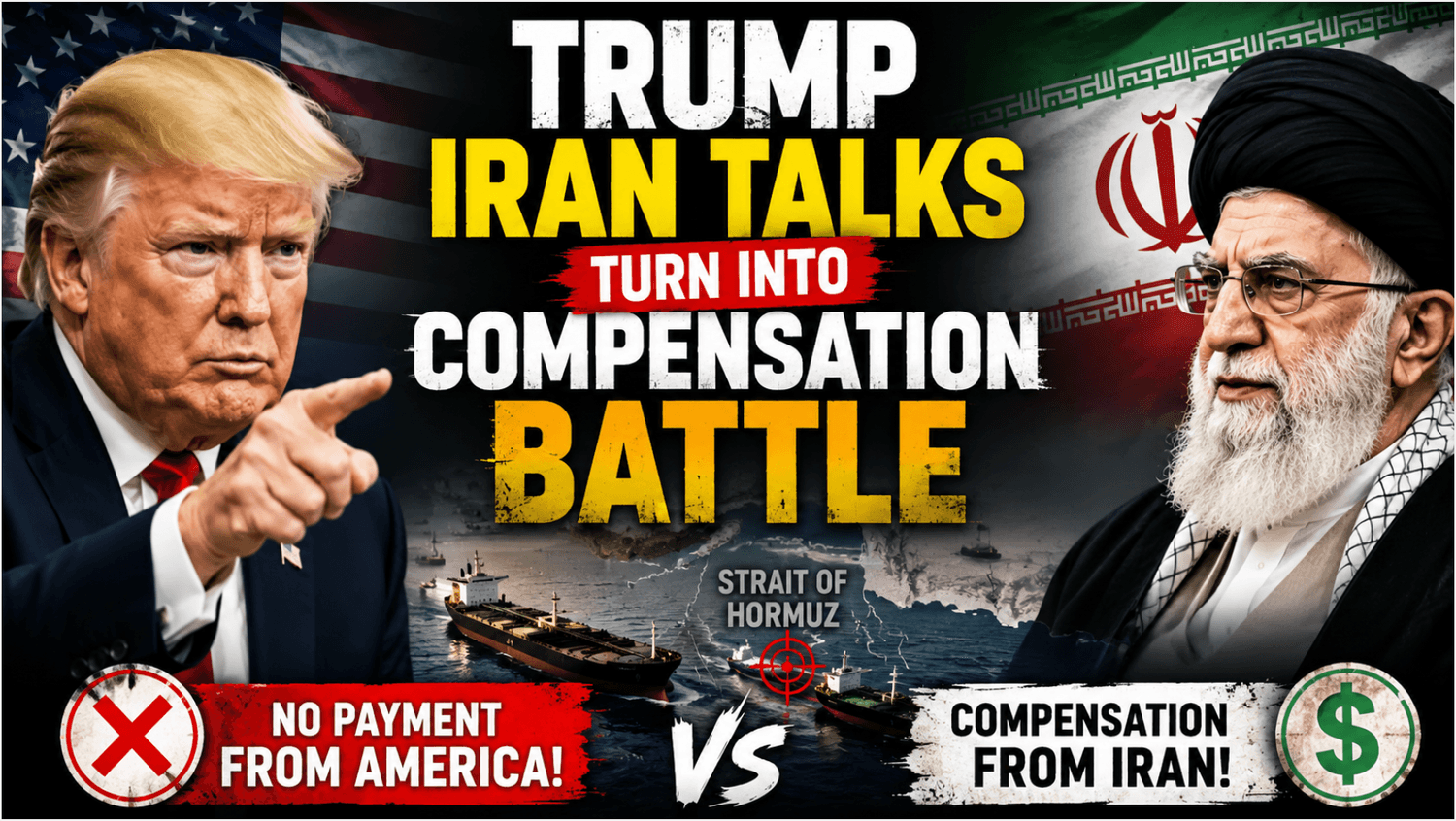
Trump Turns Iran Peace Talks Into a Compensation Battle: What Happens Next?
Trump has rejected Iran’s demand for compensation and has now made a counter-demand of his own. This could make the Iran negotiations much harder, while the Strait of Hormuz remains at the center of the crisis.
The Iran-US conflict has entered a new and very interesting stage.
There is now a strange situation.
Iran is asking the United States to pay compensation for damage caused by US and Israeli military attacks.
US President Donald Trump has answered with his own demand.
Trump says Iran should pay compensation for people he says were killed or badly wounded by Iranian actions.
He also said this demand will become part of future negotiations with Iran.
At first look, this may sound like a simple argument about money.
But it is much bigger than money.
This is about power, pressure, war, diplomacy, oil and control of the Strait of Hormuz.
And this is where the real story begins.
What Exactly Has Trump Said?
Trump has rejected Iran's demand for compensation.
Iran had said that the United States should compensate Tehran for the damage caused during the more than five months of fighting involving US and Israeli attacks.
Trump responded by saying that Iran should also pay compensation.
He pointed to people he says were killed or seriously wounded through Iranian actions, including attacks and conflicts.
Trump also referred to the families of people killed in the USS Cole attack in 2000.
However, there is an important factual point here.
The USS Cole attack was attributed by the FBI to al Qaeda, not Iran. So Trump's reference to Iran in this context should be treated carefully.
Trump also mentioned compensation for people killed during anti-government protests in Iran.
The bigger message is clear:
Trump does not want the negotiations to become a simple discussion about what America owes Iran.
He wants Iran to face its own bill.
That changes the political game.
This Is Not Really About Money
This is one of the most important points.
When countries fight a war, compensation can become a very powerful political weapon.
Why?
Because accepting compensation can sometimes look like accepting responsibility.
And accepting responsibility can create a much bigger political problem.
Imagine two countries sitting across a table.
One country says:
"You damaged our country. You must pay."
The other country says:
"You damaged us too. You must pay."
Now the discussion is no longer simply about peace.
It becomes a discussion about who is responsible for the war.
That is exactly what makes the present situation difficult.
Both sides are trying to shape the story before a final agreement is reached.
The Real Battlefield May Be the Strait of Hormuz
If you only watch the compensation argument, you can miss the bigger story.
The most important issue right now may be the Strait of Hormuz.
The Strait is a narrow waterway between Iran and Oman.
It is one of the most important energy routes in the world.
Before the current conflict, about one-fifth of global oil and LNG shipments moved through this area.
That means the Strait is not only important to Iran.
It is important to:
India
China
Japan
South Korea
Europe
Gulf countries
the United States
global energy markets
If ships cannot move normally through Hormuz, the impact can quickly spread across the world.
Oil prices can rise.
Gas prices can rise.
Transport costs can rise.
Food prices can rise.
Inflation can rise.
And ordinary people thousands of kilometres away from the Middle East can feel the impact.
This is why the Hormuz question is much bigger than a regional dispute.
Iran Says a Deal With Oman Is Near
There is another important development.
Iran has said that an agreement with Oman about new shipping lanes through the Strait of Hormuz is in its final stages.
That sounds positive.
But there is a big condition.
Iran says the Strait will not fully reopen unless the United States meets several conditions.
Iran has mentioned issues such as:
compensation for damage
an end to sanctions
stopping military threats
ending what Tehran calls aggression
lifting the blockade
freeing Iranian assets
So the situation is basically this:
Iran says: We can discuss reopening Hormuz, but America must first give us something.
Trump is now saying:
America also has demands. Iran must pay for what America says Iran has done.
This is why negotiations are becoming complicated.
The Most Important Word Here Is "Leverage"
In geopolitics, countries rarely negotiate only because they want to be friendly.
They negotiate because they have leverage.
Leverage means something you can use to put pressure on the other side.
Iran's biggest leverage is its location and its ability to affect the Strait of Hormuz.
America's leverage includes:
military power
sanctions
financial pressure
naval power
diplomatic influence
economic pressure
Both sides are therefore sitting with cards in their hands.
The question is:
Who has the stronger cards?
That is what the negotiations are really about.
Trump Is Using Economic Pressure
Trump recently said the United States was only "semi-negotiating" with Iran and was watching Iran's economic problems, including inflation and financial pressure.
This is important.
It suggests that Washington believes time may be working against Tehran.
If Iran's economy becomes weaker, the American calculation may be that Iran will eventually accept a less favorable agreement.
This is a classic pressure strategy.
Instead of immediately giving the other side what it wants, you wait.
You increase pressure.
You allow economic pain to grow.
Then you negotiate from a stronger position.
But there is also a risk.
Pressure can sometimes produce compromise.
But pressure can also produce anger.
And anger can produce escalation.
That is the dangerous part.
Iran Is Also Playing the Time Game
Iran is not simply sitting quietly.
Tehran is using the Strait of Hormuz as an important bargaining tool.
Iran says the waterway can reopen after American conditions are addressed.
Iran is also communicating through intermediaries even though direct US-Iran talks are currently not taking place, according to Reuters.
This is classic indirect diplomacy.
The countries may not want to sit together publicly.
But messages can still move through third countries.
And this is where Oman becomes important.
Why Oman Matters
Oman has historically played an important role as a communication bridge between Iran and Western countries.
Now Oman is involved in efforts related to the Strait of Hormuz.
That makes Oman an important diplomatic player.
Oman can help both sides communicate without forcing them to directly meet.
This can be useful when trust is very low.
Think of it like this:
America does not want to directly give Iran what Iran wants.
Iran does not want to directly give America what America wants.
So a third country can carry messages between them.
That is often how difficult diplomacy works.
But There Is a Major Problem
According to Reuters, Iran and the United States are currently not directly engaged in talks.
Iran has said it will not begin talks while Washington remains in violation of an interim agreement that was reached in June.
Messages are still being exchanged through intermediaries.
This is a very important difference.
There is a difference between:
"We are negotiating."
and
"We are sending messages through others."
The second situation usually means trust is still very low.
Trump Has Now Added a New Issue
This is where Trump's latest statement becomes important.
The compensation demand was reportedly not part of earlier talks.
Trump has now said it will be included in future negotiations.
That means the negotiation table is becoming bigger.
Earlier, the discussion was mainly about issues such as:
ending the conflict
nuclear concerns
sanctions
military threats
shipping
Hormuz
regional security
Now another major issue has entered:
Who pays for the damage and deaths?
This could make a final deal much harder.
Why Both Sides Want Compensation
For Iran, compensation has several possible purposes.
First, it can help Tehran claim that America caused major damage.
Second, it can create a financial demand.
Third, it can become part of a larger diplomatic package.
Fourth, it can help Iran present any agreement at home as something it achieved through resistance.
For Trump, demanding compensation serves a different purpose.
It sends a message that America does not accept the idea that Iran is simply the victim in this conflict.
Trump wants to turn the argument around.
His message is basically:
"If you want compensation from us, then we also have a bill for you."
That is why this is not just a financial argument.
It is a battle over the political narrative.
The Oil Market Has Already Reacted
The market does not wait for diplomats to finish their meetings.
Oil traders immediately watch every major development.
Reuters reported that oil prices jumped more than 4% after Iran and the United States exchanged compensation demands and hopes for a quick Hormuz deal weakened. Brent crude rose to around $87.13 per barrel, while US West Texas Intermediate rose to around $81.51 in the reported trading period.
This tells us something important.
Markets were expecting a possible reopening of Hormuz.
When that possibility became less certain, oil prices moved higher.
So diplomacy in the Middle East is directly connected to the price of fuel around the world.
Why India Should Watch This Very Carefully
For India, the Strait of Hormuz is extremely important.
India is one of the world's major energy consumers.
A prolonged disruption in the Gulf can affect:
crude oil → fuel prices → transport costs → business costs → inflation
This chain can eventually reach ordinary households.
If oil becomes expensive for a long time, the pressure can spread across the economy.
That is why India cannot look at the Iran-US conflict only as a foreign policy story.
It is also an economic story.
And it is an energy security story.
The China Factor Cannot Be Ignored
China is another major player in the background.
China has strong economic interests in the Gulf.
It also has relationships with Iran.
If the crisis continues, Beijing will have to carefully balance:
energy security
relations with Iran
relations with Gulf countries
global trade
its relationship with Washington
China does not need to become the loudest voice in the conflict.
Sometimes simply having economic relationships with all sides can create diplomatic influence.
That is why every major power is watching what happens next.
The Gulf Countries Are Also Under Pressure
Countries such as Saudi Arabia and the United Arab Emirates do not want the conflict to continue forever.
They want:
safe shipping
stable oil markets
economic growth
regional security
But they also have their own security concerns.
Reuters reported that attacks involving Iran-aligned Houthis have added another layer of risk around the Red Sea and Gulf region.
This means there is not just one battlefield.
There are several connected pressure points.
Hormuz.
Red Sea.
Yemen.
Gulf shipping.
Oil infrastructure.
One escalation can affect another.
The Dangerous Possibility: A Long Negotiation
The biggest risk now may not be an immediate large war.
It may be a long period of uncertainty.
Imagine a situation where:
Iran says:
"Lift sanctions first."
America says:
"Stop threatening shipping first."
Iran says:
"Pay compensation first."
America says:
"You pay compensation first."
Both sides keep waiting.
Meanwhile, ships remain nervous.
Oil remains expensive.
Markets remain uncertain.
Businesses delay decisions.
And regional countries continue preparing for more trouble.
This is how a temporary conflict can become a long economic problem.
Could Trump Be Using the Compensation Demand as a Negotiating Tool?
Yes, that is one possible interpretation.
The demand does not necessarily mean Trump expects Iran to simply write a huge cheque tomorrow.
In diplomacy, a demand can be used as a bargaining position.
You start with a very strong position.
The other side starts with its own strong position.
Then both sides slowly move.
This is sometimes called anchoring.
The first number or demand can influence the entire negotiation.
Trump may therefore be trying to create a strong American starting position.
Iran is doing something similar from its side.
That is why the first demands should not always be treated as the final demands.
But There Is a Serious Risk of Miscalculation
This is where geopolitics becomes dangerous.
If both sides believe the other side is under more pressure, both may refuse to compromise.
America may believe:
"Iran's economy is hurting. They will eventually give in."
Iran may believe:
"America needs Hormuz open. They will eventually give in."
If both governments believe they have the stronger hand, negotiations can become a staring contest.
And staring contests are dangerous when missiles, ships and military forces are involved.
What Could Happen Next?
There are several possible paths.
Scenario 1: Quiet Compromise
This is the best-case scenario.
Behind-the-scenes diplomacy continues.
Oman helps carry messages.
The two sides gradually reduce their demands.
A limited agreement is reached.
The Strait of Hormuz begins reopening.
Oil prices fall.
Markets calm down.
This is possible.
But it requires both sides to step back from their strongest public statements.
Scenario 2: Hormuz Reopens Without a Full Peace Deal
This is also possible.
The sides may decide that keeping global shipping moving is more important than solving every political issue immediately.
They could create a limited shipping arrangement.
Other disputes could remain unresolved.
This would be a practical solution.
Sometimes countries do not need to solve everything at once.
They only need to solve the most dangerous problem first.
Scenario 3: Negotiations Become Harder
This is the more worrying scenario.
Trump keeps the compensation demand.
Iran refuses.
America maintains pressure.
Iran keeps its own demands.
The Strait remains uncertain.
Oil prices remain high.
Regional attacks continue.
This could push the region toward a longer crisis.
Scenario 4: Military Escalation
This is the worst scenario.
If ships are attacked, military forces respond, or another major strike takes place, diplomacy could become much harder.
Once new blood is spilled, political leaders often find it difficult to explain compromise to their own people.
That is why every new attack matters.
The Biggest Question: Who Blinks First?
This may become the central question of the next phase.
Will Iran decide that economic pressure is too high?
Or will America decide that keeping Hormuz disrupted is too costly?
The answer may not come from military power alone.
It may come from economics.
It may come from oil prices.
It may come from domestic politics.
It may come from pressure from Gulf allies.
And it may come from the global shipping industry.
That is why geopolitics is never just about soldiers and weapons.
Money can be a weapon too.
What Trump's Strategy Appears to Be
Looking at the latest statements, Trump's approach appears to combine several forms of pressure:
Military pressure
Keep the threat of force alive.
Economic pressure
Use sanctions and Iran's economic problems as leverage.
Diplomatic pressure
Demand concessions before making major concessions.
Public pressure
Make strong statements publicly so the other side knows that Washington is not desperate for a deal.
Negotiating pressure
Add compensation to the list of future demands.
Reuters has reported that Trump faces domestic pressure to end the war ahead of the US midterm elections in November.
So Trump has a difficult balance.
He wants a deal.
But he does not want a deal that looks like a surrender.
That distinction is extremely important.
And Iran Has Its Own Political Problem
Iran also cannot simply accept every American demand.
The Iranian government has its own domestic audience.
If Tehran agrees to a deal that looks too favorable to Washington, its leaders could face criticism at home.
Therefore, Iran also needs to show its people that it achieved something.
This is why negotiations may take time.
Each side is negotiating with the other country.
But each side is also negotiating with its own population.
The Real Deal May Be Bigger Than Hormuz
If a serious peace agreement eventually comes, it may not be only about opening the Strait.
It could involve a much larger package.
Possible areas could include:
sanctions
nuclear restrictions
military activity
shipping security
Iranian assets
compensation claims
regional armed groups
Gulf security
US military presence
future attacks
international monitoring
That would be a very complicated agreement.
And complicated agreements need trust.
Right now, trust appears to be one of the weakest parts of the relationship.
Kootneeti Analysis: What Is Really Happening?
Here is the bigger picture.
Iran wants the cost of war to be recognised.
Trump wants Iran's own costs recognised.
Iran wants sanctions removed.
America wants pressure to remain.
Iran wants Hormuz linked to US concessions.
America wants Hormuz reopened without giving Iran excessive leverage.
So both sides are trying to control the sequence.
And sequence matters.
If Iran gets sanctions relief first, Tehran gains economic breathing room.
If America gets shipping reopened first, Washington gains economic and strategic breathing room.
Therefore, the fight is not only about what happens.
It is about what happens first.
That is the real diplomatic chessboard.
The Hormuz Question Is Bigger Than Iran
There is one lesson the world should understand.
A narrow waterway can sometimes become more important than a huge battlefield.
Why?
Because global trade depends on routes.
If one major route becomes unsafe, the effects travel everywhere.
Oil prices move.
Insurance costs rise.
Shipping companies change routes.
Delivery times increase.
Factories face higher costs.
Consumers eventually pay more.
This is why the Strait of Hormuz has become the central economic pressure point of the current crisis.
What Should We Watch Now?
Over the next few days and weeks, five things will be especially important.
1. Will Iran and the US restart direct talks?
At present, Iran says direct talks are not happening, although messages are moving through intermediaries.
2. Will Oman complete the shipping arrangement?
Iran says the agreement on new shipping lanes is close.
3. Will Trump keep the compensation demand?
If he does, it could become a permanent part of the negotiation framework.
4. Will Hormuz reopen?
This is perhaps the most important economic question.
5. What happens to oil prices?
The market has already shown that uncertainty around Hormuz can quickly push prices higher.
Final Takeaway
The latest Trump-Iran dispute may look like a fight over compensation.
But underneath it is a much bigger struggle.
It is a struggle over power, responsibility, economic pressure and control of the next negotiation.
Iran does not want to enter talks from a weak position.
Trump does not want America to enter talks from a weak position.
Both sides are therefore putting demands on the table.
The Strait of Hormuz is the biggest pressure point.
Oil is the economic pressure point.
Domestic politics is the political pressure point.
And diplomacy is the only realistic way to bring all of these pieces together.
The biggest question is no longer simply:
"Will Trump and Iran make peace?"
The more important question is:
"What will each side have to give up before peace becomes possible?"
That is where the real Kootneeti begins.
Because in international politics, countries rarely negotiate only for peace.
They negotiate for position.
And right now, both Washington and Tehran are fighting to enter the final negotiation from the strongest possible position.
The next move may decide not only the future of Iran-US relations, but also the price of oil, the safety of global shipping and the balance of power across the Middle East.
This analysis is based on the latest reporting available on August 10, 2026. The situation is changing quickly, and claims made by the parties should be distinguished from independently verified facts.

Building stronger digital visibility, smarter marketing systems and meaningful growth opportunities for businesses across industries.
BE VISIBLE. BE RELEVANT. BE REMEMBERED.