
Siddharth Rajsekar vs Sunil Chaudhary: Which Mentor Is Better
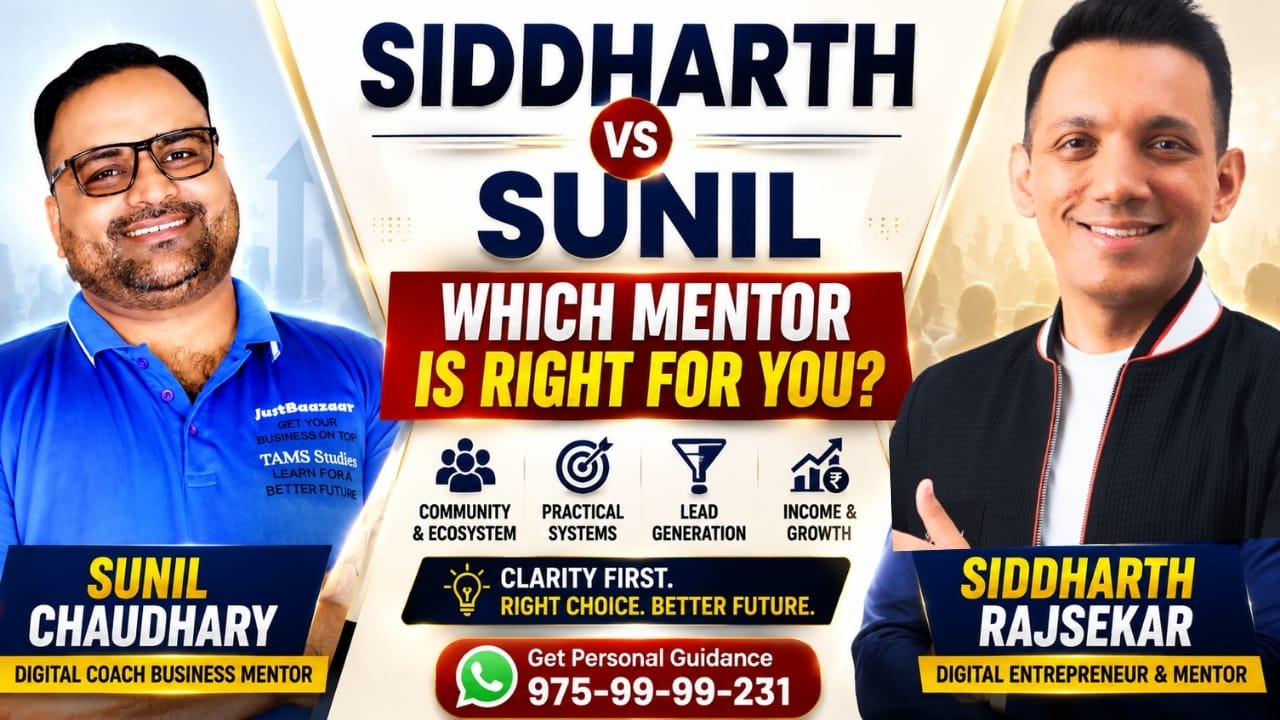
Siddharth Rajsekar vs Sunil Chaudhary: Which Digital Business Mentor Is Right for You?
Choosing a Digital Business mentor can feel confusing.
You search online for a course. You watch a few videos. You read reviews. Then you see different names again and again.
Two names that may come up in this space are Siddharth Rajsekar and Sunil Chaudhary.
But here is the important question:
Who is better?
That may not be the right question.
The better question is:
Who is the right fit for your current stage, your goals, and the kind of help you need?
This difference matters.
A mentor can be excellent, but their method may not match what you need today. One person may need mindset, clarity, and a strong community. Another may need hands-on help to build funnels, optimize online platforms, generate leads, and move toward income.
This article looks at the two approaches from that practical point of view.
It is not written to put one mentor above another.
The goal is simple:
Help you make a clearer decision.
The First Question: What Do You Actually Need?
Before buying any course or joining any community, stop for a moment.
Ask yourself:
Where am I right now?
Are you just starting?
Do you already have knowledge but no online business?
Do you have an audience but no clear offer?
Do you have an offer but no leads?
Do you have leads but no sales system?
Do you already have a working business and want to grow it faster?
These are very different problems.
And different problems need different solutions.
For example, imagine two people.
Person A has low confidence, no clear direction, and wants a strong learning environment.
Person B already knows what they want to sell but does not know how to build the website, funnel, automation, lead system, and sales process.
Both people want a Digital Business.
But their needs are not the same.
That is why choosing a mentor should start with self-analysis, not hype.
Digital Business Starts With a Strong Foundation
There is a lot of excitement around Digital Business today.
People talk about:
Social Media
AI
Automation
Communities
Personal Branding
YouTube
Instagram
Networking
Funnels
Online Courses
All these things can be useful.
But there is a basic question we often forget:
What is the foundation of the business?
A Digital Business needs clarity.
You need to know:
Who are you helping?
What problem are you solving?
What are you selling?
Why should people trust you?
How will people find you?
How will they become leads?
How will you follow up?
How will they buy?
How will you deliver the service?
How will you make a profit?
Without answers to these questions, a person can spend months learning without building a real business.
That is why foundation comes first.
Community Is Valuable, But It Is Not the Business
A strong community can be a major advantage.
People learn faster when they are surrounded by other people who are also trying to grow.
A good community can provide:
Motivation
Support
Networking
Ideas
Feedback
New opportunities
Peer learning
Positive pressure
This is important.
The people around us can influence our thinking and our actions.
If you spend time with people who are building businesses, creating content, learning new skills, and taking action, you may naturally become more active too.
So there is real value in a strong ecosystem.
But there is an important difference.
A community can support your business. It cannot replace your business.
Your business still needs an offer.
It still needs customers.
It still needs a sales process.
It still needs leads.
It still needs systems.
It still needs income.
This is where many new entrepreneurs can get confused.
They may feel productive because they are attending events, joining groups, watching sessions, and meeting people.
But activity is not always progress.
The real question is: Is the business moving forward?
Understanding Siddharth Rajsekar's Approach
Siddharth Rajsekar has built a strong presence around digital entrepreneurship, mindset, clarity, learning, and community.
One of the major attractions of this kind of approach is the ecosystem.
A person does not feel completely alone.
There are other learners.
There are conversations.
There are success stories.
There is exposure to different ideas.
There is a sense that other people are also on the same journey.
For the right person, this can be powerful.
Some people grow faster when they have a strong environment around them.
They need people who can inspire them.
They need a larger vision.
They need clarity about where they want to go.
They want to build for the long term.
For such people, an ecosystem-led approach can be very useful.
The important point is not to judge this approach as good or bad.
It is about understanding what it does best.
Its strength can be the larger journey, mindset, clarity, community, and ecosystem.
Understanding the Sunil Chaudhary Approach
The focus of Sunil Chaudhary's approach is more practical and implementation-driven.
The basic idea is simple:
Do not only learn Digital Business. Build it.
That means starting with the foundation.
Then building the systems.
Then optimizing the online platforms.
Then creating lead generation.
Then building sales processes.
Then moving toward income.
This approach is especially useful for people who say:
“I know a lot, but I do not know how to put it all together.”
Or:
“I have an offer, but I do not have a proper system.”
Or:
“I have social media accounts, but they are not bringing business.”
Or:
“I want someone to guide me step by step.”
That is where hands-on support can make a major difference.
Knowledge Is Not the Same as Implementation
This is one of the biggest problems in online learning.
Information is everywhere.
Search for almost anything online and you will find hundreds or thousands of videos.
Want to know what a funnel is?
You can find videos.
Want to learn email marketing?
You can find videos.
Want to understand social media?
You can find videos.
Want to learn automation?
You can find videos.
So information is not the main problem anymore.
Implementation is the problem.
A person may understand what a landing page is but still not know how to create one that supports their business.
They may understand lead generation but still have no lead system.
They may know that WhatsApp follow-up is important but have no sequence.
They may know about email marketing but never build an automated campaign.
This is why personal support and handholding can be valuable.
Sometimes you do not need another 50-hour course.
You need someone to look at your work and say:
“Change this.”
“Remove this.”
“Put this here.”
“Your offer is not clear.”
“Your landing page needs improvement.”
“Your follow-up is missing.”
“Your call to action is weak.”
That is practical mentorship.
Your Online Platforms Should Work Together
A modern Digital Business may have many platforms.
You may have:
A Website
Instagram
YouTube
Facebook
LinkedIn
WhatsApp
Email
Landing Pages
Lead Magnets
Funnels
But having many platforms does not automatically create a business.
The platforms need to work together.
For example:
A person discovers your YouTube video.
They visit your profile.
They click your link.
They reach your landing page.
They download your free resource.
They become a lead.
They receive useful follow-up.
They understand your offer.
They become a customer.
That is a journey.
When the journey is planned well, your platforms become business assets.
Without that connection, you may simply have many separate accounts.
More tools do not always mean a better business.
A simple system that works is often better than a complex system that nobody understands.
The Importance of Funnels
A funnel is not just a technical tool.
It is a simple path that helps a stranger become a customer.
A good funnel answers basic questions:
What should the visitor do next?
What problem are we solving?
What value are we giving?
How do we build trust?
What should the person buy?
How do we follow up?
A coach, consultant, trainer, or expert can have excellent knowledge.
But if people cannot understand the next step, the knowledge may not become business.
This is why funnel building is an important part of a Digital Business foundation.
Automation Should Save Time, Not Create More Complexity
Automation is another important part of Digital Business.
But automation should not be used just because it sounds advanced.
The purpose of automation is simple:
Save time and improve consistency.
For example, when someone becomes a new lead, a system can send a welcome message.
A useful email can be delivered.
A WhatsApp sequence can start.
A reminder can be sent.
A useful resource can be shared.
A sales invitation can be presented at the right time.
This means the business does not have to manually repeat the same task every day.
Good automation gives the business owner more time to focus on:
Customers
Content
Sales
Strategy
Product improvement
Growth
Leads Matter More Than Likes
Social media can create attention.
But attention alone is not a business.
You can have thousands of followers and still have very few customers.
You can also have a smaller audience and build a profitable business if the right people trust you and understand your offer.
That is why lead generation matters.
The goal is not simply:
“Get more views.”
The better question is:
“How do I attract the right people and move them into my business system?”
This can happen through:
YouTube
SEO
Social Media
Content
Referrals
Webinars
Lead Magnets
Paid Advertising
Partnerships
The right method depends on the business.
But there must be a clear path from attention to relationship and then to business.
Income Is an Important Part of the Journey
A Digital Business should eventually create income.
This sounds obvious, but it is often forgotten.
A person can spend months learning.
They can collect certificates.
They can attend events.
They can buy tools.
They can create content.
They can join communities.
But eventually the question remains:
Is the business making money?
Revenue is not the only measure of success.
Profit matters too.
This is why business expenses should be watched carefully.
If a new entrepreneur spends heavily on software, subscriptions, services, advertisements, and tools before creating a working revenue system, the pressure can become very high.
A better goal is:
Build a simple system with controlled running costs and clear profit potential.
Build First, Then Use the Ecosystem
This is perhaps the biggest difference in philosophy.
The recommendation is not:
“Do not join communities.”
It is not:
“Do not network.”
It is not:
“Do not learn from other mentors.”
The recommendation is:
Get the sequence right.
First build your foundation.
Then build your system.
Then start generating leads.
Then generate income.
Then scale.
And during this journey, use communities and networks wherever they can help you.
Once your business is running, a strong ecosystem can become even more valuable.
Why?
Because now you have something to leverage.
You can build partnerships.
You can create collaborations.
You can get referrals.
You can learn new strategies.
You can meet potential customers.
You can find new business opportunities.
You can learn from people who are ahead of you.
The community becomes a growth multiplier.
A Simple Example
Imagine a coach named Rahul.
Rahul has ten years of experience.
He knows his subject very well.
He can genuinely help people.
But his online business is weak.
His Instagram profile is unclear.
His YouTube channel has no clear direction.
His website is not optimized.
His offer is confusing.
There is no lead magnet.
There is no funnel.
There is no proper WhatsApp follow-up.
There is no email sequence.
Rahul may keep saying:
“I need more followers.”
But followers may not be his biggest problem.
His problem may be his business system.
Now imagine that Rahul fixes his foundation.
His offer becomes clear.
His platforms are optimized.
His funnel is ready.
His lead generation starts.
His follow-up works.
His sales process improves.
Now he starts generating income.
At this stage, joining a strong community can give him even more value.
He has a working business.
Now networking can create partnerships.
Events can create opportunities.
Other entrepreneurs can give him ideas.
The ecosystem can help him grow faster.
This is the difference between building the engine and simply standing near a fast car.
So, Who Should You Choose?
There is no universal answer.
If your current priority is:
Mindset, clarity, long-term development, community, networking, and a strong ecosystem, then the Siddharth Rajsekar approach may be a strong fit for you.
If your current priority is:
Digital Business Foundation, practical implementation, platform optimization, funnels, automation, lead generation, personal support, handholding, and moving toward income, then the Sunil Chaudhary approach may be more relevant for you.
This does not mean one person is “better” than the other.
It means the fit can be different.
That is an important difference.
Three Questions Before You Buy Any Course
Before choosing any mentor, ask yourself three questions.
1. Where am I right now?
Are you a complete beginner?
Are you already a coach?
Do you have an audience?
Do you have an offer?
Do you already have customers?
Do you already have a working business?
Your stage matters.
2. What is my biggest problem?
Do you need clarity?
Do you need confidence?
Do you need community?
Or do you need implementation?
Do you need a funnel?
Do you need leads?
Do you need sales?
Do you need automation?
Be honest with yourself.
3. What result do I want next?
Do you want knowledge?
Do you want a network?
Do you want a stronger mindset?
Or do you want a working business system?
The answer can help you choose much better.
Do Not Choose a Mentor Only Because of Hype
This is important.
Do not choose a mentor simply because they have many followers.
Do not choose because a community looks exciting.
Do not choose because an event looks impressive.
Do not choose because everyone around you is talking about the program.
And do not choose simply because someone says:
“This is the best program.”
Best for whom?
That is the real question.
Look at the teaching style.
Look at the support.
Look at the learning system.
Look at student experiences.
Look at the type of people getting results.
Most importantly...
Look at whether the program solves your current problem.
You May Learn From More Than One Mentor
There is no rule that says you can learn from only one person.
In fact, many successful people learn from different mentors at different stages.
One person may teach you mindset.
Another may teach you marketing.
Another may help you understand sales.
Another may teach leadership.
Another may help you build systems.
The important thing is to avoid becoming a permanent learner who keeps buying courses but never implements them.
At some point...
Learning has to become action.
That is where real business growth begins.
The Real Goal Is Not to Become a Perfect Student
The goal is not to collect courses.
The goal is not to collect certificates.
The goal is not to attend every event.
The goal is not to become the most active person in a community.
The goal is to build something useful.
Build an offer.
Serve people.
Create a system.
Generate leads.
Make sales.
Deliver value.
Create profit.
Improve the system.
Then grow.
That is a Digital Business.
Final Thought
Siddharth Rajsekar and Sunil Chaudhary can represent two different approaches that may help different people at different stages.
One person may need a strong ecosystem and community.
Another may need practical business building and hands-on support.
There is no need to turn this into a fight.
The market is big enough.
Learners are different.
Their goals are different.
Their stages are different.
Their personalities are different.
Their learning needs are different.
So instead of asking:
“Who is the best mentor?”
Ask:
“What do I need right now?”
If you need clarity, mindset, community, and a strong ecosystem, explore that path.
If you need to build your Digital Business foundation, optimize your online platforms, create funnels, set up automation, generate leads, and move toward income with practical support, explore that path.
And once your foundation is strong...
Go build relationships.
Join good communities.
Meet smart people.
Network.
Collaborate.
Learn.
Grow.
Because a strong business and a strong ecosystem can work beautifully together.
But remember one simple principle:
First build your engine. Then find the best road to drive it on.
Your mentor should not simply make you feel motivated.
The right mentor should help you move from where you are today to where you want to go next.
And sometimes...
The most valuable question is not:
“Who should I follow?”
It is:
“What should I build?”
That question can change everything.
About Sunil Chaudhary
Sunil Chaudhary is a Digital Coach Business Mentor who helps coaches, trainers, experts, and knowledge entrepreneurs build practical Digital Businesses.
His approach focuses on Digital Business Foundation, online platform optimization, funnels, automation, lead generation, sales systems, and practical implementation.
The goal is simple:
Build a Digital Business that can create real value, real customers, and real income.
If you want help understanding your current Digital Business stage and the next step you should take, connect with Sunil Chaudhary directly.
WhatsApp: 9759999231
Build First. Earn First. Scale Next.
जय सनातन।
वन्दे मातरम्।

Building stronger digital visibility, smarter marketing systems and meaningful growth opportunities for businesses across industries.
BE VISIBLE. BE RELEVANT. BE REMEMBERED.