
Publish a Book and Get Rich
Your Book Can Become More Than a Book
There is something powerful about seeing your name on the cover of a book.
For years, people have looked at authors as experts, thinkers, teachers and leaders.
But today, a book can do much more than establish credibility.
A well-positioned book can become a business asset.
It can introduce you to new audiences.
It can open doors to speaking opportunities.
It can attract clients.
It can strengthen your personal brand.
It can create new partnerships.
It can become the foundation of an online course.
It can support a coaching business.
It can generate consulting opportunities.
And, when it is connected to the right business model, your book can become part of a system that creates wealth.
That is why I believe we should look at publishing from a completely different perspective.
The question is not simply:
“How do I publish a book?”
A better question is:
“How can I publish a book that creates authority, attracts opportunities and builds a profitable ecosystem around my knowledge?”
That is a completely different game.
And this is exactly what I want to explore with you in this comprehensive guide.
The Real Opportunity Is Bigger Than Book Sales
Let me start with something that may surprise you.
You do not necessarily need to sell millions of copies to make significant money from a book.
In fact, many authors make the mistake of thinking that the only way to become financially successful through a book is to generate huge royalty income.
That is only one possibility.
There is another, potentially much bigger opportunity.
Your book can become a doorway to your entire knowledge business.
Imagine that you are a coach.
You publish a book about leadership.
Someone discovers your book through Google.
They read your article.
They download a chapter.
They watch one of your videos.
They join your email list.
They attend your free masterclass.
Then they discover your coaching programme.
Your book may have made only a small amount directly.
But it helped create a customer journey worth hundreds or thousands of dollars.
That is the difference between thinking like an author and thinking like a knowledge entrepreneur.
An author asks:
“How many books did I sell?”
A knowledge entrepreneur asks:
“How many opportunities did my book create?”
That second question can completely change the economics of publishing.
Your Book Is a Trust-Building Machine
Think about the last time you met someone who had written a serious book.
Did you look at that person in exactly the same way as someone who simply said:
“I am an expert”?
Probably not.
There is a psychological difference.
Anyone can call themselves a coach.
Anyone can create an Instagram account.
Anyone can launch a website.
Anyone can write:
“I am a business expert.”
But writing and publishing a complete book requires a different level of commitment.
It communicates something powerful:
“I have spent enough time thinking about this subject to organise my knowledge into a complete body of work.”
That perception matters.
Your book becomes a physical or digital representation of your expertise.
It gives people something they can hold, read, recommend and share.
And most importantly, it gives your audience a reason to remember you.
That is why a book can be an extraordinary personal branding asset.
Why Experts Should Think Seriously About Publishing
If you are a coach, consultant, trainer, speaker, educator, creator or subject-matter expert, you already possess something valuable.
You possess knowledge.
You have experiences.
You have lessons.
You have frameworks.
You have mistakes.
You have stories.
You have solutions.
You have opinions.
You have methods that you have developed over time.
The problem is that much of this knowledge remains trapped inside your head.
You may explain the same concept to clients again and again.
You may answer the same questions on WhatsApp.
You may conduct the same training repeatedly.
You may create dozens of social media posts around the same ideas.
But what happens when you turn your knowledge into a book?
You create an intellectual asset.
Your knowledge becomes organised.
Your ideas become searchable.
Your frameworks become referenceable.
Your experience becomes documented.
Your personal brand becomes easier to understand.
And your audience gets a deeper way to experience your expertise.
That is one of the most important reasons I encourage knowledge professionals to seriously consider becoming authors.
A Book Can Work While You Sleep
There is another reason publishing can be powerful.
Your time is limited.
There are only 24 hours in a day.
If your business depends entirely on your physical presence, your income can eventually become constrained by your calendar.
You can only conduct so many consultations.
You can only attend so many meetings.
You can only deliver so many live classes.
You can only coach so many people personally.
But a book is different.
Once published, it can be discovered by people at different times and in different places.
Someone can discover it today.
Another person can discover it six months from now.
Someone else may read it two years later.
A reader can purchase it while you are sleeping.
A potential client can discover your expertise without speaking to you first.
A conference organiser can find your book before inviting you to speak.
A journalist can discover your ideas.
A business owner can read your framework.
A student can share a chapter with a friend.
Your book continues communicating your ideas when you are not physically present.
That is leverage.
And leverage is one of the foundations of wealth creation.
But Let Me Give You a Warning
There is one important distinction I want you to understand.
Publishing a book does not automatically make you rich.
Simply uploading a manuscript to a publishing platform will not magically create wealth.
Writing 50,000 words does not guarantee customers.
Getting an ISBN does not guarantee authority.
Printing 1,000 copies does not guarantee sales.
And putting “Author” in your social media bio does not automatically build a successful business.
The book itself is only one part of the system.
The real opportunity comes from what you build around the book.
This is where many aspiring authors go wrong.
They spend months writing.
Then they publish.
Then they wait.
They expect Amazon, Google, social media or word of mouth to somehow do all the marketing for them.
And when sales are slow, they conclude:
“Books don't make money.”
That conclusion is too simplistic.
The better lesson is:
A book without distribution is an asset nobody knows exists.
Publishing Is Only the Beginning
Think of your book as the centre of a wheel.
Around that centre, you can build multiple business channels.
Your book can connect to:
Your personal website
Your YouTube channel
Your podcast
Your LinkedIn profile
Your email newsletter
Your social media content
Your free resources
Your workshops
Your webinars
Your coaching programmes
Your consulting services
Your online courses
Your speaking career
Your community
Your membership programme
Your affiliate partnerships
Your corporate training
Your digital products
Now imagine what happens when all these assets work together.
Your book attracts attention.
Your content builds trust.
Your website captures interest.
Your email list develops the relationship.
Your free training demonstrates your expertise.
Your programme creates transformation.
Your community creates belonging.
And your premium services create higher-value opportunities.
Suddenly, the book is no longer just a product.
It becomes part of a business ecosystem.
The Author-to-Authority Journey
I like to think of this journey as a simple progression.
Knowledge → Content → Book → Authority → Audience → Trust → Offers → Business → Wealth
Let us break this down.
1. Knowledge
You begin with something you know.
Perhaps you know marketing.
Perhaps you know leadership.
Perhaps you know fitness.
Perhaps you know spirituality.
Perhaps you know investing.
Perhaps you know parenting.
Perhaps you know technology.
Perhaps you know education.
Your expertise gives you raw material.
2. Content
You start sharing that knowledge.
You create videos.
You write articles.
You publish posts.
You answer questions.
You teach.
Over time, your audience begins to associate your name with a particular subject.
3. Book
You organise your strongest ideas into a structured body of knowledge.
Now your audience has a deeper resource.
4. Authority
Your book strengthens your positioning.
People can see your methodology.
They can understand your thinking.
They can explore your ideas in greater depth.
5. Audience
Your content and book work together to attract people who are interested in your subject.
6. Trust
People consume your ideas.
They experience your expertise.
They see your consistency.
They begin to believe that you may be able to help them.
7. Offers
You give people a logical next step.
Perhaps that is a workshop.
Perhaps it is consulting.
Perhaps it is coaching.
Perhaps it is a course.
Perhaps it is a membership.
8. Business
Your knowledge becomes commercially structured.
9. Wealth
Your intellectual property, audience, reputation, products and services begin working together.
This is the bigger picture.
Your Book Can Become Your Ultimate Lead Magnet
Here is another strategy that many authors overlook.
Your book does not always have to be the final product.
Sometimes, your book can become the beginning of the relationship.
For example, imagine that your book teaches entrepreneurs how to build a digital business.
At the end of the book, you could invite readers to access a practical workbook.
The reader visits your website.
They enter their email address.
Now you have permission to continue helping them.
You can send additional lessons.
You can invite them to a workshop.
You can offer a free masterclass.
You can introduce your community.
Eventually, if there is a genuine fit, you can present your paid programme.
This creates a much more sophisticated model.
Instead of saying:
“Buy my book.”
You are saying:
“Start your transformation with my book.”
That is a completely different positioning strategy.
The Wealth Is Often in the Ecosystem
This is perhaps the most important idea I want you to remember throughout this entire article.
The book may create the attention.
The ecosystem can create the wealth.
Suppose you sell a book for $10.
You may make a few dollars after costs, depending on the publishing model.
Now imagine that one reader becomes a $1,000 client.
Or a $2,000 coaching client.
Or a $5,000 consulting client.
Or a corporate training customer.
The economics are obviously different.
This does not mean you should manipulate readers or use a book simply as a sales brochure.
Quite the opposite.
Your book must first deliver genuine value.
You must solve meaningful problems.
You must teach.
You must explain.
You must inspire.
You must challenge assumptions.
You must help the reader make progress.
Then, naturally, you can show them what deeper support is available.
That is ethical marketing.
And it is far more sustainable than aggressive selling.
Why I Believe Every Expert Should Consider Writing a Book
Over the years, I have worked extensively around digital marketing, SEO, business growth, personal branding, coaching and knowledge entrepreneurship.
One lesson has become increasingly clear to me.
Knowledge becomes more valuable when it is packaged.
Your knowledge may be extraordinary.
But if nobody can understand it, remember it, discover it or apply it, its commercial potential remains limited.
A book forces you to package your thinking.
It makes you clarify your message.
It makes you organise your framework.
It makes you decide what you truly believe.
It makes you document your experiences.
And it gives your audience something substantial.
That is why I see a book not merely as a publishing project.
I see it as a personal authority project.
Your book can become one of the strongest assets in your personal brand.
From Unknown Expert to Recognised Authority
Imagine two professionals.
The first says:
“I help businesses grow.”
The second says:
“I am the author of a book that explains my complete framework for helping businesses grow.”
The second person has created a stronger intellectual position.
Of course, the title alone does not make the second person better.
The book needs to be genuinely useful.
The expertise needs to be real.
The claims need to be honest.
The results need to be credible.
But when those foundations are present, publishing creates a powerful signal.
It tells the market:
“I have something worth teaching.”
And when your teaching consistently creates value, your reputation can grow.
That is how authority is built.
Not through one viral post.
Not through one advertisement.
Not through one fancy website.
But through consistent value + clear positioning + proof + distribution + trust.
The Bigger Question
So, if you have ever thought:
“One day I will write a book.”
I want you to stop thinking of it as a someday project.
Start thinking strategically.
Ask yourself:
What do I know that can help people?
What problem can I solve?
What transformation can I help create?
What experience have I gained that others can learn from?
What mistakes can I help people avoid?
What framework have I developed?
What questions do people repeatedly ask me?
What could I teach for the next ten years?
And perhaps the most important question:
If my name became associated with one powerful idea, what would I want that idea to be?
That answer may become the foundation of your book.
And that book may become the foundation of your authority.
And your authority may become the foundation of your business.
And your business, when built with integrity, skill and leverage, can become the foundation of your financial freedom.
That is the opportunity.
Key Takeaway
Do not publish a book merely to become an author.
Publish a book to become more useful.
Publish a book to organise your knowledge.
Publish a book to strengthen your authority.
Publish a book to build your personal brand.
Publish a book to reach people you cannot personally meet.
Publish a book to create an intellectual asset.
And, if you are an entrepreneur, coach, consultant, expert or knowledge creator, consider building a business ecosystem around that intellectual asset.
Because the biggest opportunity may not be the money you make from the book.
It may be the opportunities your book creates because of the book.
And that is where our journey truly begins.
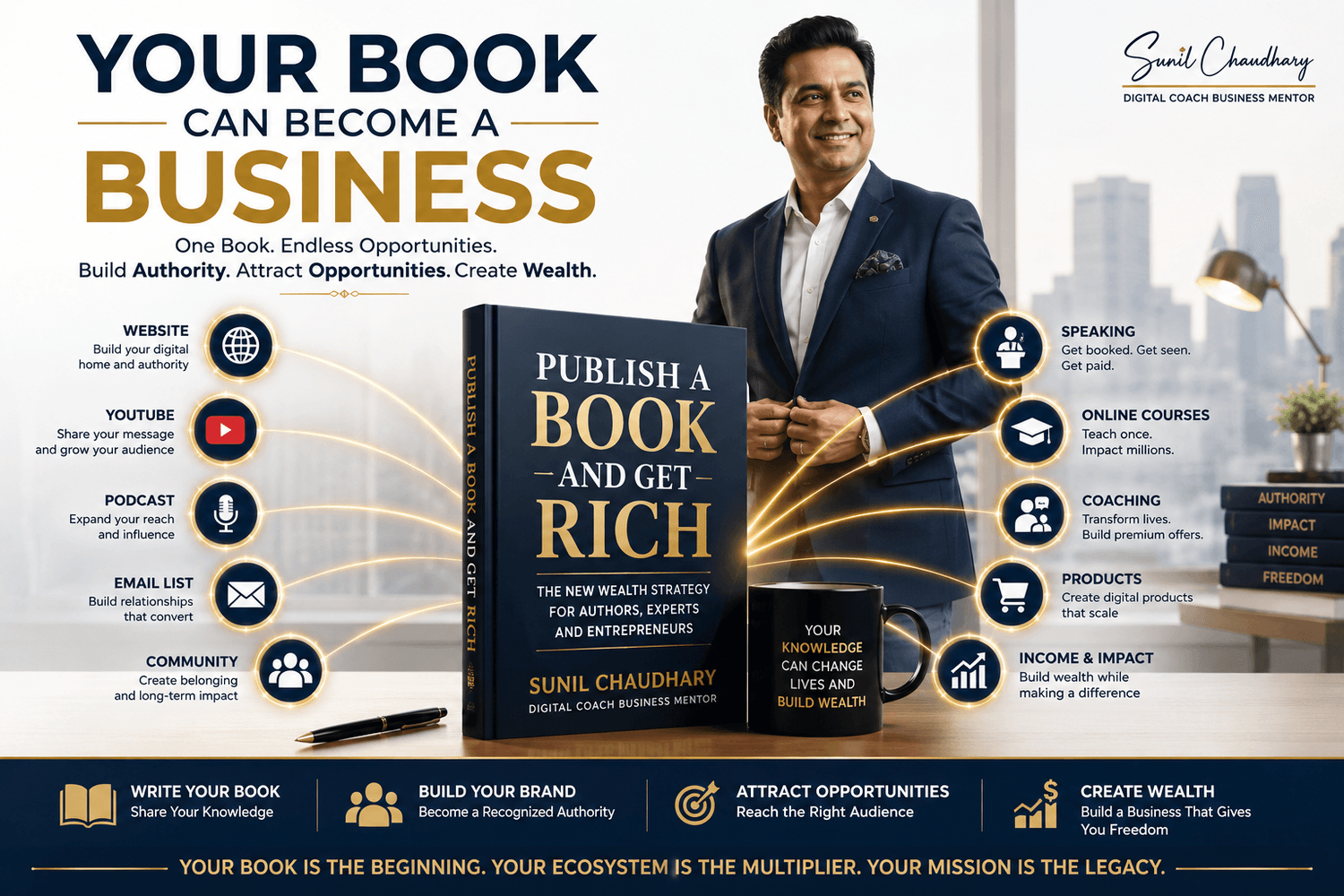
The Real Opportunity Is Bigger Than Book Sales
Most people think writing a book means creating a product.
They write the book, publish it, put a price on it, promote it on social media, and wait for people to buy.
But that is only the smallest part of the opportunity.
A book can become the front door to an entire knowledge business.
Think about what happens when someone reads your book and finds genuine value in it.
They do not just see a book anymore.
They begin to see you as an authority.
They may want to watch your videos.
They may follow you on LinkedIn.
They may visit your website.
They may join your webinar.
They may download your free resources.
They may attend your workshop.
And eventually, they may become a coaching client, consulting client, course student, or long-term business customer.
That is where the real opportunity begins.
A Book Can Build Your Authority
In the digital world, attention is everywhere.
But trust is rare.
Anyone can create an Instagram account.
Anyone can start a YouTube channel.
Anyone can call themselves a coach.
Anyone can post motivational quotes.
But becoming an author creates a different psychological perception.
When someone sees that you have written a serious book around a specific subject, they naturally begin asking:
“What does this person know that I can learn?”
That question is extremely valuable.
Your book gives you a platform to demonstrate your thinking, experience, frameworks, stories, principles, and solutions.
Instead of constantly saying:
“I am an expert.”
Your content begins to communicate:
“Here is what I know. Here is how I think. Here is how I can help you.”
That is a much stronger form of positioning.
Your Book Can Become Your Content Engine
Here is another powerful idea.
You do not have to create every piece of content from zero.
Your book can become your content engine.
One chapter can become a YouTube video.
One idea can become a LinkedIn post.
One story can become an Instagram Reel.
One framework can become a webinar.
One concept can become an email.
One chapter can become a free PDF.
One powerful statement can become a social media graphic.
Suddenly, your book is no longer sitting inside a bookshelf.
It is working across your entire digital ecosystem.
This is what smart knowledge entrepreneurs understand.
They don't create content randomly. They build content ecosystems.
Your Book Can Create Leads
Imagine that your book teaches people how to solve a major problem.
At the end of a chapter, you invite readers to download a practical checklist from your website.
They visit your landing page.
They enter their name and email.
Now you have a relationship with that person.
You can provide additional value through email.
You can invite them to a webinar.
You can offer a workshop.
You can share case studies.
You can introduce your coaching program.
The book has now performed a job that advertising alone often struggles to accomplish.
It has started the relationship with value first.
And that is powerful.
Your Book Can Become a Product Ladder
A successful knowledge business rarely depends on one product.
Instead, you can build a journey.
For example:
Book → Free Resource → Webinar → Workshop → Course → Coaching → Premium Mentorship
Each step solves a deeper problem.
The book creates awareness.
The free resource creates engagement.
The webinar creates understanding.
The workshop creates implementation.
The course creates transformation.
The coaching relationship creates deeper accountability and support.
This is how a simple intellectual asset can become the foundation of a complete business model.
The Biggest Mistake: Treating the Book as the Destination
This is where many authors stop.
They think:
“I have written my book. My job is done.”
No.
Your book should often be the beginning, not the end.
The real question is not:
“How many copies can I sell?”
The better question is:
“What can this book help me build?”
Can it help you build authority?
Can it generate leads?
Can it start conversations?
Can it bring people into your ecosystem?
Can it help you attract speaking opportunities?
Can it support your coaching business?
Can it create new partnerships?
Can it become the foundation for a course?
Can it help you build a personal brand?
Now you are thinking like a knowledge entrepreneur, not simply an author.
And that difference can completely change the economics of your expertise.
The New-Age Author Is Also a Business Builder
In the traditional publishing model, an author writes a book and hopes the book sells.
In the digital economy, you can think much bigger.
Your book can be an authority asset.
Your website can become your home.
Your YouTube channel can build trust.
Your SEO can bring people searching for solutions.
Your email list can build relationships.
Your webinars can educate prospects.
Your funnels can guide people toward the right offer.
Your coaching programs can create transformation.
And your book can connect all of these pieces together.
That is why I believe the future belongs not just to authors, but to authors who understand digital business.
Because knowledge has value.
But knowledge + authority + distribution + trust + systems = a real business.
And once you understand this model, you stop asking:
“How do I sell more books?”
You start asking a much bigger question:
“How do I turn my knowledge into an ecosystem that creates impact and income?”
That is the real opportunity.
And in the next section, we will look at why most experts and authors never build this ecosystem, even when they have valuable knowledge and years of experience.
Why Most Authors Never Get Rich From Their Books
There is a strange paradox in the world of publishing.
Millions of people dream about writing a book.
Thousands of people actually write one.
Many successfully publish.
Yet only a small percentage turn their book into a meaningful long-term income stream.
Why?
The problem is usually not the quality of their knowledge.
It is not always the writing.
It is not even necessarily the publishing platform.
The deeper problem is that most people approach a book as a publishing project instead of a business and personal-brand asset.
They think about the manuscript.
They think about the cover.
They think about the ISBN.
They think about formatting.
They think about getting the book live.
But they do not think deeply enough about positioning, audience, distribution, discoverability, conversion, customer value and long-term monetization.
That is where the opportunity is lost.
If you want to publish a book and get rich, you need to understand these mistakes before you make them.
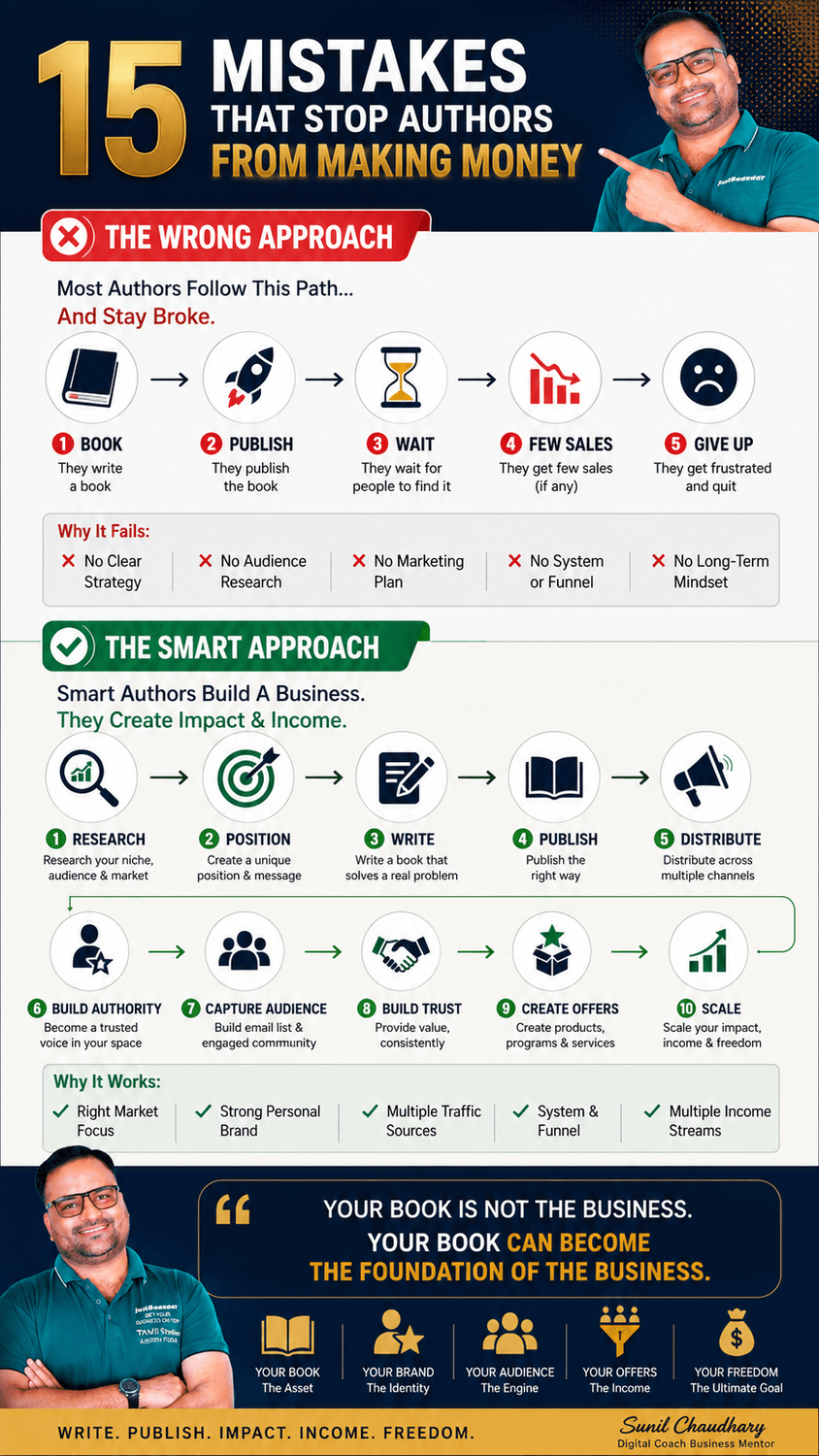
Mistake #1: Writing a Book Nobody Is Looking For
This is one of the biggest mistakes I see aspiring authors make.
They start with:
“What do I want to write about?”
That sounds reasonable.
But it is not always the best starting point for a commercially successful book.
A better question is:
“What problem does my ideal reader desperately want to solve?”
There is a huge difference.
You may be passionate about a subject.
You may have spent 20 years studying it.
You may have hundreds of pages of notes.
But if your target audience does not care about the problem, your book will struggle to gain attention.
This does not mean you should chase trends blindly.
It means you should find the intersection between:
What you know + What people need + What people are actively searching for + What you can uniquely teach
That intersection is powerful.
Mistake #2: Trying to Write for Everyone
Another common mistake is creating a book for an imaginary audience called:
“Everyone.”
A title such as:
“Everything You Need to Know About Success”
may sound broad and impressive.
But broad often becomes invisible.
Compare that with:
“The First-Time Entrepreneur's Guide to Building a Profitable Online Business”
Now we know who the book is for.
A specific reader can immediately think:
“This is for me.”
Specificity creates relevance.
Relevance creates attention.
Attention creates readership.
And readership creates opportunities.
Your book does not need to appeal to everyone.
It needs to become extremely valuable to the right people.
Mistake #3: Confusing Information With Transformation
The internet is already overflowing with information.
Your reader can find thousands of articles.
Millions of videos.
Countless podcasts.
Free courses.
Social media posts.
AI-generated summaries.
So why would someone spend hours reading your book?
Because your book should provide something more valuable than random information.
It should provide clarity, structure, context and transformation.
Information says:
“Here are ten things you should know.”
Transformation says:
“Here is where you are, here is where you want to go, and here is the path between the two.”
That is a completely different experience.
Your book should help the reader think differently, make better decisions or take meaningful action.
The reader should be able to close the book and say:
“I know exactly what I need to do next.”
That is value.
Mistake #4: Writing Without a Strong Position
A weak book tries to repeat everything everyone else has already said.
A powerful book has a point of view.
It says:
“Here is what I believe.”
“Here is what I have learned.”
“Here is what most people misunderstand.”
“Here is the framework I recommend.”
“Here is why this approach works.”
Your perspective is part of your intellectual property.
You do not need to invent facts.
You do not need to make controversial claims just to get attention.
But you do need to develop a clear perspective.
That is what makes your book memorable.
Mistake #5: Writing a Book Instead of Building a Brand
Some authors spend six months writing their book and barely communicate with their audience during that time.
Then they publish.
Suddenly they expect people to care.
But personal authority does not usually appear overnight.
It is built through repeated exposure.
Your audience needs to see you.
Hear you.
Read your ideas.
Understand your philosophy.
Experience your teaching.
And gradually develop trust.
That is why I recommend building your personal brand before, during and after publishing your book.
Your book should be connected to the person behind the book.
If people know you before the launch, the book has an audience waiting.
If people discover you through the book, the book becomes an introduction.
Either way, the relationship matters.
Mistake #6: Believing Publishing Equals Marketing
Publishing makes your book available.
Marketing makes your book discoverable.
These are completely different things.
Imagine opening a beautiful restaurant in the middle of nowhere.
The food may be exceptional.
The interior may be luxurious.
The chef may be world-class.
But if nobody knows the restaurant exists, you will not have a sustainable business.
The same principle applies to books.
Publishing creates availability.
Marketing creates visibility.
SEO creates discoverability.
Content creates attention.
Reviews create social proof.
Email creates relationships.
Partnerships create distribution.
Speaking creates exposure.
Communities create word of mouth.
A serious author needs to think beyond the publishing button.
Mistake #7: Depending Entirely on One Marketplace
Many authors think:
“I published my book on a major marketplace. Now people will find it.”
Sometimes they do.
But you should never assume that a marketplace will build your entire author business for you.
Your long-term asset is not simply your product listing.
Your long-term asset is your audience.
Build your own digital presence.
Create your website.
Build your email database ethically.
Develop your YouTube channel.
Create useful articles.
Build your LinkedIn presence.
Create relationships with relevant communities.
Collect genuine reader feedback.
Develop your author platform.
The more direct relationships you build with your audience, the less dependent you become on any single distribution channel.
Mistake #8: Ignoring Search Intent
This is where SEO becomes extremely important.
People do not always search for your book title.
They search for problems.
They search for questions.
They search for solutions.
Someone may search:
How do I write my first book?
Someone else may search:
How do authors make money?
Another person may search:
How can I publish a book?
Another may search:
How do I become a successful author?
Another may search:
Can a book help me grow my business?
These searches represent different stages of awareness.
A smart author does not create content only around the book title.
They build an entire search ecosystem around the reader's problems.
That is one of the strategies we will explore deeply later in this guide.
Mistake #9: Making the Book Too Promotional
There is another trap.
Once authors understand that their book can generate business, they sometimes turn the entire book into a sales pitch.
That usually destroys trust.
Imagine opening a book expecting valuable education and finding promotional messages on every page.
You would probably stop reading.
Your book should first be a gift of knowledge.
Teach generously.
Share useful frameworks.
Explain difficult concepts.
Provide examples.
Tell relevant stories.
Show the reader how to take action.
Then, when appropriate, invite them to take the next step.
Your commercial opportunity should emerge naturally from your value.
That is a much stronger strategy.
Mistake #10: Having No Next Step for the Reader
Now we come to the opposite problem.
Some authors provide tremendous value but give the reader nowhere to go.
The reader finishes the final chapter and thinks:
“That was useful. Now what?”
This is a missed opportunity.
Your book should have a logical next step.
Perhaps you offer:
A workbook
A checklist
A free masterclass
A newsletter
A community
A podcast
A YouTube channel
A free consultation
A workshop
An online course
A coaching programme
The next step should make sense.
Do not force it.
Guide the reader.
Your book should feel like the beginning of a relationship rather than the end of a transaction.
Mistake #11: Forgetting That Readers Buy Outcomes
People rarely buy a book because they want another object on their shelf.
They buy because they want something.
They want to solve a problem.
They want to become better.
They want to save time.
They want to make money.
They want to reduce uncertainty.
They want inspiration.
They want a shortcut.
They want a framework.
They want a new perspective.
They want a transformation.
Your marketing therefore needs to communicate the outcome, not simply the contents.
Instead of saying:
“This book contains 12 chapters about digital marketing.”
you might communicate:
“Learn how to turn your expertise into a digital business using content, authority and smart systems.”
The second message speaks to the desired outcome.
That is what attracts attention.
Mistake #12: Underestimating the Power of the Book Title
Your book title is not a decoration.
It is a marketing asset.
It has to communicate something important quickly.
A strong title can create curiosity.
A strong subtitle can explain the promise.
Together, they should help the right reader understand:
What is this?
Who is it for?
Why should I care?
This becomes especially important online.
Your title may appear in search results, social media posts, advertisements, videos, podcasts and recommendations.
Your title needs to work in multiple environments.
That is why choosing a book title should involve more than creativity.
It should involve positioning, audience research and market understanding.
Mistake #13: Thinking Short-Term
Some authors want instant results.
They publish a book.
They promote it for two weeks.
Sales are not spectacular.
They stop.
But authority rarely works that way.
A good book can have a much longer life.
You can continue creating content around it.
You can update related articles.
You can speak about its ideas.
You can create videos from its chapters.
You can use its frameworks in workshops.
You can reference it in interviews.
You can build courses from it.
You can create additional editions.
You can translate it for new markets where appropriate.
You can develop companion products.
You can keep discovering new readers.
That is why I think about a book as a long-term intellectual asset.
Mistake #14: Not Building a Distribution System
Writing is creation.
Distribution is multiplication.
You can write the greatest book in your niche, but if nobody encounters it, its impact will remain limited.
A serious author therefore needs a distribution strategy.
Think about distribution across multiple channels:
Search
Create articles that answer questions your ideal readers are asking.
YouTube
Turn your ideas into educational videos.
Social Media
Break your frameworks into short-form content.
Build a direct relationship with interested readers.
Podcasts
Discuss the problems and ideas explored in your book.
Speaking
Present your ideas to relevant audiences.
Partnerships
Collaborate with people who already serve your ideal reader.
Communities
Participate meaningfully where your audience already gathers.
The goal is simple:
Put your ideas where your ideal readers already spend their attention.
Mistake #15: Measuring Only Book Sales
This is perhaps one of the most important mistakes.
Suppose your book sells 500 copies.
Is that good or bad?
We cannot answer without context.
What if those 500 readers include:
50 potential clients?
20 corporate decision-makers?
10 speaking opportunities?
5 consulting clients?
100 newsletter subscribers?
30 podcast invitations?
15 partnership opportunities?
Suddenly, the economics look completely different.
This is why I recommend measuring the business impact of the book, not only the number of copies sold.
Track metrics such as:
Book sales
Website traffic
Email subscribers
Content engagement
Qualified leads
Speaking invitations
Consultation requests
Course enrollments
Coaching clients
Partnership opportunities
Revenue influenced by the book
This gives you a much more complete picture.
The Author Wealth Equation
I want to give you a simple mental model.
Think of your publishing business as:
Knowledge × Positioning × Book × Distribution × Trust × Offers × Systems = Business Opportunity
If one element is extremely weak, the entire system becomes weaker.
You can have brilliant knowledge.
But without positioning, people may not understand it.
You can have excellent positioning.
But without a useful book, trust may not develop.
You can have a great book.
But without distribution, people may never discover it.
You can have attention.
But without trust, people may not take action.
You can have trust.
But without relevant offers, there may be no commercial pathway.
And you can have offers.
But without systems, growth may remain dependent on your personal time.
That is why becoming a successful author in the digital economy requires a broader mindset.
The Shift I Want You to Make
Stop thinking:
“I want to write a book.”
Start thinking:
“I want to build an intellectual asset.”
Stop thinking:
“I want to sell copies.”
Start thinking:
“I want to build relationships with readers.”
Stop thinking:
“I need a publisher.”
Start thinking:
“I need a publishing and distribution strategy.”
Stop thinking:
“I need to become famous.”
Start thinking:
“I need to become useful to a clearly defined audience.”
And stop thinking:
“How can I make money from my book?”
Start thinking:
“How can my book create value, authority, relationships, opportunities and multiple ethical revenue streams?”
That shift in thinking can change everything.
The Book Is the Asset. The Ecosystem Is the Engine.
Here is the principle I want you to carry into every remaining section of this guide:
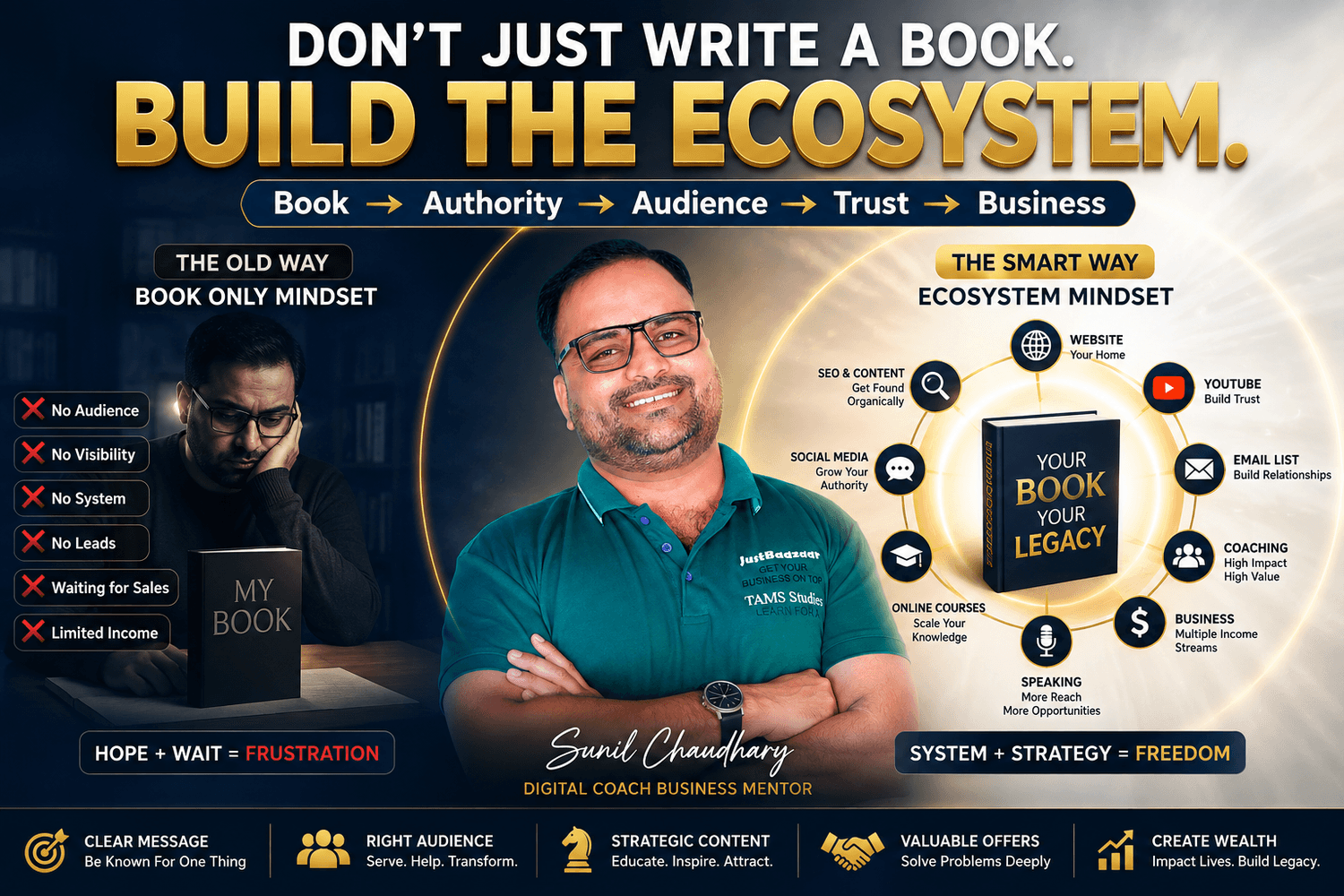
A book can create authority. An ecosystem can create leverage.
Your book is the intellectual asset.
Your personal brand gives it identity.
Your website gives it a home.
Your content gives it reach.
Your SEO gives it discoverability.
Your email list gives you relationships.
Your products and services give your expertise a commercial pathway.
Your systems give the business scalability.
And your audience gives the entire ecosystem momentum.
That is how publishing can become much bigger than publishing.
That is how an author can evolve into a knowledge entrepreneur.
And that is how your book can become one of the most valuable assets you have ever created.
Section 3: Action Plan
Before you move forward, take 15 minutes and answer these questions:
Who is the ideal reader for my book?
What major problem does this reader want to solve?
What transformation do I want to create?
What is my unique point of view?
What framework or methodology can I teach?
What content channels will support my book?
What will be the next step after someone reads it?
What business opportunities could naturally emerge from my expertise?
Do not worry if you do not have perfect answers yet.
The purpose is to start thinking like an author and an entrepreneur.
Because if your goal is simply to publish a book, you need a manuscript.
But if your goal is to publish a book and get rich, you need a strategy.
Key Takeaway
Most authors focus on writing the book. Successful knowledge entrepreneurs build the ecosystem around the book.
The difference is enormous.
Your book should not merely communicate what you know.
It should help people understand your expertise, experience your thinking, trust your approach and discover how you can help them further.
That is how a book can become more than a publication.
It can become a personal-brand asset, authority engine, lead-generation tool, content engine and business catalyst.
And once you understand that, you are ready for the next question:
What should you actually write about if you want your book to attract readers, build authority and create commercial opportunities?
That is where we go next.
How to Choose a Book Topic That Can Attract Readers and Create Wealth
Before you write a single chapter, there is one decision that can determine the future of your book.
What will you write about?
This sounds simple.
It is not.
Your book topic can influence everything that comes after it.
It can influence who discovers you.
It can influence how easily you market the book.
It can influence your SEO opportunities.
It can influence your authority.
It can influence the products and services you can build around the book.
And ultimately, it can influence whether your book becomes a forgotten publication or a valuable intellectual asset.
That is why I do not recommend starting with:
“I want to write a book.”
Start with:
“I want to solve a meaningful problem for a specific group of people.”
Once you understand that principle, choosing your topic becomes much easier.
Your Best Book Topic Is Usually Hiding Inside Your Expertise
You do not necessarily need to become an expert in something completely new to write a valuable book.
In many cases, your best topic is already inside your experience.
Think about the questions people repeatedly ask you.
What do clients ask you for help with?
What problems have you solved?
What mistakes have you made?
What have you learned through experience?
What processes have you developed?
What transformation have you personally experienced?
What do people compliment you for?
What subject can you discuss for hours without getting bored?
These questions can reveal your potential book topic.
Your life and career are already carrying raw material.
You simply need to identify the most valuable part of it.
Start With a Problem, Not a Title
One of the biggest mistakes aspiring authors make is beginning with a catchy title.
They think:
“I need a powerful book title.”
Not yet.
First, identify the problem.
For example:
Instead of starting with:
“The Digital Entrepreneur”
start with:
“Why do experts struggle to turn their knowledge into a profitable online business?”
Now you have a problem.
From that problem, you can explore solutions.
You can research the audience.
You can understand the competition.
You can identify search queries.
You can develop frameworks.
And eventually, you can create a compelling title.
The title should emerge from the value proposition, not replace it.
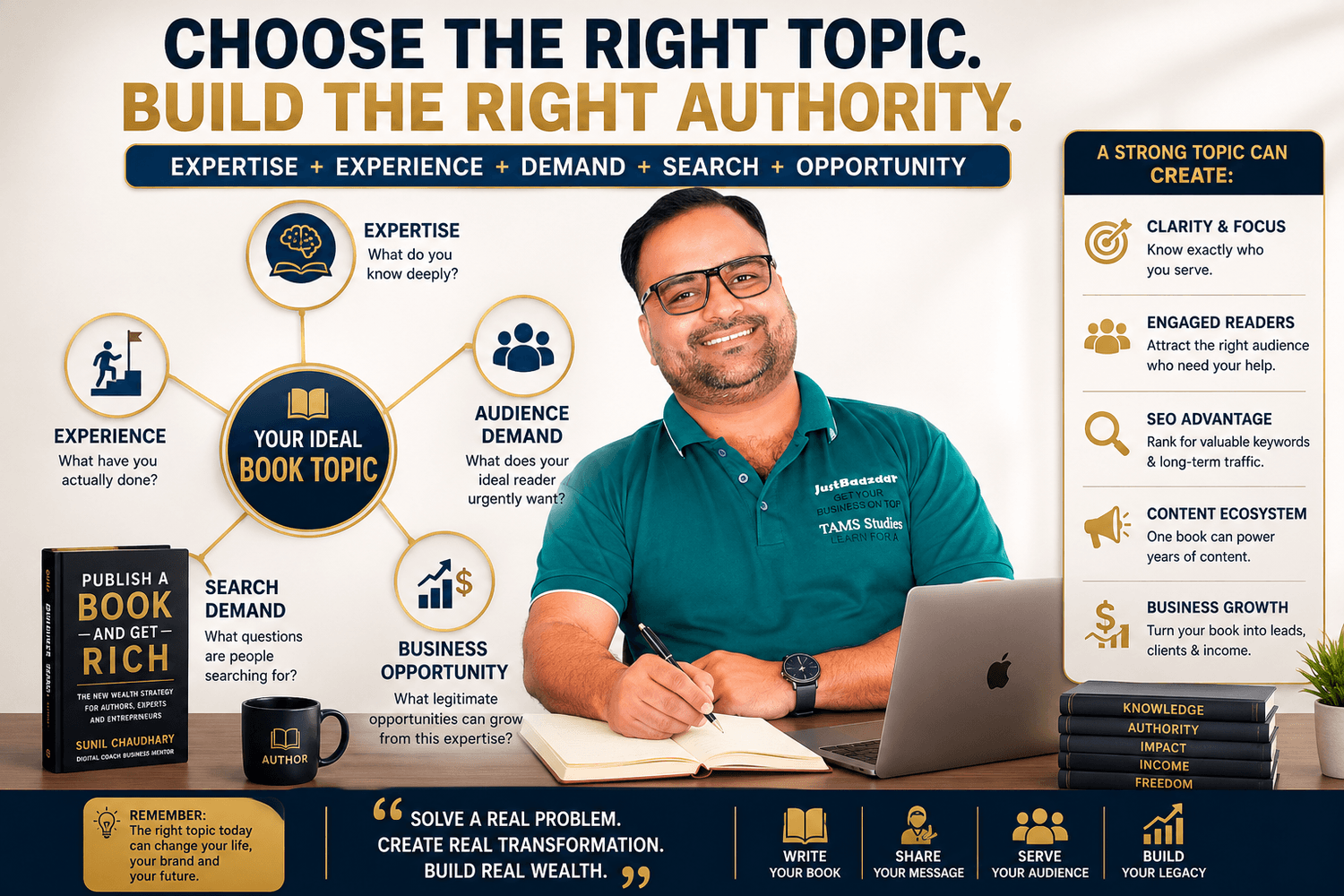
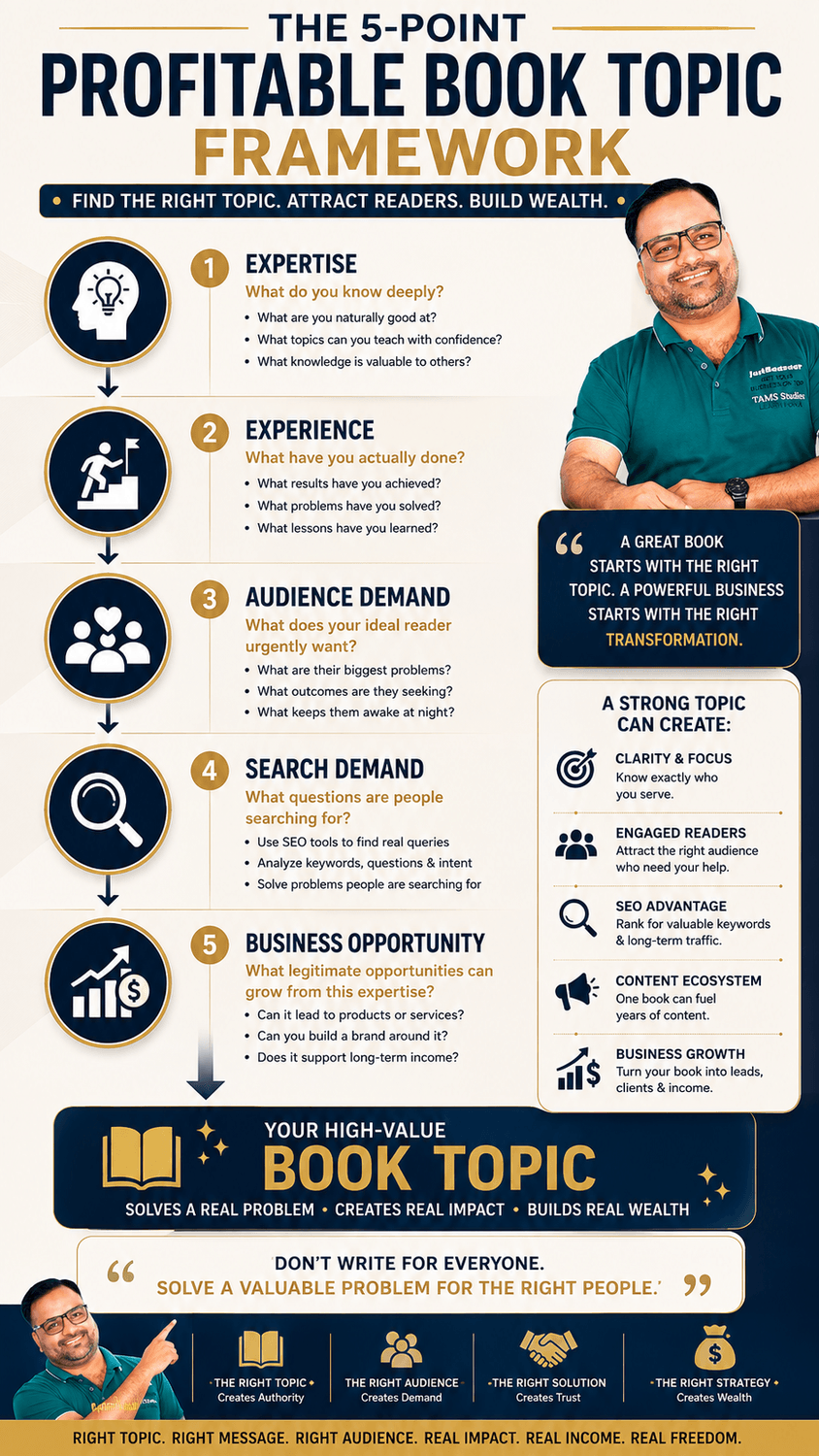
The Five-Part Book Topic Formula
Here is a simple framework I recommend.
Your ideal topic should sit at the intersection of five elements:
1. Your Expertise
What do you genuinely know?
2. Your Experience
What have you actually done?
3. Audience Demand
What do people want help with?
4. Search Demand
What are people actively searching for online?
5. Commercial Opportunity
Can solving this problem naturally lead to products, services, partnerships or other legitimate business opportunities?
When these five elements overlap, you may have a very strong book opportunity.
Think of it like this:
Expertise + Experience + Demand + Search + Commercial Relevance = Strong Book Topic
You do not need every element to be perfect.
But the more overlap you have, the stronger your foundation becomes.
Choose a Topic That Solves a Real Problem
People have unlimited things they could read.
So why should they choose your book?
Because your book promises to help them achieve something they care about.
That could be:
Making money
Saving money
Saving time
Building a business
Finding a career
Improving relationships
Becoming healthier
Learning a skill
Becoming more productive
Building confidence
Understanding technology
Solving a professional problem
Avoiding expensive mistakes
Achieving a personal transformation
The specific problem depends on your niche.
But the principle remains the same.
People pay attention to problems that matter to them.
Your job as an author is to identify those problems accurately.
Pain Is Not Enough. Look for Desire.
There is an important distinction here.
People do not only want to escape problems.
They also want to move toward desirable outcomes.
For example, someone may want to escape:
“I am not getting clients.”
But their deeper desire might be:
“I want a predictable flow of qualified clients.”
Someone may want to escape:
“I hate my job.”
But their deeper desire might be:
“I want meaningful work and financial independence.”
Someone may want to escape:
“Nobody knows my brand.”
But their deeper desire might be:
“I want to become recognised as an authority in my field.”
A powerful book connects the current problem with the desired future.
It tells the reader:
Here is where you are.
Here is where you want to go.
Here is the path.
That creates a much stronger promise.
The Three Levels of a Book Topic
I like to look at book topics at three different levels.
Level 1: The Broad Category
This is your overall field.
For example:
Business
Marketing
Leadership
Personal Development
Health
Education
Finance
Technology
Spirituality
The broad category gives you context.
But it is usually too wide to become a highly differentiated book by itself.
Level 2: The Specific Problem
Now narrow it down.
Instead of:
Business
you might choose:
Building an online business as an expert.
Instead of:
Marketing
you might choose:
Generating leads through SEO and content.
Instead of:
Leadership
you might choose:
Building leadership skills for first-time managers.
Now your book has direction.
Level 3: The Transformation
This is where things become much more powerful.
Instead of merely teaching:
“How SEO works.”
you could create a transformation around:
“How experts can use SEO to build a predictable organic lead-generation system.”
Now the reader can see the destination.
That is what makes a topic commercially and emotionally stronger.
The One-Sentence Topic Test
Before committing to your book topic, try completing this sentence:
“This book helps [specific audience] achieve [specific outcome] without [major obstacle].”
For example:
“This book helps coaches build a consistent online lead-generation system without depending entirely on paid advertising.”
Or:
“This book helps first-time entrepreneurs turn their expertise into a profitable digital business without building a complicated technology stack.”
Or:
“This book helps professionals build a personal brand that attracts opportunities without becoming full-time social media influencers.”
If you cannot complete this sentence clearly, your topic may still be too broad.
Search for Questions, Not Just Keywords
This is where SEO can dramatically improve your book research.
Do not simply ask:
“What keywords are related to my topic?”
Ask:
“What questions are people asking about this problem?”
Questions often reveal intent.
For example, if your topic is book publishing, people may search for:
How do I publish a book?
How much does it cost to publish a book?
How do authors make money?
How can I sell more books?
Should I self-publish?
How do I market my first book?
How do I become an author?
Can writing a book help my business?
How do I write a book for my personal brand?
How can I turn my knowledge into a book?
Every question represents a potential content opportunity.
And eventually, these questions can become chapters, subsections, articles, videos and social media content.
That is how one book can create an entire content ecosystem.
Your Book Can Become a Keyword Universe
This is a concept I want you to understand if you want your book to support your digital business.
Do not think of your book as targeting one keyword.
Think of it as creating a topic universe.
Suppose your book is about building a digital coaching business.
Your broader topic universe could include:
Digital coaching
Online coaching business
Personal branding
Lead generation
Sales funnels
Email marketing
SEO
Content marketing
YouTube marketing
Online courses
Business automation
Client acquisition
Coaching offers
Knowledge entrepreneurship
Each of these can become its own content cluster.
Your book provides the intellectual foundation.
Your website provides the searchable content.
Your videos provide visual education.
Your social media provides distribution.
Your email provides relationship-building.
This is how your book can support your SEO strategy rather than existing separately from it.
Find the Intersection Between Passion and Demand
Should you write about something you love?
Absolutely.
But passion alone is not enough.
You also need relevance.
Imagine someone is incredibly passionate about a very narrow topic but there is almost no audience for it.
They may enjoy writing the book.
But building a large business around it could be difficult.
Now imagine another person chooses a topic purely because it is popular.
There is huge demand.
But they have no expertise, no experience and no genuine interest.
The result may be shallow content.
The ideal position is somewhere in the middle.
Passion gives you energy.
Expertise gives you credibility.
Demand gives you an audience.
Positioning gives you differentiation.
Distribution gives you reach.
Business design gives you monetisation opportunities.
That is the combination you want.
Don't Chase Trends Blindly
Trends can create attention.
But a book can live for years.
That means you should be careful about choosing a topic purely because it is currently fashionable.
Ask yourself:
Will this problem still matter three years from now?
Will people still search for this solution five years from now?
Can I continue developing this expertise?
Can this topic support future content?
Can I build additional products around it?
Can I become known for this subject?
A strong evergreen topic can continue generating opportunities long after the initial publication.
That is one of the reasons books can be such powerful long-term assets.
Look for Evergreen Problems
Some problems never disappear.
People will continue wanting:
More customers
Better careers
More financial security
Better relationships
Better health
More confidence
Better leadership
More productivity
Better communication
Greater freedom
Stronger businesses
Technology may change.
Platforms may change.
Algorithms may change.
But fundamental human problems often remain.
That creates an opportunity for authors.
You can combine an evergreen problem with modern methods.
For example:
Evergreen problem: How to build a successful business.
Modern method: Using AI, automation, content and digital platforms.
This gives your book both durability and contemporary relevance.
Your Experience Can Become Your Differentiator
There may already be hundreds of books about your topic.
That does not automatically mean you should abandon the idea.
Ask a better question:
What can I contribute that is genuinely useful and distinct?
Your differentiation may come from:
Your experience
Your framework
Your case studies
Your methodology
Your mistakes
Your stories
Your cultural perspective
Your industry experience
Your teaching style
Your research
Your unique combination of skills
For example, there may be thousands of books about marketing.
But perhaps your perspective combines:
SEO + personal branding + coaching + automation + AI + knowledge entrepreneurship.
That combination creates a different intellectual position.
You do not have to invent a completely new subject.
Sometimes you simply need to create a new and useful way of connecting existing ideas.
Use Your Past Failures
This is one of the most underused sources of book ideas.
Your failures may contain some of your most valuable lessons.
Think about:
What did you try that did not work?
What mistake cost you money?
What decision would you make differently today?
What took you years to understand?
What problem did you repeatedly face?
What advice would you give your younger self?
What painful lesson could save someone else years of frustration?
These experiences can become powerful chapters.
Because readers do not only want polished theories.
They want wisdom that has been tested by reality.
When you share your experience honestly, you can make your teaching more human and memorable.
Build a Book Around a Framework
One of the strongest ways to differentiate a book is to develop a clear framework.
A framework turns scattered knowledge into a system.
For example:
The 7-Step Author Wealth Framework
Discover
Position
Research
Write
Publish
Distribute
Monetise
Now you have something that can become bigger than the book.
The framework can become:
A book chapter.
A webinar.
A workshop.
A presentation.
A YouTube series.
An infographic.
A course.
A coaching methodology.
A diagnostic assessment.
A lead magnet.
This is intellectual leverage.
One strong framework can create an entire ecosystem of content and products.
The Million-Dollar Question
Here is the question I want you to ask before selecting your final topic:
“If this book becomes successful, what do I want to be known for?”
Do not rush past this.
Think deeply.
Because your book can influence your personal brand for years.
If your book becomes popular around a particular subject, people may begin associating your name with that subject.
That association can become incredibly valuable.
You are not merely choosing a topic.
You are choosing a position in the market.
The Book Topic Profitability Test
Before you commit, score your idea from 1 to 10 across these areas:
Factor
Score
My expertise
/10
My experience
/10
Audience demand
/10
Search demand
/10
Problem urgency
/10
Transformation potential
/10
Competition opportunity
/10
Personal differentiation
/10
Content opportunities
/10
Business opportunities
/10
You do not need a perfect score.
But if your idea scores extremely low across several categories, pause before investing months into writing it.
Your goal is not to find a topic that is merely interesting.
Your goal is to find a topic that is:
Useful + Relevant + Searchable + Differentiated + Sustainable + Commercially meaningful
The Best Topic Is the One You Can Own
I want you to think beyond one book.
Imagine that your topic becomes your category.
You publish a book.
Then you create articles.
Then videos.
Then podcasts.
Then workshops.
Then courses.
Then coaching.
Then speaking.
Then a community.
Then additional books.
You gradually become associated with the subject.
That is how authority compounds.
The goal is not:
“I wrote a book about this topic.”
The bigger goal is:
“I became one of the people the market thinks about when this problem comes up.”
That is a much more valuable position.
Your Book Should Open a Door
When I think about publishing a book strategically, I do not see the book as a wall.
I see it as a door.
A door into your thinking.
A door into your expertise.
A door into your story.
A door into your methodology.
A door into your personal brand.
And, if the reader wants deeper help, a door into your business.
But the door only works when it leads somewhere valuable.
That is why topic selection matters so much.
Choose a topic that gives you enough depth to teach.
Choose a topic your audience genuinely cares about.
Choose a topic where you can provide a distinct perspective.
Choose a topic that gives you room to build.
Choose a topic you can continue discussing for years.
And most importantly, choose a topic that allows you to serve the reader before you sell anything.
That is the foundation of ethical authority.
My Simple Rule for Choosing a Book Topic
If you remember only one formula from this section, remember this:
Write about a problem you understand deeply, for people who care deeply about solving it, using a method you can explain clearly.
Then add one more layer:
Build your business around the transformation, not merely around the book.
That is where the real opportunity lies.
Your book becomes the intellectual asset.
Your content becomes the distribution engine.
Your personal brand becomes the trust layer.
Your audience becomes the community.
Your offers become the transformation pathway.
And your business becomes the economic engine.
That is how a book can become much more than a book.
Your Section 4 Action Plan
Before you write your first chapter, complete these ten statements:
1. My ideal reader is:
2. Their biggest problem is:
3. Their desired outcome is:
4. I have experience solving this problem because:
5. My unique perspective is:
6. My book will teach this framework:
7. The most important transformation will be:
8. The major questions my readers have are:
9. My book can support these content channels:
10. After reading my book, I want readers to:
Do not underestimate this exercise.
A clear topic can save you hundreds of hours later.
A vague topic can create months of confusion.
Key Takeaway
Do not choose a book topic because you want to write about it. Choose it because you have something valuable to teach about a problem that matters to a specific audience.
The strongest book topics sit at the intersection of:
Expertise.
Experience.
Demand.
Search intent.
Transformation.
Differentiation.
Business opportunity.
Once you find that intersection, you are no longer simply choosing a book topic.
You are choosing the foundation of your author brand and knowledge business.
And now comes the next major question.
You know what problem you want to solve.
But who exactly are you writing for?
Because the more clearly you understand your reader, the easier it becomes to write the title, subtitle, chapters, examples, content, marketing strategy and offers.
That is what we will solve next.
Know Your Ideal Reader Before You Write Your Book
If you want to publish a book and get rich, there is one question you cannot afford to ignore:
Who exactly are you writing for?
Not “everyone.”
Not “people who want success.”
Not “business owners.”
Not “young people.”
Not even simply “entrepreneurs.”
I want you to become much more specific.
Because the more clearly you understand your ideal reader, the easier it becomes to write a useful book, create a compelling title, design your chapters, produce content, build an audience and eventually create a business around your expertise.
Your reader should not feel that your book was written for the entire internet.
They should feel:
“This author understands me.”
That feeling is incredibly powerful.
Your Reader Is Not a Number
When people talk about an “ideal customer,” they often reduce the person to demographics.
Age.
Gender.
Location.
Income.
Profession.
Education.
These details can be useful.
But they are not enough.
If you want to write a powerful book, you need to understand the person behind the profile.
What are they trying to achieve?
What are they afraid of?
What frustrates them?
What have they already tried?
What do they believe?
What do they doubt?
What do they secretly want?
What prevents them from taking action?
What would success mean to them?
These questions take you much deeper.
And that deeper understanding can completely change the way you write.
Write to One Person
Here is one of the simplest writing principles I can give you:
Write to one person, even if you eventually want to reach millions.
Imagine one ideal reader sitting across the table from you.
You are having coffee.
They tell you their biggest problem.
You listen.
Then they ask:
“What should I do?”
Now you start explaining.
That conversation is the foundation of your book.
You are not writing for an abstract audience.
You are helping a real human being move from one situation to another.
That makes your writing more natural.
It also makes your examples more relevant.
And when the right readers discover your book, they can feel that relevance.
The “Dear Reader” Test
Before writing your first chapter, complete this sentence:
“I am writing this book for a person who…”
Then continue.
For example:
“I am writing this book for a coach who has valuable knowledge but does not know how to turn that knowledge into a predictable digital business.”
Or:
“I am writing this book for an experienced professional who wants to build a personal brand but feels overwhelmed by content, technology and online marketing.”
Or:
“I am writing this book for an aspiring author who wants to use a book not only to generate royalties but also to build authority and create new business opportunities.”
Notice what happens.
Suddenly, the book becomes more focused.
You know who you are talking to.
And when you know who you are talking to, you can make better decisions about almost everything else.
Understand the Reader's Current Situation
Your ideal reader has a starting point.
Perhaps they are confused.
Perhaps they are frustrated.
Perhaps they are inexperienced.
Perhaps they have tried several solutions already.
Perhaps they have achieved some success but want to reach the next level.
Your job is to understand that starting point.
Ask:
What does my reader know today?
Do they understand the basics?
Are they beginners?
Are they intermediate?
Are they experienced?
What have they already tried?
Books?
Courses?
YouTube videos?
Coaches?
Consultants?
Free resources?
What went wrong?
Did they lack consistency?
Did they lack strategy?
Did they lack money?
Did they lack confidence?
Did they lack knowledge?
Did they lack implementation?
What do they believe is stopping them?
And perhaps most importantly:
Is that belief actually correct?
This last question can create some of your most powerful chapters.
Understand Where Your Reader Wants to Go
Now turn the question around.
Your reader does not simply want to escape a problem.
They want to reach somewhere better.
Perhaps they want:
More income.
More freedom.
More recognition.
More confidence.
More clients.
More influence.
More knowledge.
More opportunities.
More impact.
Your book should help connect their current reality with their desired future.
Think of your book as a bridge.
Current Situation
“I have knowledge but no audience.”
↓
Desired Situation
“I am recognised as an authority and attract the right opportunities.”
Your book explains how to cross the bridge.
That is transformation.
The Reader's Pain, Desire and Fear
A useful way to understand your ideal reader is to look at three dimensions.
Pain
What is frustrating them today?
Perhaps they are struggling to get clients.
Perhaps they are not earning enough.
Perhaps they feel invisible.
Perhaps they have knowledge but no platform.
Perhaps they have written content but nobody reads it.
Desire
What do they really want?
Perhaps they want financial freedom.
Perhaps they want recognition.
Perhaps they want a successful business.
Perhaps they want to become an authority.
Perhaps they want their ideas to reach a global audience.
Fear
What are they afraid will happen if nothing changes?
Perhaps they will waste more years.
Perhaps they will remain unknown.
Perhaps competitors will move ahead.
Perhaps their knowledge will never reach the people who need it.
Perhaps they will remain trapped in a career they no longer enjoy.
These three dimensions can become powerful sources of writing material.
Your Reader Has a “Before” Story
Every transformation has a before and after.
The before story is where your reader currently lives.
It may sound like:
“I have an idea but don't know where to start.”
“I have expertise but no audience.”
“I have a book but no sales.”
“I have content but no clients.”
“I have a business but no predictable growth.”
“I want to become an author but I feel overwhelmed.”
These statements are valuable.
Why?
Because they help you understand the language your audience uses.
And that language matters.
Use the Reader's Own Language
This is especially important for SEO.
Search engines increasingly try to understand the meaning and intent behind queries.
Your readers, meanwhile, search using ordinary language.
They may not search:
“How can I develop an intellectual-property-driven authority ecosystem?”
They may search:
“How can I make money from my knowledge?”
They may search:
“How do authors make money?”
They may search:
“How can I publish my first book?”
They may search:
“How can I become a successful author?”
The language of your audience can therefore inform:
Your title
Your subtitle
Your headings
Your FAQs
Your examples
Your blog content
Your videos
Your social posts
Your calls to action
This is where audience research and SEO research begin working together.
Build a Reader Language Bank
I recommend creating a simple document before writing your book.
Call it:
The Reader Language Bank
Whenever you discover something your audience says, add it.
For example:
“I don't know what to write about.”
“I don't have an audience.”
“I don't know how to market my book.”
“I don't know whether self-publishing is worth it.”
“I want to write a book, but I don't have time.”
“I have expertise, but I don't know how to turn it into a business.”
These statements can become chapter ideas.
They can become FAQ questions.
They can become YouTube titles.
They can become social media hooks.
They can even become future books.
One audience insight can therefore create enormous amounts of content.
Your Reader's Questions Are Your Chapter Ideas
This is one of the most practical strategies I want you to use.
Instead of randomly brainstorming chapters, ask:
What questions would my ideal reader ask me?
Then write those questions down.
For example:
How do I choose a book topic?
How do I know whether people want this book?
How long should my book be?
How do I structure the chapters?
Should I self-publish?
How much should I charge?
How do I market the book?
How do I get reviews?
How can I use SEO to promote my book?
How can I build a business around my book?
Now you have the raw material for your table of contents.
Your audience is effectively telling you what to write.
The Reader Awareness Ladder
Not every reader starts at the same level of awareness.
Some people already know exactly what they need.
Others do not even understand their problem.
This matters enormously.
I think about readers in five stages.
Stage 1: Unaware
They do not realise they have a problem.
Stage 2: Problem Aware
They know something is wrong but do not know how to solve it.
Stage 3: Solution Aware
They know solutions exist and are researching options.
Stage 4: Method Aware
They understand specific approaches and are comparing them.
Stage 5: Decision Ready
They are looking for the right person, product or solution.
A strong book can serve multiple stages.
However, you should know which stage represents your primary reader.
That will influence your language, examples and calls to action.
Why This Matters for Your Business
Now we come to the commercial side.
Suppose your reader is a beginner.
Your introductory course may be appropriate.
But suppose your reader is already an experienced business owner.
They may need something completely different.
Perhaps they need consulting.
Perhaps they need strategic implementation.
Perhaps they need advanced coaching.
Your book therefore helps you understand not only who your reader is, but also what they may need next.
This is why audience clarity is so important for building a knowledge business.
The book is not merely attracting people.
It is helping you understand the people you are attracting.
Don't Build Your Business Around Everyone
There is a temptation to say:
“I want everyone to buy my book.”
I understand the desire.
But strategically, it can create problems.
If you try to appeal to everyone, your message becomes generic.
And generic messages are difficult to remember.
Instead, become extremely valuable to a clearly defined group.
You can expand later.
Start narrow.
Become known.
Build authority.
Develop proof.
Then broaden your reach.
This is often much more effective than trying to become everything to everyone from day one.
The “Only If” Test
Here is a useful test.
Complete this sentence:
“This book is only for you if…”
For example:
“This book is only for you if you already have valuable expertise and want to turn it into a scalable digital business.”
Or:
“This book is only for you if you want to build an author brand rather than simply publish a manuscript.”
This may feel restrictive.
But it creates positioning.
The right people lean in.
The wrong people move on.
And that is perfectly fine.
Your Ideal Reader Profile
Create a detailed profile.
You can use the following template.
Reader Identity
Name: Give your ideal reader a fictional name.
Age range: Relevant range.
Profession: What do they do?
Experience: Beginner, intermediate or advanced?
Location: Local, national or global?
Income level: Approximate business or career context.
Current Situation
What are they struggling with?
Desired Future
What do they want to achieve?
Main Problems
What are their biggest obstacles?
Emotional Frustrations
What makes them feel stuck?
Desired Transformation
What would success look like?
Buying Triggers
What makes them finally take action?
Objections
What makes them hesitate?
Search Behaviour
What questions do they type into Google or other search engines?
Content Preferences
Do they prefer videos, articles, books, podcasts, communities or courses?
Next Step
What would they logically need after reading your book?
This profile becomes your compass.
Talk to Real People
There is only so much you can discover from imagination.
If you have access to your target audience, talk to them.
Ask questions.
Listen carefully.
Do not immediately pitch.
Do not interrupt.
Do not try to prove how smart you are.
Just listen.
Ask:
What is your biggest challenge right now?
What have you already tried?
What frustrates you most?
What would you love to achieve?
What stops you from taking action?
What would make a book on this subject genuinely useful to you?
The answers can be incredibly valuable.
Sometimes your audience will give you the exact words you need for your title, chapters and marketing.
Study Communities and Conversations
Your audience is already talking somewhere.
They may be discussing their problems in:
Online communities
Professional networks
YouTube comments
Podcast discussions
Reviews
Forums
Social media
Industry groups
Question-and-answer platforms
Study those conversations.
Look for repeated questions.
Look for frustration.
Look for confusion.
Look for objections.
Look for language.
Look for gaps.
You are not copying anyone.
You are conducting market research.
Your goal is to understand what people actually need.
Reviews Can Reveal What Readers Want
Another powerful research source is book reviews.
Look at books in your category.
Study what readers praise.
Study what they criticise.
What did they find useful?
What did they find confusing?
What did they wish the author had included?
What felt repetitive?
What felt too theoretical?
What was missing?
These observations can help you create a better reader experience.
The goal is not to imitate competing books.
The goal is to understand the market and identify opportunities to serve readers better.
Your Book Should Respect the Reader's Time
One of the most valuable things you can give your reader is clarity.
People are busy.
They do not want unnecessary complexity.
They do not want repetitive explanations.
They do not want 20 pages of introduction before reaching the useful material.
Every chapter should have a reason to exist.
Every story should contribute something.
Every framework should clarify.
Every example should teach.
Every exercise should move the reader forward.
Your reader should feel that you respect their time.
That respect builds trust.
Give Your Reader Small Wins
A good book does not have to wait until the final chapter to create value.
Give your reader small wins throughout the journey.
For example:
After Chapter 1, they define their goal.
After Chapter 2, they identify their audience.
After Chapter 3, they choose their topic.
After Chapter 4, they create their positioning statement.
After Chapter 5, they build their outline.
Now the reader is progressing.
They are not simply consuming information.
They are implementing.
And implementation creates a stronger connection with the author.
Turn Your Reader Into the Hero
This is an important mindset shift.
Your book is not supposed to make you the hero.
Your reader is the hero.
You are the guide.
Think about the difference.
Weak positioning:
“Look at everything I have achieved.”
Strong positioning:
“Here is what I learned, and here is how you can use it to achieve your own goal.”
Your experience matters.
Your credentials matter.
Your stories matter.
But they should ultimately serve the reader.
That is how authority becomes useful rather than merely impressive.
The Reader Journey
I recommend designing your book as a journey.
Beginning
“I am confused and want answers.”
↓
Understanding
“Now I understand the real problem.”
↓
Clarity
“Now I know what I need to do.”
↓
Action
“I have a plan.”
↓
Progress
“I am getting results.”
↓
Transformation
“I now think and act differently.”
That is what a great book can accomplish.
It does not merely fill pages.
It changes the reader.
Your Reader Determines Your Message
This is why I keep coming back to the same principle:
Know your reader before you write your book.
Your reader determines your examples.
Your reader influences your language.
Your reader shapes your chapter structure.
Your reader informs your SEO strategy.
Your reader influences your title.
Your reader determines the most useful resources.
Your reader influences your CTA.
Your reader ultimately determines whether your book feels relevant.
When you understand the person deeply, writing becomes easier.
You stop asking:
“What should I write?”
And start asking:
“What does my reader need next?”
That is a much better question.
The Reader-First Author Wealth Formula
Here is the framework I want you to remember:
Understand the Reader
↓
Solve the Right Problem
↓
Create the Right Book
↓
Build Trust
↓
Attract the Right Audience
↓
Create the Right Next Step
↓
Build the Right Business
This is how audience understanding connects to wealth creation.
Not through manipulation.
Not through exaggerated promises.
Not through aggressive selling.
Through relevance, value, trust and transformation.
Your Section 5 Action Plan
Before moving to the next section, create your Ideal Reader Profile.
Write down:
My ideal reader is:
They currently struggle with:
They desperately want:
They have already tried:
They are afraid that:
They believe their biggest obstacle is:
Their real obstacle may actually be:
They are searching for:
My book will help them:
After reading my book, their next logical step is:
Now read your answers.
If you can clearly picture the person, you are ready for the next stage.
If you cannot, do more research.
Because a book written for nobody will struggle to become important to anybody.
Key Takeaway
Do not write a book for an audience. Write a book for a person.
Understand their current reality.
Understand their desired future.
Understand their questions.
Understand their fears.
Understand their language.
Understand their search behaviour.
Understand their objections.
Then build your book around helping them move forward.
When readers feel understood, they pay attention.
When they receive genuine value, they build trust.
When they trust you, they become more open to your ideas.
And when your book delivers a meaningful transformation, it can become the beginning of a much deeper relationship.
That is the foundation of an author brand that can grow far beyond book sales.
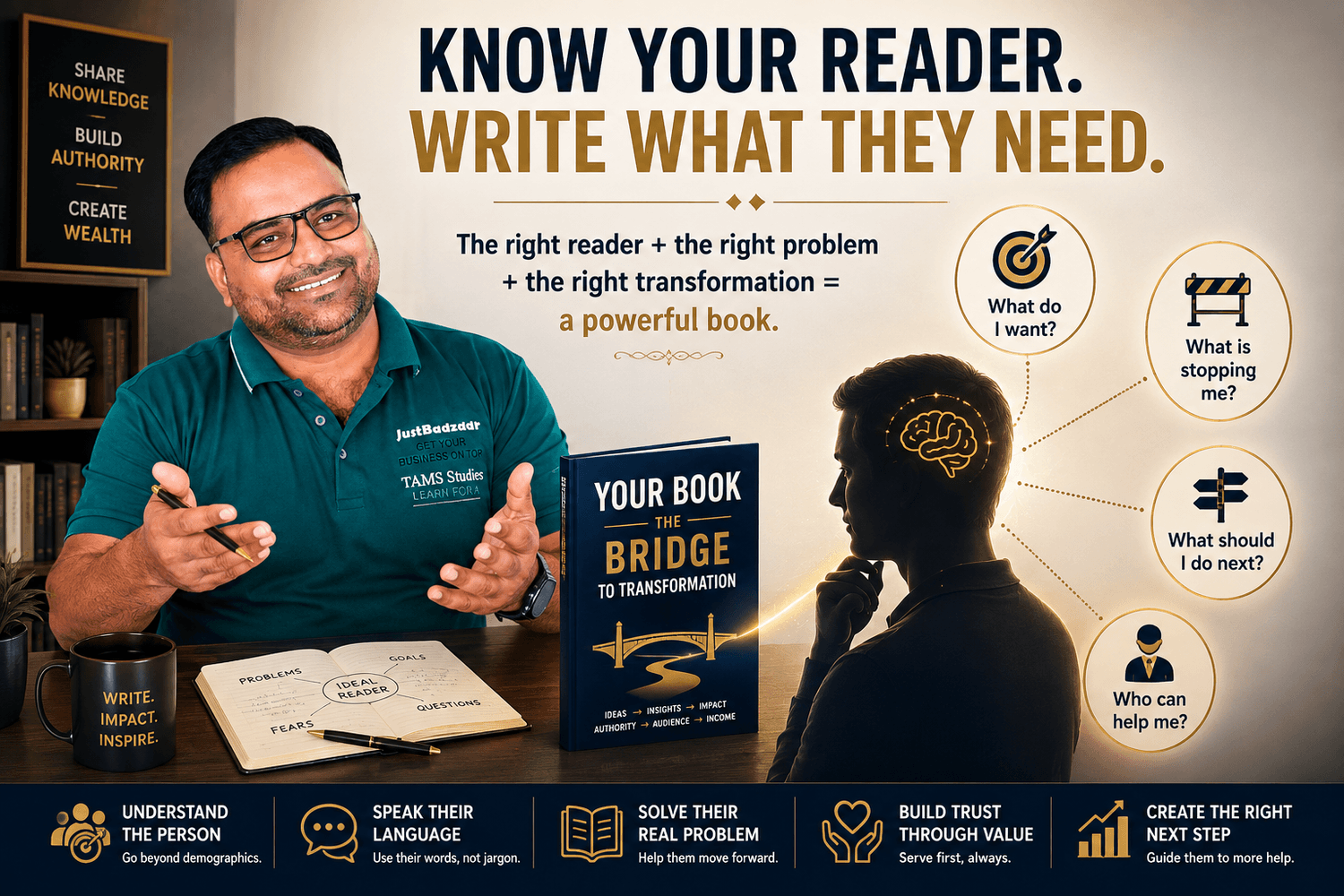
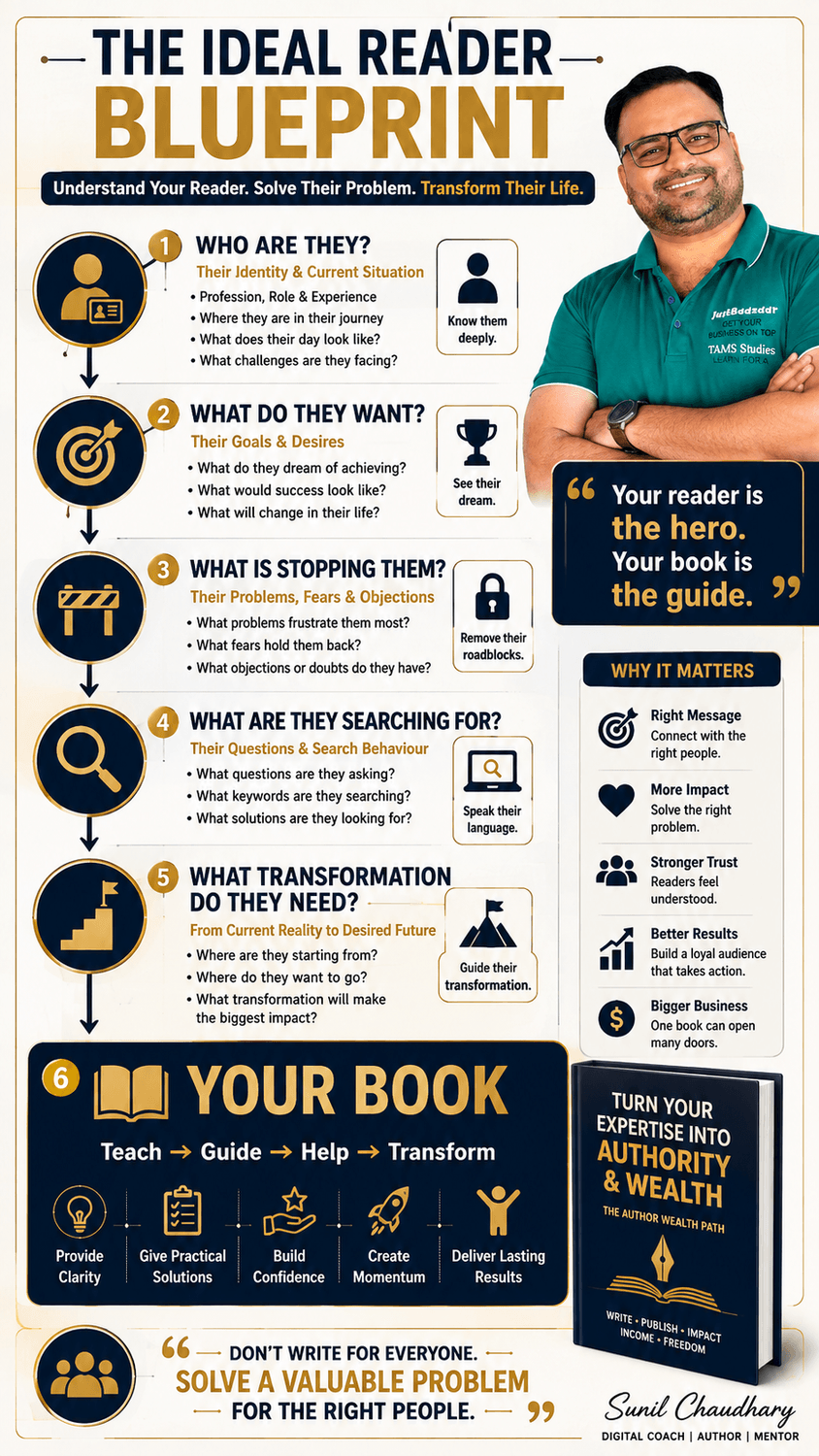
Validate Your Book Idea Before You Write 50,000 Words
There is a mistake I want you to avoid before you invest months of your life into writing a book.
Do not start writing too early.
I know that sounds strange.
You have an idea.
You are excited.
You can already imagine the cover.
You can see your name on Amazon.
You can imagine people reading your book.
You may even have the first chapter in your head.
But before you write 30,000, 40,000 or 50,000 words, there is a much more important job.
Validate the idea.
Because writing a book is a commitment.
You are committing your time.
Your energy.
Your attention.
Your reputation.
Your intellectual property.
And potentially your money.
So why would you build the entire book before checking whether the underlying idea deserves to be built?
I would rather spend a few days validating an idea than spend a year writing the wrong book.
That is the mindset I want you to develop.
A Great Idea Is Not Automatically a Great Book
This distinction is extremely important.
You may have a brilliant idea.
But a brilliant idea is not necessarily a commercially viable book.
For example, you may have an interesting personal philosophy.
You may have a fascinating story.
You may have an unusual experience.
You may have a framework that you personally love.
But the next question is:
Does this solve a problem that other people care about?
That is where validation begins.
A book should not exist only because the author wants to say something.
It should exist because there is a meaningful reason for the reader to spend time with it.
Your idea needs a reason to matter.
What Does Book Validation Actually Mean?
Validation does not mean getting a guarantee that your book will become a bestseller.
No ethical researcher can promise that.
Markets are unpredictable.
Reader behaviour changes.
Competition changes.
Platforms change.
Trends change.
Even excellent books sometimes perform differently from expectations.
Validation has a more practical purpose.
It helps you answer:
Is there a real audience?
Does the problem matter?
Are people actively looking for solutions?
Are competing books already attracting readers?
Is there room for a better perspective?
Can I clearly differentiate my book?
Can I create enough useful content around the topic?
Can this book support my broader personal brand?
Can I build ethical products or services around the transformation?
If the answer to most of these questions is yes, you have a much stronger foundation.
Start With Search Demand
If your goal is to build an online author brand, search behaviour is one of the most useful validation signals.
People reveal their interests through the questions they ask.
They search for solutions.
They compare options.
They look for explanations.
They investigate problems.
They search for reviews.
They search for methods.
They search for people who can help them.
That makes search behaviour extremely valuable for authors.
Suppose your potential book is about helping coaches build an online business.
Do not stop at:
“Digital coaching business.”
Explore the questions surrounding the subject.
People might be searching for:
How to start an online coaching business
How to get coaching clients
How to market a coaching business
How to build a personal brand as a coach
How to sell coaching online
How to create a coaching funnel
Each query gives you information.
Together, they reveal a market.
Search Queries Can Become Your Book Architecture
This is where SEO becomes much more than a marketing activity.
Your search research can influence the actual structure of your book.
Imagine you discover that your audience repeatedly asks:
How do I choose a niche?
How do I create an offer?
How do I find clients?
How do I build a website?
How do I generate leads?
How do I market myself?
How do I automate the process?
You now have the raw material for a book.
You could potentially create:
Chapter 1: Choosing Your Market
Chapter 2: Creating Your Offer
Chapter 3: Finding Your First Clients
Chapter 4: Building Your Digital Presence
Chapter 5: Creating Your Lead Generation System
Chapter 6: Building Your Personal Brand
Chapter 7: Automating Your Growth
Your readers have effectively helped you design your table of contents.
That is powerful.
Use Google as a Research Tool
One of the simplest validation techniques is also one of the most accessible.
Search your topic.
Look at what appears.
Study the questions.
Examine the types of pages ranking.
Look at related searches.
Notice recurring themes.
Pay attention to the language people use.
You are not trying to copy what already exists.
You are trying to understand the information landscape.
Ask yourself:
What is already well covered?
What is poorly explained?
What questions remain unanswered?
What perspectives are missing?
What can I explain more clearly?
Where can my experience add genuine value?
That last question is particularly important.
Competition does not always mean “stay away.”
Sometimes competition is evidence that an audience exists.
Competition Can Be Good News
Many aspiring authors become discouraged when they discover competing books.
They think:
“Someone has already written about this.”
That is not necessarily bad news.
Imagine you search your topic and discover hundreds of books.
What does that tell you?
At least one thing:
People are interested enough in the subject to create a market for it.
The real question becomes:
Why would someone choose my book?
That is where differentiation comes in.
Perhaps your approach is more practical.
Perhaps your framework is simpler.
Perhaps you focus on a particular audience.
Perhaps you combine two disciplines.
Perhaps you have unusual experience.
Perhaps you provide implementation tools.
Perhaps you approach the subject from a different cultural or professional perspective.
The goal is not to have no competition.
The goal is to have a reason to be chosen.
Read the Reviews of Competing Books
Here is a remarkably useful validation exercise.
Find books similar to the one you want to write.
Then study their reviews.
Do not only read the five-star reviews.
Read the three-star and two-star reviews carefully.
These reviews can reveal market gaps.
Readers may say:
“The concepts were good, but there were not enough practical examples.”
That is a clue.
Someone may say:
“This book was too theoretical.”
Another clue.
Someone may say:
“I wish the author had included templates.”
Another opportunity.
Someone may say:
“The information was useful, but the book was too complicated for beginners.”
Now you have positioning information.
Your competitors' weaknesses can help you design your strengths.
The Reader Is Telling You What Is Missing
Imagine that ten different readers independently complain about the same thing.
That is not random noise.
That is market intelligence.
Suppose readers repeatedly say:
“I understand the strategy, but I don't know how to implement it.”
You could build your book around implementation.
Suppose they say:
“The book explains what to do but not what tools to use.”
You can include practical tools.
Suppose they say:
“There are too many concepts and not enough examples.”
You can use case studies.
This is how you create a better reader experience without simply creating a longer book.
Validate the Problem With Conversations
Search data is useful.
But conversations can reveal something deeper.
Talk to potential readers.
Talk to your existing audience.
Talk to clients.
Talk to students.
Talk to professionals in your target market.
Ask simple questions.
What is your biggest challenge with this subject?
What have you tried already?
What is confusing you?
What would you like to learn?
What result would make this worthwhile?
If a book solved this problem, what would you want it to contain?
Then listen.
Do not sell.
Do not immediately explain your solution.
You are conducting research.
The answers can change your entire book.
Create a Simple Reader Survey
You can also create a short survey.
It does not need to be complicated.
Ask five to ten questions.
For example:
Question 1
What is your biggest challenge with ______?
Question 2
What have you already tried?
Question 3
What is your biggest frustration?
Question 4
What result would you most like to achieve?
Question 5
What would you want a practical book about this subject to teach you?
Question 6
What would make you recommend such a book to someone else?
Question 7
What is the one question you wish someone would answer for you?
That final question can be particularly valuable.
It can reveal the gap between what experts think people need and what people actually want to know.
Build a Minimum Viable Book Concept
You do not need to write the entire book to test the concept.
Create a Minimum Viable Book Concept.
It should contain only a few elements:
Working Title
Target Reader
Core Problem
Desired Transformation
Unique Method
Proposed Chapters
Primary Promise
Next Step
Then show it to real people.
Ask:
“Would you read this?”
But do not stop there.
Ask:
“Why?”
And:
“Why not?”
The second question can teach you more than the first.
Test Your Book Promise
Your book promise should be understandable in one sentence.
For example:
“This book teaches coaches how to build a predictable digital client acquisition system using content, SEO and personal branding.”
Now ask:
Does the reader understand who it is for?
Does the reader understand the problem?
Does the reader understand the outcome?
Does the reader understand why the method is relevant?
If not, simplify it.
Clarity beats cleverness.
Test the Title Before You Fall in Love With It
Authors often become emotionally attached to titles.
I understand.
You think of something beautiful.
You imagine the cover.
You feel that it sounds powerful.
But your title has a job.
It needs to help the right reader understand and notice the book.
Test multiple directions.
For example:
Benefit-led
Build Your Digital Business
Problem-led
Why Your Expertise Isn't Making You Money
Audience-led
The Digital Coach Business Guide
Transformation-led
From Expert to Digital Entrepreneur
Curiosity-led
The Hidden Business Inside Your Knowledge
These are different positioning approaches.
You can test which one resonates with your intended audience.
Don't Confuse Curiosity With Confusion
A clever title can create curiosity.
But there is a limit.
If readers cannot understand what the book is about, curiosity becomes confusion.
A good title creates interest.
A strong subtitle provides clarity.
For example:
From Expert to Digital Entrepreneur
How Coaches, Consultants and Knowledge Creators Can Turn Their Expertise Into a Scalable Online Business
The title creates identity.
The subtitle explains the promise.
That combination can be powerful.
Validate Through Content Before Publishing
Here is one of my favourite strategies.
Create content around your book idea before writing the book.
Take your proposed book topic and create:
YouTube videos
LinkedIn posts
Blog articles
Short-form videos
Email newsletters
Podcasts
Webinars
Free guides
Then observe what happens.
Which topics receive attention?
Which questions generate comments?
Which videos receive watch time?
Which posts generate meaningful conversations?
Which articles attract search traffic?
Which ideas make people contact you?
This is not a perfect prediction of book sales.
But it can provide valuable evidence.
You are effectively conducting a public market test.
Let Your Audience Help You Write the Book
This is one of the most powerful approaches available to modern authors.
Instead of disappearing for a year and returning with a finished book, involve your audience throughout the process.
Share ideas.
Ask questions.
Test frameworks.
Publish chapter concepts.
Invite feedback.
Create discussions.
Run workshops.
Observe what resonates.
Then improve the manuscript.
Now your book is being shaped by real conversations.
You are not writing inside a vacuum.
You are writing with market intelligence.
Create a Book Waitlist
Here is another simple test.
Before your book is finished, create a landing page.
Explain:
Who the book is for.
What problem it solves.
What readers will learn.
What transformation it promises.
Then invite interested people to join a waitlist.
You are not pretending that the book is already available.
You are simply measuring interest.
If people voluntarily provide their email address because they want to know when the book launches, that is useful information.
Again, it is not a guarantee.
But it is a meaningful signal.
Consider Pre-Launch Offers Carefully
Depending on your audience and business model, you may also test demand through ethical pre-launch activities.
For example, you might offer:
A book launch workshop
An author-led masterclass
A companion workbook
A founding-reader programme
A limited early-access edition
The goal is not to pressure people into buying something that does not exist.
The goal is to understand whether your audience sees enough value in the transformation to take an appropriate early action.
Transparency is essential.
Trust is more valuable than a short-term sale.
Measure Signals, Not Just Sales
When validating a book, look for multiple signals.
Stronger Signals
People ask questions.
People share your content.
People join your waitlist.
People attend your workshop.
People request more information.
People describe the problem in their own words.
People ask when the book will be available.
People recommend the concept to others.
Weaker Signals
Someone says:
“Sounds interesting.”
A friend says:
“I would definitely read that.”
A social media post gets likes without meaningful conversation.
These signals are not useless.
But they are weaker evidence.
The closer someone's behaviour is to actually investing time, attention or money, the stronger the signal generally becomes.
Use a Simple Validation Score
You can create your own scoring system.
Rate your book idea from 1 to 10 on:
Audience Demand
Problem Urgency
Search Demand
Competition
Differentiation
Author Expertise
Content Potential
Business Potential
Long-Term Relevance
Reader Transformation
Then calculate the overall picture.
You do not need a complicated algorithm.
The purpose is to force yourself to look at the idea from multiple angles.
Sometimes an idea feels exciting but scores poorly.
That is useful information.
Sometimes an idea looks ordinary at first but scores extremely well.
That can be even more interesting.
Know When to Change Your Idea
Validation is not only about confirming an idea.
It is also about improving it.
Perhaps your original topic is too broad.
Narrow it.
Perhaps the problem is not urgent enough.
Find a more important problem.
Perhaps your audience is too vague.
Choose a clearer audience.
Perhaps your title is confusing.
Rewrite it.
Perhaps your method is too generic.
Develop your own framework.
Perhaps your content gets attention but no meaningful engagement.
Investigate why.
Do not fall in love with the first version.
Fall in love with solving the right problem.
The Author's Ego Can Become the Biggest Obstacle
I want to say something honestly.
Sometimes the biggest problem in publishing is not the market.
It is the author's ego.
You may think:
“This is what I want to teach.”
But the market may be saying:
“We need something slightly different.”
Listen.
You are not losing your identity by adapting your book.
You are becoming a better communicator.
Your job is not to abandon your expertise.
Your job is to package it in a way that creates value for another human being.
That is what great teaching requires.
Validation Protects Your Time
Think about the economics of this decision.
Suppose you spend 500 hours writing a book.
That is a serious investment.
Now imagine you spend 20 hours validating the concept first.
If validation helps you discover that the original idea needs to change, you have potentially saved hundreds of hours.
Even more importantly, you may have discovered a much stronger opportunity.
That is why validation is not procrastination.
Validation is acceleration.
It helps you move faster because you are more likely to move in the right direction.
The Book Validation Flywheel
Here is the process I recommend:
IDEA
↓
RESEARCH
↓
AUDIENCE QUESTIONS
↓
COMPETITOR ANALYSIS
↓
CONTENT TESTING
↓
READER FEEDBACK
↓
REFINE POSITIONING
↓
VALIDATE THE PROMISE
↓
BUILD THE OUTLINE
↓
WRITE
This is much safer than:
Idea → Write 50,000 Words → Publish → Hope
Hope is not a strategy.
Research is.
Your 7-Day Book Validation Challenge
If you want to move quickly, give yourself seven days.
Day 1: Define the Problem
Write down the exact problem your book will solve.
Day 2: Research Search Intent
Study the questions people ask around the topic.
Day 3: Study Competing Books
Read titles, subtitles, descriptions and reviews.
Day 4: Talk to Readers
Speak with at least a few people who fit your target audience.
Day 5: Test Your Content
Publish several pieces of content around the proposed topic.
Day 6: Refine Your Promise
Improve your title, subtitle, audience and transformation.
Day 7: Build Your Book Concept
Create the working title, reader profile, promise, framework and proposed chapters.
At the end of those seven days, you should know much more than you knew when you started.
And only then should you move aggressively into writing.
The Validation Principle I Want You to Remember
Here is my simple rule:
Don't spend a year writing a book that you could have validated in a week.
You do not need perfect certainty.
You need enough evidence to make a better decision.
The purpose of validation is not to predict the future perfectly.
It is to reduce avoidable mistakes.
And if you want to publish a book and get rich, reducing avoidable mistakes is a very good habit to develop.
Section 6 Action Plan
Before you begin writing your manuscript, answer these questions:
1. What exact problem does my book solve?
2. Who urgently wants this problem solved?
3. What are people searching for around this problem?
4. What competing books already exist?
5. What do readers like about those books?
6. What do readers dislike or wish was different?
7. What is my unique perspective?
8. What content can I publish to test demand?
9. What evidence would convince me that this is a strong idea?
10. What will I change if the evidence tells me my original idea needs improvement?
Do this work before writing the manuscript.
Your future author business will thank you.
Key Takeaway
The smartest authors do not simply write. They research, validate, listen, test and then write.
Your book is too important to build on assumptions alone.
Validate the problem.
Validate the audience.
Validate the demand.
Validate the positioning.
Validate the promise.
Validate the transformation.
Then write.
Because when you know that people genuinely care about the problem you are solving, you are no longer writing blindly.
You are building with evidence.
And that brings us to the next major challenge:
How do you turn your validated idea into a book concept, title, subtitle and powerful promise that makes the right reader want to pick up the book?
That is where we go next.
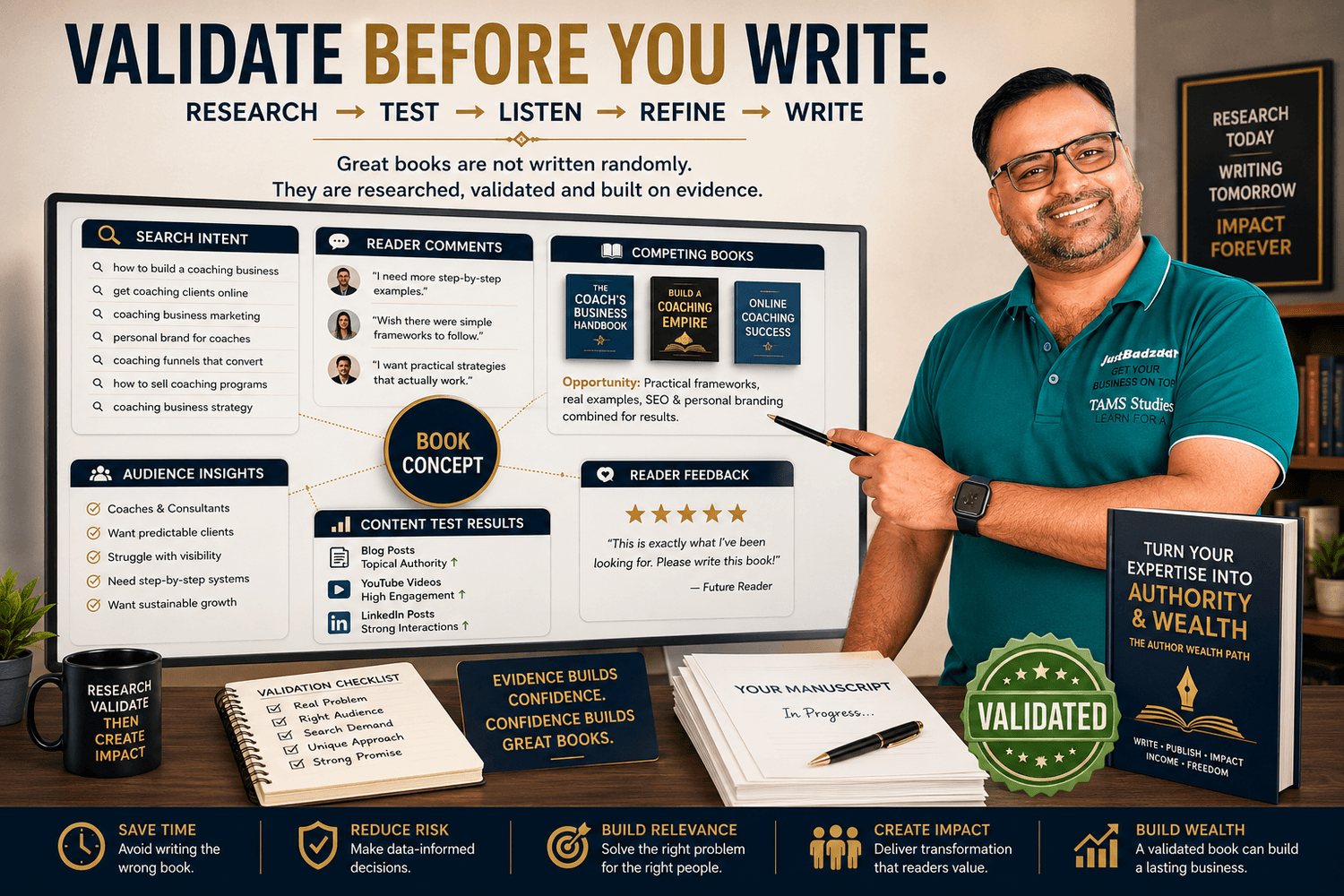
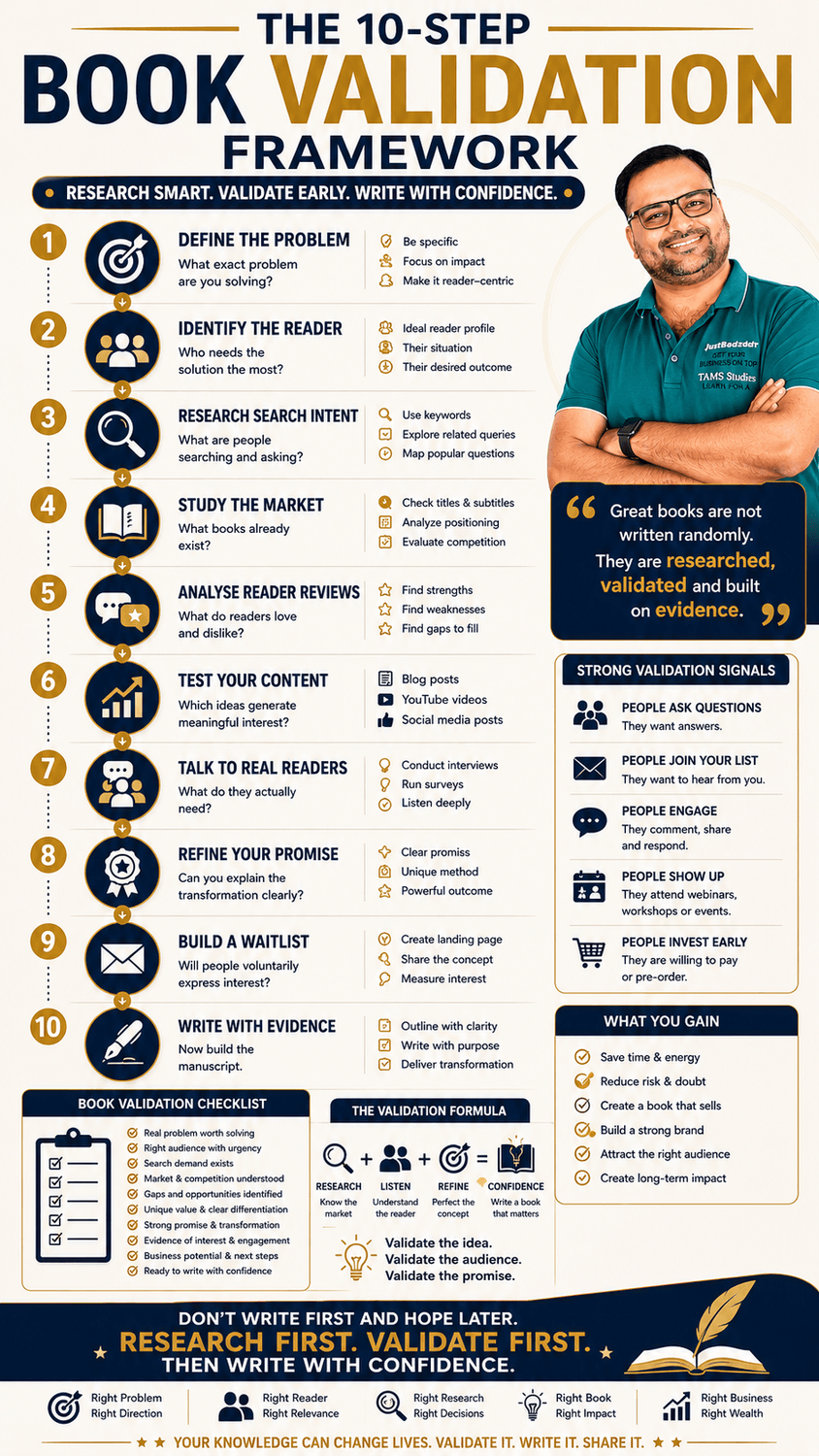
Create a Book Title, Subtitle and Promise That People Cannot Ignore
You have now identified your topic.
You understand your ideal reader.
You have researched the problem.
You have validated the idea.
Now we arrive at one of the most exciting stages of the entire publishing journey:
Naming your book.
This is where many authors become overly creative.
They search for clever words.
They brainstorm mysterious titles.
They try to sound sophisticated.
They want something that looks beautiful on a bookshelf.
And while creativity absolutely matters, there is a more important principle:
Your book title is a marketing asset.
It is not merely a name.
It is one of the first things a potential reader sees.
It may appear on Google.
It may appear on an online bookstore.
It may appear in a YouTube video.
It may appear in a podcast description.
It may appear on your website.
It may appear on LinkedIn.
It may appear in an advertisement.
It may appear in someone's recommendation.
And in every one of those situations, your title has only a few seconds to communicate why the book deserves attention.
That is why I want you to approach your title strategically.
A Great Book Title Does Three Jobs
At the most basic level, your title should accomplish three things.
1. Capture Attention
The title should make the right reader stop.
2. Create Relevance
The reader should understand that the book relates to their problem, desire or identity.
3. Create Curiosity
The reader should want to know more.
The best titles often achieve all three without becoming confusing.
That is the balance you are looking for.
Your Title Is a Promise
When someone sees a book title, they are subconsciously asking:
“What is in this for me?”
That is why a title should connect with something meaningful.
Perhaps it promises:
A transformation.
A solution.
A new way of thinking.
A shortcut.
A framework.
A discovery.
A better future.
A specific result.
An answer to an important question.
Your title does not necessarily need to reveal everything.
But it should create a reason to continue reading.
The Difference Between a Title and a Subtitle
One of the most useful techniques in modern book positioning is to think of the title and subtitle as a team.
The title creates identity, curiosity or emotion.
The subtitle creates clarity.
For example:
Title
From Expert to Entrepreneur
Subtitle
How Coaches, Consultants and Knowledge Creators Can Turn Their Expertise Into a Profitable Digital Business
The title is memorable.
The subtitle explains the promise.
Together, they communicate far more than either one alone.
This is especially useful when your title is creative or conceptual.
The Five Major Types of Book Titles
There is no single formula that works for every category.
However, most successful titles can be understood through several broad approaches.
Let's explore them.
1. The Benefit-Driven Title
This title focuses directly on the desired result.
Examples of the structure include:
Build Your Online Business
Master Your Personal Brand
Create Financial Freedom
Become a Confident Leader
The advantage is clarity.
The reader immediately understands the benefit.
The disadvantage is that highly generic benefit-based titles can become difficult to differentiate.
That is where your subtitle and positioning become important.
2. The Problem-Driven Title
This approach begins with the pain.
For example:
Why Your Expertise Isn't Making You Money
The reader immediately recognises a problem.
If they are experiencing that problem, the title creates relevance.
Problem-driven titles can be especially powerful when the audience is already aware that something is wrong.
3. The Transformation-Driven Title
This approach shows the journey.
For example:
From Unknown to Authority
Or:
From Employee to Entrepreneur
Or:
From Knowledge to Wealth
The transformation is the central idea.
This approach works particularly well for personal development, business, entrepreneurship, career and personal branding books.
4. The Framework Title
Sometimes the strongest title communicates a methodology.
For example:
The 7-Step Author Wealth System
Or:
The Digital Authority Framework
Or:
The Knowledge-to-Business Method
The reader immediately understands that the book contains a system.
This can be particularly powerful if you have developed your own framework.
5. The Curiosity-Driven Title
This approach creates an information gap.
For example:
The Hidden Business Inside Your Knowledge
Now the reader may wonder:
“What hidden business?”
“What knowledge?”
“How does this work?”
Curiosity can generate attention.
However, be careful.
Curiosity without clarity can become confusion.
Your subtitle should usually provide the missing context.
Your Title Should Match Your Reader's Awareness
Remember the reader-awareness ladder from the previous sections.
Different readers respond to different messages.
Someone who already understands the problem may respond strongly to a solution-oriented title.
Someone who is still confused may need a clearer problem statement.
Someone who is highly sophisticated may appreciate a framework or contrarian perspective.
Therefore, do not choose a title in isolation.
Choose it based on your reader.
The “Would I Click This?” Test
Here is a simple exercise.
Imagine your book title appears on a Google search page alongside ten competing results.
Would you click it?
Now imagine the same title appears on Amazon alongside dozens of other books.
Would you notice it?
Now imagine someone shares it on LinkedIn.
Would the title make you curious enough to stop scrolling?
Ask yourself:
Does this title communicate value quickly?
If the answer is no, keep working.
The “Would I Recommend This?” Test
There is another important test.
Imagine that you have read the book.
Now you are talking to a friend.
Would you naturally say:
“You should read this book called ______.”
If the title is difficult to remember, difficult to pronounce or difficult to explain, that is a problem.
A strong title should be reasonably easy to remember.
It should also be easy to communicate verbally.
Because word of mouth can become a major distribution channel.
The “Who Is This For?” Test
Look at your title and subtitle.
Can someone understand the intended audience?
For example:
The Digital Coach Business
How Coaches Can Build, Market and Scale an Online Coaching Business
The audience is immediately clear.
Compare that with a title such as:
The Infinite Journey
Beautiful?
Perhaps.
But what is it about?
Who is it for?
What problem does it solve?
What outcome does it promise?
If the reader cannot answer those questions, the subtitle needs to do much more work.
The “What Changes After Reading?” Test
Your title should ideally connect to transformation.
Ask:
What will my reader be able to do, understand or become after reading this book?
That answer should influence your title.
For example:
If the transformation is:
“Turn your expertise into an online business.”
Possible positioning could include:
From Expert to Digital Entrepreneur
The Knowledge Business Blueprint
Turn Your Knowledge Into Wealth
The Expert-to-Entrepreneur System
These are different creative expressions of the same underlying transformation.
Don't Promise What You Cannot Deliver
This is extremely important.
If your title promises:
“Make $1 Million From Your First Book”
you are making a very specific financial promise.
Can you genuinely support that promise?
For most authors, no.
A more credible approach would be:
“Build a Profitable Business Around Your Book”
That communicates an opportunity without guaranteeing an outcome.
Your title should create excitement.
But your marketing must remain honest.
Trust is a long-term asset.
Do not sacrifice it for clicks.
The “Rich” Problem
Our target phrase for this article is:
“publish a book and get rich.”
It is a powerful phrase because it combines two strong desires:
Publishing
and
wealth.
But there is an important distinction.
Getting rich should not be presented as an automatic consequence of publishing.
The responsible message is:
Publishing can create an asset that, when combined with authority, audience, distribution, products, services and business systems, can create significant financial opportunities.
That is much more realistic.
Your book is not a lottery ticket.
It is an intellectual asset.
How you build around that asset determines what happens next.
Your Subtitle Can Do the Heavy Lifting
If your title is emotional or creative, your subtitle can provide the SEO and positioning clarity.
For example:
Title
Publish a Book and Get Rich
Subtitle
How Experts, Coaches, Consultants and Knowledge Entrepreneurs Can Turn a Book Into Authority, Audience, Clients and Multiple Revenue Opportunities
Now the reader understands what the article or book is actually about.
The phrase “get rich” creates curiosity.
The subtitle provides context.
The promise becomes more sophisticated.
Use Search Language Naturally
If you want your book and author platform to be discoverable online, search language matters.
But there is a major difference between optimisation and keyword stuffing.
Do not create awkward titles simply because a keyword has search volume.
Instead, understand what people mean when they search.
For example, someone searching:
how to publish a book
probably wants a process.
Someone searching:
how do authors make money
probably wants monetisation strategies.
Someone searching:
how to make money writing books
may be looking for business models.
Someone searching:
publish a book and get rich
may be exploring whether publishing can become a path to wealth.
These are related but not identical intents.
Your title, subtitle and content should reflect the underlying intent naturally.
Your Book Title Is Also Your Brand
Think beyond launch day.
Suppose your book becomes successful.
People begin mentioning it.
Podcasts invite you to discuss it.
You speak at conferences.
You create workshops around it.
You build a course from it.
People reference your framework.
Your title now becomes associated with your personal brand.
That means you should choose carefully.
You want a title that can survive.
Not something that sounds exciting for three months and becomes irrelevant afterwards.
Make Your Title Expandable
One of the smartest things you can do is create a concept that can expand.
Imagine you create:
The Author Wealth Framework
That could become:
The Author Wealth Book
The Author Wealth Masterclass
The Author Wealth Workshop
The Author Wealth Podcast
The Author Wealth Course
The Author Wealth Community
The Author Wealth Certification
Now your intellectual property has become a brand ecosystem.
This is one of the reasons I encourage experts to think strategically about naming their frameworks.
A good framework name can become a long-term intellectual property asset.
Your Framework Can Become Your Signature
If you have a unique methodology, give it a memorable name.
For example:
The Knowledge-to-Wealth Framework
Perhaps it contains seven stages:
Discover → Position → Create → Publish → Distribute → Monetise → Scale
Now every time you teach this system, you reinforce your intellectual property.
You can explain it in:
Books.
Videos.
Presentations.
Webinars.
Articles.
Courses.
Coaching sessions.
Social media.
That repetition builds mental association.
People begin to think:
“This is Sunil's framework.”
That is personal branding at a much deeper level.
Create a Promise That Can Be Proved
Your book promise should be specific enough to matter and realistic enough to defend.
For example:
Weak:
“This book will completely transform your life.”
Too broad.
Better:
“This book will show you how to turn your expertise into a structured digital business.”
More specific.
Even better:
“This book gives coaches, consultants and knowledge creators a step-by-step framework for turning expertise into a digital business through positioning, content, lead generation and scalable offers.”
Now the promise is concrete.
The reader knows what they are getting.
The Promise Formula
Use this structure:
I help [AUDIENCE] achieve [OUTCOME] through [METHOD] without [MAJOR OBSTACLE].
For example:
I help coaches turn their expertise into a profitable digital business through content, personal branding and smart systems without depending entirely on paid advertising.
Now convert that into your positioning.
Title
From Expert to Digital Entrepreneur
Subtitle
How Coaches Can Turn Their Expertise Into a Profitable Online Business Through Content, Personal Branding and Smart Systems
The title creates identity.
The subtitle creates clarity.
The promise creates motivation.
Don't Make Your Subtitle a Paragraph
There is another common mistake.
Authors sometimes try to put the entire book into the subtitle.
The result becomes difficult to read.
Your subtitle should communicate the essential promise.
You do not need to list every chapter.
You do not need to mention every tool.
You do not need to explain your entire methodology.
Give the reader enough information to understand the value.
Then let the book reveal the depth.
Create Ten Titles Before Choosing One
Never stop at your first title.
Write at least ten.
Then write ten more.
Do not judge them immediately.
Let yourself explore.
Try:
Benefit-based
Problem-based
Transformation-based
Curiosity-based
Framework-based
Audience-specific
Contrarian
Outcome-focused
Identity-focused
Search-informed
Then compare them.
Which one is clearest?
Which one is most memorable?
Which one speaks to the ideal reader?
Which one has the strongest promise?
Which one gives you room to build a brand?
Which one can become a framework?
Which one sounds credible?
Which one would you be proud to have on your website five years from now?
That last question matters.
Ask Real Readers
Once you have your shortlist, do not make the decision entirely inside your own head.
Show the options to real people.
Ask:
Which title would you click?
Which title makes you understand the topic fastest?
Which one sounds most valuable?
Which one would you recommend to someone else?
What do you think this book is about?
That final question is particularly powerful.
If people interpret your title differently from what you intended, your positioning needs work.
Your Cover and Title Must Work Together
The title is not operating alone.
Your book cover is part of the communication system.
Think about the combination:
Title + Subtitle + Typography + Colour + Imagery + Author Name
The cover should reinforce the promise.
A business book may require a different visual language from a memoir.
A spiritual book may need a different emotional atmosphere from a technology book.
A children's book has completely different visual expectations.
Your design should match your reader.
But regardless of category, the cover needs to remain readable at small sizes.
Remember:
Your potential reader may first see your book as a tiny thumbnail.
If they cannot read the title, you have lost an opportunity.
The Thumbnail Test
This is especially important in today's digital publishing environment.
Take your proposed cover.
Shrink it dramatically.
Imagine it appearing on:
A mobile phone.
A search result.
An online bookstore.
A social media feed.
A YouTube video.
Can you still read the title?
Can you recognise the subject?
Can you identify the author?
Can you understand the basic promise?
If not, redesign it.
A beautiful cover that fails as a thumbnail is not doing its full marketing job.
The Five-Second Test
Show your title and cover to someone for approximately five seconds.
Then hide it.
Ask:
What do you think the book is about?
Who do you think it is for?
What result do you think it promises?
If they can answer reasonably accurately, you have strong communication.
If they cannot, you have more work to do.
This is a simple test.
But it can save you from months of attachment to a confusing title.
Your Author Name Matters Too
If your goal is to build an author business, your name becomes part of the asset.
Think about your long-term identity.
Do you want people to remember you as:
An author?
A coach?
A consultant?
A speaker?
A digital entrepreneur?
A thought leader?
Ideally, your book should strengthen the professional identity you want to own.
For me, this is particularly important.
My work sits at the intersection of digital marketing, SEO, personal branding, business growth, coaching and knowledge entrepreneurship.
Therefore, any book I create should strengthen that positioning rather than confuse it.
Your book should support your broader brand story.
The Title-to-Business Test
Here is my final test before choosing a title.
Ask yourself:
If this book becomes successful, can I build a business ecosystem around the concept?
Can I create:
A workshop?
A course?
A coaching programme?
A consulting offer?
A community?
A newsletter?
A podcast?
A YouTube series?
A speaking topic?
A framework?
A certification?
A second book?
If the answer is yes, you may have more than a title.
You may have discovered a category opportunity.
Your Book Promise Should Make the Reader Feel Possibility
At the end of the day, a reader buys a book because they believe something valuable might happen after reading it.
They may believe:
“I might finally understand this.”
“I might be able to do this.”
“I might avoid this mistake.”
“I might achieve this result.”
“I might become better at this.”
Your title should open that possibility.
Your subtitle should explain it.
Your content should deliver it.
Your business should extend it.
That is the complete journey.
The Title, Promise and Business Triangle
I want you to remember this simple model:
TITLE
Gets attention
↓
PROMISE
Creates expectation
↓
BOOK
Delivers transformation
↓
BUSINESS
Creates deeper opportunities
If your title attracts people but the book disappoints them, you lose trust.
If your book is brilliant but the title is invisible, people may never discover it.
If the book creates transformation but there is no logical next step, you may miss opportunities to serve readers further.
All four elements need to work together.
Your Section 7 Action Plan
Now create your own title laboratory.
Write:
My Core Audience
Their Biggest Problem
Their Desired Transformation
My Unique Method
My Working Title
My Subtitle
My One-Sentence Promise
Then create at least 10 alternative titles.
Do not choose your favourite immediately.
Test them.
Discuss them.
Research them.
Compare them.
And then choose the title that gives you the strongest combination of:
Clarity + Curiosity + Relevance + Memorability + Differentiation + Long-Term Brand Potential
Key Takeaway
Your book title is not just the name of your book. It is the first salesperson for your intellectual property.
A strong title attracts attention.
A strong subtitle creates clarity.
A strong promise creates desire.
A strong book delivers transformation.
And a strong business ecosystem turns that transformation into a long-term relationship.
So do not rush this stage.
Your title may stay with you for years.
It may appear on your website, social profiles, speaking presentations, podcasts, advertisements and future products.
Choose it like an entrepreneur.
Write it like an author.
Position it like a marketer.
And build it like a brand.
Because the right title does more than help people discover your book.
It can help people remember your name.
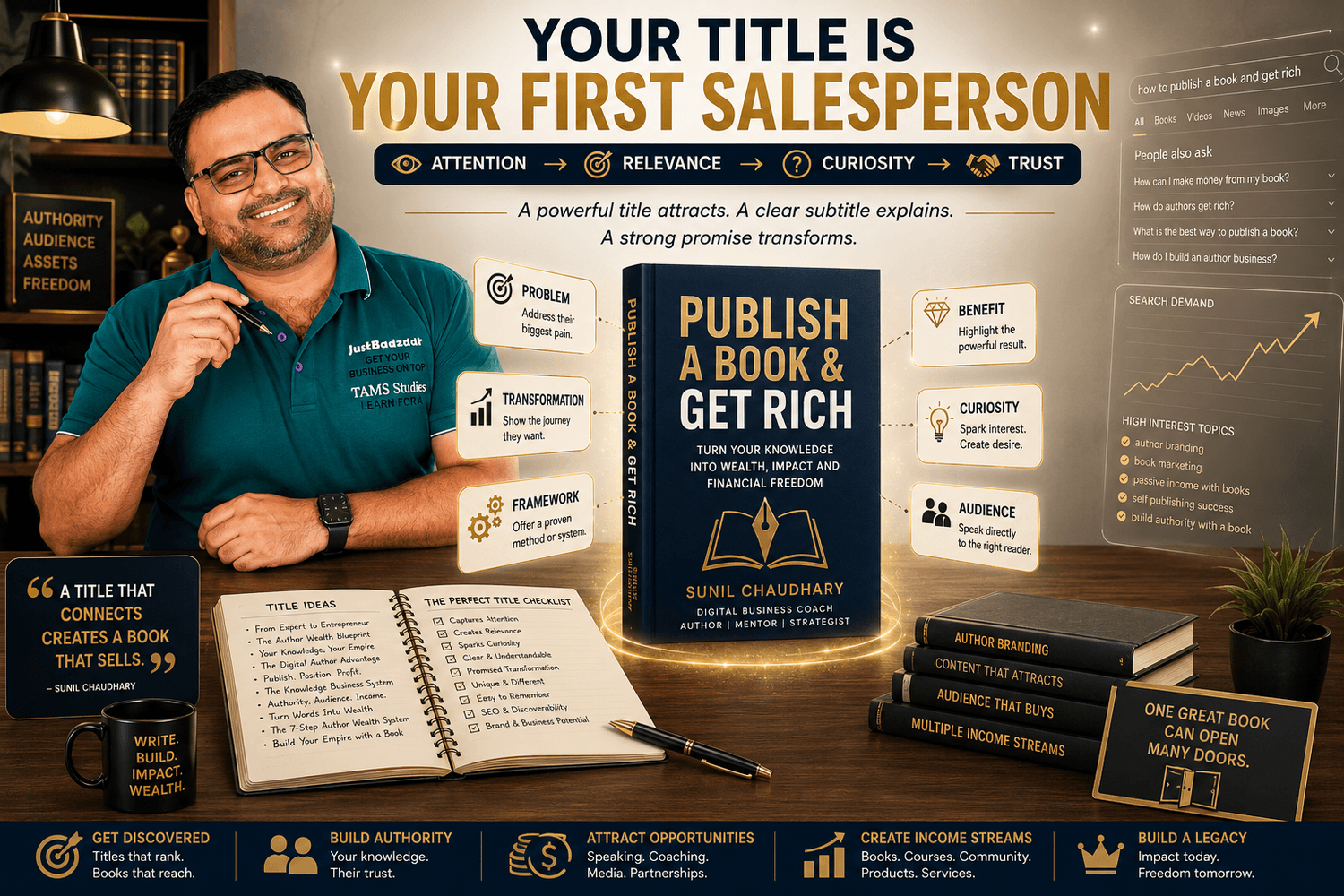
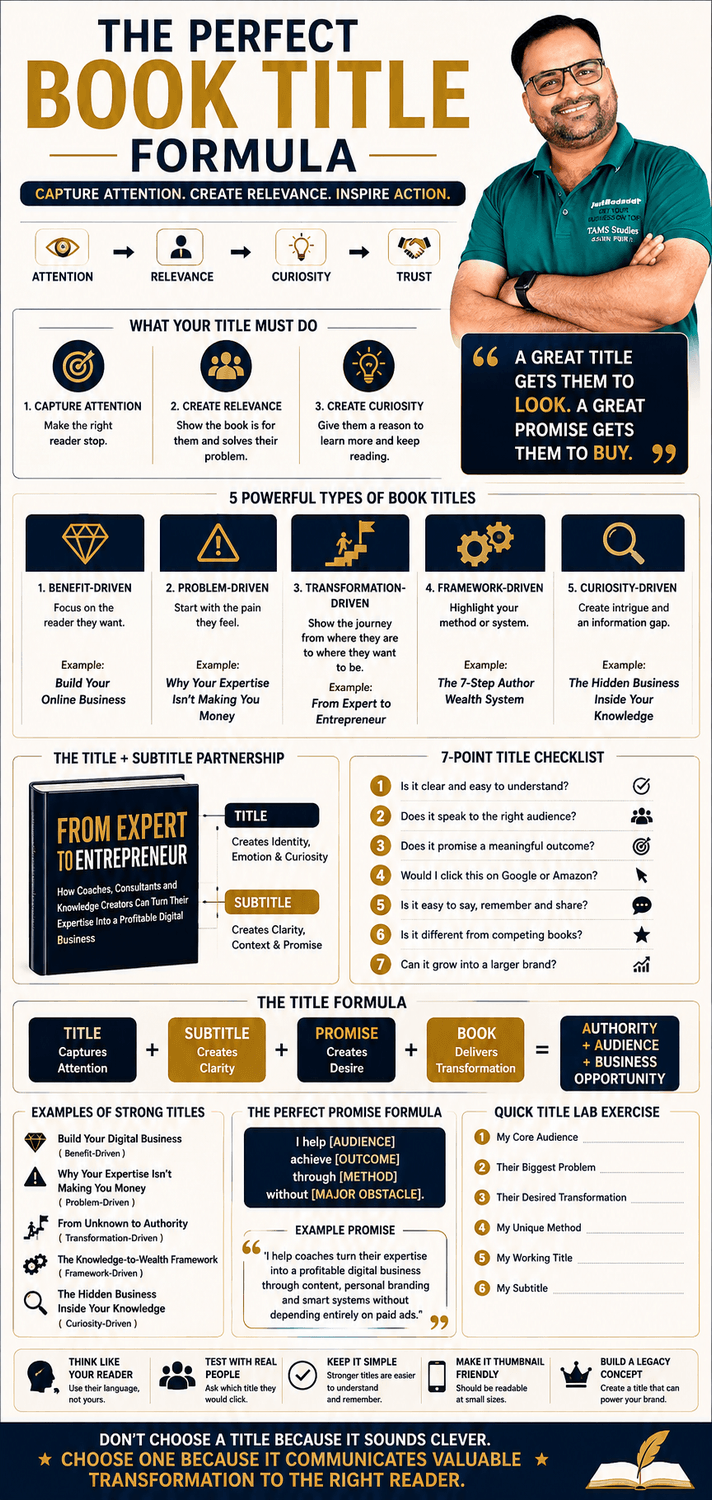
How to Turn Your Knowledge Into a Book People Actually Want to Read
Now you have something most aspiring authors never take the time to establish.
You know what problem you want to solve.
You know who you want to help.
You have validated the idea.
And you have started thinking about your title, subtitle and promise.
Now comes the real work.
You have to turn your knowledge into a book.
And this is where many experts get stuck.
They know a lot.
Sometimes they know too much.
They have spent 10, 15 or 20 years learning their subject.
They have hundreds of ideas.
They have stories.
They have frameworks.
They have case studies.
They have lessons.
They have opinions.
They have experience.
But when they open a blank document and try to write a book, suddenly everything becomes chaotic.
They ask:
“Where do I begin?”
My answer is simple:
Do not begin with writing. Begin with architecture.
A great book is not simply a collection of good ideas.
It is a carefully designed journey.
Your Knowledge Is Not Yet a Book
This distinction can change everything.
You may have 1,000 ideas.
That does not mean you have a book.
You may have delivered 500 presentations.
That does not mean you have a book.
You may have 20 years of experience.
That does not automatically create a book.
A book requires structure.
Think of your knowledge as raw material.
Your job is to turn that raw material into a system that another person can understand and use.
It is similar to building a house.
You may have bricks, steel, glass, wood and concrete.
But throwing all of those materials into one place does not create a house.
You need architecture.
The same is true for a book.
Start With the Transformation
Before creating your chapter list, write one sentence:
“By the end of this book, my reader will be able to…”
Finish that sentence.
For example:
“By the end of this book, my reader will be able to turn their expertise into a structured digital business.”
Or:
“By the end of this book, my reader will understand how to publish, market and monetise a book as part of a larger author business.”
This sentence becomes your compass.
Every chapter should contribute to that transformation.
If a chapter does not help the reader move toward the promised outcome, question whether it belongs.
Build the Journey Before the Chapters
Do not immediately start writing:
Chapter 1
Chapter 2
Chapter 3
Instead, think about the journey.
Where is the reader today?
Where do you want them to be?
What must they understand first?
What must they believe before taking action?
What skill must they develop?
What decision must they make?
What obstacle will they encounter?
What comes next?
This creates a logical progression.
For example:
Confusion
↓
Understanding
↓
Clarity
↓
Strategy
↓
Implementation
↓
Measurement
↓
Improvement
↓
Transformation
That is a book architecture.
The Reader Should Not Feel Lost
Imagine entering a large building without signs.
You walk into a room.
There is another room.
Then another.
Then another.
You have no idea where you are.
Eventually, you become frustrated.
A poorly structured book can create exactly the same feeling.
The reader thinks:
“Why am I reading this?”
“How does this connect to the previous chapter?”
“What am I supposed to do now?”
Good structure removes this friction.
Your reader should always have a sense of direction.
At the beginning of each chapter, tell them where they are going.
At the end, show them what they have achieved and where they go next.
Use the Problem-to-Solution Architecture
One of the most reliable structures for educational and business books is:
Problem → Understanding → Solution → Implementation → Transformation
Let's break it down.
Problem
Help the reader understand what is wrong.
Understanding
Explain why the problem exists.
Solution
Introduce the framework or approach.
Implementation
Show exactly how to apply it.
Transformation
Help the reader see the result and continue forward.
This structure works because it mirrors how humans learn.
We first understand the problem.
Then we understand the cause.
Then we discover the solution.
Then we apply it.
Then we experience the result.
The Five Questions Every Chapter Should Answer
Before writing any chapter, ask:
1. Why does this chapter matter?
2. What does the reader need to understand?
3. What should the reader do?
4. What result should the reader achieve?
5. Why does this prepare them for the next chapter?
If you cannot answer these questions, the chapter may not yet be ready to write.
This simple exercise can dramatically improve your manuscript.
Give Every Chapter One Big Idea
One common problem with expert-authored books is information overload.
The author knows so much that they try to include everything.
The chapter becomes 10 different lessons.
The reader remembers none of them.
Instead, give each chapter a central idea.
For example:
Chapter 1: Your Knowledge Has Economic Value
Chapter 2: Choose the Right Market
Chapter 3: Build Your Authority
Chapter 4: Create Your Book
Chapter 5: Build Your Distribution Engine
Each chapter can contain many supporting ideas.
But one central idea should dominate.
Think in Layers
A strong chapter can be structured in layers.
Layer 1: The Big Idea
What is the main lesson?
Layer 2: Explanation
Why does it matter?
Layer 3: Evidence
What supports it?
Layer 4: Examples
How does it look in real life?
Layer 5: Framework
What system can the reader follow?
Layer 6: Action
What should the reader do?
Layer 7: Reflection
What should the reader consider before moving forward?
This structure turns information into learning.
Use Stories to Make Ideas Memorable
Facts can inform.
Stories can make those facts memorable.
If you have personal experiences that genuinely support your lesson, use them.
Tell the reader:
What happened?
What did you believe at the time?
What went wrong?
What did you learn?
What changed?
What would you do differently today?
A story should not exist simply because it is interesting.
It should serve the lesson.
The best stories are not interruptions.
They are teaching tools.
Your Failures Are Valuable Intellectual Property
This is something I strongly believe.
You should not only document your victories.
Document your failures.
If you lost money, explain what caused it.
If a strategy failed, explain why.
If you made the wrong decision, explain what you learned.
If you wasted time, explain what you would do differently.
A reader can often learn more from:
“Here is what I did wrong.”
than:
“Here is everything I did right.”
Your failures can become shortcuts for someone else.
That is a form of value.
Turn Experience Into Frameworks
Suppose you have solved the same problem repeatedly.
You probably have a process.
Maybe you do not call it a framework yet.
But it exists.
You might naturally:
Diagnose the situation.
Identify the problem.
Create the strategy.
Implement the system.
Measure the result.
Improve the process.
That is a framework.
Name it.
Document it.
Teach it.
A framework turns experience into intellectual property.
And intellectual property can travel.
It can move from your mind into:
Books
Courses
Workshops
Videos
Consulting
Coaching
Presentations
Infographics
AI knowledge systems
That is leverage.
Do Not Try to Put Everything You Know Into One Book
This is one of the hardest lessons for experts.
You will always know more than you can fit into one book.
And that is okay.
Your job is not to empty your brain onto the page.
Your job is to create the most useful path for the reader.
Some ideas can become:
A second book.
A bonus chapter.
A workbook.
A blog post.
A YouTube video.
A podcast episode.
A course.
A workshop.
A future product.
Think of your book as a gateway to your intellectual ecosystem.
Not the warehouse containing everything you know.
The 80/20 Principle for Book Content
A useful way to think about your manuscript is:
What 20% of the knowledge will create 80% of the value for my reader?
You do not need to include every possible detail.
Focus on what creates movement.
If a concept helps the reader understand the problem, keep it.
If it helps them make a decision, keep it.
If it helps them implement, keep it.
If it provides important context, keep it.
If it is merely there because you happen to know it, reconsider it.
Expertise is not measured by how much information you can include.
Expertise is demonstrated by knowing what matters.
Build Chapters Around Questions
A very practical way to create your outline is to turn your reader's questions into chapters.
Suppose your reader asks:
How do I know what to write about?
That could become:
Chapter: Choosing Your Book Topic
Then:
Who should I write for?
Chapter: Defining Your Ideal Reader
Then:
How do I know whether people want my book?
Chapter: Validating Your Book Idea
Then:
How do I create a title?
Chapter: Creating Your Book Title and Promise
You are no longer inventing chapters randomly.
You are answering real questions.
That makes the book naturally reader-focused.
Create a Content Matrix
Once you know your main chapters, create a simple matrix.
Chapter
Problem
Big Idea
Framework
Example
Action
1
Confusion
Why the topic matters
Core Principle
Story
Reflection
2
Wrong audience
Reader clarity
Reader Blueprint
Example
Persona
3
Weak idea
Validation
Validation Framework
Case Study
Test
4
Poor positioning
Title
Title Formula
Examples
Title Lab
5
Information overload
Structure
Book Architecture
Outline
Draft
This simple table can save enormous time.
It tells you what each chapter needs to accomplish.
Use Consistent Chapter Architecture
Readers appreciate consistency.
If every chapter has a familiar rhythm, they know how to navigate the book.
For example, each chapter could contain:
Opening Hook
A strong idea or question.
The Problem
What is going wrong?
The Insight
What does the reader need to understand?
The Framework
What system can they use?
Examples
How does it work?
Action Steps
What should they do?
Key Takeaway
What should they remember?
Next Step
What comes next?
This creates a predictable learning experience.
Your Opening Paragraph Matters
The first paragraph of each chapter should create movement.
Do not begin every chapter with:
“In this chapter, we will discuss…”
That can feel mechanical.
Instead, create a reason to continue.
For example:
“Most people don't fail at publishing because they cannot write. They fail because they never design the book before they begin.”
Now the reader has a reason to continue.
The opening creates tension.
The chapter promises resolution.
That is storytelling.
Use Short Paragraphs
Especially for modern digital readers, readability matters.
Avoid walls of text.
Break large paragraphs into smaller units.
Use subheadings.
Use bullet points.
Use numbered lists.
Use examples.
Use callout statements.
Use tables where appropriate.
This makes the content easier to scan.
But do not turn every sentence into a separate paragraph.
The objective is readability, not visual fragmentation.
Use Transition Phrases
A professional book should feel like a conversation.
Transition phrases help ideas connect.
Useful transitions include:
However,
More importantly,
For example,
That said,
At the same time,
Now consider this,
The important point is,
This leads to another question,
Here is where things become interesting,
In practical terms,
As a result,
The next step is,
Before moving forward,
These phrases create continuity.
They help the reader follow your thinking.
Use Examples Aggressively
If you explain an abstract concept, follow it with an example.
For example:
Concept: Build an audience before launching your book.
Example: Publish weekly articles around your book's subject, collect email subscribers, answer audience questions and use those conversations to improve the manuscript.
The reader immediately understands the idea.
Examples reduce cognitive distance.
They turn theory into something visible.
Use Case Studies
Case studies can be even more powerful.
A good case study explains:
Situation
Problem
Decision
Action
Result
Lesson
You do not need to reveal confidential information.
You can anonymise examples where appropriate.
The purpose is to demonstrate how an idea works in reality.
A case study answers the reader's silent question:
“Does this actually work outside the theory?”
Add Exercises
If you want your book to create transformation, do not only teach.
Ask the reader to do something.
For example:
Exercise
Write your ideal reader in one sentence.
Then answer:
What do they want?
What are they struggling with?
What have they already tried?
What would success look like?
This changes the reader from a passive consumer into an active participant.
That is a major difference.
Build Momentum Between Chapters
Each chapter should create a reason for the next.
For example:
Chapter 1: Why authors need a business strategy.
↓
Chapter 2: Who the business should serve.
↓
Chapter 3: What problem to solve.
↓
Chapter 4: How to position the solution.
↓
Chapter 5: How to create the book.
Now the reader is naturally moving forward.
The book feels like a journey rather than a collection of essays.
Create an “Idea Parking Lot”
While writing, you will constantly discover new ideas.
You will think:
“This should be another chapter.”
Then:
“Wait, I should explain this here.”
Then:
“Maybe I need a whole section on that.”
This can destroy your structure.
Instead, create an Idea Parking Lot.
Whenever a new idea appears, write it there.
Do not immediately change your outline.
Review the parking lot after completing a chapter or major section.
Then decide:
Does this idea belong?
Does it replace something?
Does it become a bonus?
Does it belong in another book?
This protects your writing momentum.
Don't Edit While Creating
One of the biggest productivity killers for authors is trying to write and edit simultaneously.
You write one paragraph.
Then you reread it.
You change a word.
You rewrite the sentence.
You change the opening.
You search for a better example.
You change the paragraph again.
Two hours later, you have written three paragraphs.
Separate the processes.
Phase 1
Create.
Phase 2
Structure.
Phase 3
Edit.
Phase 4
Polish.
Phase 5
Proofread.
This distinction can dramatically improve your writing speed.
The First Draft Is Not the Final Book
Give yourself permission to write a bad first draft.
Your first draft has one job:
Exist.
You cannot improve a blank page.
You can improve a rough page.
You can restructure it.
You can rewrite it.
You can remove weak sections.
You can strengthen examples.
You can add evidence.
You can improve transitions.
But first, there must be something to work with.
So do not demand perfection from the first draft.
Demand progress.
Write Like You Speak
This is especially useful if you are a coach, consultant, trainer or speaker.
Your natural teaching voice is often more engaging than formal academic writing.
Imagine you are explaining the concept to a smart client sitting in front of you.
How would you say it?
Write that.
Then edit for clarity.
Do not make every sentence sound artificially sophisticated.
International English should be clear.
Professional English should be accessible.
And strong writing should sound human.
Your Voice Is an Asset
Thousands of people can write about the same subject.
But nobody can reproduce your exact combination of:
Experience + perspective + stories + frameworks + personality + values.
That combination is your voice.
Do not hide it.
Your book should sound like a human being who has lived the subject.
Not like a textbook assembled from generic information.
Readers connect with authors.
They do not connect with information alone.
Use AI as an Assistant, Not as Your Identity
Modern authors have access to powerful AI tools.
They can help with:
Brainstorming
Research organisation
Outlining
Editing
Summarisation
Content repurposing
Idea generation
SEO analysis
Question discovery
Draft refinement
But there is an important principle:
AI can accelerate your thinking. It should not replace your thinking.
Your experience should remain at the centre.
Your frameworks should be authentic.
Your stories should be yours.
Your opinions should be yours.
Your intellectual contribution should be clear.
Use technology to increase leverage.
Do not use it to erase your identity.
Your Book Should Contain Original Thinking
This is especially important if your goal is authority.
Information is abundant.
The internet is full of information.
AI can generate information.
Search engines can retrieve information.
What people increasingly value is:
Interpretation.
Experience.
Judgment.
Frameworks.
Examples.
Original connections.
Practical implementation.
That is where your authority grows.
Do not merely tell people what everyone already knows.
Explain:
Why it matters.
What most people misunderstand.
What you learned.
What you would do differently.
How the ideas connect.
That is where your intellectual value lives.
Build a Book That Can Become 100 Pieces of Content
Here is where your book becomes strategically powerful.
Suppose you write 20 chapters.
Each chapter can produce:
One YouTube video
Three short videos
One LinkedIn article
Five LinkedIn posts
One email
One infographic
One carousel
One podcast topic
One FAQ article
One webinar segment
Twenty chapters can therefore become hundreds of content assets.
Now you understand why I keep saying:
Your book is not just a book.
It can become a content engine.
Build an Intellectual Property Ecosystem
Your book can sit at the centre of your knowledge business.
Think about the ecosystem:
BOOK
↓
BLOG
↓
YOUTUBE
↓
SOCIAL MEDIA
↓
EMAIL LIST
↓
WEBINAR
↓
COURSE
↓
COACHING
↓
CONSULTING
↓
COMMUNITY
This is how one idea can travel across multiple platforms.
The book gives depth.
Content gives reach.
Email gives relationship.
Offers give implementation.
That is a powerful combination.
Your Book Should Create Momentum
A great educational book should make the reader think:
“Now I understand.”
Then:
“Now I know what to do.”
Then:
“Now I want to do it.”
And eventually:
“Now I need help implementing it.”
That final stage can create a natural opportunity for your business.
Not because you manipulated the reader.
Because your book created clarity and the reader wants deeper implementation.
That is the right relationship between content and commerce.
The Knowledge-to-Book Framework
Here is the process I want you to remember:
EXPERIENCE
↓
What have I learned?
↓
INSIGHTS
What did I discover?
↓
FRAMEWORKS
How can I organise it?
↓
EXAMPLES
How does it work in reality?
↓
ACTION
What should the reader do?
↓
TRANSFORMATION
What changes for the reader?
That is how raw expertise becomes a useful book.
Your Section 8 Action Plan
Before you write your manuscript, complete these steps.
Step 1
Write your one-sentence transformation.
Step 2
List the five to ten biggest questions your reader has.
Step 3
Turn those questions into possible chapters.
Step 4
Give every chapter one central idea.
Step 5
Create a framework for every major concept.
Step 6
Add at least one example or story.
Step 7
Add an action exercise.
Step 8
Define how each chapter connects to the next.
Step 9
Create an Idea Parking Lot.
Step 10
Start writing the first draft without trying to make it perfect.
Key Takeaway
Your expertise becomes valuable to others only when you can organise it into a form they can understand, remember and implement.
That is what a book does.
Do not simply transfer information from your brain to the page.
Build a journey.
Create a structure.
Develop frameworks.
Use stories.
Give examples.
Ask questions.
Create exercises.
Show the reader what to do.
And most importantly, help them move from where they are to where they want to be.
Because a powerful book does not merely demonstrate how much the author knows.
It demonstrates how much the author can help the reader accomplish.
And once your architecture is strong, the next challenge becomes much more practical:
How do you actually write the manuscript consistently without spending years trying to finish it?
That is where we go next.
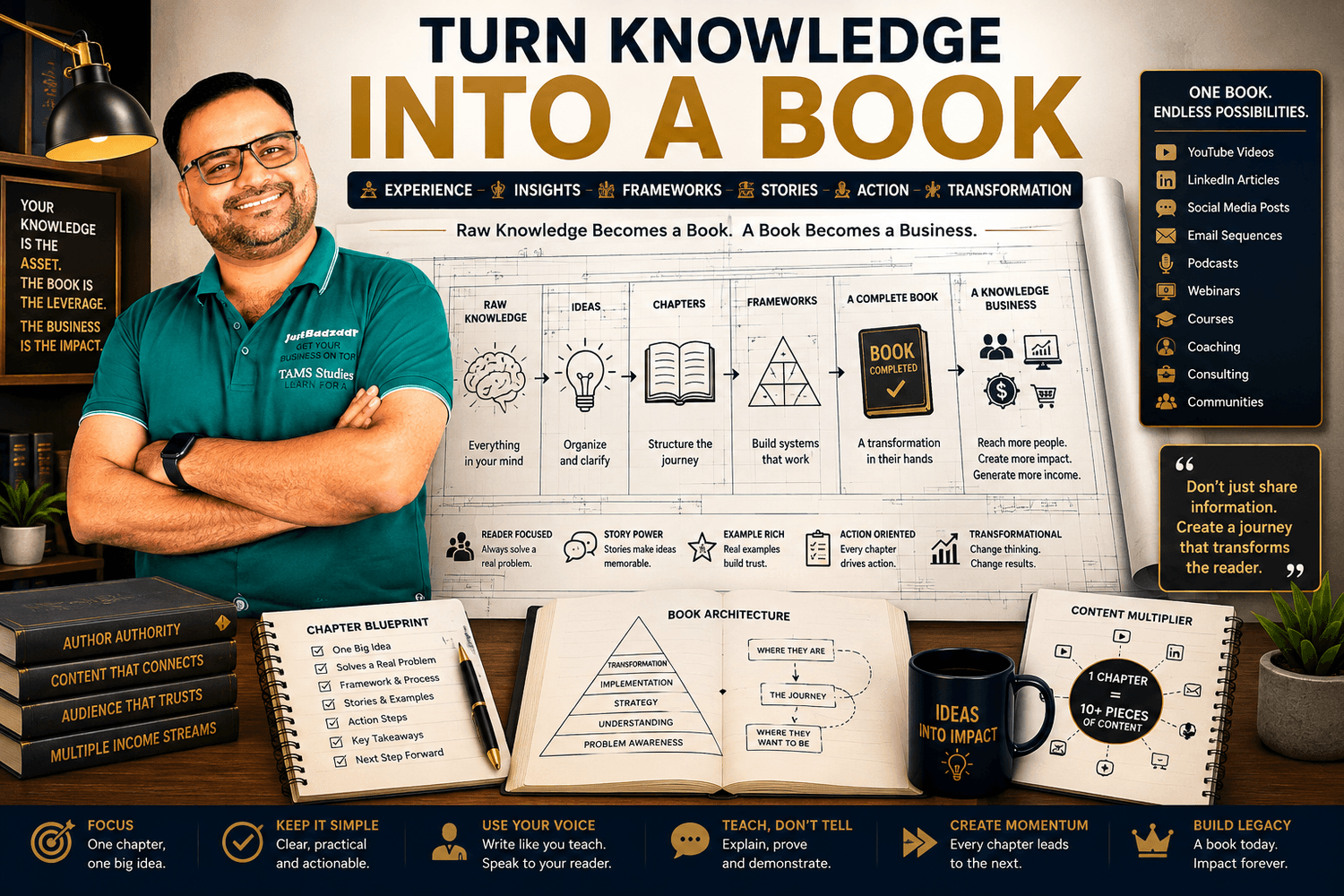
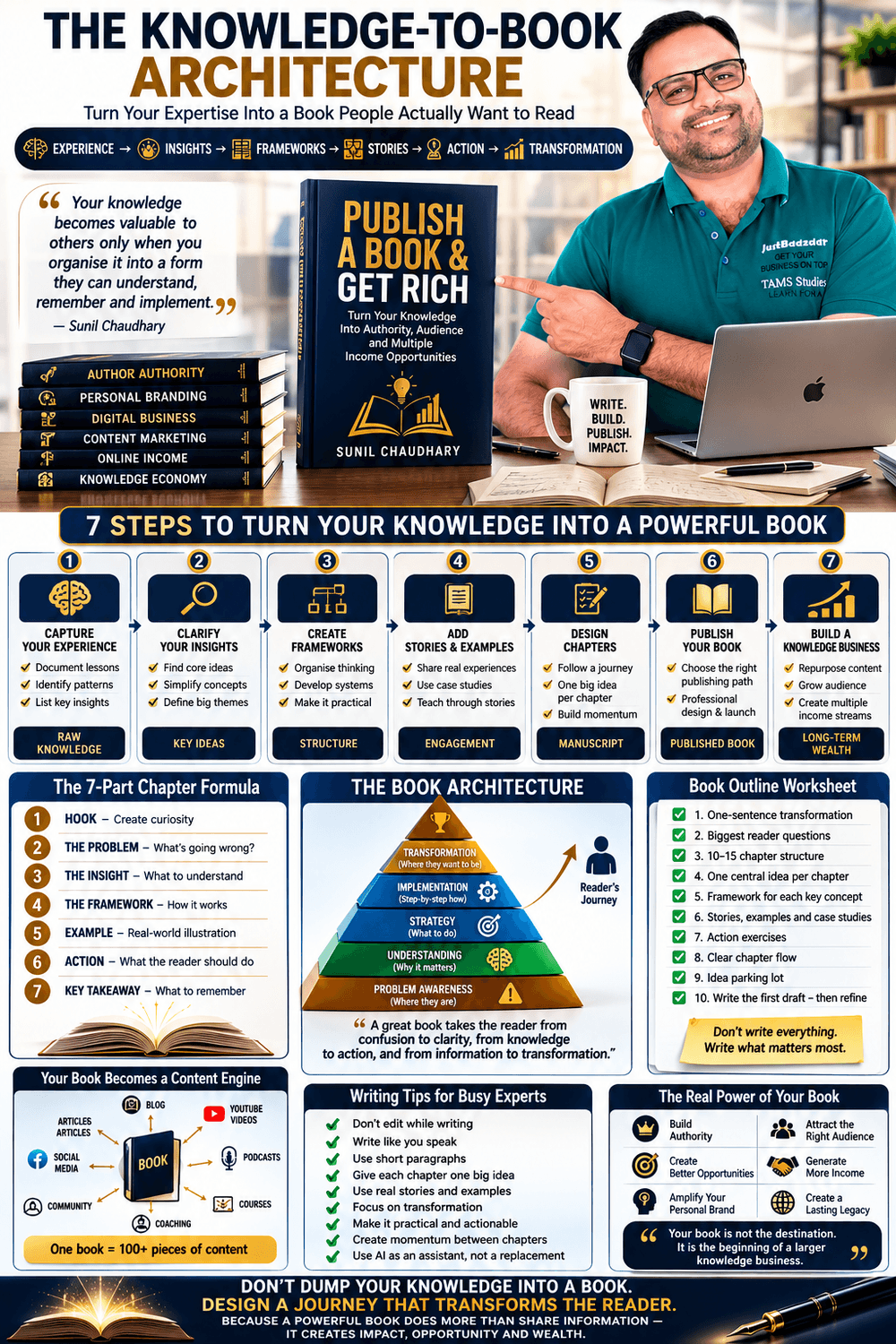
How to Write Your Book Faster Without Sacrificing Quality
Now comes the part where many aspiring authors suddenly discover the real enemy.
It is not lack of knowledge.
It is not lack of ideas.
It is not even lack of writing ability.
It is inconsistency.
You start writing on Monday.
You feel inspired.
You write 2,000 words.
On Tuesday, something else becomes important.
On Wednesday, you are busy.
On Thursday, you decide to research the topic more.
On Friday, you rewrite Monday's chapter.
A month later, you still have one chapter.
Six months later, the book is still unfinished.
I have seen this pattern repeatedly.
People say:
“I want to write a book.”
But wanting to write a book and actually completing a manuscript are two completely different things.
If you want to publish a book and build wealth around your knowledge, you need a system that makes writing predictable.
You do not need to wait for inspiration.
You need a writing process.
Stop Waiting for Inspiration
This is one of the biggest myths about writing.
People imagine that successful authors wake up every morning overflowing with inspiration.
They sit at a beautiful desk.
Coffee beside them.
Music playing.
The perfect idea arrives.
They write for six hours.
The manuscript magically grows.
Reality is usually much less glamorous.
Writing is often repetitive.
Some days you will feel brilliant.
Some days you will feel completely ordinary.
Some days you will write 2,000 words.
Some days you will struggle with 300.
The important thing is not whether every writing session feels extraordinary.
The important thing is that the manuscript continues moving forward.
Consistency beats inspiration.
Your Goal Is Not to Write a Book
This may sound strange.
But when you sit down to work, do not tell yourself:
“I have to write a book.”
That goal is too large.
Your brain sees 40,000 or 50,000 words and immediately feels overwhelmed.
Instead, tell yourself:
“I am going to write today's section.”
That is manageable.
Then tomorrow, write another section.
Then another.
Eventually, those sections become chapters.
Those chapters become a manuscript.
The manuscript becomes a book.
The book becomes an asset.
Big outcomes are often created through very small repeated actions.
Calculate the Book Backwards
Let's make this practical.
Suppose your target manuscript is approximately 40,000 words.
You want to complete the first draft in 60 days.
That means you need approximately:
667 words per day.
That is not an impossible number.
You could potentially write that in one focused session.
Now imagine you write:
1,000 words per day × 40 days = 40,000 words.
Suddenly, the book looks achievable.
This is the power of reverse planning.
Don't stare at the mountain.
Calculate the steps.
Choose Your Daily Word Target
There is no universal word count that every author must follow.
Choose a target you can maintain.
For example:
Beginner Writer
500 words per day
Consistent Writer
750–1,000 words per day
Experienced Writer
1,500+ words per day
The number matters less than consistency.
If you can write 700 words every weekday, that can produce approximately:
3,500 words per week.
In twelve weeks:
42,000 words.
That is already a substantial manuscript.
You do not need to write 10,000 words every day.
You need to keep showing up.
Create a Book Writing Calendar
Treat your book like a project.
Create a simple calendar.
For example:
Week
Target
Week 1
3,500 words
Week 2
3,500 words
Week 3
3,500 words
Week 4
3,500 words
Week 5
3,500 words
Week 6
3,500 words
Week 7
3,500 words
Week 8
3,500 words
Week 9
3,500 words
Week 10
3,500 words
Week 11
3,500 words
Week 12
3,500 words
You now have a target of approximately 42,000 words.
That is far more concrete than saying:
“I will finish my book soon.”
Soon is not a deadline.
A calendar is.
Divide Your Book Into Writing Sprints
Instead of thinking about the entire manuscript, divide it into sprints.
For example:
Sprint 1: Introduction
Sprint 2: Chapters 1–2
Sprint 3: Chapters 3–4
Sprint 4: Chapters 5–6
Sprint 5: Chapters 7–8
And so on.
Every sprint should have a clear outcome.
When you complete it, you should be able to say:
“That part is done.”
Small wins create momentum.
Create a Writing Environment
Your environment matters more than you think.
Before every writing session, remove unnecessary friction.
Keep your:
Laptop ready
Manuscript open
Notes available
Research documents organised
Water nearby
Phone away
Notifications disabled
Writing timer ready
The objective is simple:
Reduce the number of decisions between you and the first sentence.
If you spend 20 minutes deciding what to work on, you have already lost valuable energy.
Know your task before the writing session begins.
Use a “Next Sentence” Strategy
Sometimes the hardest part of writing is beginning.
You open the document.
You look at the cursor.
Nothing happens.
Here is a simple trick.
Do not ask:
“How do I write this chapter?”
Ask:
“What is the next thing I want the reader to understand?”
Write that.
Then ask:
“What example would make this clearer?”
Write that.
Then:
“What should the reader do with this information?”
Write that.
You are no longer trying to write an entire chapter.
You are simply continuing a conversation.
Write the Way You Teach
If you are a coach, consultant, trainer, speaker or educator, you already have a secret advantage.
You probably explain ideas verbally every day.
Use that ability.
Imagine one ideal reader is sitting across from you.
You are explaining the concept to them.
What would you say?
Write it.
Do not initially worry about making it sound like a “book”.
Get the teaching onto the page first.
Then improve the writing.
This often produces more natural and engaging content.
Record Yourself Speaking
This can be a powerful technique for people who speak better than they write.
Open a voice recorder.
Choose one topic.
Talk for 10–15 minutes.
Explain it naturally.
Tell a story.
Give an example.
Answer an imaginary question.
Then convert that conversation into a written draft.
You can edit it later.
The advantage is that your natural speaking voice often contains:
Stories
Examples
Analogies
Emphasis
Personality
Natural transitions
Those elements can make a book feel more human.
Use the “Teach One Person” Method
Imagine that you are helping one specific person.
Not:
“My audience.”
Not:
“Everyone.”
One person.
Perhaps they are intelligent but confused.
Perhaps they are ambitious but inexperienced.
Perhaps they know the basics but cannot implement.
Now write specifically for that person.
You will naturally become clearer.
Your examples will become more relevant.
Your language will become more direct.
And your writing will feel like a conversation rather than a lecture.
Write in Layers
You do not need to produce a perfect chapter in one pass.
Use layers.
Layer 1: Ideas
Get the ideas onto the page.
Layer 2: Structure
Arrange the ideas logically.
Layer 3: Examples
Add stories, case studies and illustrations.
Layer 4: Clarity
Remove confusing language.
Layer 5: Flow
Improve transitions.
Layer 6: Authority
Add evidence, frameworks and original insights.
Layer 7: Polish
Improve grammar, rhythm and style.
This is much more efficient than trying to produce perfection sentence by sentence.
Separate Creation From Editing
This deserves special attention.
Do not become your own editor while you are trying to become your own writer.
During creation, your job is to generate.
During editing, your job is to judge.
Those are different mental modes.
When you constantly switch between them, you slow yourself down.
Write the rough version.
Keep moving.
Then return later.
You will often discover that the rough version contains more energy than the over-edited version.
Use the “Bad First Draft” Principle
Your first draft is allowed to be imperfect.
In fact, it should be.
You may write:
“I need a better example here.”
“Add research later.”
“Rewrite this section.”
“Insert case study.”
That is perfectly fine.
Keep moving.
A rough manuscript can be improved.
A blank document cannot.
Your first draft is not your final product.
It is the raw material for your final product.
Don't Research Forever
Experts can become trapped in research.
They find one article.
Then another.
Then another book.
Then another study.
Then another podcast.
Then another interview.
Eventually, they know everything about the topic but have written nothing.
Research is important.
But research must have a boundary.
Create a research list.
Write down:
What do I actually need to verify?
Then research those questions.
Do not turn every writing session into an endless research expedition.
Create a Research Parking Lot
If you discover something interesting while writing, do not immediately disappear into Google.
Write:
[RESEARCH: add current statistics about publishing market]
Then continue writing.
Later, return to the research list.
This preserves momentum.
You can research several related questions in one focused session.
That is far more efficient.
Know the Difference Between Facts and Your Ideas
Your manuscript may contain several types of material:
Your Experience
What happened to you?
Your Opinion
What do you believe?
Your Framework
What system have you developed?
External Evidence
What research supports the claim?
Examples
How does the idea work in practice?
Keeping these categories distinct makes your writing stronger.
When you make a factual claim that needs support, verify it.
When you share your experience, identify it as your experience.
When you present your framework, make it clear that it is your approach.
This creates intellectual honesty.
Build Your Signature Frameworks
One of the best ways to accelerate writing is to create repeatable frameworks.
For example:
The 5-Step Author Wealth Framework
The 7-Part Book Architecture
The Knowledge-to-Authority Model
The Publish-to-Profit System
Once you have a framework, you can explain it through:
Diagrams
Chapters
Stories
Examples
Exercises
Videos
Workshops
A framework gives your book structure and gives your audience something memorable to take away.
Use Examples Before Abstract Theory
If an idea is difficult, introduce it through an example.
For instance:
Instead of saying:
“Positioning is the process of establishing differentiated market relevance.”
Say:
“Imagine two authors write books about personal branding. One writes for everyone. The other writes specifically for coaches who want to build a client-generating personal brand. The second author has a clearer position.”
Now explain the theory.
The reader understands the concept before encountering the terminology.
That is good teaching.
Make Every Chapter Produce an Outcome
Before starting a chapter, write:
After reading this chapter, the reader will be able to ________.
Fill in the blank.
Perhaps:
identify their ideal reader.
Or:
create a book promise.
Or:
build a publishing plan.
Or:
design a monetisation strategy.
Then make the chapter deliver that outcome.
This creates accountability.
The chapter is no longer just information.
It becomes an experience.
Use Chapter Completion Criteria
You can create a simple checklist.
A chapter is ready for editing when it contains:
☐ A strong opening
☐ One central idea
☐ A clear problem
☐ Relevant explanation
☐ Practical framework
☐ Examples or stories
☐ Action steps
☐ Key takeaway
☐ Transition to the next chapter
This prevents you from endlessly asking:
“Is this chapter finished?”
You have a standard.
Meet the standard.
Move on.
Use Technology to Increase Leverage
Modern authors have access to tools that previous generations did not have.
You can use technology for:
Voice-to-text
Grammar checking
Document organisation
Reference management
Mind mapping
Outline creation
Content repurposing
AI-assisted brainstorming
Search research
SEO analysis
But remember:
Technology should reduce friction.
It should not replace your intellectual contribution.
Your experience remains the foundation.
AI Can Help You Think Faster
Used responsibly, AI can help you:
Generate questions your readers may ask
Challenge your assumptions
Identify gaps in an outline
Suggest alternative structures
Create chapter checklists
Turn a framework into an infographic concept
Repurpose a chapter into social content
Improve readability
Find repetitive sections
Suggest examples
However, do not simply ask AI to generate an entire book and publish the output without serious human review.
Your reputation is attached to the book.
Your name is on the cover.
Your authority is at stake.
Use AI as a powerful assistant.
Remain the author.
Create a Weekly Author Dashboard
If you are serious about publishing, track the project.
Your dashboard can include:
Manuscript Progress
Words written: 12,500
Target: 40,000
Completion: 31%
Chapters
Completed: 5
In progress: 2
Remaining: 8
Research
Open questions: 7
Verified: 24
Content
Articles created: 8
Videos created: 5
Audience
Email subscribers: ___
Waitlist: ___
This turns writing into a measurable project.
Protect Your Writing Time
If you wait until your entire day is free, you may never write your book.
There will always be:
Emails.
Meetings.
Clients.
Family responsibilities.
Messages.
Unexpected problems.
Business decisions.
Therefore, create protected writing blocks.
Even 45–60 minutes of focused writing can produce meaningful progress.
The key is protecting the time.
Put it on your calendar.
Treat it like an important business meeting.
Because it is.
Create a “No Zero Days” Rule
Some days you may have very little time.
Fine.
Write 100 words.
Write 200.
Write one paragraph.
Review an outline.
Record a voice note.
Improve a heading.
The goal is to maintain continuity.
A small action keeps the project alive.
Because once you stop for weeks, restarting becomes psychologically expensive.
Momentum is an asset.
Protect it.
The 30-Minute Emergency Writing Session
Suppose you have only 30 minutes.
Do this:
First 5 Minutes
Review what you wrote yesterday.
Next 20 Minutes
Write without editing.
Final 5 Minutes
Leave yourself a note about what comes next.
That final step is powerful.
Write:
“Tomorrow, explain why authors should build an email list before launch.”
Now tomorrow's session already has a starting point.
You do not have to figure out where to begin.
End Mid-Sentence Sometimes
This is an interesting technique.
If you know you will continue tomorrow, stop while you still know what you want to say.
For example:
**“The biggest mistake most authors make when building their audience is…”
Stop.
Tomorrow, you already know where to begin.
You are not facing a blank page.
You are continuing an existing thought.
That can reduce resistance significantly.
Don't Aim for Perfect Word Counts
A book is not valuable because it contains 50,000 words.
It is valuable because those words create value.
A 30,000-word book that transforms the reader can be far more valuable than a 70,000-word book filled with repetition.
Do not inflate your manuscript merely to hit a number.
Write what needs to be written.
Remove what does not.
Clarity is more important than length.
Read Your Manuscript Aloud
When your first draft is complete, read it aloud.
You will discover things your eyes miss.
You will notice:
Repetition
Awkward sentences
Missing transitions
Unnatural phrasing
Long paragraphs
Weak openings
Unclear explanations
If a sentence feels difficult to say, it may also be difficult to read.
Reading aloud is one of the simplest editing techniques available.
Get an External Reader
Eventually, your manuscript needs another pair of eyes.
Ideally, give it to someone who represents your target reader.
Ask:
Where were you confused?
Where did you become bored?
What did you find most valuable?
What do you remember?
What would you remove?
What did you want more of?
Do not only ask:
“Did you like it?”
That question produces weak feedback.
Ask specific questions.
Remember What You Are Actually Building
You are not simply creating a manuscript.
You are building an intellectual asset.
Your book can become:
A credibility asset
A lead-generation asset
A content asset
A speaking asset
A teaching asset
A personal branding asset
A search visibility asset
A product asset
A business development asset
That is why completing the book matters.
From Manuscript to Business Asset
Imagine the finished book.
One chapter becomes a YouTube video.
Another becomes a LinkedIn article.
Another becomes a webinar.
Another becomes a workshop.
Another becomes a lead magnet.
Another becomes an email sequence.
Another becomes a coaching module.
Your book now has a life beyond the pages.
That is the real leverage.
One idea can travel through many formats.
Your 60-Day Author Sprint
If you want a concrete challenge, try this.
Days 1–5
Finalise your outline.
Days 6–35
Write the first draft.
Aim for approximately 1,000 words per day.
Days 36–45
Complete missing sections and strengthen examples.
Days 46–52
Structural edit.
Days 53–56
Language and readability edit.
Days 57–58
Proofreading and fact verification.
Days 59–60
Final manuscript preparation and publishing checklist.
The exact timeline will vary by book.
But the principle is important:
Give your book a deadline.
Without a deadline, a book can remain “almost finished” forever.
Your Section 9 Author Action Plan
Today, create these five things:
1. Your Target Word Count
Example:
40,000 words
2. Your Deadline
Example:
60 days
3. Your Daily Target
Example:
700–1,000 words
4. Your Writing Block
Example:
7:00–8:00 AM
5. Your Progress Dashboard
Track:
Words + Chapters + Research + Editing + Content
Then start.
Not tomorrow.
Not when the perfect writing environment appears.
Start with the next paragraph.
Key Takeaway
You do not finish a book by writing whenever you feel inspired. You finish it by creating a system that makes writing inevitable.
Choose a target.
Break it into manageable pieces.
Protect your writing time.
Separate writing from editing.
Use your natural speaking voice.
Build frameworks.
Use stories.
Use technology intelligently.
Track your progress.
And most importantly:
Keep moving.
Because there will come a day when the blank document disappears.
The chapters will be written.
The manuscript will be complete.
Your name will be on the cover.
And you will realise something important:
You did not become an author on the day your book was published.
You became an author the day you decided to finish it.
And now that you know how to create the manuscript consistently, the next question becomes even more important:
How do you edit, polish and professionally package your book so that it looks and feels like a book worth paying for?
That is the next stage of the journey.
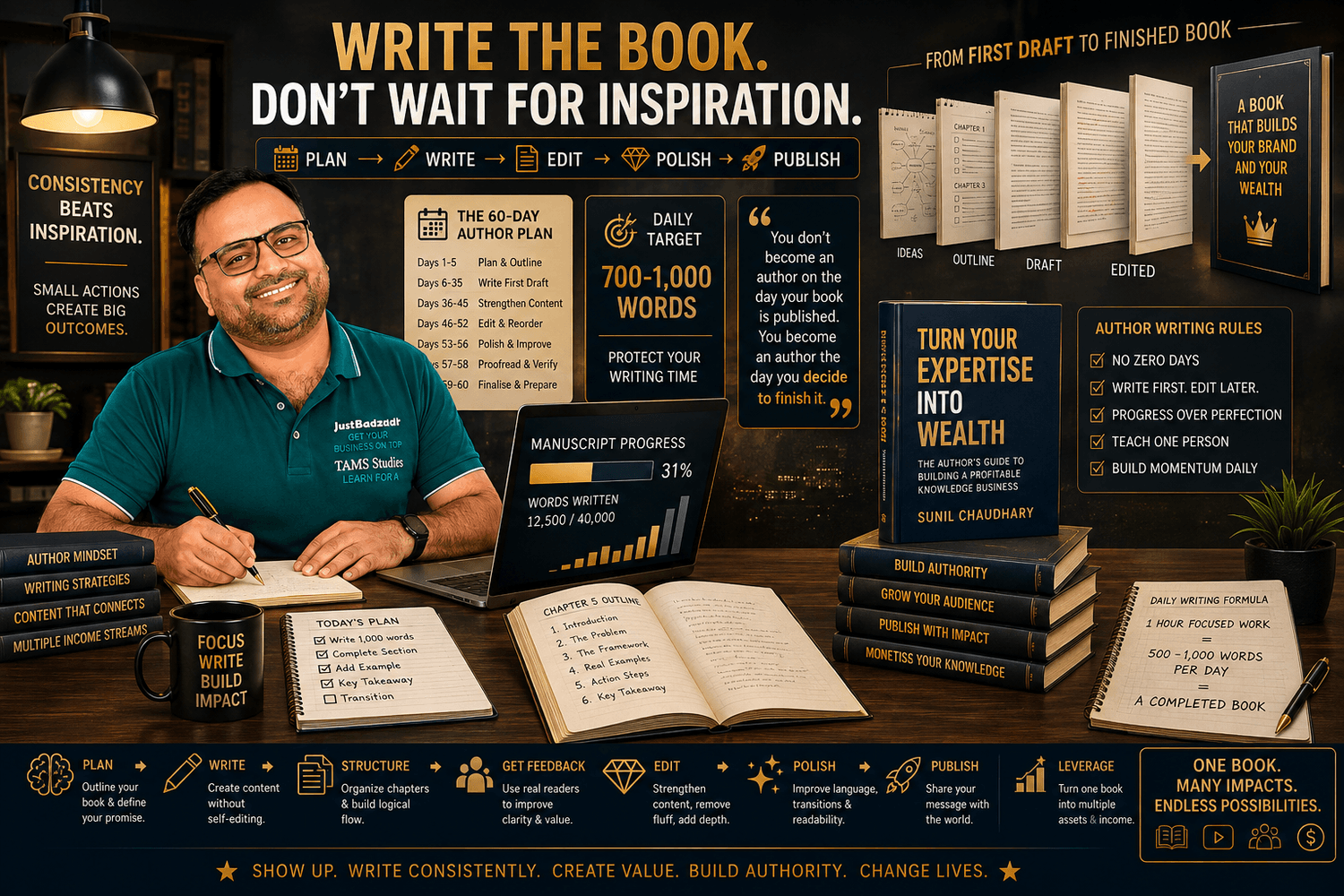
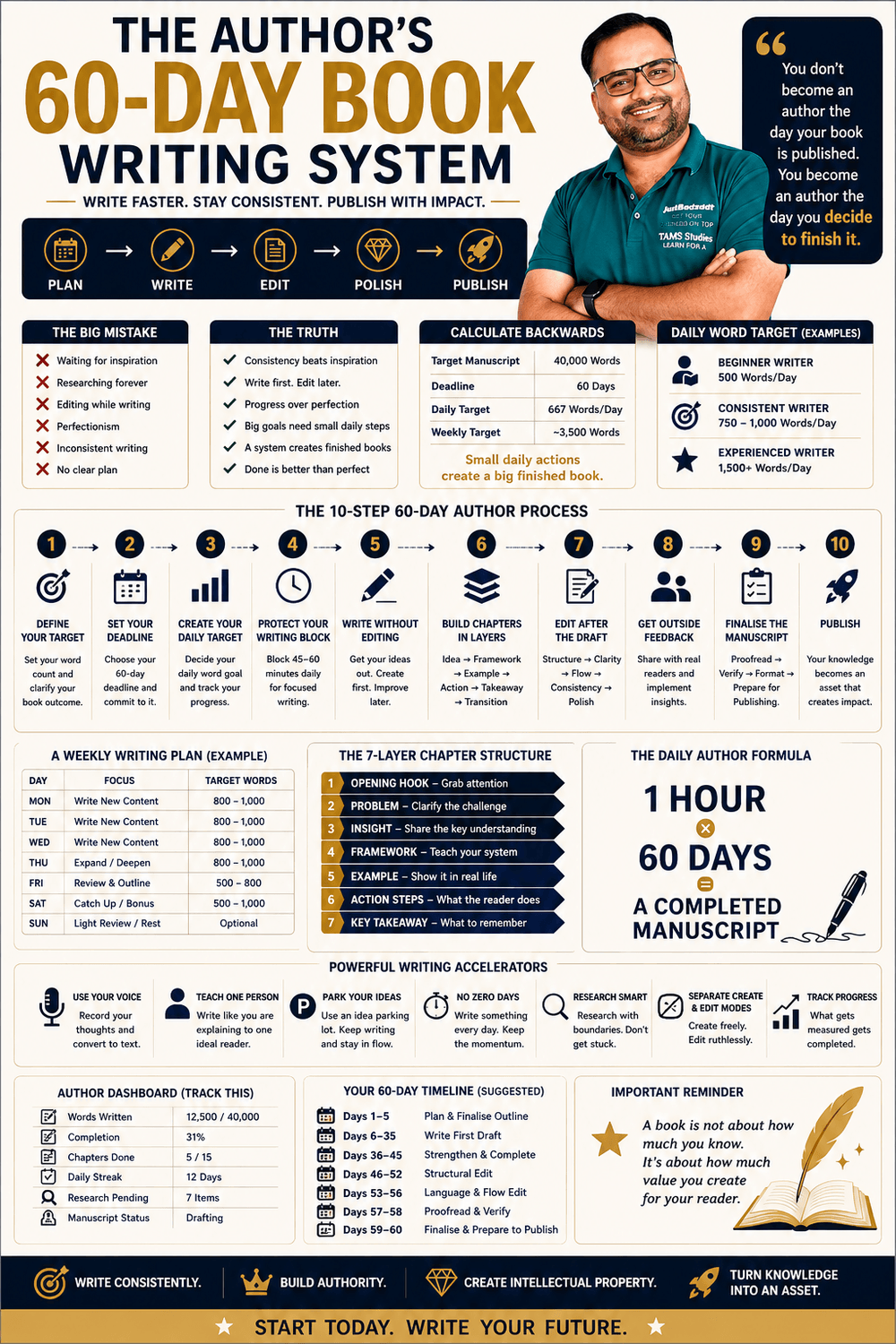
How to Publish Your Book Professionally: Traditional Publishing, Self-Publishing and Hybrid Options
Writing the manuscript is a major achievement.
But it is not the finish line.
It is the beginning of another important stage:
Publishing.
And this is where many new authors become confused.
They hear terms such as:
Traditional publishing
Self-publishing
Independent publishing
Hybrid publishing
Print-on-demand
Ebooks
Audiobooks
ISBN
Distribution
Book metadata
Retail platforms
Bookstores
Suddenly, something that seemed simple becomes complicated.
So let me simplify it.
If your goal is to publish a book and get rich, you should not think about publishing merely as the process of putting a manuscript into a bookstore.
Think bigger.
Publishing is the process of turning your manuscript into a discoverable, credible and commercially usable intellectual property asset.
That changes the entire conversation.
Publishing Is a Business Decision
Your publishing model affects:
How quickly you can launch
How much control you have
How much you may need to invest
How the book is distributed
How you manage pricing
How you control the cover and positioning
How you handle rights
How you build your author brand
How quickly you can make changes
How you monetise the intellectual property
Therefore, do not choose a publishing model simply because another author used it.
Choose based on your goals.
If your primary objective is literary recognition, your decision may be different.
If your primary objective is building a personal brand, your decision may be different.
If your primary objective is creating a business around your expertise, your decision may be different again.
The Three Major Publishing Paths
For most independent authors, the conversation usually begins with three broad paths:
Traditional Publishing
A publishing company acquires and publishes your book.
Self-Publishing
You control the publishing process and use publishing and distribution services yourself.
Hybrid Publishing
A model that combines elements of traditional and independent publishing, depending on the specific arrangement.
There are legitimate businesses operating under different models.
However, the contracts, economics and services can vary significantly.
So never choose a publisher simply because someone promises:
“We will make you a bestseller.”
Understand exactly what you are buying.
Traditional Publishing
Traditional publishing is the model most people imagine when they think about becoming an author.
You write a manuscript.
You approach agents or publishers.
The publisher evaluates the proposal or manuscript.
If they are interested, they may offer a publishing agreement.
The publisher may then take responsibility for some or most of the production and distribution process.
Depending on the contract, this can include:
Editing
Cover design
Production
Distribution
Marketing support
Rights management
However, the exact arrangement varies.
And there is an important reality:
Getting traditionally published can be competitive.
A strong manuscript does not automatically guarantee a publishing deal.
Advantages of Traditional Publishing
Traditional publishing can provide significant benefits.
1. Professional Infrastructure
A good publisher may provide experienced editors, designers and production professionals.
2. Distribution
Depending on the publisher and territory, you may gain access to established distribution networks.
3. Industry Credibility
Being published by a respected publishing house can contribute to perceived authority.
4. Editorial Support
Professional editorial feedback can improve the manuscript.
5. Rights Expertise
Publishers may have experience handling different forms of rights and licensing.
For some authors, these advantages are extremely valuable.
The Limitations of Traditional Publishing
However, traditional publishing also has trade-offs.
You may have less control over:
Cover design
Title
Pricing
Publication schedule
Marketing decisions
Distribution strategy
Formats
International rights
The contract determines the details.
There may also be a longer timeline between manuscript submission and publication.
And even after securing a publishing deal, authors should not assume the publisher will handle every aspect of marketing.
Modern authors often need to participate actively in building their audience.
Self-Publishing
Self-publishing has changed the publishing landscape dramatically.
Instead of waiting for a traditional publisher to approve your manuscript, you can manage the publishing process yourself or hire specialists.
You control the project.
You can choose:
The title
The subtitle
The cover
The interior design
The pricing strategy
The publication schedule
The marketing strategy
The distribution channels
The formats
This can be particularly attractive for entrepreneurs, coaches, consultants and knowledge creators.
Why?
Because speed and control can be extremely valuable.
Self-Publishing Does Not Mean Doing Everything Yourself
This is an important distinction.
Self-publishing does not mean you personally have to become:
An editor
A graphic designer
A typesetter
A proofreader
A distributor
A marketing specialist
A metadata expert
An audiobook producer
You can build a professional team.
For example:
You: Author and intellectual property owner
↓
Editor: Improves the manuscript
↓
Proofreader: Checks language and errors
↓
Designer: Creates the cover and interior
↓
Publishing Specialist: Prepares files and metadata
↓
Distributor: Makes the book available through selected channels
↓
Marketing System: Drives discovery and sales
That is still an independently controlled publishing operation.
The Biggest Advantage: Speed
Imagine finishing your manuscript today.
With an independent publishing approach, you can potentially move toward publication without waiting for a traditional acquisition process.
That does not mean you should rush.
Professional preparation still matters.
You need editing.
You need proofreading.
You need a good cover.
You need correct formatting.
You need accurate metadata.
You need distribution planning.
You need a launch strategy.
But you control the timeline.
And speed can matter enormously in a rapidly changing market.
The Biggest Advantage: Control
For me, control is one of the most attractive features of independent publishing.
Imagine you discover that a chapter is outdated.
You can update it.
You discover a better case study.
You can add it.
You want to change the subtitle.
You can evaluate the change.
You want to release an updated edition.
You can plan it.
You want to create a workbook.
You can create it.
You want to turn the book into a course.
You can do that too.
Your intellectual property becomes an asset you can develop over time.
Hybrid Publishing Requires Careful Due Diligence
The term hybrid publishing can mean different things depending on the company and contract.
Therefore, do not assume that every organisation using the word “hybrid” offers the same model.
Ask:
What exactly do I receive?
What am I paying for?
Who owns the copyright?
Who controls the ISBN?
Who controls the files?
Who owns subsidiary rights?
What distribution is actually included?
What marketing is actually included?
What happens if I want to leave?
Can I publish future editions independently?
Are there additional fees?
What sales reporting will I receive?
What happens to unsold inventory?
These questions are not negative.
They are professional.
Never Sign a Publishing Contract You Do Not Understand
This deserves a strong warning.
A publishing agreement can contain important provisions involving:
Copyright
Territory
Duration
Formats
Royalties
Advances
Licensing
Translation rights
Audio rights
Film and television rights
Digital rights
Adaptation rights
Reversion clauses
Exclusivity
Do not sign simply because you are excited to see your name on a book cover.
Read the agreement carefully.
If necessary, seek qualified legal advice from someone experienced in publishing contracts.
Your intellectual property may become one of your most valuable long-term assets.
Treat it accordingly.
Copyright Is an Asset
Your manuscript is your intellectual creation.
Depending on the jurisdiction and circumstances, copyright protection generally gives creators certain rights over their original works.
However, publishing contracts can transfer or license particular rights.
This is why you must understand the distinction between:
Owning the work
and
licensing rights to someone else.
For an author building a long-term business, this distinction can become extremely important.
Imagine your book becomes successful.
Someone wants to translate it.
Another company wants to create an audiobook.
A media company wants to adapt it.
An education company wants to license your framework.
If you have retained or properly structured the relevant rights, you may have additional opportunities.
Think in Rights, Not Just Royalties
This is one of the most important ideas in this entire article.
Many new authors ask:
“How much royalty will I receive per book?”
That is a useful question.
But it is not the only question.
Also ask:
“What rights am I giving away?”
Your book may contain intellectual property that can potentially exist in many formats.
For example:
Ebook
Audiobook
Translation
Course
Workshop
Corporate training
Speaking
Licensing
Certification
Digital products
The exact opportunities depend on your subject, market and rights arrangements.
But the principle remains:
Your book can contain more value than the physical book itself.
Print Is Only One Format
Modern readers consume information in different ways.
Consider offering appropriate formats such as:
Paperback
Good for physical reading and gifting.
Hardcover
Can support premium positioning where appropriate.
Ebook
Convenient for digital readers.
Audiobook
Useful for people who prefer listening.
Workbook
Useful for implementation-focused topics.
Companion Resources
Checklists, templates, worksheets and other materials can deepen the reader experience.
You do not necessarily need every format on day one.
Choose based on your audience.
Print-on-Demand Can Reduce Inventory Risk
One important development in modern publishing is print-on-demand.
Instead of printing thousands of copies and storing them in a warehouse, a book can be printed when an order is placed through a suitable distribution system.
This can reduce the need for large upfront inventory commitments.
It can be especially useful for independent authors.
However, print economics vary.
You should calculate:
Retail Price − Printing Cost − Distribution Fees − Platform Fees = Your Contribution
Do not assume that a high retail price automatically means high profit.
Understand the economics.
Calculate Your Unit Economics
Let's imagine, purely as an example, that your book sells for $20.
Suppose your total variable publishing and distribution costs consume a significant portion of that price.
Your actual contribution may be much smaller than the $20 headline price.
That is why you should know:
Retail price
Printing cost
Distribution cost
Platform fees
Discount structure
Royalty or revenue share
Taxes
Advertising cost
Promotional discounts
Then calculate your actual economics.
This is business.
Not just publishing.
Do Not Choose a Price Emotionally
Some authors say:
“My book contains 50,000 words, so it should cost $30.”
That is not how pricing works.
Price depends on:
Category
Audience
Format
Positioning
Competitive context
Perceived value
Author authority
Distribution
Production cost
Business strategy
A book can be a low-cost entry product.
Or it can be a premium professional resource.
Your pricing should fit the strategy.
Your Book Can Be the Entry Point
This is where publishing becomes particularly interesting for experts and entrepreneurs.
Suppose you sell a book for $15.
The book introduces your ideas.
A reader finds it useful.
They visit your website.
They join your email list.
They watch your videos.
They attend a free masterclass.
Then perhaps they purchase a workshop.
Later, some become coaching clients.
Others purchase a course.
Some may hire you for consulting.
Now the economics have changed.
You are no longer asking:
“How much money did I make from this one book?”
You are asking:
“What business relationship did this book create?”
That is a much more powerful question.
The Book-as-a-Funnel Model
Think about the journey:
BOOK
↓
WEBSITE
↓
LEAD MAGNET
↓
EMAIL LIST
↓
EDUCATIONAL CONTENT
↓
WEBINAR / MASTERCLASS
↓
CORE OFFER
↓
PREMIUM SERVICE
This does not mean every reader will travel through the entire journey.
They will not.
But some may.
And the book can serve as the first point of contact.
That is why your book should contain a clear, relevant next step.
Your Book Should Have a Call to Action
A book without a next step may leave your reader wondering:
“What now?”
Give them an appropriate next step.
For example:
Download the companion workbook.
Join the author's newsletter.
Watch the free training.
Take the assessment.
Access the templates.
Join the community.
Book a consultation.
The CTA should make sense in context.
It should provide additional value.
It should not feel like the book suddenly became a sales brochure.
Build Your Author Website
If you want your book to become part of a long-term business, your website matters.
Create a dedicated author or book page.
It can include:
Book title
Cover
Author introduction
Book promise
Reader benefits
Reviews
Testimonials
Formats
Frequently asked questions
Media appearances
Companion resources
Email signup
Relevant next step
The book should not exist in isolation.
It should live inside your digital ecosystem.
Your Book Metadata Matters
Metadata is one of those technical areas that authors often ignore.
But metadata can influence how your book is categorised and discovered.
Depending on the publishing platform, metadata can include information such as:
Title
Subtitle
Author name
Description
Categories
Keywords
Language
Format
Publication information
Think of metadata as the digital information architecture surrounding your book.
Your book cover may attract attention.
Your metadata helps platforms understand what the book is about.
Write a Powerful Book Description
Your book description is not merely a summary.
It is a conversion asset.
A strong description can include:
The Problem
What is frustrating the reader?
The Promise
What can the reader learn?
The Transformation
What will they be able to do?
The Differentiation
Why is your approach different?
The Audience
Who is this book for?
The CTA
What should they do next?
Avoid simply writing:
“This book contains 12 chapters about…”
That may describe the structure.
It does not necessarily sell the transformation.
Think Like a Search Marketer
This is where my SEO background becomes particularly relevant.
Your book needs to be discoverable.
Your website needs to be discoverable.
Your author profile needs to be discoverable.
Your supporting content needs to be discoverable.
Think about the questions your ideal reader is searching.
Then build your content ecosystem around those questions.
For example:
How to publish a book
How to self-publish a book
How to market a book
How to sell more books
How authors make money
How to build an author brand
How to turn a book into a business
These topics can become your content strategy.
Build Topic Clusters Around the Book
Suppose your book is about author entrepreneurship.
Your central topic could be:
Publish a Book and Build Wealth
Then create supporting content around:
How to choose a profitable book topic
How to write a book
How to publish a book
How to market a book
How to build an author platform
How to sell books online
How to build an email list as an author
How to create products from a book
How to monetise intellectual property
Your book becomes the central authority asset.
Your articles and videos become discovery channels.
Create a Professional Book Production Checklist
Before publishing, review:
Manuscript
☐ Developmental editing complete
☐ Copy editing complete
☐ Proofreading complete
☐ Fact checking complete
Design
☐ Cover complete
☐ Interior design complete
☐ Front matter complete
☐ Back matter complete
Publishing
☐ ISBN requirements understood
☐ Metadata prepared
☐ Book description prepared
☐ Categories selected
☐ Keywords researched
☐ Formats prepared
Marketing
☐ Author website updated
☐ Book landing page ready
☐ Email campaign ready
☐ Social content prepared
☐ Launch assets prepared
☐ Reviews strategy prepared
This checklist can prevent avoidable mistakes.
Don't Rush the Cover
Your cover is one of your most important marketing assets.
A professional cover should communicate:
Category
Promise
Positioning
Quality
Author identity
And it should remain readable at thumbnail size.
Do not overcrowd it.
Do not use too many fonts.
Do not add unnecessary visual elements.
Do not try to communicate the entire book on the cover.
The cover's job is to create a strong first impression and encourage further exploration.
Your Author Photo Matters
For non-fiction, business, coaching and professional books, your photograph can be an important authority signal.
Use a professional photograph.
Keep it aligned with your brand.
Your author photo should communicate the identity you want readers to associate with your work.
If your positioning is premium, your photography should support that.
Consistency matters across:
Book
Website
YouTube
Podcast profiles
Speaking materials
You are building one author brand.
Publishing Is Not Launching
This distinction is critical.
Publishing means making the book available.
Launching means creating attention around its availability.
You can publish a book quietly.
You can also create a strategic launch.
A launch might include:
Pre-launch content
Author interviews
Email campaigns
Reader communities
Podcast appearances
Webinars
Social media
Reviews
Partnerships
Speaking events
Video content
Publishing creates availability.
Marketing creates discovery.
Do Not Expect the Platform to Market the Book for You
Uploading a book does not automatically create demand.
This is one of the most important realities new authors need to understand.
A distribution platform can make your book available.
But availability is not the same as attention.
Your job is to create attention.
Build an audience.
Create content.
Start conversations.
Build relationships.
Generate interest.
Earn reviews.
Create useful resources.
Develop your author platform.
The strongest long-term advantage is often not the publishing platform.
It is your relationship with your audience.
Build Your Audience Before Launch
If possible, start before the publication date.
Share:
The problem your book solves.
Lessons from the manuscript.
Behind-the-scenes writing.
Research discoveries.
Frameworks.
Stories.
Questions.
Short excerpts where appropriate.
Reader discussions.
You are gradually building awareness.
Then when the book launches, you are not starting from zero.
Your First Readers Matter
You do not need millions of readers on day one.
You need the right first readers.
They can:
Read the book
Give honest feedback
Identify mistakes
Share reviews
Recommend it
Discuss the ideas
Help you discover what resonates
Build a genuine community around the book.
Do not think only about transaction.
Think about participation.
Reviews Are Social Proof
Reviews can reduce uncertainty.
A potential reader may think:
“Is this book actually useful?”
Reviews help answer that question.
However, reviews should be genuine.
Do not buy fake reviews.
Do not manufacture testimonials.
Do not manipulate readers into making misleading claims.
Ask genuine readers to share honest feedback if they enjoyed the book and found it useful.
Trust compounds.
So does distrust.
Think Beyond the First Edition
Your first edition does not have to be the final version forever.
You may eventually release:
Updated Edition
Expanded Edition
Workbook Edition
Professional Edition
Audiobook
International Edition
Translated Edition
The possibilities depend on your rights, audience and market.
This is another reason to think of your book as intellectual property rather than a one-time event.
Build a Publishing Flywheel
Here is the model I want you to remember:
WRITE
↓
EDIT
↓
PUBLISH
↓
DISTRIBUTE
↓
PROMOTE
↓
COLLECT FEEDBACK
↓
IMPROVE
↓
CREATE CONTENT
↓
BUILD AUDIENCE
↓
SELL BOOK
↓
CREATE DEEPER OFFERS
↓
REINVEST
↓
GROW AUTHOR BRAND
This is a flywheel.
You are not doing one activity.
You are building a system.
The Real Goal Is Not “Published Author”
Becoming a published author is an achievement.
But if your larger goal is wealth, authority and impact, do not stop there.
Your goal should be to become an author with an ecosystem.
There is a huge difference.
A published author has a book.
An author with an ecosystem has:
A book
An audience
A platform
A content engine
A mailing list
A framework
An offer
A community
A reputation
A long-term intellectual property strategy
That is where the real leverage can emerge.
My Recommended Mindset
If you ask me what mindset you should have before publishing, I would say:
Don't ask, “How do I get my book published?”
Ask:
“How do I turn this book into an asset that creates value for readers and strengthens my long-term business?”
That question changes your decisions.
You become more careful about rights.
More thoughtful about positioning.
More serious about editing.
More strategic about distribution.
More intentional about marketing.
And much more focused on the reader.
Your Section 10 Action Plan
Before choosing your publishing route, answer these questions:
1. What is my primary objective?
Authority?
Income?
Audience growth?
Traditional recognition?
Business development?
Impact?
2. How much control do I want?
3. How quickly do I want to publish?
4. What professional help do I need?
5. What rights am I willing to license?
6. What formats do I want?
7. What is my unit economics?
8. What is my distribution strategy?
9. What is my launch strategy?
10. What happens after someone reads the book?
That final question is one of the most important.
Because your book should not be the end of the customer journey.
It should be the beginning of a relationship.
Key Takeaway
Publishing is not simply putting your manuscript on a platform. It is the process of turning your knowledge into a professional, discoverable and commercially useful intellectual property asset.
Choose your publishing model strategically.
Understand your rights.
Invest in professional editing and design.
Prepare your metadata.
Build your author website.
Create your distribution plan.
Build your audience.
Prepare your launch.
And think beyond royalties.
Because if you are serious about the idea of publishing a book and getting rich, the bigger opportunity may not be the money you make from the book itself.
The bigger opportunity may be what the book causes to happen next.
A reader discovers you.
They trust you.
They join your ecosystem.
They consume your content.
They attend your event.
They buy your programme.
They hire you.
They recommend you.
They introduce you to another opportunity.
That is how a book can become a business asset.
And now we reach one of the most important questions in the entire journey:
How do you actually get people to discover, buy and talk about your book after it is published?
That is the subject of the next section.
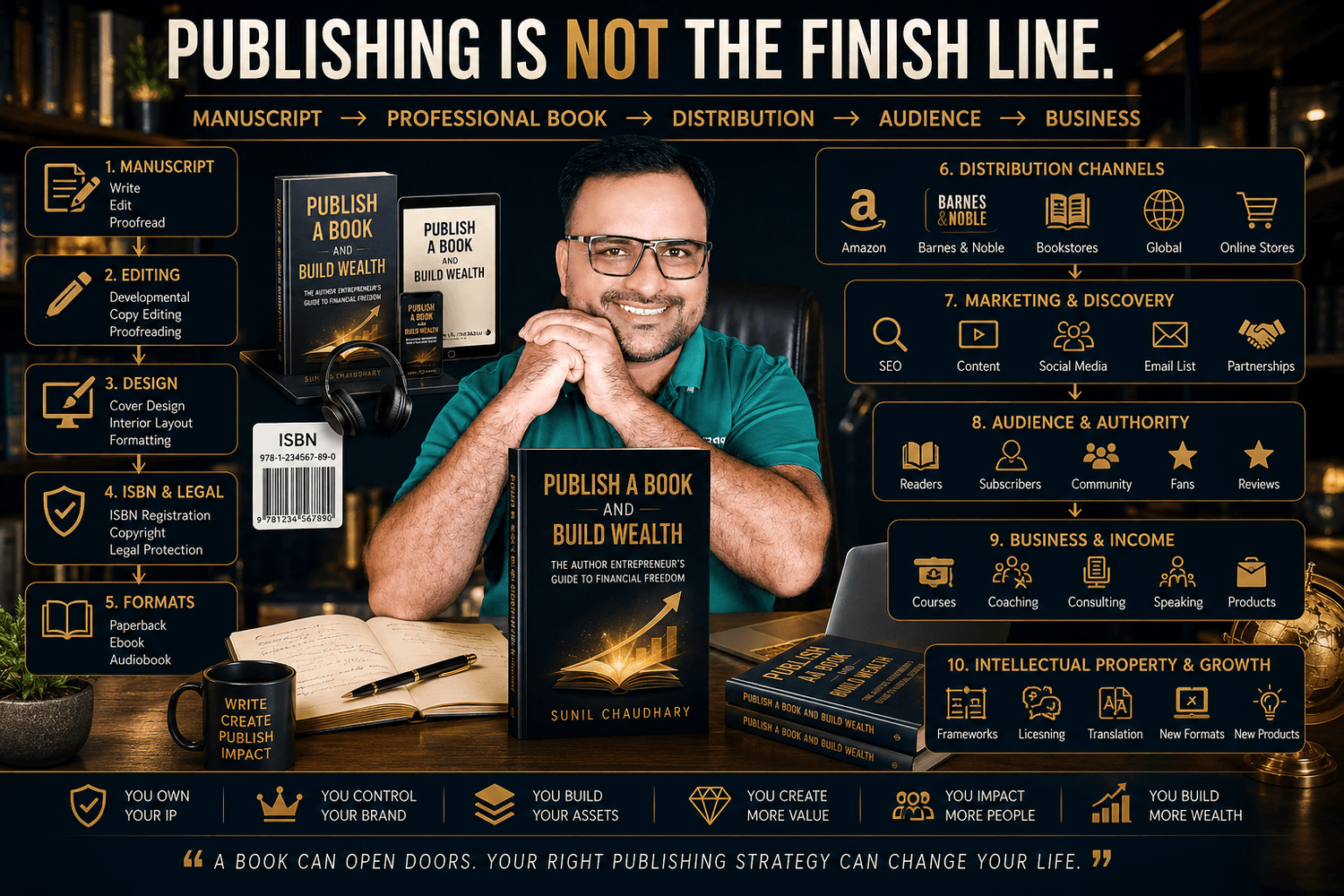
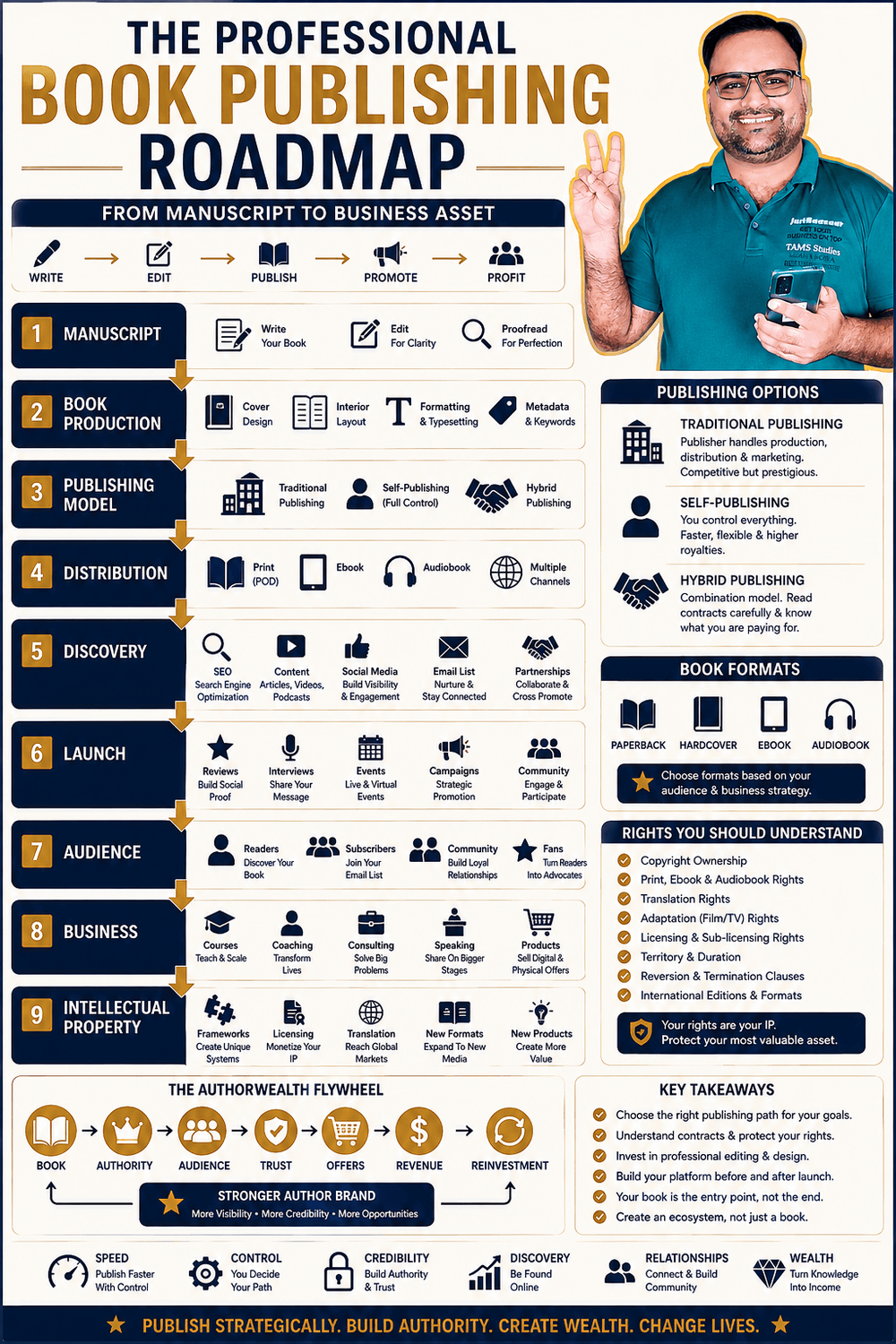
How to Market Your Book and Build a Powerful Author Brand
Publishing your book is an achievement.
But publishing is only the beginning.
The next challenge is getting the right people to discover it.
Because here is an uncomfortable truth:
A great book can remain invisible.
You can spend months researching.
You can spend weeks writing.
You can invest in editing and professional design.
You can publish a beautiful book.
And still, very few people may know that it exists.
Why?
Because quality does not automatically create visibility.
Visibility has to be built.
That is why every serious author needs to understand book marketing.
And if your bigger objective is to publish a book and get rich, you need to think beyond selling copies.
You need to build an author brand.
Your book should become a powerful reason for people to discover you, trust you, follow you and eventually buy other products or services from you.
That is where the real opportunity begins.
Your Book Needs an Audience Before It Needs Sales
When most people think about book marketing, they immediately think:
“How can I sell more copies?”
I want you to think differently.
First ask:
“How can I get more of the right people to discover my ideas?”
Because discovery comes before sales.
The journey often looks like this:
DISCOVERY
↓
CURIOSITY
↓
INTEREST
↓
TRUST
↓
PURCHASE
↓
EXPERIENCE
↓
RECOMMENDATION
You cannot force someone to purchase a book they have never heard about.
Therefore, marketing begins long before the transaction.
The Author Is Part of the Product
This is particularly true in non-fiction.
If you write fiction, readers may primarily connect with the story, characters and world.
But if you write about:
Business
Marketing
Coaching
Leadership
Personal development
Finance
Entrepreneurship
Technology
Education
Professional expertise
the author becomes part of the value proposition.
Readers are asking:
Who wrote this?
Why should I trust this person?
What experience do they have?
What makes their approach different?
Your book answers some of these questions.
Your author brand answers the rest.
Build Your Author Positioning
Before you start publishing hundreds of promotional posts, define your positioning.
Complete this sentence:
“I help [specific audience] achieve [specific outcome] through [specific expertise or approach].”
For example:
“I help coaches, experts and knowledge entrepreneurs turn their expertise into digital businesses through content, personal branding and digital marketing.”
That statement is much more powerful than:
“I am an author, entrepreneur and coach.”
Why?
Because the first statement communicates:
Audience + Problem + Outcome + Method
That creates positioning.
Your Book Should Strengthen Your Positioning
Your book should reinforce the identity you want to own.
If you want to become known for digital business, your book should support that.
If you want to become known for leadership, your book should strengthen that association.
If you want to become known for personal branding, your book should reinforce that category.
This creates repetition.
And repetition creates association.
Eventually, people begin to connect:
Your Name → Your Topic → Your Framework → Your Book
That is powerful.
Don't Try to Market to Everyone
One of the biggest mistakes authors make is trying to reach everyone.
They write:
“This book is for everyone who wants success.”
That sounds attractive.
But it is strategically weak.
Who exactly is the reader?
A student?
A corporate executive?
A founder?
A coach?
A freelancer?
A parent?
A retiree?
A new entrepreneur?
The clearer your audience, the easier it becomes to create relevant marketing.
Create Your Ideal Reader Profile
Write down:
Who are they?
What do they do?
What are they trying to achieve?
What frustrates them?
What have they already tried?
What are they afraid of?
What do they want badly?
What questions do they ask?
Where do they spend time online?
What kind of content do they consume?
This information becomes the foundation of your marketing strategy.
Your Book Is a Content Factory
This is one of the most powerful ideas I want you to understand.
Your book should not be promoted only as:
“Buy my book.”
That becomes repetitive.
Instead, use the ideas inside the book to create valuable content.
Suppose your book has 20 chapters.
Each chapter can generate:
Short videos
Long-form videos
Blog posts
LinkedIn posts
Carousels
Infographics
Emails
Podcast episodes
Webinars
Interviews
Frequently asked questions
Case studies
Checklists
Worksheets
Suddenly, your book becomes a content factory.
One Chapter Can Become an Entire Campaign
Imagine you have a chapter called:
“Why Most Authors Never Make Money.”
That single chapter could become:
YouTube Video
Why Most Authors Never Make Money From Their Books
Short Video
3 Reasons Your Book Is Not Selling
LinkedIn Post
Your Book Is Not Your Business
Carousel
7 Author Mistakes That Destroy Book Sales
The biggest mistake I see new authors making
Infographic
The Author Wealth Funnel
Webinar
How to Turn Your Book Into a Business
One chapter.
Multiple assets.
One central idea.
That is leverage.
Build Your Content Around Search Intent
This is where SEO becomes extremely powerful.
Your audience is already asking questions.
Your job is to discover those questions and answer them.
For example:
How do I publish a book?
How much does it cost to publish a book?
How do I self-publish a book?
How do authors make money?
How do I market my book?
How do I sell more books?
How do I become a successful author?
How do I build an author brand?
Can a book help me grow my business?
Each question can become a piece of content.
Over time, these pieces form a search-driven content ecosystem.
Create a Book-Centred SEO Strategy
Do not optimise only the book page.
Build an entire topic ecosystem.
Your central topic might be:
Publish a Book and Build Wealth
Then create supporting content around:
Publishing
How to publish a book
Self-publishing guide
Traditional vs self-publishing
How to prepare a manuscript
Writing
How to write a book
How to structure a book
How to finish a book
How to write faster
Marketing
How to market a book
How to launch a book
How to promote a book
How to get book reviews
Business
How authors make money
How to turn a book into a business
How to monetise intellectual property
How to build an author business
This creates topical depth.
Your Book Should Have a Digital Home
Create a dedicated page for your book.
Do not rely exclusively on third-party marketplaces.
Your website should become the central destination for your author brand.
Your book page can include:
Book cover
Title
Subtitle
Author introduction
Core promise
Reader benefits
Table of contents
Testimonials
Reviews
Media
FAQs
Purchase options
Companion resources
Email signup
Next-step CTA
Now your book has a home you control.
Build an Author Hub
If you plan to publish multiple books, take this one step further.
Create an author hub.
It can include:
About the Author
Books
Articles
Videos
Podcast appearances
Media
Speaking
Resources
Courses
Community
Contact
This changes your digital identity.
You are no longer simply someone who published a book.
You become a knowledge brand.
Use Your Book as an Authority Signal
Imagine two consultants approach a potential corporate client.
Consultant A says:
“I have 15 years of experience.”
Consultant B says:
“I have 15 years of experience, and I have written a book on this subject.”
The second statement can create an additional authority signal.
The book does not automatically prove expertise.
But it demonstrates that the person has organised their thinking into a substantial body of work.
That can influence perception.
Your Book Can Open Doors
A book can create opportunities beyond book sales.
For example:
Podcasts
Hosts need interesting guests.
Conferences
Event organisers need speakers.
Media
Journalists need subject-matter experts.
Corporations
Businesses need trainers and consultants.
Universities
Institutions need speakers and educators.
Communities
Groups need experts who can teach.
Partnerships
Brands need credible collaborators.
The book becomes a credibility asset that can help start conversations.
Build a Media Strategy
Do not wait for journalists to discover you.
Create a list of relevant media opportunities.
Think about:
Podcasts
YouTube interviews
Industry publications
News websites
Business communities
Professional newsletters
Online events
Webinars
Panels
When you appear on these platforms, do not only promote the book.
Teach something useful.
Share a framework.
Tell a story.
Answer a difficult question.
Give the audience a reason to remember you.
Then the book becomes a natural next step.
Use the “Teach, Don't Pitch” Principle
If every post says:
“Buy my book.”
people will eventually stop listening.
Instead:
Teach.
Give them a useful idea.
Then another.
Then another.
Demonstrate your thinking.
Share your frameworks.
Explain mistakes.
Show examples.
Tell stories.
Eventually, people will ask:
“Where can I learn more?”
That is when your book becomes highly relevant.
Build the 90-Day Author Content Engine
Here is a simple model.
Month 1: EDUCATE
Teach the major problems your book solves.
Create:
Educational videos
Articles
Posts
FAQs
Infographics
Month 2: BUILD AUTHORITY
Share:
Stories
Case studies
Frameworks
Results
Interviews
Behind-the-scenes content
Month 3: CONVERT
Introduce:
Book
Reader resources
Launch events
Masterclasses
Webinars
Community
Now you have a content journey.
Use the 5 Content Pillars
For your author brand, I recommend five major content pillars.
1. Education
Teach something valuable.
2. Authority
Demonstrate your experience.
3. Story
Show your journey.
4. Transformation
Show what is possible.
5. Invitation
Give people a next step.
This prevents your content from becoming one long sales campaign.
Your Personal Story Matters
People may discover your book because of a keyword.
But they may connect with you because of your story.
Talk about:
Where you started.
What you struggled with.
What you learned.
What failed.
What worked.
What changed.
Why you wrote the book.
Your story gives context to your expertise.
But remember:
Your story should serve the reader.
Do not tell your story only to celebrate yourself.
Tell it so the reader can find themselves inside it.
Turn Your Journey Into a Narrative
A strong author narrative can follow this pattern:
I faced a problem.
↓
I tried something.
↓
It did not work.
↓
I learned something.
↓
I developed a better approach.
↓
I tested it.
↓
It created results.
↓
Now I teach it to others.
This creates credibility without needing to constantly say:
“I am an expert.”
Your journey demonstrates it.
Build Your Signature Ideas
Every strong author brand needs memorable ideas.
Think about the phrases you want people to associate with you.
For example:
“Your book is not the business. Your book can become the foundation of the business.”
Or:
“Knowledge becomes an asset when it is organised, packaged and distributed.”
Or:
“Don't write a book to become famous. Write a book that makes you useful to the right people.”
These ideas become intellectual fingerprints.
People begin remembering the philosophy behind your work.
Create Frameworks People Can Name
A framework becomes more powerful when it is memorable.
Instead of:
“There are several stages to building an author business.”
Create:
The AUTHOR Wealth Framework
A — Authority
U — Understanding the audience
T — Transformation
H — Human connection
O — Offers
R — Revenue
The exact framework should reflect your genuine methodology.
The important principle is:
Give your ideas names.
Named frameworks are easier to remember, teach and discuss.
Create a Signature Book Funnel
A simple book funnel could look like:
Step 1
Someone discovers your article.
↓
Step 2
They watch your video.
↓
Step 3
They discover your book.
↓
Step 4
They visit your website.
↓
Step 5
They download a free resource.
↓
Step 6
They join your email list.
↓
Step 7
They receive valuable education.
↓
Step 8
They attend your masterclass.
↓
Step 9
They explore your deeper offer.
This is where your book can become a powerful business entry point.
Create a Free Resource Connected to Your Book
Instead of simply asking readers to buy, offer something useful.
For example:
Book Workbook
Author Business Checklist
Chapter Action Guide
Book Marketing Planner
Knowledge Monetisation Checklist
Book Launch Calendar
Author Wealth Calculator
The resource should naturally complement the book.
This creates another reason for readers to visit your website.
Build an Email List
Social media platforms can change.
Algorithms can change.
Reach can change.
Your email list gives you a direct communication channel with people who have chosen to hear from you.
Use your book to encourage relevant readers to join your list.
Then continue providing value.
Send:
Lessons
Case studies
Ideas
Book insights
New resources
Events
New content
Relevant offers
The objective is not to spam people.
The objective is to build a relationship.
Your Email List Can Become More Valuable Than Your Bestseller Status
A bestseller badge may create attention.
But an engaged audience can create long-term business value.
Imagine having 10,000 people who actively read your emails.
You publish another book.
You launch a course.
You host an event.
You release a workshop.
You introduce a new service.
You have a relationship with an audience that already understands your ideas.
That is an asset.
Use Social Media Strategically
Do not try to be everywhere.
Choose platforms where your ideal audience actually spends time.
For a professional author, this could include platforms such as:
YouTube
X
Podcasts
The exact mix depends on your audience.
The principle is simple:
Be visible where your readers already are.
LinkedIn Can Be Powerful for Business Authors
If your book is about:
Business
Leadership
Marketing
Entrepreneurship
Personal branding
Professional growth
LinkedIn can be particularly useful for authority-building.
You can publish:
Lessons from your book
Business insights
Case studies
Contrarian opinions
Frameworks
Short stories
Reader questions
Do not make every post promotional.
Build intellectual credibility.
YouTube Can Turn Your Book Into a Search Engine
Long-form video is especially powerful for educational authors.
One chapter can become a detailed video.
Then create shorter clips from that video.
Your video can rank for relevant questions.
A viewer discovers the video.
They learn from you.
They become familiar with your voice.
Then they discover your book.
Now the relationship is deeper.
Use Short-Form Content for Discovery
Short videos can introduce your ideas to new people.
A simple structure is:
Hook
“Most authors make this mistake after publishing their book.”
Insight
Explain the problem.
Value
Give one practical solution.
CTA
“I explain the complete framework in my book and resources.”
The short-form content creates curiosity.
The long-form content builds depth.
The book builds authority.
Build a Book Launch Team
You do not have to launch alone.
Identify people who genuinely support your work.
They might include:
Existing readers
Students
Clients
Peers
Industry friends
Podcast hosts
Community leaders
Professional contacts
Give them useful launch material.
For example:
Book announcement
Author story
Key quote cards
Short video
Book summary
Launch information
Make it easy for supporters to share.
Do Not Buy Fake Popularity
This deserves to be said clearly.
Do not build your author brand on:
Fake reviews
Fake followers
Fake testimonials
Fake sales screenshots
Artificial engagement
These may create temporary appearances.
But they destroy trust.
Your goal is not to look successful.
Your goal is to become valuable.
Build real readers.
Real relationships.
Real authority.
Real outcomes.
Measure the Right Metrics
Book sales matter.
But they are not the only metric.
Track:
Discovery
Website visitors
Search impressions
Video views
Social reach
Engagement
Email signups
Comments
Shares
Watch time
Downloads
Conversion
Book purchases
Event registrations
Lead magnet downloads
Consultation requests
Business
Course sales
Coaching enquiries
Consulting opportunities
Speaking invitations
Partnership opportunities
Now you can understand the full impact of your book.
The Book Marketing Flywheel
Here is the system:
BOOK
↓
CONTENT
↓
SEARCH
↓
DISCOVERY
↓
AUDIENCE
↓
TRUST
↓
BOOK SALES
↓
REVIEWS
↓
AUTHORITY
↓
MORE CONTENT
↓
MORE DISCOVERY
The flywheel becomes stronger over time.
Every new piece of content can introduce another person to the book.
Every reader can potentially introduce another person.
Every review can reduce uncertainty.
Every interview can expand your reach.
Think Long-Term
Do not judge your book marketing after seven days.
Some books become relevant gradually.
Your article may rank months later.
Your YouTube video may gain traction later.
A podcast interview may introduce you to someone six months from now.
A reader may recommend your book to a business owner.
That business owner may invite you to speak.
That speaking opportunity may create several clients.
You cannot always predict the path.
That is why you build an ecosystem.
Your Book Can Become a Reputation Engine
This is the deeper opportunity.
When you consistently publish:
Books
Articles
Videos
Frameworks
Research
Case studies
Interviews
you begin creating a public body of work.
People can discover your thinking from multiple directions.
Your reputation becomes less dependent on one post going viral.
You are building a searchable library of your expertise.
That is incredibly powerful.
Don't Chase Virality
A million views from the wrong audience may produce less business than 10,000 views from the right audience.
Your objective should not simply be:
More views.
It should be:
More relevant attention.
Ask:
Did the right people discover me?
Did they understand my expertise?
Did they trust my approach?
Did they take the next step?
That is a better definition of marketing success.
The Author Brand Formula
Remember this:
Expertise + Content + Distribution + Trust + Consistency = Author Brand
Your book provides depth.
Your content provides reach.
Your distribution provides discovery.
Your relationships create trust.
Your consistency creates recognition.
Together, they build an author brand.
Your Section 11 Action Plan
Before launching your book, create these assets:
1. Author Positioning Statement
Who do you help and what do you help them achieve?
2. Author Website
Create a central home for your book and expertise.
3. Book Landing Page
Make the book easy to understand and discover.
4. Content Calendar
Plan at least 30–90 days of content around your book.
5. Search Strategy
Identify the questions your audience is searching.
6. Email List
Create a mechanism for building direct relationships.
7. Free Resource
Offer a useful companion resource.
8. Launch Campaign
Plan your announcements, interviews, content and events.
9. Authority Strategy
Build podcasts, videos, articles, speaking and partnerships.
10. Business Path
Decide what readers can do after reading your book.
Key Takeaway
Do not publish a book and then hope people discover it. Build the discovery system before you publish.
Your book should become the centre of your content ecosystem.
Your content should introduce people to your ideas.
Your SEO should help people discover your expertise.
Your social media should create conversations.
Your email list should build relationships.
Your interviews should expand your reach.
Your website should give people a place to go deeper.
And your offers should help readers implement what you teach.
Because the goal is not simply to become an author.
The goal is to become a recognised authority with an audience that trusts your ideas.
And once you understand that, the next question becomes extremely interesting:
What if your book could become more than a marketing tool? What if you could turn the knowledge inside your book into multiple products, services and revenue streams?
That is where we go next.
How to Turn One Book Into Multiple Income Streams
Here is where the idea of “publish a book and get rich” becomes much more interesting.
If you think the only way to make money from a book is to sell copies, you are thinking too narrowly.
Book royalties can be useful.
But for an expert, coach, consultant, trainer, educator, entrepreneur or knowledge creator, the book itself may be only one part of the opportunity.
The real power of a book is that it can organise your knowledge into intellectual property.
Once your knowledge is organised, you can potentially distribute, teach, license, package and expand it in multiple ways.
Think about it like this:
One idea.
One framework.
One book.
Then:
Book → Content → Course → Workshop → Coaching → Consulting → Speaking → Licensing
That is leverage.
And this is one of the biggest mindset shifts I want you to make.
Do not ask only, “How much money can my book make?” Ask, “How many valuable assets can I build from the knowledge inside my book?”
Your Book Is a Knowledge Asset
Imagine that you have spent 15 years learning about a particular subject.
You have made mistakes.
You have studied.
You have experimented.
You have worked with clients.
You have developed frameworks.
You have collected stories.
You have discovered what works.
You have discovered what does not work.
All of that knowledge exists inside your head.
That creates a problem.
Your knowledge is difficult to scale when it exists only inside your head.
A book begins solving that problem.
It takes your knowledge and converts it into a structured asset.
Now people can read it.
They can share it.
They can discuss it.
They can teach from it.
They can reference it.
They can discover you through it.
And, depending on your business model and rights, you can potentially build additional products and services around it.
The Knowledge-to-Wealth Ladder
I like to think about this as a ladder.
Level 1: Knowledge
You know something valuable.
↓
Level 2: Framework
You organise the knowledge into a repeatable methodology.
↓
Level 3: Book
You document the methodology.
↓
Level 4: Content
You distribute ideas from the book.
↓
Level 5: Audience
People discover and follow your work.
↓
Level 6: Products
You package deeper implementation.
↓
Level 7: Services
You help people apply the knowledge.
↓
Level 8: Licensing
You potentially allow others to use appropriate intellectual property under suitable agreements.
↓
Level 9: Ecosystem
Your intellectual property becomes the foundation of a larger business.
This is how one body of knowledge can potentially create multiple forms of value.
Income Stream #1: Book Sales
Let's begin with the obvious one.
You can sell:
Paperback books
Hardcover books
Ebooks
Audiobooks
Special editions
The economics depend on your publishing model, pricing, production costs, distribution arrangements and other factors.
But remember:
Book sales are only the first layer.
If you build a strong audience, book sales can become a meaningful revenue stream.
However, I would not build your entire wealth strategy around book royalties.
Instead, use the book to open the door to the larger ecosystem.
Income Stream #2: Companion Workbooks
A book explains.
A workbook helps people implement.
This distinction can be commercially useful.
Suppose your book teaches:
How to Build a Personal Brand
You could create a companion workbook containing:
Exercises
Worksheets
Templates
Reflection questions
Planning pages
Checklists
Implementation tasks
Now you have another product.
The reader does not simply consume your ideas.
They work through them.
That creates a different kind of value.
Income Stream #3: Digital Templates
Your book may contain processes that can be converted into templates.
For example:
Business planning template
Content calendar
Book launch planner
Personal branding worksheet
Marketing checklist
Customer research template
Goal-setting worksheet
Sales script
Email template
Strategy canvas
Instead of leaving these tools buried inside the book, package them as useful digital resources.
Your book becomes the theory.
Your templates become the implementation tools.
Income Stream #4: Online Courses
This is one of the most natural extensions.
Suppose your book contains 12 chapters.
Those chapters can potentially become 12 course modules.
For example:
Module 1
Understanding the Problem
Module 2
Finding Your Position
Module 3
Building Your Framework
Module 4
Creating Your Content
Module 5
Publishing
Module 6
Marketing
And so on.
The book gives readers the intellectual foundation.
The course can provide:
Video lessons
Demonstrations
Assignments
Templates
Quizzes
Community
Implementation support
Now your knowledge has moved from reading to learning.
Income Stream #5: Live Workshops
Not everyone wants to learn alone.
Some people want interaction.
That creates another opportunity.
Turn one major concept from your book into a live workshop.
For example:
The 3-Hour Author Business Workshop
or
The Book-to-Business Masterclass
You can teach the framework.
Answer questions.
Review participant work.
Demonstrate implementation.
Give assignments.
The workshop can also become a natural bridge between your book and your higher-value services.
Income Stream #6: Group Coaching
Some readers will want more than information.
They will want guidance.
They may say:
“I understand the strategy, but I don't know how to implement it.”
That is where coaching can become relevant.
You can create a group coaching programme around the transformation promised by your book.
For example:
90-Day Author Business Accelerator
Participants might receive:
Weekly sessions
Implementation assignments
Community access
Templates
Feedback
Accountability
Q&A sessions
The book becomes the foundation.
The coaching becomes the implementation environment.
Income Stream #7: One-to-One Consulting
At the premium end of the ecosystem, you can offer personalised help.
Suppose your book is about building a digital business.
A reader may want you to review their:
Business model
Marketing strategy
Personal brand
Content system
Sales funnel
Digital assets
Instead of simply selling another copy of the book, you are now selling your expertise and personalised attention.
This is one reason authority books can be valuable for consultants.
The book demonstrates your thinking.
The consultation applies it to an individual situation.
Income Stream #8: Corporate Training
Your book may also have applications inside organisations.
Imagine you have written a book about:
Leadership
Sales
Customer experience
Digital transformation
Communication
Productivity
Personal branding
Artificial intelligence
Marketing
Companies may need training around these topics.
You can potentially create corporate workshops based on your intellectual property.
Now your book becomes part of your corporate positioning.
Income Stream #9: Speaking
A strong book can strengthen your speaking platform.
Event organisers want speakers who can provide useful ideas.
Your book gives them a clear representation of your thinking.
You can build speaking topics directly from your book.
For example:
The Future of Digital Business
The Knowledge Economy
Build Your Personal Brand
From Expertise to Income
The Author Entrepreneur
The exact topics should reflect your genuine expertise.
The important idea is this:
Your book can become a speaking asset.
Income Stream #10: Paid Masterclasses
You do not always need a massive course.
Sometimes a focused masterclass is enough.
Take one important chapter.
Expand it.
Add examples.
Add exercises.
Add live Q&A.
Then create a 90-minute or two-hour masterclass.
For example:
How to Build a Profitable Author Brand
Your book introduces the concept.
Your masterclass provides deeper implementation.
This creates a natural product ladder.
Income Stream #11: Memberships and Communities
Some topics require ongoing support.
If your book teaches a process that takes months to implement, consider building a community around it.
Members could receive:
Live sessions
Q&A
New resources
Monthly workshops
Peer interaction
Expert sessions
Accountability
The book becomes the common foundation.
The community becomes the ongoing environment.
Income Stream #12: Certification
This requires more thought and should only be used where genuinely appropriate.
If you have developed a robust methodology that others can legitimately learn and apply, you may eventually create a structured certification programme.
For example:
Certified Digital Business Coach
or
Certified Personal Branding Practitioner
The programme might include:
Training
Assessments
Practical application
Standards
Supervised implementation
Certification requirements
If you pursue this model, be very clear about what the certification means.
A certificate should represent real learning and competency, not simply payment.
Income Stream #13: Licensing Your Intellectual Property
This is where intellectual property becomes particularly interesting.
Suppose you have created:
A framework
A methodology
A curriculum
A proprietary process
You may potentially license appropriate rights to other organisations under suitable agreements.
For example, an organisation might want to use your methodology in its training programme.
Instead of personally delivering every session, you could structure a licensing arrangement.
This can potentially create leverage.
However, licensing is a legal and commercial area where professional advice is often worthwhile.
Your contract should clearly define:
What is being licensed
To whom
For how long
In which territory
For which purpose
Whether sublicensing is allowed
What fees apply
What quality standards apply
Income Stream #14: Translation and International Editions
A successful idea does not necessarily have to remain in one language.
Depending on your subject and audience, your intellectual property may have international potential.
A book could potentially become:
Spanish edition
French edition
German edition
Arabic edition
Hindi edition
and others.
Translation is not simply changing words from one language to another.
Cultural context matters.
The quality of the translation matters.
Rights and contracts matter.
But if your idea solves a universal problem, international expansion can become an interesting long-term possibility.
Income Stream #15: Audiobooks
Many people prefer listening to reading.
That creates another format.
An audiobook can potentially reach:
Drivers
Commuters
Busy professionals
People who prefer auditory learning
Readers with limited time
You can consider professional narration or, depending on the platform and market, other appropriate production options.
Your book becomes available in another consumption format.
Again:
One intellectual asset. Multiple formats.
Income Stream #16: Podcast or Video Series
Your book can also become a media property.
Imagine 20 chapters.
Create 20 episodes.
Each episode explores one major idea.
Now you have a podcast or video series.
This can create:
Search visibility
Audience growth
Authority
Community engagement
Book discovery
The book provides the intellectual architecture.
The media expands the reach.
Income Stream #17: Newsletter
A book should not necessarily be the final word on your subject.
You can continue the conversation.
Create a newsletter.
Every week, explore:
One lesson
One story
One framework
One mistake
One case study
One practical action
Now your relationship with the reader continues.
The book was the beginning.
The newsletter becomes the ongoing conversation.
Income Stream #18: Premium Resources
Your most serious readers may want deeper implementation materials.
You could create:
Research reports
Advanced playbooks
Strategy guides
Industry benchmarks
Implementation manuals
Templates
Toolkits
The key is to create something that genuinely provides additional value.
Do not artificially divide your book into tiny pieces just to sell more products.
Build products that solve meaningful problems.
Income Stream #19: Events
Your book can become the theme for an event.
Imagine:
The Author Business Summit
or
Knowledge Entrepreneur Conference
You can bring together:
Authors
Coaches
Experts
Entrepreneurs
Publishers
Marketers
Speakers
The book becomes the intellectual foundation of the event.
The event becomes a community-building experience.
Income Stream #20: Advisory and Strategic Partnerships
Eventually, your book may attract organisations that want your expertise.
They may need:
Strategy
Advisory
Consulting
Training
Partnerships
Implementation
This is where authority can create opportunities you could not have predicted when you first opened your manuscript.
And that is why I keep repeating:
Do not measure your book only by its sales.
Measure what the book makes possible.
The Book-to-Business Product Ladder
Here is a simple model you can use.
LEVEL 1
Free Content
YouTube
Blog
Social Media
Podcast
↓
LEVEL 2
Book
Low-friction entry product
↓
LEVEL 3
Workbook / Templates
Implementation tools
↓
LEVEL 4
Workshop
Focused transformation
↓
LEVEL 5
Course
Structured learning
↓
LEVEL 6
Group Coaching
Implementation + accountability
↓
LEVEL 7
Consulting
Personalised expertise
↓
LEVEL 8
Premium Advisory
High-value strategic transformation
↓
LEVEL 9
Licensing / Partnerships
Intellectual property leverage
This is not a rigid formula.
You do not need every level.
But it demonstrates the principle:
Different people want different levels of depth.
Your ecosystem should give them appropriate ways to go deeper.
Do Not Create Products Just for the Sake of Creating Products
This is where entrepreneurs sometimes go wrong.
They publish a book.
Then create a course.
Then create a membership.
Then create a coaching programme.
Then create another course.
Soon they have ten products and no clear customer journey.
Do not do this.
Start with the reader.
Ask:
What problem does the reader have after finishing the book?
Then create the next product around that problem.
Use the “Next Problem” Principle
Suppose your book teaches someone how to start a podcast.
After reading it, they know how to start.
But then they face a new problem:
How do I get listeners?
That can become your next product.
Then perhaps:
How do I monetise the podcast?
That becomes another opportunity.
The product ecosystem grows naturally from customer needs.
This is much stronger than inventing products randomly.
One Book Can Become Hundreds of Pieces of Content
Imagine a 20-chapter book.
Each chapter contains:
5 key ideas
That gives you:
100 core ideas.
Each idea could become:
A social post
A short video
An email
A visual
A discussion
A podcast segment
You suddenly have a content library.
This is why writing a book can dramatically increase your content leverage.
You have already done the deep thinking.
Now distribute it intelligently.
Create a Content Repurposing System
Here is a simple process:
BOOK CHAPTER
↓
LONG-FORM ARTICLE
↓
YOUTUBE VIDEO
↓
5 SHORT VIDEOS
↓
3 SOCIAL POSTS
↓
↓
INFOGRAPHIC
↓
PODCAST EPISODE
↓
LEAD MAGNET
One idea.
Multiple channels.
Multiple opportunities to reach the right audience.
This is not about producing meaningless volume.
The core idea remains consistent.
You are simply adapting it to different consumption formats.
Your Book Can Reduce Customer Acquisition Friction
Imagine a potential client is considering working with you.
They have questions.
They want to know:
Do you understand my problem?
Can I trust you?
Do you have a methodology?
Can you explain complex ideas clearly?
A book can answer some of these questions before the sales conversation even happens.
The prospect may read your ideas.
They may recognise your framework.
They may feel that you understand their situation.
Now the conversation begins from a different place.
This is one of the reasons a strong book can be commercially valuable even when the direct book revenue is modest.
Build Your Author-to-Client Journey
Consider this journey:
Someone discovers your content.
↓
They download a free resource.
↓
They discover your book.
↓
They read it.
↓
They trust your thinking.
↓
They join your masterclass.
↓
They experience your teaching.
↓
They explore your programme.
↓
They become a client.
The book becomes one important bridge in the journey.
Not the entire journey.
Your Book Can Become a Sales Asset
This is especially powerful in consulting and coaching.
Instead of sending a prospect a generic sales presentation, you may be able to provide a relevant book or selected educational material.
The prospect gets to experience your thinking.
You are demonstrating value before asking for a large commitment.
Again, the book does not guarantee a sale.
But it can help establish context and authority.
Build Intellectual Property That Compounds
There is a major difference between income and intellectual property.
If you work one hour and get paid once, you have created income.
If you develop an intellectual asset that can be used repeatedly, you may create leverage.
For example:
You create a framework.
You document it in a book.
You teach it in a course.
You speak about it on stage.
You create videos about it.
You train clients with it.
You license it where appropriate.
The same intellectual work continues creating value in different contexts.
That is the power of intellectual property.
The Wealth Principle
I want you to remember this:
Income comes from transactions. Wealth can be built through assets, systems, relationships and intellectual property.
A book can contribute to that asset base.
But do not confuse the book with guaranteed wealth.
There is no publishing formula that guarantees riches.
A book can fail.
A course can fail.
A business can fail.
Markets change.
Audiences change.
Execution matters.
The opportunity comes from building something valuable and creating a system around it.
The Author Wealth Ecosystem
Put everything together:
YOUR KNOWLEDGE
↓
YOUR FRAMEWORK
↓
YOUR BOOK
↓
YOUR CONTENT
↓
YOUR AUDIENCE
↓
YOUR EMAIL LIST
↓
YOUR COMMUNITY
↓
YOUR PRODUCTS
↓
YOUR SERVICES
↓
YOUR INTELLECTUAL PROPERTY
↓
YOUR BRAND
This is much bigger than a book.
This is an ecosystem.
Your Section 12 Action Plan
Take your book outline and create this exercise.
For every chapter, ask:
Question 1
What is the primary problem this chapter solves?
Question 2
Could this become a workshop?
Question 3
Could this become a video?
Question 4
Could this become a template?
Question 5
Could this become a course module?
Question 6
Could this become a consulting framework?
Question 7
Could this become a speaking topic?
Question 8
Could this become a newsletter series?
Question 9
Could this become a community discussion?
Question 10
What is the next problem the reader will face?
Write down your answers.
You may discover that your book contains far more commercial potential than you initially realised.
Key Takeaway
Do not build a business around selling one book. Build an ecosystem around the knowledge inside the book.
Your book can generate direct sales.
Your content can generate attention.
Your email list can generate relationships.
Your workshops can generate implementation.
Your courses can generate scalable education.
Your coaching can generate transformation.
Your consulting can generate premium value.
Your speaking can generate authority.
Your licensing can potentially create intellectual-property leverage.
And your personal brand can connect everything together.
That is how I want you to think about the phrase:
Publish a Book and Get Rich
Not as a magical promise.
Not as a shortcut.
Not as a guarantee.
But as a strategic pathway from knowledge to intellectual property, from intellectual property to authority, and from authority to a diversified business ecosystem.
Your book is the seed.
Your audience is the soil.
Your content is the distribution system.
Your offers are the branches.
And your intellectual property is the asset that can continue growing.
The next question is therefore even more important:
How do you build an audience that is ready to buy your book before you even launch it?
That is what we will explore next.
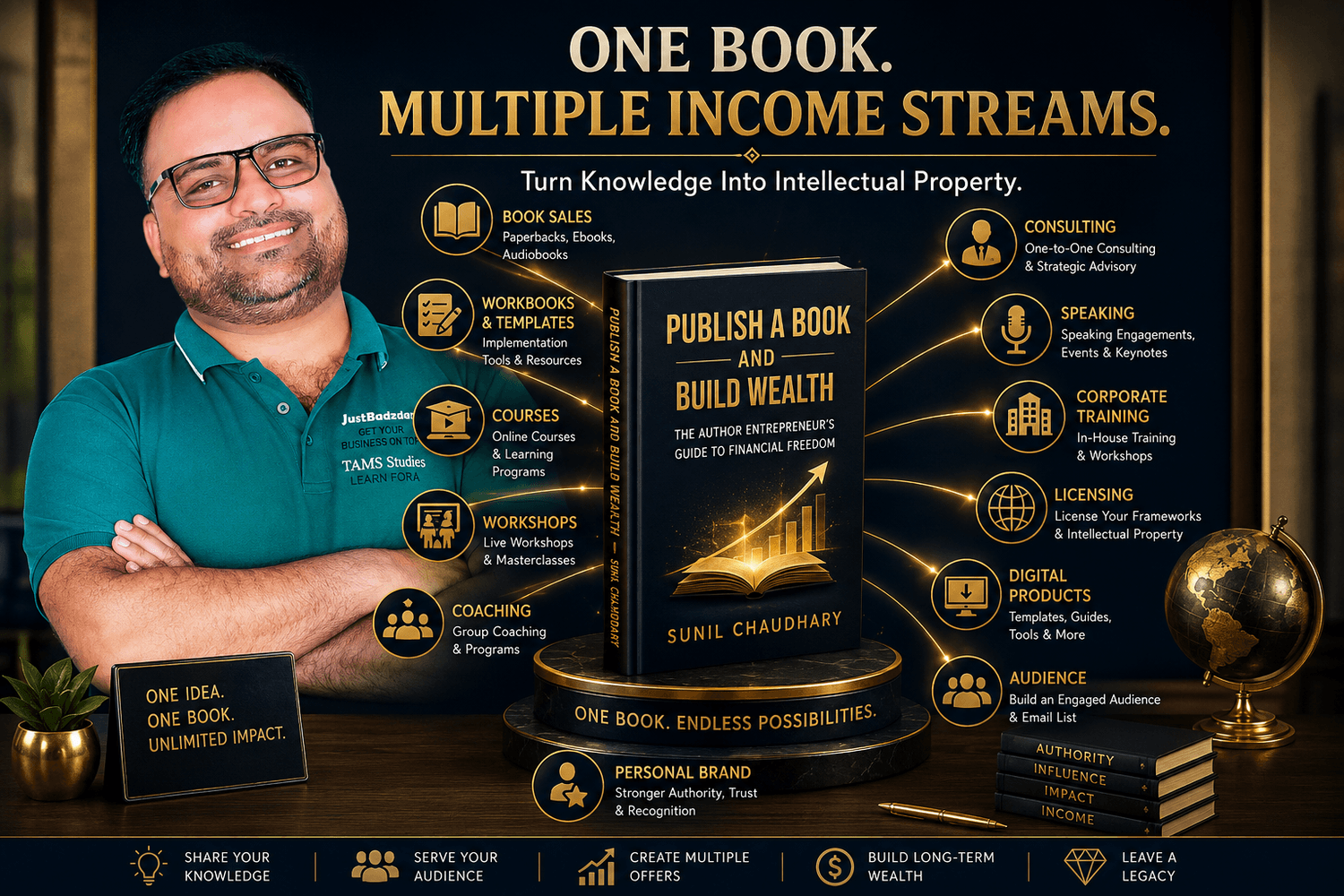
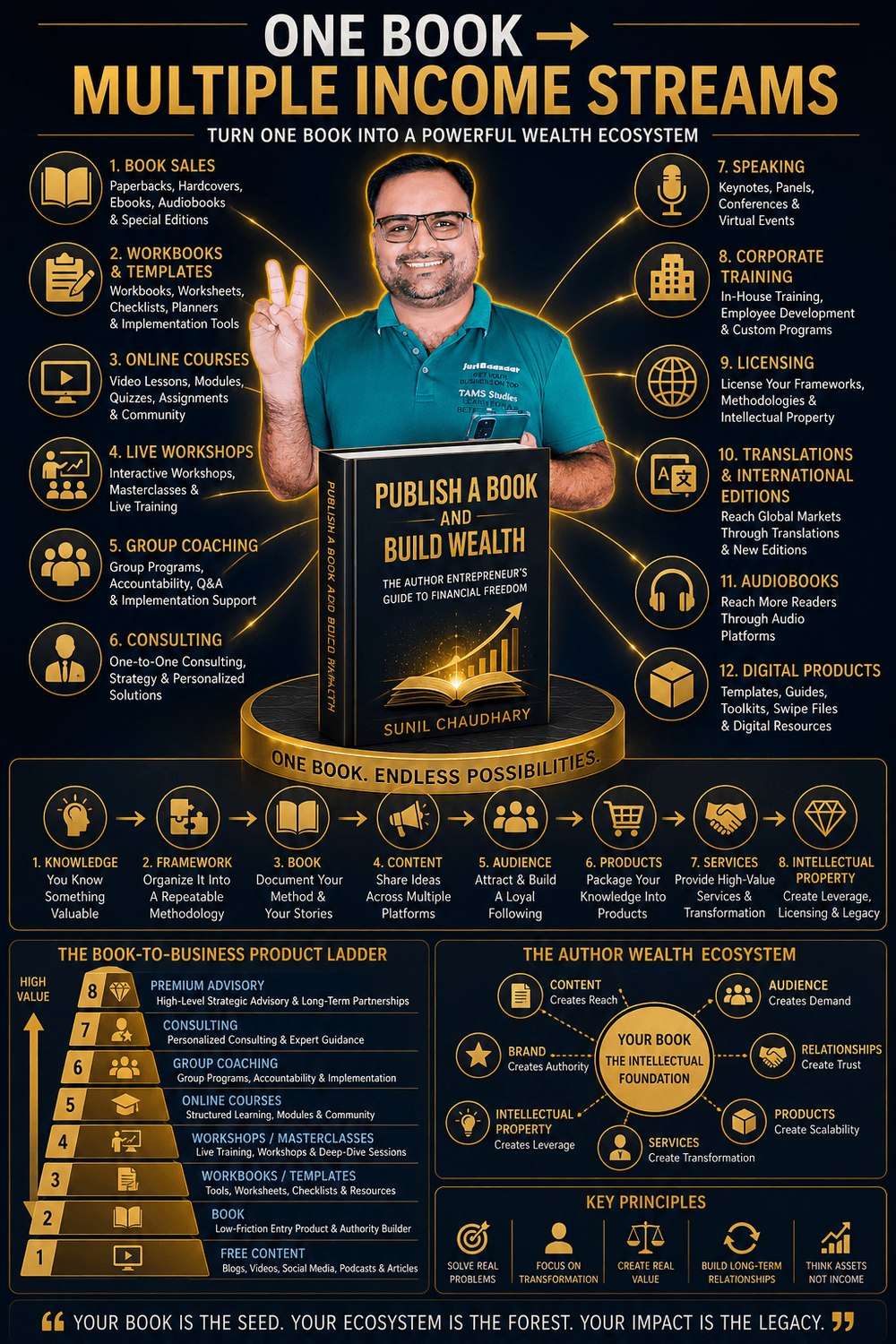
How to Build an Audience Before You Publish Your Book
If you want to publish a book and get rich, there is one principle you should understand before you spend another hour worrying about your book launch:
Do not wait until your book is published to start building your audience.
Start before you publish.
In fact, ideally, your audience should already know who you are, understand what you teach and be interested in the problem your book solves before your book becomes available.
Why?
Because publishing without an audience creates a difficult situation.
You have a book.
But nobody is waiting for it.
You have a launch date.
But nobody knows about it.
You have a purchase link.
But there is no meaningful traffic.
You have something valuable to sell.
But you have not yet built enough trust.
That is why I believe:
The best time to build your book audience is before your book is finished.
Your manuscript is not the first asset you need.
Your relationship with the reader is.
The Difference Between an Author and an Author With an Audience
Anyone can publish a book.
That does not mean everyone can build a readership.
And there is a huge difference.
A published author has created a book.
An author with an audience has created a distribution advantage.
That distribution advantage can become incredibly valuable.
Imagine two authors launch books on the same day.
Author A has:
No email list
No YouTube audience
No social media presence
No community
No relationships with other creators
No website traffic
Author B has:
20,000 email subscribers
A growing YouTube channel
An active LinkedIn presence
A community
Podcast relationships
A strong personal brand
A search-driven website
Even if both books are equally good, their launch conditions are completely different.
Author B already has attention.
And attention is one of the most valuable resources in the modern knowledge economy.
Your Audience Is an Asset
I want you to stop thinking about followers as vanity numbers.
A follower is not automatically valuable.
A million irrelevant followers can be less useful than 5,000 people who genuinely care about your subject.
What matters is relevant attention.
If you write about entrepreneurship, you want entrepreneurs.
If you write about parenting, you want parents.
If you write about leadership, you want leaders and aspiring leaders.
If you write about digital marketing, you want people interested in digital marketing.
Your objective is not simply to collect followers.
Your objective is to build a community of people who care about the problem you solve.
Start With the Problem, Not the Book
This is one of the most important principles in audience building.
Do not begin by saying:
“I am writing a book.”
Begin by asking:
“What problem am I helping people solve?”
Suppose your book is about building a digital coaching business.
Instead of constantly posting:
“My new book is coming soon.”
you could create content around:
How coaches can get their first clients
How to build a coaching offer
How to create a personal brand
How to generate leads
How to build an online coaching funnel
How to sell expertise online
Now people discover you because they have a problem.
Your book eventually becomes the deeper resource.
Create a Clear Audience Promise
Your audience should be able to understand why they should follow you.
Complete this sentence:
“Follow me if you want to…”
For example:
“Follow me if you want to turn your knowledge and expertise into a profitable digital business.”
That is much stronger than:
“Follow me for motivation, business tips, marketing and success.”
Specificity creates relevance.
Relevance creates attention.
Attention creates the opportunity for trust.
Build Around One Core Topic
Many new creators make their content too broad.
Today they talk about:
Business.
Tomorrow motivation.
The next day technology.
Then politics.
Then personal life.
Then random news.
The audience becomes confused.
If you are building an author brand, especially around a non-fiction book, you want a strong central theme.
Think of it as your content territory.
For example:
Core Territory
Knowledge Entrepreneurship
Then supporting subjects could include:
Personal branding
Digital marketing
Coaching
Content creation
Sales
Automation
Online education
Intellectual property
Now your content has a centre.
Build Your Author Platform
Your author platform is the collection of channels through which people discover and interact with your work.
It may include:
Website
Your digital home.
Email List
Your direct communication channel.
YouTube
Your long-form educational platform.
Your professional authority platform.
Your visual discovery platform.
Podcast
Your conversation and relationship platform.
Community
Your deeper engagement environment.
You do not need to dominate every platform.
Start where your audience already exists.
Then expand gradually.
Your Website Should Be the Headquarters
Social platforms are useful.
But your website should remain an important part of your long-term strategy.
Why?
Because your website gives you greater control over your:
Brand
Content
Search visibility
Book information
Resources
Email capture
Offers
Author profile
Create a dedicated book ecosystem.
For example:
YourWebsite.com/book
That page can eventually become the central destination for your book.
Create a Pre-Launch Book Page
You do not have to wait until publication.
Create a simple pre-launch page.
It can say:
Coming Soon
Your Book Title
A short explanation of the problem the book solves.
Then add:
Who this book is for
What readers will learn
Why you are writing it
Expected publication period
And most importantly:
Join the Early Reader List
Now you have started building a list of people who have already expressed interest.
That is far more valuable than simply announcing the book after it is finished.
Create an Early Reader Community
You can take this further.
Invite a selected group of interested people to become early readers.
They may:
Review early chapters
Give feedback
Identify unclear sections
Suggest improvements
Share reactions
Participate in discussions
Eventually leave honest reviews
This can make the writing process more collaborative.
It can also create a group of people who are emotionally invested in the book before launch.
Give Your Audience a Reason to Participate
People do not join communities simply because you ask them to.
Give them a reason.
For example:
Behind-the-scenes access
Early chapters
Author Q&A
Book-building sessions
Research insights
Exclusive worksheets
Live discussions
Early access
The goal is to make people feel that they are participating in something meaningful.
Document the Journey
One of the easiest ways to build an audience before publishing is to document the journey.
You can share:
“Today I finished Chapter 3.”
“I discovered an interesting research insight today.”
“I rewrote this chapter because I realised I was solving the wrong problem.”
“Here is the framework I am developing.”
“Here is the biggest lesson I learned while writing this book.”
This creates a story.
Your audience is no longer waiting for a product.
They are following a journey.
Turn Your Book Into a Public Project
Imagine announcing:
“I am documenting my journey of writing, publishing and building a business around a book.”
Now you have created a content theme.
You can share:
Writing
Research
Publishing
Marketing
Business
Failures
Lessons
Experiments
Results
Your book becomes the central storyline.
Build Curiosity Before Revealing Everything
You do not need to reveal the entire book.
Instead, create curiosity.
For example:
“I have identified five reasons why most experts never turn their knowledge into a valuable intellectual asset. I am dedicating an entire chapter to this.”
Now you have created interest.
Another example:
“I used to believe that publishing was the difficult part. I now believe distribution is the bigger challenge.”
That creates a conversation.
Then explain the idea.
Teach first.
Promote second.
Create a Signature Series
A content series is easier for an audience to follow than random posts.
For example:
Building My Book in Public
Episode 1: Choosing the Topic
Episode 2: Researching the Market
Episode 3: Creating the Outline
Episode 4: Writing the First Chapter
Episode 5: Editing
Episode 6: Designing the Cover
Episode 7: Publishing
Episode 8: Building the Launch
Episode 9: Getting the First Readers
Episode 10: Turning the Book Into a Business
Now your audience has a reason to return.
Use Your Book Research as Content
Research can create extraordinary content.
Suppose you discover an interesting statistic while researching your book.
Do not hide it inside the manuscript.
Turn it into:
A LinkedIn post
A YouTube video
An infographic
A newsletter
A discussion
A short video
Your research becomes content.
Your content attracts attention.
Your attention feeds the book.
This creates a powerful cycle.
Answer Questions Your Future Readers Are Already Asking
Your audience is telling you what to write.
Look at:
Comments
Questions
Search queries
Community discussions
Customer conversations
YouTube comments
Social media posts
Reviews of competing books
Frequently asked questions
If people repeatedly ask:
“How do I…?”
that question may deserve an answer.
If people repeatedly complain:
“I tried this and it didn't work.”
investigate why.
If people repeatedly misunderstand something:
Teach it clearly.
Your audience can help you discover your best content.
Use SEO to Build an Audience Before Launch
Search engine optimisation can be one of the most powerful long-term audience-building strategies.
Why?
Because social media often depends on timing.
Search can continue bringing people to your content long after publication.
Suppose your future book is about:
How to Build a Personal Brand
You could create articles targeting questions such as:
What is personal branding?
How do I build a personal brand?
How to create a personal brand on LinkedIn
Personal branding strategies for entrepreneurs
Personal branding mistakes
Each article introduces your thinking.
Some readers may eventually discover your book.
Build Topic Authority
Do not create one article and expect Google to immediately recognise you as an authority.
Build depth.
Create multiple useful pieces around the same subject.
For example:
Main Topic
Book Marketing
Supporting content:
How to market a new book
How to create a book launch plan
How to get your first book reviews
How authors can use YouTube
How to build an author email list
How to promote a book without paid advertising
How to build an author personal brand
Now you are building topical coverage.
Create a YouTube Audience
YouTube can become a powerful discovery engine for authors.
Create videos around the problems your book solves.
For example:
How to Write Your First Book
How to Publish a Book
How to Market a Book
How Authors Make Money
How to Build an Author Brand
How to Turn Your Book Into a Business
Each video can naturally point toward your deeper resources.
But remember:
Teach something valuable in the video.
Do not make the entire video a sales pitch.
Create a LinkedIn Audience
For professional and business books, LinkedIn can be extremely useful.
Share:
Original insights
Frameworks
Case studies
Lessons
Contrarian perspectives
Professional stories
Book-building lessons
For example:
I have changed my opinion about what makes a book commercially successful.
Then explain your reasoning.
This creates conversation.
And conversation creates relationships.
Build Relationships With Other Creators
You do not have to build your audience entirely by yourself.
Find people who already serve your target audience.
They could be:
Podcast hosts
YouTubers
Newsletter writers
Coaches
Industry experts
Community leaders
Conference organisers
Bloggers
Start by providing value.
Comment thoughtfully.
Share their work when genuinely relevant.
Have conversations.
Offer useful insights.
Then, over time, collaboration opportunities may emerge.
Interview Experts for Your Book
This can create a powerful networking opportunity.
Suppose your book discusses entrepreneurship.
You could interview:
Entrepreneurs
Investors
Coaches
Marketers
Founders
Educators
Their insights could inform your research, where appropriate and with permission.
You may also turn those conversations into content.
Now your book project creates relationships.
Those relationships can expand your reach.
Create a Podcast Guest Strategy
You do not need to start your own podcast immediately.
You can become a guest on existing podcasts.
Prepare a strong media profile containing:
Your bio
Your expertise
Your book topic
Speaking topics
Interview questions you can answer
Your website
Your social profiles
Your book information
Then reach out to relevant podcast hosts.
Do not send generic:
“Please promote my book.”
Instead:
“I can provide your audience with a practical framework for turning expertise into intellectual property.”
Lead with value.
Build an Email List Before Publication
If I had to choose one audience asset that I would prioritise heavily, it would be the email list.
Why?
Because people who voluntarily give you permission to communicate with them are more valuable than anonymous traffic.
Create a lead magnet related to your book.
For example:
The Author Wealth Checklist
Book Writing Planner
Book Publishing Roadmap
Author Business Blueprint
Book Marketing Checklist
Then invite visitors to download it.
Now you have a mechanism for continuing the relationship.
Your Pre-Launch Email Sequence
You can create a simple sequence.
Email 1
Why I Decided to Write This Book
Tell the story.
Email 2
The Problem I Want to Solve
Teach something useful.
Email 3
The Biggest Mistake I See
Provide insight.
Email 4
Behind the Scenes
Share the journey.
Email 5
A Framework From the Book
Give genuine value.
Email 6
Meet the Early Reader Community
Build participation.
Email 7
The Book Is Coming
Begin the launch conversation.
This sequence builds anticipation without turning every email into a sales pitch.
Give Before You Ask
This principle is fundamental.
If every interaction is:
Buy my book.
Buy my course.
Join my programme.
Book a call.
people will eventually tune you out.
Instead:
Teach.
Help.
Inspire.
Challenge.
Explain.
Demonstrate.
Then make relevant offers.
Your audience should feel:
“Every time I interact with this person, I learn something useful.”
That is a powerful brand position.
Build Trust Through Consistency
One viral post does not create a durable author brand.
Consistency does.
If you publish one useful piece of content every week for a year, you have created a substantial body of work.
If you answer questions consistently, people begin recognising you.
If you teach consistently, people begin trusting your expertise.
If you communicate consistently, your ideas become familiar.
That is how authority develops.
Build a Reader Avatar
Give your ideal reader a name.
Not because the name matters.
Because it forces you to think about a real human being.
Imagine:
A 35-year-old professional.
They have valuable experience.
They want to start a side business.
They have expertise but no digital system.
They are confused about marketing.
They want more freedom.
They are willing to learn.
They need practical guidance.
Now write for that person.
Your content becomes more human.
Speak to One Person
When writing your content, imagine that you are sitting across the table from one reader.
Say:
“You may be thinking…”
“Here is what I would do…”
“Let me show you…”
“This is where most people make a mistake…”
It creates a conversation.
And conversations build relationships.
Build a Community Around a Belief
The strongest communities are often connected by more than information.
They share a belief.
For example:
Experts should own their knowledge.
Education should create economic opportunity.
Knowledge should be converted into useful assets.
Personal brands should be built on real value.
Your book can become the manifesto for that belief.
Now people are not simply buying a book.
They are joining an idea.
Create a Movement Carefully
A movement is not a marketing trick.
It begins when people genuinely identify with a shared mission.
If your work is about helping knowledge creators build businesses, your movement could be centred around:
Turning knowledge into impact.
Then your book becomes one expression of that mission.
Your content becomes another.
Your community becomes another.
Your programmes become another.
Your business becomes an operating system for the mission.
Use Social Proof Before Launch
Before publication, you may not have reviews.
But you can build credibility in other ways.
Share:
Your experience
Client outcomes where appropriate
Case studies
Relevant credentials
Speaking appearances
Media features
Professional collaborations
Educational content
Do not exaggerate.
Do not manufacture authority.
Show evidence.
Create a “Why This Book?” Video
Record a simple video answering:
Why did I write this book?
Talk about:
The problem
Your experience
What you discovered
What readers will learn
Who should read it
Why this matters
This video can become a central pre-launch asset.
Use it on your website.
Share it on social media.
Include it in your email campaign.
Send it to potential podcast hosts.
Create a Book Trailer
A book trailer does not need to look like a Hollywood movie.
It needs to communicate:
The problem
The promise
The emotion
The author
The book
The next step
Keep it short.
Make it memorable.
Use professional visual design.
Then distribute it across your channels.
Create a Countdown
As publication approaches, anticipation can increase.
For example:
30 Days to Launch
21 Days
14 Days
7 Days
3 Days
Tomorrow
Today
But do not simply post:
“7 days left!”
Give each countdown post a reason to exist.
7 Days
7 lessons from the book
5 Days
5 mistakes the book helps you avoid
3 Days
3 frameworks inside the book
1 Day
Why I wrote this book
Now your countdown is educational.
Create a Launch Day Experience
Launch day should feel like an event.
You could host:
Live stream
Book launch webinar
Author Q&A
Virtual celebration
Book discussion
Special masterclass
The objective is not simply to sell.
It is to create an experience around the book.
Turn Readers Into Participants
Ask readers questions.
For example:
Which chapter helped you most?
What idea are you implementing?
What surprised you?
What did you disagree with?
What would you like me to explain further?
This creates conversation.
And conversations create additional content.
Create a Reader Feedback Loop
Your first readers can become your research partners.
Listen carefully.
Maybe they say:
“Chapter 4 was too complicated.”
Improve it.
Maybe they say:
“I want a worksheet.”
Create one.
Maybe they say:
“Can you teach this live?”
Consider a workshop.
Your audience tells you what they need next.
Listen.
Build an Audience Flywheel
The model is simple:
CONTENT
↓
DISCOVERY
↓
VALUE
↓
TRUST
↓
AUDIENCE
↓
BOOK
↓
FEEDBACK
↓
MORE CONTENT
↓
MORE DISCOVERY
The cycle continues.
Every new reader can become part of the next stage.
Do Not Depend on One Platform
This is a strategic principle worth remembering.
You do not control social media algorithms.
You do not control search engine rankings.
You do not control marketplace algorithms.
Therefore, build multiple channels.
Your ecosystem could include:
Website
YouTube
Community
Podcast relationships
Search traffic
Book platforms
Diversification reduces dependence on any single channel.
Build an Audience You Can Reach
This is why email and community are so important.
A social follower may never see your next post.
An email subscriber can receive your message directly.
A community member may actively participate.
A reader who has your book may have a deeper relationship with your ideas.
The objective is to gradually move people from:
Anonymous attention
to
Known audience
to
Trusted relationship
Your 90-Day Pre-Launch Audience Plan
Here is a simple framework.
Days 1–30: DISCOVERY
Focus on:
Educational content
SEO
YouTube
Social media
Questions
Short-form videos
Your goal:
Get discovered.
Days 31–60: AUTHORITY
Focus on:
Frameworks
Case studies
Stories
Interviews
Research
Book insights
Your goal:
Build trust.
Days 61–90: ANTICIPATION
Focus on:
Book announcements
Early readers
Behind-the-scenes
Book trailer
Email sequence
Countdown
Your goal:
Create demand.
The Golden Rule of Pre-Launch Marketing
Here is the rule I want you to remember:
Do not spend 90 days telling people that your book is coming. Spend 90 days becoming worth following before your book arrives.
That is a completely different approach.
You are not creating noise.
You are creating value.
You are not begging people to buy.
You are earning attention.
You are not manufacturing excitement.
You are building genuine anticipation.
Your Section 13 Action Plan
Before you publish your book, complete these steps:
1. Define Your Ideal Reader
Know exactly who you want to reach.
2. Define Your Core Problem
Know what problem your book solves.
3. Create Your Author Positioning
Make your expertise easy to understand.
4. Build Your Website
Create your digital headquarters.
5. Create a Book Landing Page
Start collecting early interest.
6. Build an Email List
Create a direct relationship with potential readers.
7. Create 30–90 Days of Content
Teach the ideas behind your book.
8. Build Relationships
Connect with creators, podcasters and communities.
9. Create an Early Reader Group
Invite genuine participants.
10. Plan the Launch
Turn publication into an event rather than an upload.
Key Takeaway
The book should not be the first thing your audience sees from you.
Ideally, they should discover your ideas first.
Then your expertise.
Then your story.
Then your frameworks.
Then your book.
Then your deeper ecosystem.
That creates a much stronger relationship.
Remember:
A book can give you authority, but an audience gives your authority distribution.
Without distribution, even excellent ideas can remain invisible.
With the right audience, one idea can travel much further.
And once you have built that audience, something fascinating happens.
You no longer have to ask:
“How can I sell my book?”
You can begin asking:
“How can I create a community of people who want to learn from me for years?”
That is the foundation of a real author business.
And now we are ready for another crucial question:
How do you launch your book in a way that creates attention, sales, reviews and long-term momentum instead of producing one quiet announcement and then silence?
That is what we will explore in the next section.
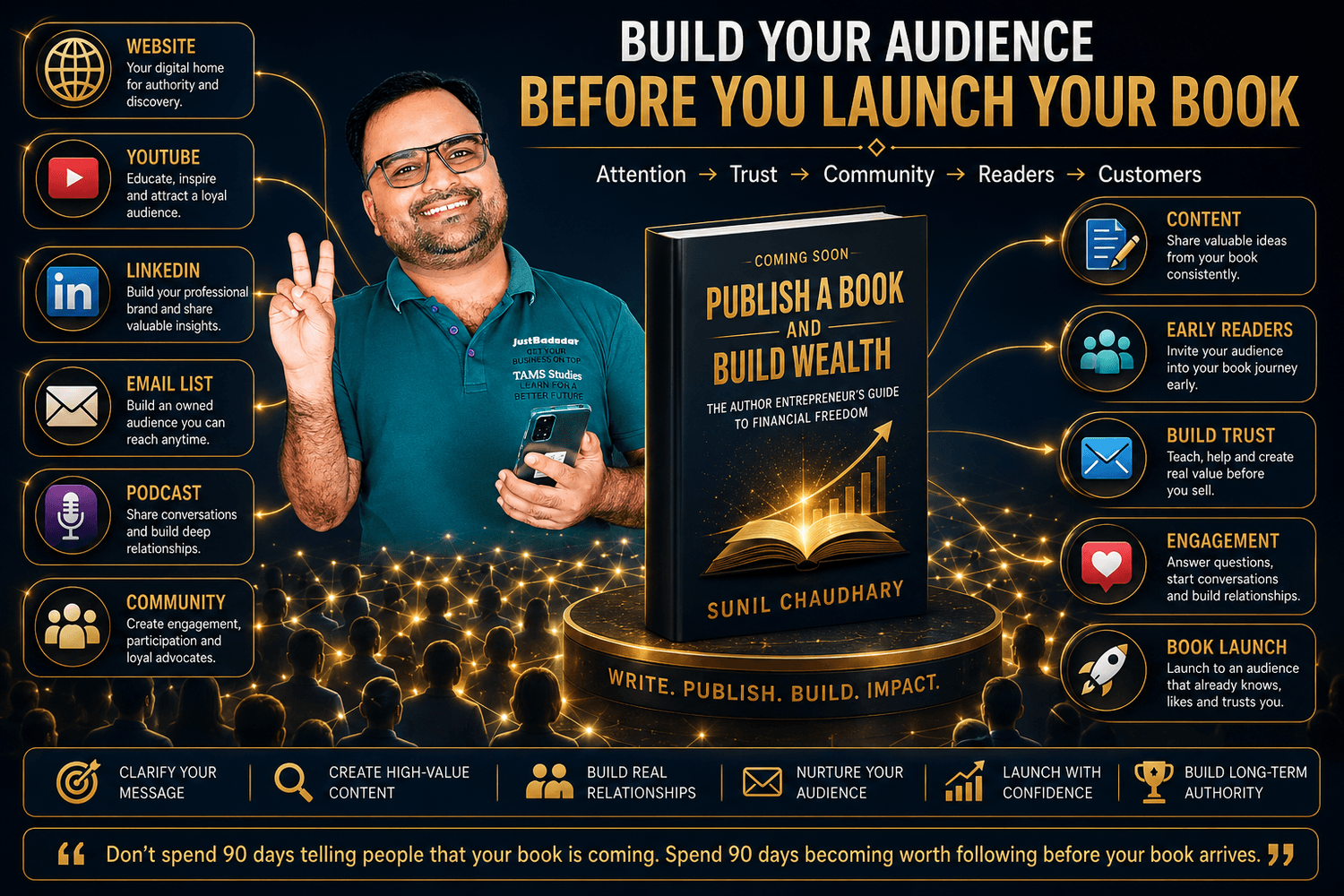
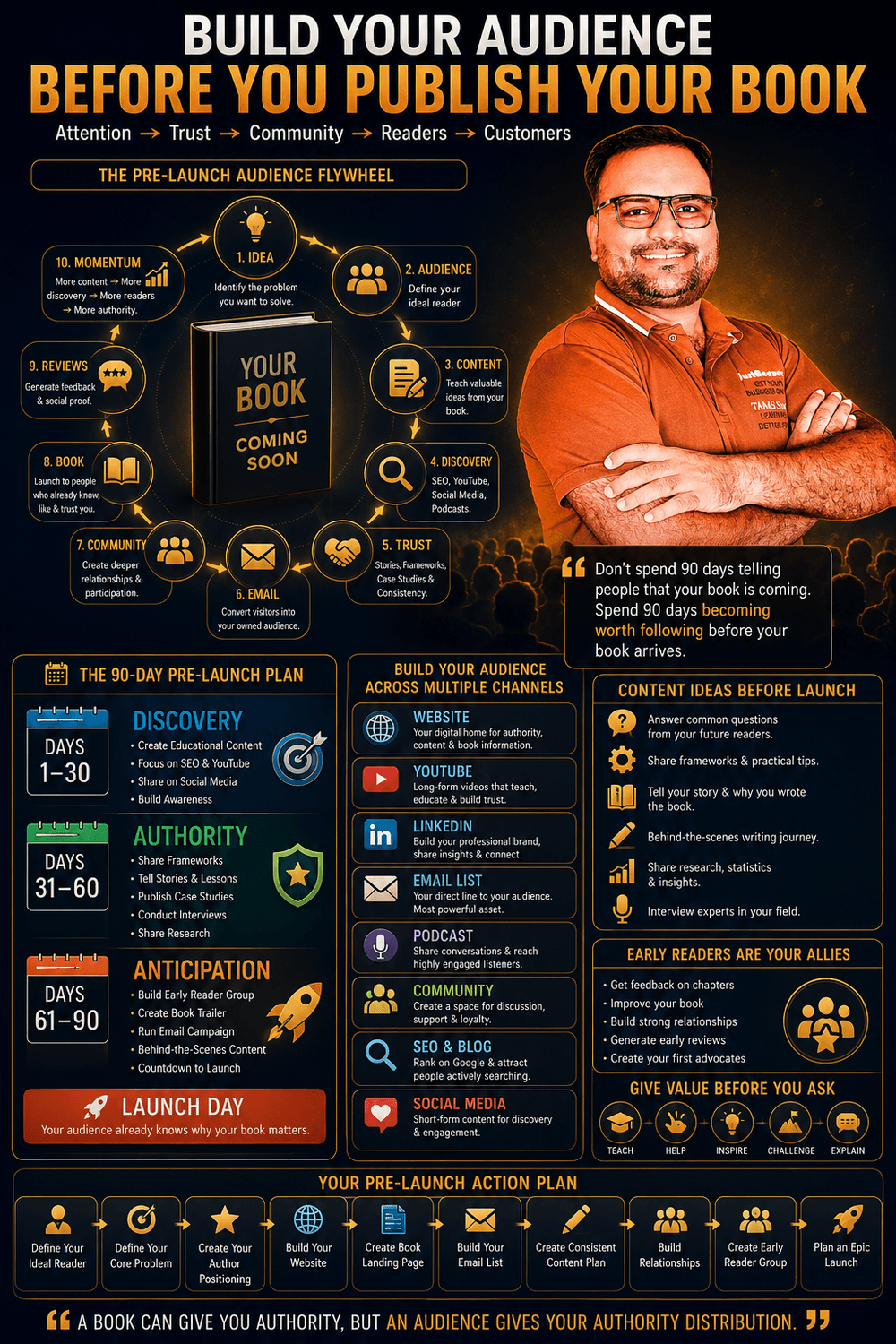
How to Launch Your Book and Create a Wave of Attention
Publishing your book is not the finish line.
It is the moment when your preparation becomes visible to the market.
And if you want to publish a book and get rich, you need to understand something that many first-time authors discover too late:
A great book does not automatically create a great launch.
You can write an excellent manuscript.
You can design a beautiful cover.
You can publish through the right channels.
You can even price the book correctly.
And still have a quiet launch.
Why?
Because publishing and marketing are two different activities.
Publishing makes your book available.
Marketing makes people care that it exists.
That distinction can completely change the way you approach your launch.
The Book Launch Is a Campaign, Not a Date
Many new authors think like this:
Book finished → Upload → Publish → Post on Social Media → Wait
That is not a launch strategy.
That is a publication event.
A real launch is a coordinated campaign designed to create:
Awareness
Curiosity
Anticipation
Conversations
Traffic
Sales
Reviews
Social proof
Long-term discovery
Your publication date is simply the centre point of the campaign.
The campaign begins before the book becomes available.
And it continues after launch day.
Why Most Book Launches Become Quiet
Let me describe a situation you may recognise.
An author spends six months writing.
They spend weeks editing.
They invest money into cover design.
They upload the book.
Then they make one social media post:
“My new book is now available. Please buy it.”
They wait.
A few friends purchase.
A few family members congratulate them.
Perhaps some colleagues share the announcement.
Then the excitement disappears.
The author concludes:
“Books don't sell.”
But that conclusion may be completely wrong.
The real problem may have been:
There was no launch system.
Your Launch Has Three Jobs
A strong book launch should accomplish three major objectives.
1. Get Attention
People need to know the book exists.
2. Create Trust
People need a reason to believe the book is worth their time and money.
3. Create Action
People need a clear reason to buy, read, review or share it.
These three stages work together.
Attention
gets people to notice you.
Trust
gets people to believe you.
Action
gets people to move.
Start With a Big Idea
Your launch needs a central message.
Do not try to promote twenty different ideas simultaneously.
Choose one powerful statement.
For example:
Your knowledge is an asset. Build it, package it and turn it into intellectual property.
Everything around the launch can connect back to that idea.
Your videos.
Your emails.
Your interviews.
Your social posts.
Your webinar.
Your book trailer.
Your launch event.
Your conversations.
This creates consistency.
Create a Launch Narrative
People remember stories better than announcements.
So instead of saying:
“My book is launching on September 1.”
tell the story behind the book.
Explain:
Why you wrote it.
What problem inspired it.
What you discovered.
What changed your thinking.
Who you wrote it for.
What you hope readers will do differently after reading it.
Now your launch has meaning.
Your Story Is Part of the Product
People are not only buying information.
They are buying context.
They want to know:
Why should I listen to this author?
Your story can answer that question.
Perhaps you struggled with the problem yourself.
Perhaps you spent years studying it.
Perhaps you worked with hundreds of people.
Perhaps you made expensive mistakes.
Perhaps you developed a framework after years of experimentation.
Tell the truth.
Do not manufacture a dramatic story.
Your real journey is enough.
Create a Launch Calendar
I recommend planning your launch backwards from publication day.
Think in phases.
Phase 1: 30 Days Before Launch
Build awareness.
Phase 2: 14 Days Before Launch
Build anticipation.
Phase 3: 7 Days Before Launch
Increase conversation.
Phase 4: Launch Week
Create concentrated attention.
Phase 5: 7–30 Days After Launch
Extend momentum.
This is much stronger than trying to create everything on publication day.
30 Days Before Launch: Start the Story
At this stage, do not constantly ask people to buy.
Instead, introduce the problem.
Create content around:
The problem your book solves
Common mistakes
Unexpected lessons
Industry misconceptions
Your personal experience
Interesting research
Frameworks
Your audience should gradually understand:
Something important is coming.
21 Days Before Launch: Reveal the Book
Now you can become more specific.
Reveal:
The title
The cover
The subtitle
The central promise
Who the book is for
What readers will learn
You can also share the story behind the title.
Make the reveal feel like an event.
14 Days Before Launch: Introduce the Transformation
Now answer:
What changes after someone reads this book?
Do not simply list chapters.
Talk about outcomes.
For example:
Instead of:
“Chapter 5 explains personal branding.”
Say:
“Chapter 5 helps you turn your expertise into a clear market position that people can understand.”
Focus on transformation.
10 Days Before Launch: Share Proof
If you have early readers, this is the time to begin sharing genuine feedback.
You might receive comments such as:
“This framework finally made the subject clear.”
“Chapter 4 completely changed how I think about my business.”
“The practical examples were extremely useful.”
Use authentic feedback.
Do not manufacture testimonials.
Do not exaggerate.
Trust is more valuable than temporary hype.
7 Days Before Launch: Begin the Countdown
Now the launch becomes visible.
You can publish:
7 Days to Go
6 Days to Go
5 Days to Go
and so on.
But remember:
Every countdown post should contain value.
7 Days
7 lessons from the book
6 Days
6 mistakes the book helps you avoid
5 Days
5 ideas I wish I had understood earlier
4 Days
4 frameworks inside the book
3 Days
3 reasons I wrote this book
2 Days
2 people who absolutely need this book
1 Day
Tomorrow, the book becomes available
Now your countdown is not empty promotion.
It is educational marketing.
Create a Book Trailer
A short book trailer can create emotional momentum.
Keep it focused.
Start with the problem.
Then introduce the idea.
Then introduce you.
Then show the book.
Then communicate the transformation.
Finally:
Give the reader one clear next step.
Do not try to explain the entire book in 60 seconds.
Create curiosity.
Use Multiple Content Formats
Your launch should not depend on one type of content.
Create:
Long-form video
Explain the big idea.
Short-form video
Deliver one powerful insight.
Social post
Tell a story.
Carousel
Teach a framework.
Infographic
Simplify the model.
Create a personal conversation.
Podcast interview
Explore your ideas deeply.
Blog article
Capture search traffic.
Different formats reach different people.
The 5-5-5 Launch Content Model
Here is a simple framework.
Create:
5 Educational Posts
Teach the ideas inside the book.
5 Story Posts
Share your journey.
5 Authority Posts
Share frameworks, research and insights.
5 Short Videos
Create quick, memorable lessons.
5 Promotional Posts
Invite people to buy or participate.
That gives you 25 pieces of launch content.
You can distribute them across your launch period.
Create a Launch Event
A launch becomes much more powerful when people can participate.
You could host:
Virtual Book Launch
or
Author Masterclass
or
Book Launch Webinar
or
Live Author Q&A
The event can include:
Your story
Why you wrote the book
Three major lessons
One practical framework
Audience questions
Book announcement
Reader invitation
Do not make the entire event a sales pitch.
Teach something genuinely useful.
Then invite people to continue with the book.
Give People a Reason to Attend
Your launch event needs a promise.
For example:
Learn the five principles I used to turn years of experience into a structured intellectual property system.
That is stronger than:
Join my book launch.
The first promises value.
The second simply announces an event.
Create a Launch Bonus Carefully
You may also offer a relevant bonus.
For example:
Book + Author Workbook
Book + Private Masterclass
Book + Implementation Checklist
Book + Digital Templates
The bonus should enhance the book.
Do not create artificial scarcity.
Do not make false claims such as:
“Only 10 copies left”
when you can produce unlimited digital copies.
Ethical marketing creates stronger brands.
Use Your Book as a Lead Generator
Remember the ecosystem we discussed earlier.
Your book does not necessarily have to be the final transaction.
Inside the book, you can invite readers to access a relevant free resource.
For example:
Visit yourwebsite.com/bookbonus to download the Author Business Workbook.
Now the book can move the reader into your broader ecosystem.
The journey becomes:
Book
↓
Free Resource
↓
Email Relationship
↓
Masterclass
↓
Programme
↓
Coaching / Consulting
This is where the commercial potential of a book becomes much greater.
Build Your Email Launch Sequence
Email should be one of your most important launch channels.
Here is a simple seven-email sequence.
Email 1: The Story
Why I Wrote This Book
Tell your story.
Email 2: The Problem
Why Most People Never Turn Their Knowledge Into an Asset
Teach something valuable.
Email 3: The Framework
The Framework Inside My New Book
Give a useful piece of your methodology.
Email 4: The Reveal
Here It Is
Introduce the book.
Email 5: Launch Day
My Book Is Now Available
Give the clear purchase invitation.
Email 6: Reader Reaction
What Early Readers Are Saying
Share genuine feedback.
Email 7: The Bigger Mission
This Book Is About More Than a Book
Explain your larger vision.
That final email can be particularly powerful.
Because people often want to belong to something bigger than a transaction.
Make Your Launch Shareable
You want readers to talk about the book.
Give them easy ways to participate.
Create:
Shareable quotes
Book graphics
Short videos
Author images
Reader badges
Discussion questions
Launch hashtags
Make it easy for someone to say:
“I am reading this.”
or
“This idea changed how I think about business.”
Create a Reader Ambassador Group
Your early readers can become your launch ambassadors.
Invite people who genuinely like your work.
Give them:
Early access
Shareable graphics
Key quotes
Launch information
Discussion prompts
But never pressure people to give positive reviews.
Ask for honest feedback.
That distinction matters.
The First 48 Hours Matter
Your launch does not end when the book becomes available.
The first couple of days are an opportunity to create concentrated attention.
You can:
Go live.
Answer questions.
Share reader reactions.
Publish educational content.
Appear on podcasts.
Send emails.
Engage with comments.
Thank readers.
Encourage genuine reviews.
The objective is to create a wave rather than a single splash.
But Do Not Depend Entirely on Launch Day
This is extremely important.
Some books sell well immediately.
Others grow slowly.
Some become successful months or even years after publication because:
A creator discovers them.
A podcast mentions them.
A search query brings a reader.
A video goes viral.
A course references them.
A company purchases copies.
A new audience discovers the author.
Therefore:
Launch hard, but build for the long term.
Turn Launch Content Into Evergreen Content
Your best launch content should continue working after launch.
Suppose you create:
“10 Mistakes New Authors Make.”
That can become an evergreen article.
A video.
A podcast episode.
A social carousel.
An email.
A chapter excerpt.
The launch creates content.
The content continues attracting people.
Create a Book Sales Page That Converts
Your book page should answer the reader's questions quickly.
Include:
The Promise
What will the reader gain?
The Problem
What problem does the book address?
The Audience
Who should read it?
The Author
Why should they trust you?
What's Inside
What will they discover?
Proof
What do genuine readers say?
Format
Paperback, hardcover, ebook, audiobook, where applicable.
Call to Action
What should they do next?
Keep the page clear.
Do not bury the purchase button.
Your Book Description Is Sales Copy
Do not write your book description like a university abstract.
Write for the reader.
Instead of:
“This book examines the relationship between knowledge entrepreneurship and intellectual capital…”
Try:
“You already know something valuable. The question is whether you have turned that knowledge into an asset.”
Then explain what the reader will discover.
Your description should create curiosity without making promises the book cannot deliver.
Use the Power of Specificity
Specific language is more believable.
Instead of:
“This book will transform your life.”
say:
“You will learn how to structure your expertise, develop a signature framework and build a practical path from knowledge to intellectual property.”
Specificity communicates confidence.
Use Your Personal Brand
Your book should strengthen your identity.
The cover.
The website.
The social graphics.
The launch event.
The videos.
The author biography.
The presentation.
All should feel connected.
People should recognise:
This is the same author.
Consistency builds familiarity.
Think Beyond Bookstores
Your book can potentially be distributed through many channels depending on your publishing strategy.
Think about:
Online marketplaces
Your website
Events
Corporate sales
Speaking engagements
Workshops
Courses
Communities
Partnerships
Book clubs
Professional networks
The objective is not to put your book in one place and hope.
The objective is to build multiple paths to discovery.
Corporate Book Sales Can Be Interesting
Suppose your book is relevant to a company.
Instead of selling one copy at a time, there may be opportunities to sell multiple copies for:
Employee learning
Training programmes
Leadership initiatives
Events
Client gifts
Workshops
For example, if you conduct a corporate workshop, the organisation could potentially provide your book to participants.
Now the book becomes part of a larger commercial engagement.
Speaking Can Accelerate Book Distribution
Imagine you speak to 500 people.
Instead of simply giving a presentation, you can make your book part of the experience.
Depending on the event arrangement, books could be:
Sold
Bundled
Gifted
Included with registration
Used as workshop material
The book extends the relationship beyond the stage.
Build a Long-Term Book Marketing Engine
After launch, continue creating content around the book.
Every week, extract one idea.
Teach it.
Discuss it.
Demonstrate it.
Then connect it back to the book when relevant.
This creates an evergreen loop:
Book
→ Content
→ Discovery
→ Reader
→ Review
→ Social Proof
→ More Discovery
→ More Readers
That is much more sustainable than repeatedly shouting:
“Buy my book!”
Your 30-Day Post-Launch Strategy
Week 1
Launch + Engagement
Focus on:
Reader reactions
Questions
Live sessions
Interviews
Reviews
Week 2
Education
Teach the book's biggest frameworks.
Week 3
Stories + Case Studies
Show how the ideas can be applied.
Week 4
Expansion
Introduce related resources, workshops or programmes.
Now your book begins feeding your broader ecosystem.
Do Not Chase Fake Virality
Let me make this clear.
You do not need millions of views to build a successful author business.
You need the right people to discover you.
A video with 20,000 views from your target audience may be far more valuable than a video with 2 million random views.
Your goal is not vanity.
Your goal is relevance.
Measure More Than Book Sales
Book sales matter.
But they are not the only metrics.
Track:
Awareness
Website visits
Video views
Search impressions
Social reach
Engagement
Comments
Shares
Saves
Email replies
Audience Growth
Email subscribers
Community members
Followers
Commercial Outcomes
Book sales
Workshop registrations
Course purchases
Coaching enquiries
Consulting leads
Authority
Podcast invitations
Speaking invitations
Media mentions
Collaboration requests
Now you can see the full impact of the launch.
The Author Business Funnel
Your launch can be represented like this:
CONTENT
↓
ATTENTION
↓
BOOK
↓
READER
↓
EMAIL / COMMUNITY
↓
TRUST
↓
WORKSHOP
↓
COURSE
↓
COACHING
↓
CONSULTING
↓
LONG-TERM CLIENT
The book is not necessarily the end.
It can be the beginning of the relationship.
Your Launch-Day Checklist
Before going live, make sure you have:
Final manuscript
Final cover
Book description
Author bio
Sales page
Purchase links
Email sequence
Social media graphics
Launch video
Book trailer
Launch event
Early readers
Review process
Follow-up content
Tracking system
Then test everything.
Click every link.
Check every page.
Check the mobile experience.
Check the payment process.
Check your emails.
Check your download links.
A small technical problem can create unnecessary friction during launch.
Your Book Launch Script
If you need a simple announcement, use this structure:
Today, I am publishing a book.
But this is not simply a book about [TOPIC].
I wrote it because I have seen too many people struggle with [PROBLEM].
Over the years, I learned that [KEY INSIGHT].
So I brought those lessons, frameworks and experiences together in one place.
The book is for [IDEAL READER].
Inside, you will learn [3 SPECIFIC BENEFITS].
Today, I am opening it to readers who are ready to [DESIRED TRANSFORMATION].
The book is now available.
[CALL TO ACTION]
Simple.
Clear.
Human.
The Biggest Launch Mistake
Here is the mistake I want you to avoid:
Making the launch about yourself instead of the reader.
Yes, you should celebrate.
Yes, you should tell your story.
Yes, you should be proud.
But ultimately the reader is asking:
“Why should I care?”
Answer that question.
Your book is not important simply because you wrote it.
It becomes important when it solves a problem for someone.
That is the standard.
The Bigger Opportunity
A successful launch can do much more than generate book sales.
It can create:
New relationships.
New subscribers.
New clients.
New speaking opportunities.
New partnerships.
New media opportunities.
New content.
New authority.
New intellectual property.
That is why I do not want you to think like a person who is simply publishing a book.
I want you to think like an author entrepreneur.
Your Section 14 Action Plan
Before your launch, answer these questions:
1. What is the single biggest idea behind my book?
2. What problem does it solve?
3. Who is the ideal reader?
4. What transformation does the reader want?
5. What is my launch story?
6. What is my central launch message?
7. What will I publish 30 days before launch?
8. What will I publish during launch week?
9. What will I do during the 30 days after launch?
10. What happens after someone buys the book?
That final question is critical.
Because if you have built the audience correctly, your first sale should not be the end of the relationship.
It should be the beginning.
Key Takeaway
A book launch is not about making the loudest announcement.
It is about creating the strongest connection between:
Your idea
Your story
Your audience
Your book
Your larger mission
When these five elements work together, your launch becomes more than a sales campaign.
It becomes an authority event.
And remember:
Do not launch a book and then search for an audience. Build the audience, create anticipation and then give that audience a book worth buying.
Because the ultimate goal is not to have one successful launch.
The goal is to build a machine that can continue discovering readers long after launch day.
And once the book is published, the next challenge begins:
How do you get your book discovered on Google, Amazon and other search-driven platforms so that readers can find it even when you are not actively promoting it?
That is where Book SEO, search intent and discoverability become incredibly important.
How to Make Your Book Discoverable: Book SEO, Amazon SEO and Google Search Strategy
Publishing your book is one achievement.
Getting the right people to discover your book consistently is another.
And if your larger goal is to publish a book and get rich, discoverability cannot be an afterthought.
You need people to find your book when they are searching for answers, solutions, ideas, authors, experts and resources related to your subject.
This is where Book SEO becomes powerful.
But I want to make one distinction immediately.
SEO is not about stuffing keywords into your book. SEO is about helping the right people discover the right content at the right moment.
That principle should guide everything you do.
Google itself emphasises people-first, helpful content rather than content created primarily to manipulate search rankings.
Amazon follows a different discovery system, but the principle is similar: accurate metadata, relevant keywords, appropriate categories and strong customer behaviour all contribute to discoverability.
So, let us build a proper discovery strategy.
What Is Book SEO?
Book SEO is the process of making your book, author brand, supporting content and related resources easier to discover through search engines and book marketplaces.
It can include:
Google Search
Amazon Search
Your author website
Blog articles
YouTube
Podcasts
Social platforms
Book-related landing pages
Online communities
Interviews
Digital PR
External websites
Think of your book as the centre of a search ecosystem.
Your book is one asset.
Around it, you can build dozens or even hundreds of discoverable assets.
For example:
Book
↓
Author Website
↓
Book Landing Page
↓
Blog Articles
↓
YouTube Videos
↓
Podcasts
↓
Social Content
↓
Email Newsletter
↓
Reader Community
↓
Products and Services
Now your book is no longer sitting alone on a digital bookshelf.
It has an ecosystem around it.
The Biggest SEO Mistake Authors Make
Many authors think:
“I need to put my main keyword everywhere.”
That is not how modern search works.
If your target phrase is:
publish a book and get rich
you should not repeat that phrase twenty times in every section.
That would make the writing unnatural.
Instead, build a semantic topic ecosystem.
For example, related topics might include:
How to publish a book
How to make money from a book
How authors make money
Book publishing
Self-publishing
Book marketing
Author branding
Book promotion
Amazon book marketing
Book SEO
Author platform
Intellectual property
Knowledge business
Expert positioning
Personal branding
Publishing strategies
Book sales
Author business
Monetising expertise
These related concepts help establish the broader subject of your content.
Your Primary Keyword Is Not Your Entire Strategy
For this article, our primary phrase is:
Publish a Book and Get Rich
But I would build the SEO strategy around several layers.
Primary Keyword
publish a book and get rich
Secondary Keywords
publish a book and make money
how to publish a book
how to make money from a book
how authors make money
book publishing business
profitable book publishing
self-publishing
book marketing
book promotion
Long-Tail Keywords
how to publish a book and make money
how to publish a book and build a business
how to make money after publishing a book
how authors make money beyond book sales
how to turn a book into a business
how to monetize your book
how to build authority with a book
how to use a book to get clients
These long-tail phrases are particularly useful because they often reflect specific questions and intentions.
Think in Search Intent
This is one of the most important SEO concepts you can understand.
Not everyone searching for a book-related phrase wants the same thing.
Someone searching:
“How to publish a book”
has a different intention from someone searching:
“How to make money from a book.”
And that person has a different intention from someone searching:
“Best self-publishing platforms.”
Therefore, ask:
What does this person actually want to accomplish?
Four Important Search Intent Categories
1. Informational Intent
The reader wants knowledge.
Examples:
How do I publish a book?
How long does it take to write a book?
How do authors make money?
2. Commercial Investigation
The reader is evaluating options.
Examples:
Best self-publishing platforms
Best book marketing services
Amazon KDP vs traditional publishing
3. Transactional Intent
The person is ready to take action.
Examples:
Publish my book
Book publishing service
Hire a book marketing agency
4. Navigational Intent
The reader is trying to find a specific destination.
Examples:
Amazon KDP
Author website
Book publisher
Understanding intent helps you create content that actually satisfies the reader.
Your Website Should Become Your Author Headquarters
If you are serious about building wealth through publishing, do not allow your entire author presence to depend on a marketplace.
Build an owned digital property.
Your website can contain:
Home
Your overall author brand.
About
Your story and authority.
Books
Your complete catalogue.
Book Pages
Dedicated pages for each book.
Blog
Search-driven educational content.
Media
Interviews, podcasts and appearances.
Resources
Guides, checklists and downloads.
Speaking
Your speaking topics.
Contact
Your professional opportunities.
Work With Me
Your services, programmes or consulting opportunities.
Now your book becomes part of your personal brand rather than the entire brand.
Create a Dedicated Book Landing Page
Every important book should have its own page.
For example:
yourwebsite.com/book-name
The page should clearly communicate:
Book Title
Subtitle
Author
Core Promise
Who It Is For
What Readers Will Learn
Key Chapters
Author Story
Reviews
Frequently Asked Questions
Purchase Options
Bonus Resources
Call to Action
This page can rank independently from the marketplace listing.
That gives you another opportunity to capture search traffic.
Write Supporting Blog Content
Here is where things become extremely interesting.
Suppose your book is about building a digital business.
You could create articles such as:
How to Build a Digital Business From Scratch
How Coaches Can Monetize Their Expertise
How to Build a Personal Brand
How to Turn Knowledge Into Intellectual Property
How to Create Your First Online Course
How to Build an Author Platform
Each article can naturally connect to your book.
Now your blog becomes a discovery engine.
Build a Topic Cluster Around Your Book
Instead of publishing random articles, create a structured content ecosystem.
Imagine your central topic is:
Publish a Book and Get Rich
Around it, create supporting articles:
Publishing
How to Write a Book
How to Structure a Book
How to Edit a Book
How to Publish a Book
Marketing
How to Market a Book
How to Promote a New Book
How to Launch a Book
How to Get Book Reviews
Monetisation
How to Make Money From a Book
How Authors Make Money
How to Turn a Book Into a Business
How to Sell Services Through a Book
Authority
How a Book Builds Personal Branding
How Authors Build Authority
How to Become a Thought Leader
How to Build an Author Platform
SEO
Book SEO
Amazon Book SEO
Author SEO
How to Rank a Book Website
Now you have a complete content universe.
Internal Linking Is Your Secret Weapon
Your articles should not exist as isolated pages.
Connect them.
For example:
How to Write a Book
can link to:
How to Publish a Book
which can link to:
How to Market a Book
which can link to:
How to Make Money From a Book
which can link back to:
Publish a Book and Get Rich
This creates a logical journey for the reader.
It also helps search engines understand the relationship between your pages.
Use Your Book as a Content Factory
Here is one of my favourite strategies.
Do not write a book and then wonder:
“What should I post on social media?”
Instead, reverse the process.
Your book becomes your content factory.
One chapter can produce:
1 Blog Article
A detailed explanation.
5 LinkedIn Posts
Five individual insights.
10 Short Videos
Ten small lessons.
1 YouTube Video
A comprehensive discussion.
1 Podcast Episode
A deeper conversation.
1 Infographic
A visual summary.
1 Email
A personal lesson.
1 Webinar
A practical implementation session.
One chapter.
Multiple assets.
Your Book Can Become Your SEO Content Map
Imagine your book has 20 chapters.
You could potentially create:
20 pillar articles
plus:
100+ supporting articles
plus:
hundreds of short-form content pieces
Now you are not simply promoting a book.
You are building a searchable knowledge library.
And that library can continue attracting people long after your launch campaign ends.
Amazon SEO Works Differently
Now let's talk about Amazon.
Amazon is not Google.
You should not treat them as identical search engines.
Amazon is fundamentally a shopping environment.
The reader is often much closer to making a purchase.
That makes Amazon discoverability and conversion extremely important.
Amazon KDP specifically recommends using accurate, reader-focused keywords and allows up to seven keyword fields for a title. Amazon also advises authors to think like readers when selecting search terms.
Choose Amazon Keywords Like a Reader
Do not ask:
“What keyword do I want to rank for?”
Ask:
“What would my ideal reader type into Amazon?”
Suppose your book teaches entrepreneurs how to use knowledge to build businesses.
Potential searches could include:
knowledge business
personal branding
business coaching
digital entrepreneurship
expert business
online business
thought leadership
Your actual choices should depend on the precise content and audience of your book.
Relevance comes first.
Do Not Stuff Your Amazon Metadata
This is important.
Amazon explicitly warns against misleading or irrelevant keywords and categories. It also recommends accurate metadata rather than manipulative search terms.
Do not try tricks such as:
Best Book Ever
#1 Author
Bestselling
or unrelated competitor names.
Your metadata should accurately describe your book.
The goal is not to trick Amazon.
The goal is to help Amazon understand where your book belongs.
Categories Matter
Amazon categories act like digital shelves.
If you place your book in a relevant category, readers browsing that subject have another pathway to discover it. Amazon currently allows authors to select up to three categories during KDP title setup, with the exact available categories varying by marketplace.
Do not simply choose the largest category.
Choose the category that best represents your book.
Relevance is more important than trying to manufacture an artificial ranking.
Your Book Description Is a Conversion Asset
Getting discovered is only half the job.
You also need the reader to say:
“This book is for me.”
That is the job of your description.
A strong description should communicate:
Problem
↓
Promise
↓
Possibility
↓
Content
↓
Credibility
↓
Action
Do not write a boring summary.
Write a compelling invitation.
Your Title and Subtitle Matter
Your title should be memorable.
Your subtitle should clarify the promise.
For example:
Publish a Book and Get Rich
How to Turn Your Knowledge, Story and Expertise Into Intellectual Property, Authority and a Profitable Business
The title creates curiosity.
The subtitle creates clarity.
However, your actual book title and subtitle should be chosen based on the book itself and checked against the publishing platform's metadata rules. Amazon requires the title field to contain the actual title rather than extra promotional keywords.
Your Author Name Is a Search Asset
Think about your author name as a long-term brand keyword.
Over time, people may search:
Your Name
Your Name books
Your Name author
Your Name business
Your Name digital marketing
This is why your author identity should remain consistent across:
Website
Book
Social profiles
YouTube
Podcasts
Speaker profiles
Interviews
Articles
Every appearance creates another connection between your name and your expertise.
Build Author Entity Signals
This is a more advanced concept.
Search engines increasingly need to understand:
Who are you?
What do you know?
What topics are you associated with?
Where else have you been mentioned?
What content have you created?
That means your authority should exist across multiple legitimate sources.
For example:
Your Website
Your Books
Your Videos
Your Interviews
Your Articles
Your Professional Profiles
Your Speaking
Together, these create a stronger digital identity.
Get Featured Where Your Audience Already Exists
Do not only publish on your own website.
Look for opportunities to appear on:
Podcasts
Industry websites
News publications
Interviews
Expert roundups
Conferences
Webinars
YouTube channels
Professional communities
When appropriate, these opportunities can create:
Traffic
Brand awareness
Authority
Relationships
and potentially:
Backlinks
The objective is not to chase backlinks blindly.
The objective is to become visible in places where your audience already pays attention.
Use YouTube as a Search Engine
This is particularly powerful for authors.
Suppose your book teaches:
How to Build a Personal Brand
You could create videos such as:
How to Build a Personal Brand From Zero
7 Personal Branding Mistakes
How Experts Can Build Authority Online
How to Become a Thought Leader
Every video can introduce your ideas.
And your book can become the deeper resource.
Use Google, Amazon and YouTube Together
Think of them as three discovery engines.
People search for answers.
YouTube
People search for explanations.
Amazon
People search for products.
Your author ecosystem can serve all three.
For example:
Google article
↓
YouTube explanation
↓
Book
↓
Email list
↓
Programme or service
That is a powerful journey.
Create a Search-Driven Book Funnel
Here is the complete model I recommend:
Step 1: Search
Someone searches for a problem.
↓
Step 2: Content
They discover your article or video.
↓
Step 3: Authority
They consume your expertise.
↓
Step 4: Book
They discover your book.
↓
Step 5: Reader Relationship
They join your email list or community.
↓
Step 6: Trust
They consume more of your work.
↓
Step 7: Offer
They discover your programme, coaching or service.
↓
Step 8: Client
They become a customer.
Now you can see why I keep saying:
The book is not necessarily the business. The book can become the gateway to the business.
Do Not Try to Rank for Everything
This is another mistake.
You do not need to rank for every publishing keyword on the internet.
Choose your territory.
If you are known for:
Digital Business
then build authority around that.
If you are known for:
Leadership
own that.
If you are known for:
Personal Branding
own that.
If you are known for:
Coaching Business
own that.
Your goal is not to become relevant for everything.
Your goal is to become deeply relevant for something valuable.
The 10-Keyword Book SEO Framework
For every book, identify:
Primary topic
Primary keyword
Five secondary keywords
Ten long-tail questions
Five audience problems
Five desired outcomes
Five competitor topics
Five content gaps
Five video topics
Five supporting articles
This gives you a practical content roadmap.
The SEO Flywheel for Authors
Here is the model I want you to remember:
Write
↓
Publish
↓
Optimise
↓
Promote
↓
Get Discovered
↓
Get Read
↓
Get Reviewed
↓
Build Authority
↓
Create More Content
↓
Attract More Readers
↓
Build Your Business
That is the SEO flywheel.
One More Important Truth About Ranking
I want to be very clear about something.
No ethical SEO professional can guarantee that a page will remain number one on Google or that a book will permanently remain at the top of Amazon search.
Search results are dynamic.
Amazon itself says search results can fluctuate and that it cannot guarantee top placement. Its search system considers multiple factors, including sales history, availability, listing age and popularity.
So your goal should not be:
“How do I trick the algorithm into ranking me?”
Your goal should be:
“How do I become the most useful and relevant answer for my ideal reader?”
That mindset creates better content.
And better content creates a stronger brand.
Your Book SEO Checklist
Before publishing, ask:
Book
Is the title clear?
Is the subtitle useful?
Is the description compelling?
Is the cover professional?
Amazon
Are the keywords relevant?
Are the categories accurate?
Is the metadata consistent?
Is the book description optimised for readers?
Amazon provides specific guidance on keywords, categories and metadata, so always check the current KDP requirements before publishing or updating a title.
Website
Do I have a dedicated book page?
Is the page easy to navigate?
Can readers purchase the book easily?
Can readers join my email list?
Content
Do I have supporting blog posts?
Do I have YouTube videos?
Do I have social content?
Do I have interviews and podcasts?
Conversion
What happens after someone buys?
What happens after someone joins my email list?
What is my next offer?
How will I continue the relationship?
The Real Power of Book SEO
The most exciting thing about Book SEO is not simply selling another copy.
It is creating compounding visibility.
Imagine publishing one useful article today.
Someone finds it six months later.
They discover your book.
They read it.
They join your community.
They watch your videos.
They attend your webinar.
They become a client.
And perhaps years later, they recommend you to someone else.
That entire journey may have started with one search.
That is the power of discoverability.
My Philosophy: Don't Chase Traffic. Build Authority.
Traffic is temporary.
Authority compounds.
A random visitor may disappear.
A reader who remembers your name can become an advocate.
A book can help create that memory.
A strong book can tell the world:
This person has something to say.
SEO can help people find you.
Content can help them understand you.
The book can help them remember you.
Your expertise can help them trust you.
And your business can help them work with you.
That is the complete ecosystem.
Your Section 15 Action Plan
Before you move forward, do this exercise.
Write down:
My Book's Core Topic:
My Primary Keyword:
My 10 Secondary Keywords:
My 20 Long-Tail Search Questions:
My 10 Blog Topics:
My 10 YouTube Topics:
My Amazon Keywords:
My Relevant Amazon Categories:
My Book Landing Page:
My Lead Magnet:
My Next Commercial Offer:
If you can answer these questions, you are no longer thinking like someone who simply wants to publish a book.
You are thinking like an author building a digital asset ecosystem.
Final Thought
Your book should not disappear into the internet after publication.
It should become a searchable, discoverable, shareable and monetisable intellectual asset.
That means you should not stop at:
Write → Publish.
Build the complete system:
Write → Publish → Optimise → Distribute → Get Discovered → Build Authority → Capture Audience → Build Trust → Create Offers → Scale.
And this brings us to one of the most exciting parts of the entire publish a book and get rich strategy.
Because once people discover your book, you need to turn those readers into a real audience.
You need an author platform.
You need an email list.
You need a community.
You need relationships that you own rather than depending completely on Amazon, Google or social media algorithms.
Because ultimately:
A book can make you visible. An audience can make you valuable. An ecosystem can make you wealthy.
Build an Author Platform: Turn Readers Into an Audience, Community and Business
Publishing a book can give you visibility.
SEO can help people discover you.
Marketing can help people buy your book.
But there is one asset that can completely change your long-term results:
Your audience.
If you want to publish a book and get rich, you cannot build your entire strategy around selling copies.
You need to build relationships with the people who discover your ideas.
Because here is the uncomfortable truth:
A customer you cannot reach again is a transaction. A reader you can build a relationship with is an asset.
Your book may be sold through a marketplace.
Your videos may be distributed through a social platform.
Your content may be discovered through a search engine.
But your audience relationship should gradually move toward platforms and channels where you can communicate with people directly and consistently.
That is the foundation of an author platform.
What Is an Author Platform?
An author platform is the ecosystem you build around your identity, expertise, ideas and relationship with your audience.
It can include:
Your website
Your email list
Your social media presence
Your YouTube channel
Your podcast
Your community
Your books
Your speaking platform
Your professional network
Your digital products
Your courses
Your coaching or consulting services
Think of your book as one powerful pillar.
Your author platform is the entire structure.
The book establishes your intellectual property.
Your platform distributes your intellectual property.
Your audience creates demand for your intellectual property.
And your business model converts that demand into revenue.
The Author Platform Flywheel
Here is the model I want you to understand:
IDEA
↓
BOOK
↓
CONTENT
↓
DISCOVERY
↓
READERS
↓
EMAIL / COMMUNITY
↓
TRUST
↓
OFFERS
↓
CLIENTS
↓
RESULTS
↓
TESTIMONIALS
↓
AUTHORITY
↓
MORE DISCOVERY
↓
MORE READERS
This is a flywheel.
The more intelligently you build it, the less dependent you become on constantly finding new people from scratch.
Your Book Should Open the Door to a Bigger Relationship
Imagine that someone buys your book.
They read it.
They enjoy it.
They finish the final chapter.
Then what?
If the answer is:
“Nothing.”
you have missed an enormous opportunity.
The final page should not feel like the end of the relationship.
It should feel like the beginning of the next chapter.
You can invite readers to:
Download a workbook
Join your newsletter
Access bonus material
Attend a webinar
Join your community
Watch a masterclass
Receive additional resources
Follow your educational content
Attend an event
Explore your programmes
The invitation must be relevant to the book.
Do not turn every page into an advertisement.
Instead, create a natural continuation.
The Reader Journey
Think about the journey from the reader's perspective.
Someone searches for a problem.
They discover your article.
They watch one of your videos.
They become curious about you.
They discover your book.
They purchase it.
They read it.
They discover your free resource.
They join your email list.
They receive useful ideas from you.
They attend one of your webinars.
They understand your methodology.
They eventually decide:
“I want to work with this person.”
That is a very different business from:
“I need to sell another book today.”
The second model is transactional.
The first is transformational.
Build an Owned Audience
This is one of the most important principles I teach.
You can have:
100,000 followers
and still have very little control over your business.
Why?
Because followers exist inside someone else's platform.
Algorithms change.
Distribution changes.
Features change.
Reach changes.
Your account can grow rapidly one month and become almost invisible the next.
That does not mean social media is useless.
It means you should use social media for discovery and relationship building, while developing owned channels such as your website and email list.
Your Email List Is an Author Asset
If I were starting an author business today, I would take email seriously from day one.
Why?
Because email gives you a direct communication channel with people who have voluntarily chosen to hear from you.
Your email list can become a long-term audience for:
New books
Articles
Courses
Events
Workshops
Webinars
Consulting
Coaching
Speaking
New products
Your book may have one purchase.
Your relationship with the reader can potentially last for years.
Give People a Reason to Join Your List
Do not simply put:
“Subscribe to my newsletter.”
That is weak.
Give people a reason.
For example:
Get the Author Business Blueprint
or:
Download the 30-Day Book-to-Business Action Plan
or:
Get My 25-Step Book Publishing Checklist
The resource should be directly connected to your book.
This creates a natural bridge.
Build a Reader Lead Magnet
Your lead magnet could include:
The Book Companion Workbook
A practical workbook that helps readers implement the ideas.
The Implementation Checklist
A step-by-step checklist based on your methodology.
The Author Toolkit
Templates, frameworks and resources.
The Private Masterclass
A deeper explanation of one major idea.
The Action Plan
A structured 30-day implementation roadmap.
The important thing is this:
Do not give away random information.
Give away the next logical step.
Create a Welcome Sequence
When someone joins your email list, do not immediately bombard them with offers.
Welcome them.
Introduce yourself.
Explain what they can expect.
Then start delivering value.
A simple sequence could look like this.
Email 1: Welcome
You Are In
Thank them and deliver the promised resource.
Email 2: Your Story
Why I Believe Knowledge Should Become an Asset
Tell your personal story.
Email 3: The Problem
Why Most Experts Struggle to Monetise Their Knowledge
Teach an important concept.
Email 4: Your Framework
My Simple Framework for Turning Knowledge Into Intellectual Property
Give a useful framework.
Email 5: The Bigger Opportunity
Your Book Could Be Only the Beginning
Explain the author-business model.
Email 6: Invitation
Invite readers to your next relevant programme, webinar, consultation or community.
Now the offer feels like a continuation of the relationship.
Become a Publisher of Ideas
Here is a mindset shift I want you to make.
Do not think:
“I am an author because I wrote a book.”
Think:
“I am an author because I continuously develop and distribute valuable ideas.”
Your book is one expression of your thinking.
Your articles are another.
Your videos are another.
Your presentations are another.
Your podcasts are another.
Your courses are another.
Your workshops are another.
Now you are building an intellectual property ecosystem.
One Idea Can Become Twenty Assets
Suppose your book contains one powerful idea:
Your expertise can become intellectual property.
That single idea could become:
A book chapter
A blog post
A LinkedIn post
An Instagram carousel
A short video
A YouTube video
A podcast episode
An email
A webinar
A presentation
An infographic
A checklist
A worksheet
A case study
A client discussion
A workshop
A course lesson
A social media quote
A lead magnet
Another book chapter
That is leverage.
You are no longer creating from zero every day.
You are multiplying your intellectual assets.
Build Your Signature Framework
One of the strongest ways to build authority is to create your own framework.
Do not simply repeat what everyone else says.
Package your experience into a model.
For example:
The AUTHOR Business Framework
A — Authority
Build credibility around your expertise.
U — Unique Positioning
Own a clear category or problem.
T — Trust
Build relationships through content and communication.
H — High-Value Offers
Create products and services around your expertise.
O — Owned Audience
Build an email list and community.
R — Revenue Ecosystem
Connect your intellectual property to multiple revenue streams.
Now you have something memorable.
And something memorable is easier to teach, market and sell.
Your Framework Can Become Your Brand
This is where authors can become much more powerful.
Instead of people remembering only your book title, they begin remembering your methodology.
They say:
“I use Guruji's framework.”
That is a different level of authority.
Your framework can eventually appear in:
Books
Courses
Workshops
Keynotes
Consulting
Coaching
Certification programmes
Corporate training
Podcasts
Interviews
Articles
Your intellectual property begins travelling without you.
That is leverage.
Create a Community Around the Idea
Some readers want more than information.
They want implementation.
They want discussion.
They want accountability.
They want connection.
This is where a community can become valuable.
Your community could be built around:
The book
or
The problem your book solves
or
The transformation you teach
For example:
The Author Entrepreneurs Community
could bring together people who want to turn expertise into books, brands, businesses and intellectual property.
Now the book becomes the entry point into a larger movement.
Do Not Build a Community Just for Numbers
A community with 50,000 silent members may be less valuable than a community with 500 engaged people.
Focus on:
Conversations
Questions
Implementation
Results
Relationships
Peer learning
Events
Accountability
Community is not about collecting people.
It is about creating an environment where people make progress.
Your Audience Should Know What You Stand For
Strong authors have a point of view.
You should be able to complete this sentence:
“I believe that…”
For example:
I believe your knowledge should not remain trapped inside your head. It should become intellectual property that creates impact, authority and economic value.
Now you have a philosophy.
Your content can reinforce it.
Your book can explain it.
Your community can practise it.
Your business can monetise it.
That is brand positioning.
Build a Personal Brand Around Your Ideas
Your personal brand is not simply your photograph.
It is the mental association people create when they hear your name.
If people hear your name and immediately think:
Digital Business
Personal Branding
Knowledge Entrepreneurship
SEO
Coaching
Author Business
you have built positioning.
The goal is not to be famous for everything.
The goal is to become memorable for something valuable.
Use Your Book in Your Bio
Your book should become part of your professional identity.
Instead of simply:
Sunil Chaudhary | Digital Success Coach
you can potentially position yourself as:
Sunil Chaudhary | Author, Digital Success Coach & Digital Business Mentor
Your book gives you another authority marker.
It becomes part of your professional story.
Use Your Book to Open Doors
A book can change the nature of your conversations.
Compare these two introductions.
Introduction One
“I am a coach and consultant.”
Introduction Two
“I am the author of a book on turning knowledge into a profitable digital business, and I help experts build their digital business ecosystems.”
The second immediately creates context.
It gives people something to ask about.
That is the power of intellectual property.
A Book Can Become a Business Card That Never Gets Thrown Away
Traditional business cards are easily forgotten.
A useful book can stay on someone's desk.
It can sit on a bookshelf.
It can be recommended to a colleague.
It can be discussed in a meeting.
It can be referenced months later.
It can introduce you when you are not physically present.
That is why I see a good book as a form of portable authority.
Turn Readers Into Advocates
Your best readers can become your strongest marketing channel.
But advocacy must be earned.
Create a book that genuinely helps people.
Then encourage readers to:
Review it
Recommend it
Share a favourite idea
Tag you
Discuss it
Give it to someone else
Invite you to speak
Introduce your work to their network
Do not manipulate people.
Create something worth recommending.
Build a Reader Referral Loop
Imagine this:
Reader discovers book
↓
Reader gets result
↓
Reader shares experience
↓
New person discovers book
↓
New reader gets result
↓
New reader shares experience
That is an organic growth loop.
And the stronger the transformation, the stronger the loop can become.
Create a Book Club Strategy
A book can become the centre of group conversations.
You can create:
Monthly Book Discussions
Author Q&A Sessions
Implementation Challenges
Reading Circles
Live Workshops
This gives your intellectual property a second life.
The book is no longer consumed only individually.
It becomes something people experience collectively.
Your Book Can Feed Your Coaching Business
If you are a coach, consultant or expert, this becomes particularly powerful.
Suppose someone reads your book and thinks:
“I understand the problem now, but I want help implementing this.”
That is where your premium offer can enter.
Your book teaches.
Your programme implements.
Your coaching personalises.
Your consulting solves complex problems.
Your community creates accountability.
Now each layer has a purpose.
The Knowledge Business Ladder
Here is a simple model:
Level 1: Free Content
Articles, videos and social posts.
↓
Level 2: Book
Structured intellectual property.
↓
Level 3: Workshop
Guided implementation.
↓
Level 4: Course
Structured education.
↓
Level 5: Group Coaching
Implementation with support.
↓
Level 6: One-to-One Coaching
Personalised transformation.
↓
Level 7: Consulting
High-value business solutions.
The book can sit near the centre of this ecosystem.
Do Not Make Every Reader a Customer
This is another important lesson.
Not everyone who reads your book should buy your coaching.
Some people only need the book.
Some need your free content.
Some may join your community.
Some may buy a course.
Some may eventually become premium clients.
Respect the journey.
Your job is not to force everyone upward.
Your job is to create value at every stage.
Build Multiple Entry Points
Different people will discover you differently.
One person may find you through Google.
Another through YouTube.
Another through LinkedIn.
Another through your book.
Another through a podcast.
Another through a recommendation.
Another through a speaking event.
All of these should lead toward the same ecosystem.
Think:
Many entry points.
One clear brand.
One audience relationship.
Multiple ways to create value.
Your Author Platform Architecture
I recommend thinking about your ecosystem like this:
DISCOVERY LAYER
Google
YouTube
Social Media
Podcasts
PR
Speaking
↓
AUTHORITY LAYER
Book
Articles
Videos
Frameworks
Case Studies
↓
OWNED AUDIENCE LAYER
Website
Email
Community
↓
MONETISATION LAYER
Books
Courses
Workshops
Coaching
Consulting
Memberships
↓
LEGACY LAYER
Intellectual Property
Brand
Community
Systems
Additional Authors / Creators
Long-Term Assets
This is how a book can evolve into something much bigger.
Your 90-Day Author Platform Plan
You do not need to build everything overnight.
Start with the essentials.
Days 1–30: Foundation
Build:
Author website
Book page
Email list
Lead magnet
Social profiles
YouTube presence
Basic content strategy
Days 31–60: Authority
Publish:
Blog articles
Videos
Interviews
Book-related content
Frameworks
Case studies
Reader stories
Start building relationships.
Days 61–90: Monetisation
Introduce:
Webinar
Workshop
Course
Coaching
Consulting
Community
Now your platform begins converting attention into revenue.
Your Author Platform Scorecard
Ask yourself:
Visibility
Can people find me?
Credibility
Can people understand why they should trust me?
Authority
Can people see evidence of my expertise?
Relationship
Can I communicate with my audience directly?
Community
Do my readers have a place to connect?
Conversion
Do I have a clear next step for interested people?
Monetisation
Do I have products or services beyond the book?
Leverage
Can my intellectual property continue working without my constant involvement?
If you answered no to several of these questions, your author platform still has room to grow.
And that is good news.
Because you now know exactly what to build.
The Most Important Principle
Let me give you one principle that I want you to remember throughout this entire article:
Do not build a business around your book. Build an ecosystem around your expertise, and let the book become one of its most powerful assets.
That small shift changes everything.
You stop thinking:
“How many copies can I sell?”
And start asking:
“How much value can this intellectual property create?”
Now the possibilities become much larger.
Your Book Can Outlive Your Launch
A launch may last 30 days.
A book can remain relevant for years.
Your social post may receive attention for 24 hours.
A strong article can attract readers for years.
A video may continue generating discovery.
A framework may become part of your brand.
A book can become part of your professional legacy.
That is why I believe authors should think beyond immediate sales.
Think:
Impact.
Authority.
Audience.
Intellectual Property.
Business.
Legacy.
Section 16 Action Plan
Before moving forward, complete these statements.
My Author Identity
I am the author of:
My Core Expertise
I help people:
My Big Idea
I believe:
My Ideal Reader
I serve:
My Reader's Biggest Problem
They struggle with:
My Signature Framework
My methodology is called:
My Lead Magnet
I will give readers:
My Community
My community will help people:
My Next Offer
After the book, readers can:
My Long-Term Vision
I want my book to become the foundation for:
If you can answer these questions clearly, you are beginning to think beyond publishing.
You are building an author business.
The Bigger Picture
Let us step back for a moment.
We started with a simple question:
Can you publish a book and get rich?
My answer is:
Yes, it is possible, but the book itself is rarely the entire wealth strategy.
The real opportunity comes from combining:
Knowledge
Intellectual Property
Personal Brand
Audience
Distribution
Trust
Offers
Systems
Scale
Your book can become the bridge connecting all of these assets.
That is why I want you to stop thinking like someone who is trying to become a published author.
Start thinking like an author entrepreneur.
Because the modern author does not have to choose between:
Writing
and
Business.
You can build both.
And when your ideas become intellectual property, your knowledge can begin working beyond the hours you personally spend delivering it.
That is leverage.
And leverage is one of the foundations of wealth creation.
Final Thought
A reader buys your book once.
But if you serve that reader well, the relationship can continue for years.
They can read your next book.
Join your community.
Attend your event.
Buy your course.
Hire you.
Recommend you.
Introduce you.
Invite you to speak.
And become part of your mission.
That is why your real asset is not simply your book.
Your real asset is the relationship your book helps you create.
A book creates authority. An audience creates opportunity. A trusted relationship creates a business.
And now we have reached the next major question.
You have a book.
You have an audience.
You have an author platform.
But how do you actually turn all of this into multiple streams of income without destroying your credibility by constantly selling?
That is where the real wealth strategy begins.
How to Make Money From Your Book: 15 Revenue Streams Every Author Should Know
Most people think the financial journey of an author looks like this:
Write a book → Publish it → Sell copies → Receive royalties.
That is only one model.
And honestly, if your entire financial strategy depends on book royalties, you may be leaving the biggest opportunity on the table.
If you want to publish a book and get rich, you need to think beyond the book itself.
Your book contains something much more valuable than pages.
It contains:
Knowledge.
Experience.
Ideas.
Frameworks.
Stories.
Intellectual Property.
And intellectual property can be transformed into multiple products, services, experiences and business opportunities.
That is where the real leverage begins.
Do not ask, “How much money can my book make?” Ask, “How many valuable assets can I create from the ideas inside my book?”
That is the mindset of an author entrepreneur.
The Book Is the Seed, Not the Tree
Imagine planting a mango seed.
You would never look at the seed and say:
“This seed must produce only one mango.”
The seed can become a tree.
The tree can produce thousands of mangoes over time.
Your book can work the same way.
The book is the seed.
Your content is the branches.
Your audience is the ecosystem.
Your products are the fruits.
Your brand is the tree.
Your intellectual property is the underlying asset.
This is why I do not want you to measure the success of your book only by the number of copies sold.
A book that sells 1,000 copies but generates hundreds of high-value relationships may be more commercially valuable than a book that sells 10,000 inexpensive copies without creating any further opportunity.
Revenue Stream #1: Book Royalties
Let us begin with the obvious one.
You can make money directly from book sales.
Depending on your publishing model, format, pricing, distribution agreements and platform, you may earn royalties or other forms of author income.
You can potentially sell:
Ebooks
Paperback editions
Hardcover editions
Audiobooks
Special editions
Signed copies
Bundled editions
But remember:
Book royalties are only one layer of the model.
Do not build your entire financial plan around them.
Revenue Stream #2: Audiobooks
Some people do not want to read your book.
They want to listen.
They may consume books while:
Driving
Walking
Exercising
Travelling
Cooking
Working
Relaxing
That creates another opportunity.
If your subject works well in audio, consider creating an audiobook edition.
And there is an additional strategic advantage.
Hearing your own voice can strengthen the relationship between the reader and the author.
Your book becomes more personal.
Your ideas become something people can listen to repeatedly.
Revenue Stream #3: Workshops
Now we move from information to implementation.
A book can explain what to do.
A workshop can help people do it.
Suppose your book teaches:
How to Build a Personal Brand.
You could create a workshop:
Personal Brand Accelerator
In the book, you explain the principles.
In the workshop, participants implement them.
They may:
Define their positioning
Identify their audience
Develop their message
Create content pillars
Build a profile
Design a content plan
Now your book has become the foundation for a paid experience.
Revenue Stream #4: Online Courses
This is where your intellectual property can become highly scalable.
Take the ideas from your book and organise them into a structured learning experience.
For example:
Book
↓
Course
Module 1: Foundation
Module 2: Positioning
Module 3: Content
Module 4: Authority
Module 5: Distribution
Module 6: Monetisation
Module 7: Implementation
The book provides the intellectual foundation.
The course provides structured implementation.
You do not have to create completely unrelated content.
You can expand what you already know.
Revenue Stream #5: Group Coaching
Some readers will understand your ideas but struggle to implement them alone.
That is where group coaching can become valuable.
You can create a structured programme where participants:
Learn your framework
Attend live sessions
Ask questions
Receive feedback
Share progress
Learn from other participants
The book becomes the prerequisite.
The coaching becomes the implementation environment.
This creates a natural value ladder.
Revenue Stream #6: One-to-One Coaching
Some readers will want personalised help.
They may say:
“I understand your methodology, but I want you to help me apply it to my specific situation.”
That is the natural role of one-to-one coaching.
For example:
Book: Learn the framework.
Group Programme: Implement the framework.
Private Coaching: Apply the framework to your unique situation.
The deeper the personalisation, the greater the potential value.
Revenue Stream #7: Consulting
If your book is built around solving business problems, consulting can become an even larger opportunity.
Imagine your book teaches:
How to Build a Digital Business Engine.
A company reads it.
The leadership team likes your methodology.
Instead of simply purchasing another copy, they may want:
You to help them implement it.
Now the book has created a consulting opportunity.
This is one reason expertise-based books can be powerful business-development assets.
Revenue Stream #8: Speaking
A book can strengthen your positioning as a speaker.
Event organisers often want people who have:
A clear area of expertise
A strong message
A recognisable framework
Evidence of experience
Ideas worth presenting
Your book can demonstrate that you have something substantial to say.
You can build speaking topics around the book.
For example:
Keynote
Turn Your Knowledge Into an Asset
Corporate Workshop
Build Your Organisation's Knowledge Advantage
Conference Talk
The Future of the Expert Economy
Now the book becomes a credibility asset for your speaking business.
Revenue Stream #9: Corporate Training
This is particularly interesting if your book addresses professional or business challenges.
Suppose you write a book about:
Leadership
Sales
Customer Experience
Digital Transformation
AI
Personal Branding
Communication
Management
Entrepreneurship
Your book can become the intellectual foundation for corporate training.
Instead of selling one copy to one individual, you may eventually sell:
Training programmes
Workshops
Leadership sessions
Executive programmes
Team learning experiences
The commercial value can be significantly greater than the book itself.
Revenue Stream #10: Certification Programmes
Now we enter a more advanced model.
Suppose your book introduces a proprietary framework.
You could eventually create a certification programme around that methodology.
For example:
Certified Digital Business Coach
or
Certified Author Business Strategist
The exact model depends on your expertise, market and ability to maintain meaningful standards.
The important principle is:
A framework can become intellectual property that other people learn to apply.
If the programme is genuinely useful and responsibly designed, certification can become another business layer.
Revenue Stream #11: Memberships
Your book can also become the starting point for a membership ecosystem.
Imagine:
Book
↓
Reader Community
↓
Monthly Membership
Members receive:
Live sessions
New resources
Q&A
Workshops
Templates
Community access
Expert sessions
Implementation support
Now your book creates the first relationship.
The membership creates recurring value.
This can be powerful because you are no longer dependent entirely on one-time transactions.
Revenue Stream #12: Digital Products
You can extract individual tools from your book.
For example:
Checklists
The Author Launch Checklist
Templates
Book Marketing Templates
Workbooks
Book-to-Business Workbook
Planners
90-Day Author Business Planner
Swipe Files
Author Content Swipe File
Prompt Packs
AI Prompts for Authors
Framework Cards
Your Signature Framework Toolkit
These products can be sold individually or bundled.
Revenue Stream #13: Licensing Your Intellectual Property
This is where thinking like an intellectual property owner becomes extremely important.
Suppose you develop a strong framework.
Instead of personally delivering every workshop forever, you may eventually explore licensing the methodology to qualified organisations or practitioners.
For example:
Your Framework
↓
Licensed Practitioner
↓
Implementation
↓
Royalty / Licensing Revenue
This requires careful legal structuring, quality control and brand protection.
But conceptually, it demonstrates an important principle:
You do not always have to personally deliver everything you create.
That is leverage.
Revenue Stream #14: Affiliate and Partner Revenue
Your book may naturally introduce readers to tools, platforms, books, services or resources relevant to the subject.
Where appropriate and where you have a legitimate relationship, affiliate partnerships can create another revenue stream.
For example, if you teach:
Digital Business
you may discuss tools for:
Email marketing
Websites
Automation
SEO
Analytics
Design
Video
Productivity
The key is relevance.
Never recommend something simply because it pays you.
Recommend something because it genuinely helps the reader.
Trust is your most valuable long-term asset.
Revenue Stream #15: High-Ticket Offers
Now we reach the top of the value ladder.
Your book can become an entry point into a premium offer.
Imagine the journey:
Book
₹500–₹1,500
↓
Workshop
₹2,000–₹10,000
↓
Course
₹10,000–₹50,000
↓
Group Coaching
₹25,000–₹1,00,000+
↓
Private Coaching
₹50,000–₹5,00,000+
↓
Consulting
Potentially much higher depending on the problem, client and engagement.
These numbers are examples, not promises or fixed market rates.
The principle is more important than the price.
As the level of personalisation, complexity and business impact increases, the value proposition can increase as well.
The Author Revenue Ladder
Put everything together and you get something like this:
FREE
Articles
Videos
Podcasts
Social Content
↓
ENTRY
Book
Ebook
Audiobook
↓
LOW / MID TICKET
Templates
Workbooks
Workshops
Courses
↓
HIGHER TICKET
Group Coaching
Memberships
Masterminds
↓
PREMIUM
Private Coaching
Consulting
Corporate Training
↓
ADVANCED
Licensing
Certification
Partnerships
Intellectual Property
This is not about forcing every reader through every level.
It is about creating appropriate options for people with different needs.
One Book Can Create Multiple Products
Let us take a hypothetical book called:
The Digital Expert
Imagine the book contains 10 major chapters.
You could transform them into:
Book
The complete intellectual framework.
Workbook
Practical exercises.
Course
Step-by-step implementation.
Workshop
Live implementation.
Coaching Programme
Accountability and personal guidance.
Certification
Training others to use your methodology.
Corporate Programme
Applying the framework inside organisations.
Consulting
Custom implementation.
Membership
Ongoing support.
Suddenly, you are no longer selling a book.
You are building a knowledge business.
Do Not Create Everything at Once
This is important.
When authors discover this model, they sometimes make another mistake.
They think:
“I need a book, course, membership, mastermind, certification and consulting offer immediately.”
No.
Start simple.
First create something genuinely valuable.
Then observe what readers ask for.
Their questions will tell you what to build next.
If readers repeatedly ask:
“Can you help me implement this?”
You may have a coaching opportunity.
If they ask:
“Can you teach my team?”
You may have a corporate training opportunity.
If they ask:
“Do you have templates?”
You may have a digital product opportunity.
Your audience can help you discover the next product.
Let the Market Tell You What to Build
This is one of the most powerful entrepreneurial principles.
Do not spend six months building a massive programme based on assumptions.
Start with the book.
Talk to readers.
Collect questions.
Observe patterns.
Look for repeated problems.
Then build solutions around demonstrated demand.
The book becomes a form of market research.
Every reader conversation gives you information.
Your Book Can Pre-Sell Your Expertise
Imagine someone reads your book and thinks:
“This person understands my problem.”
That is a powerful moment.
You have already demonstrated your thinking.
You have already explained your framework.
You have already established credibility.
The reader does not have to wonder what you know.
They have experienced your knowledge.
This reduces the distance between:
Stranger
and
Potential Client.
That is why a book can be an extremely powerful trust-building asset.
The Value Ladder Should Feel Natural
Do not create a funnel where every page screams:
BUY NOW!
Instead:
Free Content
“Here is an idea that can help you.”
Book
“Here is the complete framework.”
Workshop
“Let us implement it together.”
Course
“Let me teach you the complete system.”
Coaching
“Let me help you apply it to your situation.”
Consulting
“Let us solve the problem together.”
Now each level makes sense.
The customer decides how much support they need.
Your Book Can Become Your Best Sales Letter
Think about what happens when someone reads 200 pages of your thinking.
They spend hours with your ideas.
They understand your philosophy.
They learn your frameworks.
They see your examples.
They become familiar with your voice.
If the book is genuinely useful, it can do something that a traditional sales page cannot easily accomplish:
It allows the reader to experience your expertise before making a larger buying decision.
That is powerful.
The Author-to-Client Journey
Here is the complete journey:
Stranger
↓
Discovers your content.
↓
Follower
↓
Consumes more of your ideas.
↓
Reader
↓
Buys your book.
↓
Subscriber
↓
Joins your email list.
↓
Community Member
↓
Participates in your ecosystem.
↓
Student
↓
Buys a programme.
↓
Client
↓
Works with you directly.
↓
Advocate
↓
Recommends you to others.
This is how a book can create business momentum.
The Most Valuable Product May Not Be the Book
This is the paradox.
The book may be the thing that creates the opportunity.
But the highest-value product may be:
Your expertise.
Your implementation.
Your access.
Your guidance.
Your systems.
Your network.
Your transformation.
That is why premium businesses often use books, podcasts, newsletters and educational content as trust-building mechanisms.
The free or low-cost content creates awareness.
The premium service creates transformation.
Build a Product Ecosystem, Not a Product Catalogue
There is a difference.
A catalogue says:
Here are 17 things you can buy.
An ecosystem says:
Here is the journey you can take.
For example:
Start
Read the book.
Learn
Attend the masterclass.
Implement
Join the programme.
Accelerate
Get coaching.
Scale
Hire consulting.
Lead
Become certified.
That feels like a pathway.
Not a shopping list.
The 70/20/10 Author Revenue Principle
Here is a simple strategic model you can use as a starting point.
70%
Focus on your strongest, most proven revenue engine.
20%
Develop a complementary revenue stream.
10%
Experiment with new opportunities.
The exact percentages do not need to be followed rigidly.
The principle is:
Do not destroy a profitable core business by chasing every new opportunity.
Build depth before complexity.
Protect Your Reputation
There is a temptation in the “get rich from a book” conversation to become overly aggressive.
Do not.
Never promise readers:
“Buy this book and you will become rich.”
You cannot guarantee that.
Instead, say:
“This book can help you understand the principles, strategies and opportunities involved in turning knowledge into intellectual property and building a business around it.”
That is responsible.
Your reputation is worth more than one sale.
Wealth Is Not Created by Selling Harder
This is perhaps the most important lesson in this section.
Wealth creation is often about building assets, systems and leverage.
Instead of asking:
“How can I personally work more hours?”
ask:
“How can I create something valuable once and allow it to create value repeatedly?”
A book can be one such asset.
A course can be another.
A framework can be another.
A community can be another.
A brand can be another.
A software platform can be another.
A licensing system can be another.
The goal is to create a portfolio of complementary assets.
The Author Wealth Flywheel
Here is the model I want you to remember:
Knowledge
↓
Book
↓
Audience
↓
Trust
↓
Products
↓
Clients
↓
Results
↓
Testimonials
↓
Authority
↓
More Audience
↓
More Intellectual Property
↓
More Revenue
↓
More Assets
And then the cycle repeats.
This is how one idea can become an ecosystem.
Your Section 17 Revenue Map
Take a piece of paper and write your book title in the centre.
Now draw 15 branches.
Write:
Book Sales
Audiobook
Workshops
Online Course
Group Coaching
Private Coaching
Consulting
Speaking
Corporate Training
Certification
Membership
Digital Products
Licensing
Partnerships
Premium Offers
Now ask yourself:
Which of these could naturally emerge from my expertise?
You do not need all 15.
You may discover that only three or four are perfect for you.
That is enough.
My Recommended Starting Model
If you are a new author, I would keep it simple.
Start with:
1. Book
Your core intellectual property.
2. Free Resource
Your audience capture mechanism.
3. Email List
Your relationship channel.
4. Workshop or Masterclass
Your first implementation offer.
5. Premium Programme or Service
Your high-value transformation.
That is already a complete ecosystem.
You can add more layers later.
The One Question That Changes Everything
Instead of asking:
“How do I sell more books?”
ask:
“What problem becomes more valuable to solve after someone reads my book?”
That question will reveal your business model.
If your book teaches people how to build a business, perhaps they need coaching.
If your book teaches leadership, perhaps companies need training.
If your book teaches fitness, perhaps readers need a structured programme.
If your book teaches marketing, perhaps businesses need consulting.
If your book teaches spirituality, perhaps people want guided learning and community.
Your business opportunity is hidden inside the transformation.
Section 17 Action Plan
Complete this map for your own book.
My Book
Title:
My Core Problem
I help readers solve:
My Transformation
After reading the book, they can:
My Workshop
I can help them implement:
My Course
I can teach them:
My Coaching Offer
I can personally help them:
My Consulting Offer
I can help organisations:
My Community
I can bring together people who:
My Digital Product
I can create a toolkit containing:
My Long-Term IP
I can eventually build:
Now you are no longer looking at your manuscript as a product.
You are looking at it as intellectual capital.
The Final Lesson
A book can generate royalties.
But a book can also generate:
Leads.
Trust.
Authority.
Speaking opportunities.
Clients.
Courses.
Coaching.
Consulting.
Communities.
Licensing opportunities.
Partnerships.
New intellectual property.
And perhaps most importantly:
A reputation that compounds.
That is why I believe the smartest question is not:
“How much can I earn from selling my book?”
The smarter question is:
“How much economic value can I build around the ideas contained in my book?”
Once you start thinking that way, you stop being merely an author.
You become an intellectual property entrepreneur.
And that brings us to a critical challenge.
You now know how to create revenue streams.
But there is a danger.
If you create ten different offers without a clear brand, message and positioning, your audience can become confused.
They may know your name.
They may know you have a book.
But they may not know what you are actually known for.
And that is why the next section is so important.
Turn Your Book Into a Personal Brand: Become the Go-To Authority in Your Category
Publishing a book can give you credibility.
But credibility alone does not create a powerful personal brand.
You need something more.
You need recognition.
You want people to hear your name and immediately associate it with a particular problem, category, philosophy or transformation.
That is the real objective.
Because if you want to publish a book and get rich, you should not aim merely to become a published author.
You should aim to become a recognised authority.
And there is a major difference.
A published author says:
“I wrote a book.”
A recognised authority creates the reaction:
“If you want to learn about this subject, you should talk to that person.”
That second position is where personal branding becomes incredibly powerful.
Your Book Can Become the Foundation of Your Personal Brand
Think about what happens when someone discovers your book.
They immediately encounter:
Your name.
Your ideas.
Your philosophy.
Your frameworks.
Your experience.
Your point of view.
Your methodology.
That is why a book can be much more than a product.
It can become a brand-defining asset.
But there is a catch.
The book cannot build the entire brand for you.
You must consistently reinforce the ideas inside it.
Your website should communicate them.
Your content should communicate them.
Your videos should communicate them.
Your interviews should communicate them.
Your speaking should communicate them.
Your products should communicate them.
Eventually, people begin to associate your name with your category.
What Does “Go-To Authority” Actually Mean?
Being a go-to authority does not mean knowing everything.
It means being strongly associated with a particular problem or outcome.
For example:
When people think about:
Personal Branding
they may think of particular experts.
When people think about:
Leadership
they may have particular names in mind.
When people think about:
SEO
they may remember certain specialists.
When people think about:
Digital Coaching
they may remember specific educators.
That association is valuable.
The question is:
What do you want people to think about when they hear your name?
That is your authority territory.
Choose Your Category
Your category is the mental shelf where people place you.
You might position yourself around:
Digital Business
Personal Branding
Knowledge Entrepreneurship
Leadership
Entrepreneurship
Coaching
Marketing
Sales
AI
Education
Author Business
Thought Leadership
The mistake is trying to own all of them simultaneously.
You may have expertise across multiple areas.
But your audience needs a simple mental association.
Narrow Positioning Creates Stronger Recognition
Consider these two statements.
Statement One
“I help people with business, marketing, mindset, technology, branding, coaching and success.”
That sounds broad.
It is also difficult to remember.
Now consider:
Statement Two
“I help coaches and experts turn their knowledge into digital businesses.”
Much clearer.
Now people know:
Who you serve.
What you help them do.
What category you operate in.
That creates positioning.
Your Book Should Support Your Category
If you want to become known for a subject, your book should strengthen that association.
Suppose your category is:
Knowledge Entrepreneurship.
Then your book could explore:
How Experts Turn Knowledge Into Intellectual Property and Businesses.
Now your book reinforces your positioning.
Then your content can reinforce it further.
Your workshops reinforce it.
Your speaking reinforces it.
Your consulting reinforces it.
Eventually:
Your Name → Knowledge Entrepreneurship
That is the goal.
Create a Signature Point of View
Authority is not simply information.
It is perspective.
You need to have something you believe strongly enough to teach repeatedly.
For example:
“I believe experts should stop selling time and start building intellectual property.”
That is a point of view.
Or:
“Your personal brand should be built around the problem you solve, not the number of followers you have.”
Another point of view.
Or:
“A book should not be the end product. It should become the foundation of a knowledge business.”
Now you have ideas people can associate with you.
Your Point of View Becomes Your Intellectual Signature
Imagine someone reads one of your posts without seeing your name.
If they can say:
“This sounds like something he would say.”
you are developing an intellectual signature.
That is powerful.
Your signature comes from:
Your language
Your frameworks
Your beliefs
Your examples
Your stories
Your philosophy
Over time, these elements become recognisable.
Develop Signature Frameworks
A framework is one of the most powerful assets an expert can create.
Instead of explaining the same concept repeatedly, you organise it into a model.
For example:
The AUTHOR Authority Framework
A — Audience
Know exactly who you serve.
U — Unique Positioning
Own a clear problem or category.
T — Thought Leadership
Develop original ideas.
H — Human Connection
Build relationships and trust.
O — Owned Audience
Build channels you control.
R — Revenue
Create products and services around your expertise.
A framework like this can appear across:
Your book
Your website
Your videos
Your presentations
Your courses
Your workshops
Your coaching
Your consulting
Now one intellectual asset supports your entire brand.
Name Your Methodology
If you have developed a repeatable process, give it a name.
Instead of saying:
“I have a process for helping coaches build online businesses.”
you could develop a proprietary methodology.
For example:
Digital Coach Business Engine™
or
Knowledge-to-Business Framework™
or
Author Authority System™
The exact name should be authentic and legally appropriate.
The important principle is:
Named ideas are easier to remember than unnamed ideas.
Your Book Can Create a Category
Sometimes the biggest opportunity is not competing inside an existing category.
It is defining a clearer category of your own.
For example, instead of saying:
“I am a business coach.”
you might develop a more specific category:
Digital Coach Business Mentor
That immediately communicates a more specialised identity.
Now your content can own that territory.
Your book can reinforce it.
Your programmes can reinforce it.
Your website can reinforce it.
This is category positioning.
Do Not Invent a Category Nobody Understands
There is a balance.
If your category is too complicated, people become confused.
Avoid phrases that require five minutes of explanation.
Your category should be:
Simple.
Relevant.
Memorable.
Defensible.
Connected to a real market need.
If someone asks:
“What do you do?”
you should be able to answer in one sentence.
Build Your Authority Stack
Your authority should not depend on one credential.
Build an authority stack.
It can include:
Experience
What have you actually done?
Results
What outcomes have you created?
Knowledge
What do you understand deeply?
Intellectual Property
What frameworks have you developed?
Published Work
What books and articles have you created?
Media
Where have you been featured?
Speaking
Where have you presented?
Community
Who follows and engages with your work?
Consistency
Have you been doing this long enough to establish credibility?
Together, these create a stronger authority profile.
Your Book Is Evidence of Serious Thinking
A book requires sustained thought.
It requires:
Research
Organisation
Writing
Editing
Decision-making
Communication
That alone can strengthen your professional positioning.
But remember:
A book is evidence that you published something.
It is not automatically evidence that everything inside it is correct.
Your authority should come from the combination of:
Experience + evidence + expertise + usefulness.
Build a Body of Work
One book is valuable.
A body of work is more powerful.
Imagine over the next decade you create:
3 books
500 articles
1,000 videos
50 frameworks
100 workshops
Dozens of interviews
Now you have something much bigger than a single publication.
You have created a knowledge library.
That library becomes part of your professional legacy.
The Authority Compounding Effect
Imagine you publish one useful article.
It gets discovered.
Someone shares it.
Another person links to it.
You create a video about the same topic.
Someone invites you onto a podcast.
You discuss the framework.
A reader discovers your book.
They recommend you.
Another organisation invites you to speak.
The speech becomes a video.
The video becomes another article.
That article attracts another reader.
This is compounding.
Your authority creates more opportunities to demonstrate your authority.
Your Content Should Reinforce Your Book
Do not publish random content simply to remain active.
Ask:
Does this strengthen the association I want to own?
If your book is about knowledge entrepreneurship, your content should regularly return to:
Expertise
Digital business
Personal branding
Intellectual property
Content
Marketing
Monetisation
Authority
Now your audience begins seeing a pattern.
Patterns create positioning.
Build Five Content Pillars
I recommend creating five core content pillars around your personal brand.
Pillar 1: Education
Teach practical concepts.
Pillar 2: Authority
Share experience, research and insights.
Pillar 3: Story
Share your journey and lessons.
Pillar 4: Perspective
Challenge conventional thinking.
Pillar 5: Transformation
Show what people can achieve.
Everything you publish can fit into one or more of these pillars.
Thought Leadership Is More Than Motivation
This is important.
If you want to become a recognised authority, do not fill your content with generic quotes.
You need original thinking.
Instead of:
“Never give up.”
say something specific.
For example:
“Most experts do not have a knowledge problem. They have a packaging problem.”
That is a thought.
It challenges the reader.
It creates curiosity.
It gives you a position.
That is closer to thought leadership.
Use Contrarian Ideas Carefully
Contrarian content can attract attention.
But being controversial simply for attention is not thought leadership.
The goal is to challenge an assumption with reasoning.
For example:
“You do not need more content. You need a stronger point of view.”
Then explain why.
Or:
“Most authors don't have a book marketing problem. They have an audience problem.”
Then demonstrate the reasoning.
This creates intellectual tension.
And intellectual tension creates discussion.
Create Memorable One-Liners
A strong personal brand needs phrases people remember.
For example:
Your book is not the business. Your book can become the foundation of the business.
Or:
Knowledge becomes an asset when it is organised, packaged and distributed.
Or:
Do not chase followers. Build people who trust your thinking.
Or:
Write once. Teach many times. Build assets.
These phrases can become associated with your brand.
Your Book Can Become Your Signature Asset
When people ask:
“What should I read if I want to understand your philosophy?”
you should be able to point to your book.
That is powerful.
The book becomes the deep reference point.
Your short-form content creates discovery.
Your long-form content creates understanding.
Your book creates depth.
Your programmes create implementation.
Now the ecosystem has structure.
Create an Author Bio That Positions You
Your biography should not simply list everything you have ever done.
It should communicate:
Who you are
What you are known for
Who you help
What you have created
Why people should listen
A strong structure is:
Sunil Chaudhary is a Digital Coach Business Mentor, author and digital marketing expert who helps coaches, experts and knowledge entrepreneurs turn their expertise into authority-driven digital businesses. Through his books, content, frameworks and programmes, he teaches people how to build visibility, trust, systems and scalable intellectual assets.
The exact wording can evolve as your positioning evolves.
Your Author Photo Is Part of Your Brand
People remember faces.
Use a consistent professional image across:
Book
Website
LinkedIn
YouTube
Podcast profiles
Speaker pages
Press materials
Social media
Your visual identity should support your positioning.
If your brand is premium, your photography should look premium.
If your brand is educational, your visual identity should communicate clarity.
Consistency increases recognition.
Create a Visual Identity
Your personal brand should have visual consistency.
Think about:
Colours
Typography
Photography
Graphic style
Book covers
Presentation decks
Social media graphics
Website
Everything should feel connected.
You want someone to see your graphic before reading the name and think:
“That looks like his content.”
That is visual branding.
Build a Recognisable Content Style
Your written content can have a consistent structure.
For example:
Strong Hook
↓
Unexpected Insight
↓
Explanation
↓
Practical Example
↓
Action Step
↓
Question / CTA
Your audience gradually becomes familiar with the rhythm.
The same applies to video.
You can develop:
Opening Hook
Story
Teaching
Framework
Action
CTA
Consistency makes content production easier too.
Your Book Can Become Your Speaking Platform
Your personal brand grows when your ideas travel.
Speaking is one of the most powerful ways to do that.
Build keynote topics directly from your intellectual property.
For example:
Keynote
From Knowledge to Wealth
Keynote
Build a Personal Brand That Outlives Algorithms
Keynote
Why Experts Need Intellectual Property
Keynote
The Author Entrepreneur
These topics become extensions of your book.
Become Easy to Introduce
This is an underrated personal branding principle.
If someone wants to recommend you, make it easy.
Instead of:
“You should talk to Sunil. He does many things.”
you want:
“You should talk to Sunil. He helps coaches and experts turn their knowledge into digital businesses.”
That is powerful positioning.
A clear category makes referrals easier.
Build a Referral Sentence
Create your own one-sentence introduction.
For example:
“I help coaches, experts and knowledge entrepreneurs turn their expertise into digital business assets.”
Or:
“I help experts build authority, audience and revenue around their knowledge.”
Test different versions.
Choose the one people understand quickly.
Your Reputation Should Travel Without You
This is the ultimate goal.
Imagine someone who has never met you says:
“I have heard about your framework.”
That means the idea has started travelling.
Someone else says:
“I read your book.”
Another says:
“I watched your video.”
Another says:
“My mentor recommended your work.”
Another says:
“Your framework helped us change our strategy.”
Now your reputation is no longer dependent entirely on your direct conversations.
Your intellectual property is travelling.
That is authority.
Build a Knowledge Ecosystem
Your personal brand can be organised into four layers.
Layer 1: Ideas
Your beliefs and insights.
Layer 2: Intellectual Property
Books and frameworks.
Layer 3: Distribution
Content, SEO, social media, speaking and media.
Layer 4: Business
Courses, coaching, consulting, communities and licensing.
When these layers align, your personal brand becomes a business system.
The Author Authority Funnel
Here is the complete model:
UNKNOWN
↓
They discover your content.
↓
CURIOUS
↓
They consume more.
↓
INTERESTED
↓
They discover your book.
↓
READER
↓
They experience your ideas.
↓
TRUSTED AUTHORITY
↓
They join your ecosystem.
↓
CLIENT
↓
They experience transformation.
↓
ADVOCATE
↓
They recommend you.
This is the journey.
Do Not Confuse Visibility With Authority
You can become visible without becoming respected.
A viral video may create visibility.
Authority requires:
Consistency
Expertise
Evidence
Useful ideas
Trust
Results
Time
That is why I would rather build a small audience that deeply respects my work than a huge audience that barely remembers why they followed me.
Authority Is Built Through Repetition
You may think:
“I have already talked about this topic 20 times.”
Your audience may have heard it twice.
Some people have never heard it.
Some have heard it but forgotten it.
Some are discovering you today.
Repeat your important ideas.
Just present them through different stories, examples and formats.
Repetition is not redundancy when the message is valuable.
It is reinforcement.
Build a Signature Vocabulary
Your brand can develop specific words and concepts that become associated with you.
For example:
Knowledge Asset
Author Entrepreneur
Digital Coach Business
Authority Engine
Knowledge-to-Business
Intellectual Property Flywheel
These terms help create a distinct language around your methodology.
Again, make sure they genuinely represent your work.
Do not invent terminology simply to sound clever.
Your Audience Should Know Your Mission
People connect more deeply with a mission than a product.
Your mission might be:
Help knowledge holders turn expertise into impact, authority and economic opportunity.
Your book becomes one tool for advancing that mission.
Your content becomes another.
Your programmes become another.
Your community becomes another.
Now your brand has meaning.
Build a Brand That Can Outlive You
This is where the idea of wealth becomes deeper.
Money is one form of success.
Legacy is another.
What happens if your ideas continue helping people ten years from now?
What happens if your book is still being read?
What happens if your framework is still being taught?
What happens if your students teach others?
What happens if your community continues growing?
What happens if your intellectual property becomes bigger than your personal calendar?
That is legacy.
The Long-Term Author Strategy
Think in:
1 Year
Build your platform.
3 Years
Build your authority.
5 Years
Build your intellectual property portfolio.
10 Years
Build a knowledge ecosystem that can operate beyond individual pieces of content.
You do not need to achieve everything immediately.
You need to start building assets that compound.
Your Personal Brand Should Lead Somewhere
Branding without a business model becomes vanity.
You need to connect your brand to transformation.
For example:
Personal Brand
↓
Book
↓
Education
↓
Implementation
↓
Transformation
↓
Business
The brand attracts attention.
The intellectual property builds trust.
The offer creates transformation.
The results strengthen the brand.
That is the cycle.
Your Section 18 Action Plan
Take a blank page and answer these questions.
1. What do I want to be known for?
2. Who do I want to be known by?
3. What problem do I solve?
4. What is my unique point of view?
5. What do I strongly believe?
6. What is my signature framework?
7. What category do I want to own?
8. What three phrases should people associate with me?
9. What is my signature book?
10. What is my long-term mission?
Now create one sentence:
“I am known for helping __________ achieve __________ through __________.”
That sentence is the beginning of your authority positioning.
The Final Lesson
Your book can make you an author.
But your ideas can make you an authority.
Your authority can build an audience.
Your audience can create opportunities.
Your intellectual property can create leverage.
And your personal brand can connect all of it.
That is why the real objective is not:
“I want to publish a book.”
The deeper objective is:
“I want to build a body of work that makes my expertise impossible to ignore.”
A book is one of the strongest ways to begin.
But do not stop at one book.
Build the ideas.
Build the frameworks.
Build the audience.
Build the platform.
Build the business.
Build the reputation.
Build the legacy.
Because ultimately:
A book can introduce you to the world. Your body of work determines what the world remembers about you.
And now we reach the final stage of the wealth equation.
You have the book.
You have the audience.
You have the platform.
You have the personal brand.
You have the revenue opportunities.
But how do you make all of this compound over years rather than becoming another short-term project?
That is the question that separates an author who publishes from an author who builds an enduring intellectual business.
The Long-Term Author Wealth Strategy: Build Assets, Systems and Legacy
Publishing your first book can feel like the destination.
You finish the manuscript.
You design the cover.
You publish it.
You launch it.
People buy it.
You celebrate.
And then, a few weeks later, you ask yourself:
“What now?”
This is where many authors lose momentum.
They treat the book as a project rather than an asset.
They celebrate the launch, post a few more promotional messages, perhaps write another book, and then move on to something else.
But if your goal is to publish a book and get rich, I want you to think much bigger.
Your book should not be a one-time event.
It should become part of a long-term asset-building strategy.
Do not build a book business that depends on constant activity. Build an intellectual asset system that becomes more valuable over time.
That is the difference between publishing and building.
Think in Decades, Not Launch Weeks
The internet has trained us to think in short cycles.
A post gets attention today.
A video performs this week.
A campaign runs for 10 days.
A launch happens next month.
But books can operate on a completely different timeline.
A good book can remain relevant for:
5 years.
10 years.
20 years.
Sometimes much longer.
That changes the way you should think about writing.
You should not ask only:
“Will this sell this month?”
Ask:
“Will this idea still be useful five years from now?”
That question pushes you toward timeless ideas.
Build Assets, Not Just Income
Income is important.
But income and assets are not the same thing.
You can earn money today by selling your time.
But when you stop working, the income may stop.
An asset can continue creating value after the initial work has been completed.
A book can be an asset.
A course can be an asset.
A framework can be an asset.
A website can become an asset.
An email list can become an audience asset.
A community can become an organisational asset.
A strong brand can become an intangible asset.
A licensing system can become a commercial asset.
Your goal is to gradually build a collection of complementary assets.
The Author Asset Stack
Imagine building your business like this:
Level 1: Knowledge
Your experience, expertise and insights.
↓
Level 2: Intellectual Property
Books, frameworks, methodologies and systems.
↓
Level 3: Content
Articles, videos, podcasts and educational resources.
↓
Level 4: Audience
Readers, subscribers, followers and community members.
↓
Level 5: Products
Books, courses, workshops and digital resources.
↓
Level 6: Services
Coaching, consulting and implementation.
↓
Level 7: Systems
Automation, processes, teams and distribution.
↓
Level 8: Brand
Recognition, reputation and authority.
↓
Level 9: Legacy
Ideas and assets that continue beyond individual transactions.
This is the progression I want you to understand.
Your First Book Should Teach You How to Build the Second Asset
Do not look at your first book as the final achievement.
Use it as a learning laboratory.
During the process, you will discover:
What people care about.
What questions they ask.
Which chapters resonate.
Which ideas create discussion.
Which concepts generate sales.
Which problems are commercially valuable.
Which topics attract your ideal audience.
This information is incredibly valuable.
Use it.
Your first book becomes research for your next stage.
Create a Portfolio of Intellectual Property
One book is an asset.
A portfolio of intellectual property is a much larger asset.
Imagine you eventually create:
Book 1
Your foundational philosophy.
Book 2
A practical implementation guide.
Book 3
Advanced strategies.
Book 4
Case studies.
Now you have a library.
Then create:
Frameworks
Workbooks
Courses
Certification
Speaking programmes
Training systems
Now your intellectual property portfolio becomes deeper.
Your Books Should Connect
If you eventually publish multiple books, do not necessarily treat them as unrelated projects.
Create a knowledge architecture.
For example:
Book 1
The Foundation
Book 2
The Implementation
Book 3
The Scale
Book 4
The Leadership
Now readers can move from one book to another.
Your books become a curriculum.
Your curriculum becomes an ecosystem.
Your ecosystem becomes a business.
Build a Signature Methodology
Long-term wealth from knowledge becomes easier when your ideas are organised.
Create a methodology.
For example:
Step 1: Discover
Step 2: Position
Step 3: Package
Step 4: Publish
Step 5: Distribute
Step 6: Monetise
Step 7: Scale
Now your methodology can appear everywhere.
Your book teaches it.
Your course explains it.
Your workshop implements it.
Your coaching personalises it.
Your consulting applies it.
Your certification teaches others to use it.
One framework.
Multiple applications.
That is leverage.
Systematise Your Knowledge
Eventually, you should ask:
“What am I repeatedly explaining?”
If you explain the same concept every week, document it.
If you answer the same question repeatedly, create a resource.
If clients follow the same process, turn it into a framework.
If students need the same checklist, create one.
If your team repeatedly performs the same task, document the process.
Every repeated activity is a candidate for systemisation.
Turn Experience Into Intellectual Property
This is one of the biggest opportunities for experts.
You have probably learned lessons through:
Successes
Failures
Experiments
Clients
Projects
Mistakes
Challenges
Breakthroughs
Do not allow those lessons to disappear into memory.
Document them.
Organise them.
Name them.
Teach them.
Package them.
That is how experience becomes intellectual property.
Your Mistakes Can Become Assets
You do not need to hide every failure.
Some of your most valuable intellectual property may come from things that did not work.
For example:
What I Would Never Do Again
10 Expensive Mistakes I Made
What I Learned After Losing Money
The Strategy That Failed and Why
These stories can create trust because they demonstrate reflection.
But do not glorify failure.
Extract the lesson.
The lesson is the asset.
Build a Knowledge Management System
If you are serious about becoming a long-term author, create a place where you capture ideas.
It could contain:
Ideas
Random insights.
Research
Useful information and sources.
Questions
Questions people repeatedly ask.
Stories
Personal experiences.
Frameworks
Models you are developing.
Examples
Case studies and applications.
Quotes
Memorable lines.
Content Ideas
Future articles and videos.
Book Ideas
Potential chapters and future books.
This becomes your personal knowledge bank.
Never Start From a Blank Page Again
One of the greatest advantages of a knowledge system is that you stop creating from zero.
When you need a:
LinkedIn post
you already have ideas.
When you need a:
YouTube video
you already have frameworks.
When you need a:
Newsletter
you already have stories.
When you need a:
Book chapter
you already have research.
When you need a:
Workshop
you already have your methodology.
This creates enormous creative leverage.
Build a Content Repurposing Engine
Your book should continuously generate content.
Take one chapter.
Turn it into:
One long-form article
↓
Three YouTube videos
↓
Ten short videos
↓
Five social posts
↓
One email
↓
One infographic
↓
One webinar
↓
One podcast discussion
Now one intellectual asset becomes dozens of distribution assets.
This is how you create scale without constantly inventing new ideas.
Build Evergreen Content
Not everything should be tied to today's news.
Create timeless content around:
Principles
Frameworks
How-to guides
Mistakes
Case studies
Definitions
Strategies
Frequently asked questions
Evergreen content can continue attracting people through search and recommendations.
This is especially valuable for authors.
Your content becomes the discovery layer for your books.
Build a Searchable Knowledge Library
Imagine your website five years from now.
Instead of having:
20 random articles
you have:
500 deeply connected resources.
Someone searches for a problem.
They find your article.
Another question leads them to another article.
Then your framework.
Then your book.
Then your programme.
Your website becomes a knowledge library.
That library can become a long-term authority asset.
Build Your Email Audience Gradually
Do not obsess over the size of your email list.
Focus on quality.
A smaller audience that opens, reads, replies and buys can be extremely valuable.
Send useful communication consistently.
You can share:
Ideas
Lessons
Stories
Case studies
Book recommendations
New articles
Videos
Events
Offers
Your newsletter can eventually become one of your most valuable distribution channels.
Protect Your Relationship With Your Audience
Trust takes years to build.
It can disappear quickly.
Do not exploit your audience.
Do not manipulate.
Do not manufacture fake scarcity.
Do not create fake testimonials.
Do not promise guaranteed wealth.
Do not pretend every product is “life-changing.”
Your audience should believe:
“When this person recommends something, there is a genuine reason behind it.”
That reputation can become more valuable than any individual product.
Build Multiple Distribution Channels
Never put your entire future into one platform.
YouTube can change.
Google can change.
Amazon can change.
Social media algorithms can change.
Advertising costs can change.
Your website, email list, community and intellectual property give you more control.
Think of distribution as a portfolio.
Owned
Website
Email
Community
Earned
Media
Podcasts
Recommendations
PR
Rented
Social platforms
Marketplaces
Use all three.
But understand the difference.
Build a Team When the Economics Make Sense
At some point, you may become the bottleneck.
You are:
Writing
Recording
Editing
Designing
Posting
Answering emails
Selling
Delivering programmes
Managing clients
Running operations
That is not sustainable forever.
Eventually, delegate activities that do not require your unique expertise.
You might eventually have:
Editor
Designer
Video team
Content manager
Operations support
Customer support
Sales support
Your role should gradually move toward:
Thinking
Creating
Teaching
Leading
Building relationships
Making strategic decisions
Keep Your Highest-Value Work
Do not outsource everything.
Your unique thinking is part of the brand.
Your voice matters.
Your philosophy matters.
Your ideas matter.
Your frameworks matter.
You can delegate production.
But protect your intellectual core.
The team should help your ideas travel further.
It should not replace your thinking.
Automate Repetitive Work
Automation can help with:
Email delivery
Lead capture
Scheduling
Customer onboarding
Course access
Event reminders
Content distribution
Reporting
Follow-up sequences
The objective is not to automate relationships.
The objective is to automate repetitive administration so you have more time for meaningful relationships.
Build a Business That Does Not Depend Entirely on Your Calendar
This is a major transition.
Early in your career, you may earn primarily from:
Hours
Then:
Sessions
Then:
Programmes
Then:
Products
Then:
Intellectual Property
Then:
Systems
Then:
Licensing
The exact path will differ for every person.
But the direction is important.
Move gradually from:
Time → Transactions → Assets → Leverage
Understand the Power of Leverage
Leverage means your output can grow without your effort increasing proportionally.
A book is leverage.
You write it once.
Many people can read it.
A course is leverage.
You create it once.
Many people can learn from it.
A framework is leverage.
You develop it once.
You can teach it repeatedly.
A licensing model can be leverage.
Others can apply your methodology under defined terms.
Technology can be leverage.
Systems can be leverage.
Teams can be leverage.
Capital can be leverage.
Your job as an author entrepreneur is to identify where leverage can responsibly increase value.
Your Reputation Is Also an Asset
There is another asset that does not appear on a spreadsheet in the same way.
Reputation.
Suppose someone hears your name and thinks:
“That person knows what they are talking about.”
That reputation can create:
Invitations
Referrals
Partnerships
Clients
Speaking opportunities
Media opportunities
Book sales
Business opportunities
Reputation compounds.
Protect it.
Think About Legacy
At some point, the question changes.
Early in the journey, you may ask:
“How can I make money?”
Then:
“How can I build a successful business?”
Then:
“How can I create something scalable?”
Eventually:
“What will remain after I am gone?”
That is the question of legacy.
Your book can become part of that legacy.
Your frameworks can become part of it.
Your students can become part of it.
Your community can become part of it.
Your ideas can become part of it.
A Book Can Travel Beyond Your Lifetime
Think about the books you have read from people who are no longer alive.
Their bodies are gone.
But their ideas remain accessible.
Their thinking continues to influence people.
Their words continue to educate.
That is extraordinary.
A book is one of humanity's most powerful mechanisms for transferring ideas across generations.
That is why writing matters.
You are not merely filling pages.
You are creating a container for thought.
Build Something That Outlives You
This is one of the deepest principles in this entire article.
Do not ask only:
“What can I sell?”
Ask:
“What can I build that continues creating value after I stop actively working?”
That could be:
A book.
A methodology.
A school.
A community.
A foundation.
A knowledge platform.
A library.
A training system.
A company.
A movement.
Your book may be the first brick.
The 10-Year Author Vision
Imagine your life ten years from now.
You have:
5–10 books
A recognised personal brand
A large email audience
A thriving community
A library of courses
Signature frameworks
A speaking career
A consulting practice
A trained team
A strong digital platform
A portfolio of intellectual property
Now your business does not depend on one book.
It depends on an ecosystem.
That is the destination.
The Author Wealth Equation
I want to simplify everything we have discussed.
Here is my model:
KNOWLEDGE
What do you know?
↓
INTELLECTUAL PROPERTY
Can you package what you know?
↓
DISTRIBUTION
Can people discover it?
↓
AUDIENCE
Can you build relationships with them?
↓
TRUST
Do they believe in your expertise?
↓
OFFERS
Can you help them go further?
↓
SYSTEMS
Can you deliver value efficiently?
↓
LEVERAGE
Can your assets work repeatedly?
↓
SCALE
Can you increase impact without increasing complexity at the same rate?
↓
LEGACY
Can the value continue beyond individual transactions?
That is the journey.
Your Wealth Strategy Should Not Depend on Luck
You may get lucky.
A book may suddenly go viral.
A celebrity may mention it.
A major publication may feature you.
A video may explode.
Wonderful.
But do not build your strategy around luck.
Build systems that work even when nothing goes viral.
Create:
Consistent content
SEO
Community
Partnerships
Speaking
Books
Offers
Follow-up
Systems
These create durable growth.
The 1% Improvement Principle
You do not have to reinvent your entire business every month.
Improve something.
Perhaps your:
Book description
Website
Email sequence
Landing page
Content
Offer
Sales process
Customer experience
Community
Small improvements compound.
The goal is not constant revolution.
It is continuous optimisation.
Review Your Author Business Every Quarter
Every 90 days, ask:
What worked?
What did not work?
Which content performed best?
Which topics attracted the right people?
Which book generated the most interest?
Which offer converted best?
What questions are readers asking?
What should I stop doing?
What should I start doing?
What should I double down on?
This creates a learning system.
Keep Writing
Once your first book is successful, do not stop learning.
And do not stop writing.
Your second book may be better than your first.
Your third may be better than your second.
Every book improves your ability to:
Think
Research
Explain
Structure
Teach
Communicate
Build authority
Writing is not merely a marketing activity.
It is intellectual training.
Build a Library, Not a Single Bestseller
The obsession with becoming a bestseller can distract authors.
A bestseller is exciting.
But a body of valuable work can be more strategically powerful over the long term.
Imagine someone discovers your fifth book.
They like it.
Then they discover your fourth.
Then your third.
Then your first.
Your catalogue becomes a discovery engine.
Each book can sell the others.
That is portfolio leverage.
Your Books Can Become a Curriculum
Imagine:
Book 1
Foundation
Book 2
Implementation
Book 3
Growth
Book 4
Leadership
Book 5
Mastery
Now you have an intellectual curriculum.
That curriculum can become:
Books
Courses
Workshops
Certifications
Speaking
Consulting
This is how a body of work can become an institution.
Build an Institution, Not Just a Personal Brand
This is the highest level of thinking.
A personal brand says:
“People know me.”
An institution says:
“People know what we stand for.”
That can eventually include:
Curriculum
Community
Faculty
Mentors
Certifications
Events
Books
Research
Technology
Systems
Your personal brand may start the journey.
But your intellectual institution can eventually become bigger than your personal calendar.
Your Knowledge Can Create Jobs
There is another dimension to this.
As your ecosystem grows, you may create opportunities for:
Editors
Designers
Teachers
Coaches
Community managers
Technologists
Marketers
Researchers
Operations professionals
Now your intellectual property is creating economic activity beyond yourself.
That is a much bigger vision than selling books.
Your Book Can Become a Movement
Movements are created when people believe in something bigger than a product.
If your book represents:
A new way of working
A new philosophy
A new educational model
A new business model
A new approach to leadership
people can gather around the idea.
The book becomes the manifesto.
The community becomes the gathering place.
The content becomes the communication system.
The programmes become the implementation mechanism.
The brand becomes the symbol.
But Start With One Reader
Do not become overwhelmed by the size of the vision.
Start with one person.
Help one reader.
Teach one useful idea.
Solve one problem.
Write one page.
Publish one article.
Record one video.
Build one relationship.
Then repeat.
Massive intellectual businesses are often built through thousands of small acts of value creation.
Your Long-Term Author Operating System
I recommend building five recurring systems.
System 1: Create
Write books, frameworks and ideas.
System 2: Publish
Turn ideas into content.
System 3: Distribute
Use SEO, email, social media, video, podcasts and partnerships.
System 4: Monetise
Create relevant products and services.
System 5: Compound
Improve the ecosystem and create additional assets.
Repeat.
Your Annual Author Plan
Every year, aim to create:
One Major Intellectual Asset
A book, major framework, programme or methodology.
One Major Audience Asset
Email list, community or media platform.
One Major Distribution Engine
SEO, YouTube, podcasting or partnerships.
One Major Commercial Asset
Course, programme, consulting offer or licensing model.
One Major Authority Milestone
Speaking, media, certification, major collaboration or industry recognition.
The exact goals will depend on your stage.
But thinking annually forces you to build assets rather than chase daily activity.
The Author's Wealth Dashboard
Track:
Intellectual Property
Number of books
Number of frameworks
Number of courses
Number of digital assets
Audience
Email subscribers
Community members
Readers
YouTube subscribers
Website visitors
Authority
Media features
Podcast appearances
Speaking invitations
Collaborations
Revenue
Book revenue
Course revenue
Coaching revenue
Consulting revenue
Corporate revenue
Licensing revenue
Leverage
Percentage of revenue from repeatable products
Automation
Team capacity
Recurring revenue
Owned audience
This dashboard gives you a much better picture than book sales alone.
The Most Important Question
At the end of every year, ask:
“Did I become more valuable, more discoverable, more trusted and more leveraged than I was twelve months ago?”
If the answer is yes, you are building.
That is the game.
Section 19 Action Plan
Today, create your 10-Year Author Asset Map.
Write down:
My Books
My Signature Frameworks
My Audience Assets
Website
Email list
Community
YouTube
Podcast
Social media
My Revenue Assets
Books
Courses
Workshops
Coaching
Consulting
Corporate training
Membership
Licensing
My Legacy Assets
Knowledge library
Curriculum
Community
Institution
Intellectual property
Research
Future authors / teachers
Now ask yourself:
“What is the first asset I need to build?”
Start there.
The Final Lesson of Section 19
If you remember only one thing from this section, remember this:
Rich authors do not simply sell books. They build assets around ideas.
The book is one asset.
The audience is another.
The brand is another.
The framework is another.
The course is another.
The community is another.
The business is another.
The reputation is another.
The legacy is another.
And when these assets reinforce one another, you create something much more powerful than a book business.
You create an intellectual property ecosystem.
Your Book Is the Beginning
Perhaps you started this journey thinking:
“I want to write a book.”
Now I want you to think:
“I want to build a body of work.”
Then:
“I want to build an audience around that body of work.”
Then:
“I want to build products and services around the transformation my work creates.”
Then:
“I want to build systems that allow that value to scale.”
And finally:
“I want to build something that continues creating value beyond me.”
That is a completely different ambition.
And it is one worth pursuing.
Because a book can generate income.
A body of work can generate authority.
An audience can generate opportunity.
A business can generate wealth.
But a legacy can generate impact for generations.
The Complete Publish-a-Book-and-Get-Rich Blueprint: From Idea to Book, Brand, Business, Wealth and Legacy
We have now reached the final section of this journey.
And I want to take you back to the question that started everything:
Can you really publish a book and get rich?
My answer is still the same:
Yes, it is possible.
But not because a book is a magic money machine.
Not because publishing automatically makes you successful.
Not because becoming an author guarantees wealth.
And certainly not because you can upload a manuscript to a publishing platform and wait for money to appear.
The real opportunity is much more powerful.
A book can become the foundation of an intellectual property business.
It can help you build:
Authority.
Audience.
Trust.
Personal Brand.
Products.
Services.
Partnerships.
Distribution.
Leverage.
Wealth.
And ultimately:
Legacy.
That is the complete idea behind this book.
The Journey Begins With One Idea
Every great book begins with something very small.
An observation.
A question.
A frustration.
A personal experience.
A problem.
A belief.
A discovery.
A story.
Perhaps you have spent years thinking:
“Someone should explain this properly.”
Maybe that person is you.
Maybe you have learned something through experience that other people are still struggling to understand.
Maybe you have developed a process that repeatedly produces results.
Maybe you have a story that can give someone hope.
Maybe you have a perspective that challenges the way people currently think.
That is where your book begins.
Not with Microsoft Word.
Not with a publishing platform.
Not with a book cover.
It begins with an idea worth sharing.
Step 1: Find the Idea Worth Owning
Do not start by asking:
“What book should I write?”
Ask:
“What idea do I want to become known for?”
That question is much more powerful.
Your book should strengthen your positioning.
It should help people understand what you believe.
It should demonstrate what you know.
It should solve a meaningful problem.
And ideally, it should create a foundation for future intellectual property.
The 5-Question Book Idea Test
Before writing, ask:
1. Does this solve a real problem?
If nobody has the problem, there may be no meaningful market.
2. Do I have something valuable to say?
Experience, expertise, research or a unique perspective matters.
3. Can I explain it clearly?
A complicated idea can still become a great book if you can make it understandable.
4. Is there a defined audience?
You should know who needs the book.
5. Can this idea expand into something bigger?
This final question is critical.
Can the book eventually become:
Content?
Course?
Workshop?
Coaching?
Consulting?
Community?
Framework?
If yes, you may have found a strong business opportunity.
Step 2: Define Your Ideal Reader
Do not write for everyone.
Write for someone specific.
Imagine sitting across from your ideal reader.
What are they struggling with?
What do they want?
What are they afraid of?
What have they already tried?
What do they misunderstand?
What would success look like for them?
The more clearly you understand this person, the more naturally you will communicate.
Write for One Person
When I write, I prefer to imagine one reader rather than an imaginary crowd.
I think:
“What does this person need to understand next?”
That creates clarity.
You stop trying to impress everyone.
You start trying to help someone.
And helpful writing is much more powerful than impressive writing.
Step 3: Research the Market
Your idea may be excellent.
But you still need to understand the market.
Research:
Existing books
Competing authors
Search queries
Reader questions
Reviews
Forums
Communities
YouTube discussions
Social media conversations
Industry trends
Look for patterns.
What do people want?
What do they complain about?
What do existing books fail to explain?
Where are the gaps?
Those gaps can become your opportunity.
Read the Negative Reviews
This is one of the most useful forms of research.
Find books similar to yours.
Read their lower-rated reviews.
Look for comments such as:
“Too theoretical.”
“Not enough examples.”
“I wanted a step-by-step process.”
“The author didn't explain this clearly.”
“Good information, but difficult to implement.”
These criticisms can reveal opportunities.
You do not have to attack competing authors.
Simply learn from the market.
Step 4: Position the Book
Your book needs a clear promise.
Ask:
“After reading this book, what will the reader understand, believe or be able to do differently?”
That becomes the transformation.
For example:
Instead of:
“A book about digital marketing.”
you might position it around:
“How experts can turn their knowledge into a profitable digital business.”
The second statement is more specific.
Specificity improves positioning.
Step 5: Create the Title and Subtitle
Your title needs to create interest.
Your subtitle needs to create clarity.
Think of them as a team.
Title
Creates curiosity.
Subtitle
Explains the promise.
Your final title should also be checked against the metadata and naming rules of the publishing platforms you intend to use.
Do not sacrifice clarity for keyword stuffing.
Step 6: Build the Book Architecture
Before writing chapters, create the structure.
Think:
Beginning
↓
Problem
↓
Context
↓
New Perspective
↓
Framework
↓
Implementation
↓
Examples
↓
Advanced Strategy
↓
Future Possibilities
↓
Action Plan
A strong structure creates momentum.
Every chapter should have a job.
The Chapter Test
For every chapter, ask:
What problem does this chapter solve?
What new idea does it introduce?
What does the reader learn?
What should the reader do?
How does it connect to the next chapter?
If you cannot answer these questions, the chapter may need restructuring.
Step 7: Write the First Draft
Now write.
Do not try to make every sentence perfect.
Your first draft is about getting the thinking onto the page.
Write freely.
Explain.
Tell stories.
Give examples.
Develop frameworks.
Ask questions.
Teach.
Then edit.
Remember:
You cannot edit a blank page.
Your first responsibility is creation.
Your second responsibility is refinement.
Step 8: Edit for Clarity
Editing is where good writing becomes stronger.
Remove:
Repetition
Unnecessary words
Confusing explanations
Weak transitions
Long sentences
Unnecessary jargon
Make the reader's journey easier.
Your goal is not to prove how intelligent you are.
Your goal is to make the reader understand.
Step 9: Add Stories
Information informs.
Stories create connection.
Whenever appropriate, use:
Personal stories
Client stories
Case studies
Failures
Experiments
Turning points
Lessons
But never invent stories simply to make the book more dramatic.
Authenticity creates trust.
Step 10: Build Frameworks
Frameworks make ideas easier to remember.
Instead of writing:
“There are several things you should consider.”
organise them.
For example:
The 5A Framework
Awareness
Authority
Audience
Action
Assets
Now the reader has a mental model.
That model can become part of your brand.
Step 11: Create Visual Assets
A modern book does not necessarily have to be a wall of text.
Depending on the format, subject and audience, consider:
Diagrams
Charts
Frameworks
Tables
Checklists
Flowcharts
Infographics
Worksheets
Illustrations
Visual explanations can make complex ideas easier to understand.
They can also become standalone marketing assets.
Step 12: Build Your Author Platform Before Launch
Do not wait until publication.
Build:
Website
Email list
YouTube
Community
Podcast relationships
Search visibility
Your audience should already know you when the book arrives.
Step 13: Create Pre-Launch Content
Talk about the ideas before talking constantly about the product.
Teach:
Problems
Mistakes
Frameworks
Stories
Research
Lessons
Then gradually introduce:
The book
The cover
The title
The launch date
The early reader programme
Now the book feels like the next step in an existing conversation.
Step 14: Build an Early Reader Group
Find people who genuinely care about the subject.
Invite them to:
Read selected chapters
Give feedback
Identify confusing sections
Share useful observations
Participate in discussions
Their feedback can improve the manuscript.
And their genuine enthusiasm can help create launch momentum.
Step 15: Publish Professionally
Choose the publishing route that makes sense for your goals.
Depending on your situation, that could include:
Traditional publishing
Self-publishing
Hybrid approaches
Each model has different implications for:
Control
Costs
Distribution
Royalties
Speed
Rights
Marketing
There is no universal best option.
The right option depends on your goals.
Step 16: Optimise Your Book for Discovery
Now apply the SEO principles we discussed.
Think about:
Title
Subtitle
Description
Keywords
Categories
Author positioning
Website
Supporting articles
YouTube
Podcasts
Your goal is not to manipulate search.
Your goal is to make your book easier for the right reader to discover.
Step 17: Launch Like a Campaign
Do not simply publish.
Launch.
Build:
30-day awareness
↓
14-day anticipation
↓
7-day countdown
↓
Launch event
↓
Reader engagement
↓
Reviews
↓
Post-launch content
Your launch should create a wave.
But remember:
A wave is useful only if you have built something that remains after the water moves away.
That is your long-term platform.
Step 18: Turn the Book Into an Audience Engine
Your book should invite readers into your ecosystem.
Create:
Book bonus
Workbook
Newsletter
Community
Masterclass
Reader group
The reader relationship should continue.
The book becomes the bridge.
Step 19: Turn Readers Into Customers
Now we enter the commercial ecosystem.
Your reader may need:
More information
→ Course
Implementation
→ Workshop
Accountability
→ Group Coaching
Personalisation
→ Private Coaching
Business transformation
→ Consulting
Ongoing support
→ Membership
The key is relevance.
Do not sell something simply because you can.
Create the next logical step.
Step 20: Build Multiple Revenue Streams
A mature author business can potentially generate revenue from:
Book sales
Audiobooks
Workshops
Courses
Coaching
Consulting
Speaking
Corporate training
Memberships
Certification
Digital products
Licensing
Partnerships
Events
Premium services
You do not need all fifteen.
Start with the few that fit your expertise and audience.
Step 21: Build Your Personal Brand
Ask:
“What do I want my name to represent?”
Then reinforce that association.
Your:
Book
Content
Website
Videos
Speaking
Frameworks
Products
should all tell the same larger story.
That creates brand coherence.
Step 22: Create a Signature Methodology
Give your expertise a structure.
Name it.
Teach it.
Improve it.
Use it.
Turn it into:
Book chapters
Courses
Workshops
Coaching
Consulting
Speaking
Eventually, your methodology may become one of your most valuable intellectual assets.
Step 23: Build Your Knowledge Library
Do not allow your ideas to disappear.
Create a knowledge repository containing:
Research
Stories
Questions
Frameworks
Examples
Case studies
Content ideas
Book ideas
Reader feedback
Over time, this becomes your intellectual operating system.
Step 24: Create a Content Flywheel
Your book becomes the source.
One chapter can become:
Article
↓
YouTube video
↓
Short videos
↓
LinkedIn posts
↓
Newsletter
↓
Infographic
↓
Webinar
↓
Podcast
↓
Lead magnet
This is how you multiply your ideas.
Step 25: Build Evergreen Traffic
Continue publishing content that answers questions people will have next month, next year and perhaps five years from now.
Focus on:
Search intent
Evergreen questions
Practical tutorials
Frameworks
Case studies
Definitions
Comparisons
Your content becomes a discovery engine for your books and offers.
Step 26: Build an Owned Audience
Do not depend entirely on rented platforms.
Build:
Website
Community
These are increasingly important because they give you more control over your relationship with your audience.
Social platforms are valuable.
But your business should not collapse if an algorithm changes.
Step 27: Build Systems
At first, you may personally do everything.
Eventually, document your processes.
Create systems for:
Content
Publishing
Marketing
Sales
Customer onboarding
Support
Events
Reporting
The goal is simple:
Make the business repeatable.
Step 28: Add Leverage
Look for ways to create value repeatedly.
A book.
A course.
A framework.
A community.
A licensing model.
A training system.
Technology.
A team.
These can allow your impact to grow without your workload increasing at exactly the same rate.
Step 29: Build a Portfolio
Do not depend on one book forever.
Over time, create a portfolio of intellectual property.
You might build:
Book 1
Foundation.
Book 2
Implementation.
Book 3
Advanced strategy.
Book 4
Case studies.
Book 5
Future vision.
Your books can support one another.
Your audience can move through the catalogue.
Your intellectual property becomes deeper.
Step 30: Think About Legacy
Eventually, the question becomes bigger than money.
Ask:
“What do I want to leave behind?”
Your answer may be:
Books
Ideas
Students
Frameworks
Businesses
Communities
Institutions
Research
A movement
Your book is one of the simplest ways to put that intention into a durable form.
The Complete Book-to-Wealth Flywheel
Now let us put the entire strategy together.
1. IDEA
Find an important idea.
↓
2. MARKET
Understand the audience and problem.
↓
3. POSITION
Define what you want to be known for.
↓
4. RESEARCH
Study the market, questions and gaps.
↓
5. WRITE
Create the intellectual property.
↓
6. EDIT
Improve clarity and usefulness.
↓
7. DESIGN
Create a professional reader experience.
↓
8. PUBLISH
Make the book available.
↓
9. OPTIMISE
Improve search and marketplace discoverability.
↓
10. DISTRIBUTE
Use content, SEO, video, email, podcasts and partnerships.
↓
11. BUILD AUDIENCE
Turn attention into relationships.
↓
12. BUILD TRUST
Teach consistently.
↓
13. MONETISE
Create relevant products and services.
↓
14. SYSTEMISE
Build processes and automation.
↓
15. SCALE
Add leverage, people and distribution.
↓
16. COMPOUND
Create additional intellectual assets.
↓
17. LEGACY
Build something that continues creating value.
This is the complete journey.
The 90-Day Publish-a-Book Action Plan
Now let us make this practical.
You do not need to implement everything simultaneously.
Here is a simple starting roadmap.
DAYS 1–30: BUILD THE FOUNDATION
Week 1
Choose:
Book topic
Ideal reader
Core problem
Core promise
Positioning
Week 2
Research:
Competitors
Search queries
Reader questions
Market gaps
Week 3
Create:
Book title
Subtitle
Outline
Chapter structure
Week 4
Begin writing.
Do not wait for perfection.
DAYS 31–60: CREATE THE ASSET
Week 5
Write the first chapters.
Week 6
Continue writing.
Create frameworks and examples.
Week 7
Complete the first draft.
Week 8
Begin editing.
At the same time, begin sharing your book journey publicly.
DAYS 61–90: BUILD THE MARKET
Week 9
Create:
Book landing page
Email list
Lead magnet
Author profile
Week 10
Recruit:
Early readers
Potential collaborators
Podcast opportunities
Week 11
Prepare:
Launch content
Book trailer
Email sequence
Launch event
Week 12
Launch.
Collect:
Reader feedback
Reviews
Questions
Content ideas
And then keep going.
The 12-Month Author Roadmap
The first 90 days create the foundation.
The next 12 months create the ecosystem.
Quarter 1
Write and publish.
Quarter 2
Build audience and content.
Quarter 3
Develop your first major programme or service.
Quarter 4
Optimise, scale and prepare your next intellectual asset.
By the end of the year, you should not simply have a book.
You should have:
A book
An audience
A platform
A content engine
A commercial offer
A stronger personal brand
A repeatable system
Your Book-to-Business Funnel
Here is the complete funnel:
FREE
Articles
YouTube
Social Media
Podcasts
↓
ENTRY
Book
↓
CAPTURE
Workbook
Newsletter
Community
↓
EDUCATION
Masterclass
Workshop
Course
↓
IMPLEMENTATION
Group Coaching
↓
TRANSFORMATION
Private Coaching
Consulting
↓
SCALE
Corporate
Certification
Licensing
↓
LEGACY
Intellectual Property
Community
Institution
This is the ecosystem.
The Most Important Principle in This Entire Book
I want you to pause here.
Everything we have discussed can be reduced to one principle:
Your book is not the destination. Your book is the beginning of a relationship between your ideas and the people who need them.
Once you understand that, your strategy changes.
You stop asking:
How do I sell this book?
You start asking:
How do I make this book useful?
Then:
How do I make it discoverable?
Then:
How do I build trust?
Then:
How do I help readers implement the ideas?
Then:
How do I build a business around the transformation?
And finally:
How do I create something that continues creating value?
That is the complete journey.
What Does “Get Rich” Really Mean?
Let me also challenge the phrase in the title.
Getting rich should not mean:
Make money quickly at any cost.
That is not the philosophy I want to promote.
Real wealth can include:
Financial freedom
Time freedom
Intellectual freedom
Creative freedom
Impact
Reputation
Relationships
Ownership
Legacy
Money matters.
But money becomes much more meaningful when it gives you the ability to create more value, help more people and live according to your priorities.
Do Not Chase Overnight Success
Some authors become successful very quickly.
Most do not.
Some books become bestsellers.
Many books sell gradually.
Some brands explode.
Others compound quietly.
You should not compare your chapter one with somebody else's chapter twenty.
Build.
Learn.
Improve.
Publish.
Listen.
Repeat.
The Compound Effect of a Book
Imagine your book sells:
100 copies
Then:
500
Then:
1,000
Then:
5,000
Perhaps some readers recommend it.
Some join your audience.
Some hire you.
Some invite you to speak.
Some share your content.
Some introduce you to organisations.
Now the book has generated more than book revenue.
It has generated relationships.
Those relationships can create additional opportunities.
That is compounding.
Your First Book May Not Make You Rich
And that is okay.
I want to be completely honest with you.
Your first book may make:
Very little money.
It may make:
Some money.
It may eventually make:
Significant money.
There are no guarantees.
But the first book can still be incredibly valuable because it teaches you how to:
Think
Write
Publish
Market
Build authority
Build an audience
Create intellectual property
Your first book can be the training ground for your larger business.
Your Second Book Can Be Better
By the time you write your second book, you know more.
You understand your audience.
You understand your positioning.
You know what people ask.
You know what content performs.
You know what problems matter.
You know what your readers need.
That information makes the second book smarter.
And the third can be smarter still.
This is how a body of work compounds.
Do Not Wait Until You Feel Like an Expert
This is something I want aspiring authors to hear.
You do not need to know everything.
You need to know something valuable deeply enough to explain it responsibly.
You can write from:
Experience
Research
Observation
Practice
Study
Experimentation
And you should be transparent about the basis of your claims.
You do not have to pretend to know everything.
You simply need to create genuine value.
Write the Book You Wish Existed
This is perhaps the best creative test.
Think about a time when you were struggling.
What book would have helped you?
What explanation would have saved you months?
What framework would have made things simpler?
What mistake would you have avoided?
Write that book.
Someone else may be standing where you once stood.
And your experience may be exactly what they need.
Your Book Can Become a Bridge
A book can connect:
Your past
with
Your future.
Your experience becomes knowledge.
Knowledge becomes ideas.
Ideas become intellectual property.
Intellectual property becomes a book.
The book becomes content.
Content becomes audience.
Audience becomes trust.
Trust becomes opportunity.
Opportunity becomes business.
Business becomes assets.
Assets create leverage.
And leverage can create freedom.
That is the journey.
The Ultimate Author Mindset
If you want to build a meaningful author business, adopt these beliefs:
I am not just writing a book.
I am creating intellectual property.
I am not just seeking readers.
I am building relationships.
I am not just chasing sales.
I am creating value.
I am not just building followers.
I am building an audience.
I am not just creating content.
I am building authority.
I am not just selling products.
I am creating transformation.
I am not just building income.
I am building assets.
I am not just building a career.
I am building a body of work.
I am not just building a brand.
I am building a legacy.
Your Final Book-to-Wealth Checklist
Before you call your author journey successful, ask yourself:
IDEA
☐ Do I have a meaningful idea?
AUDIENCE
☐ Do I know exactly who I serve?
PROBLEM
☐ Do I understand their biggest problem?
POSITIONING
☐ Do I know what I want to be known for?
BOOK
☐ Is my manuscript genuinely useful?
DESIGN
☐ Does the book look professional?
PUBLISHING
☐ Have I chosen an appropriate publishing strategy?
DISCOVERY
☐ Can people find my book?
WEBSITE
☐ Do I have a dedicated author and book presence?
CONTENT
☐ Am I consistently teaching the ideas?
☐ Am I building an owned audience?
COMMUNITY
☐ Do readers have a place to connect?
BRAND
☐ Is my positioning clear?
FRAMEWORK
☐ Do I have proprietary ideas?
OFFERS
☐ Do I have a logical next step beyond the book?
SYSTEMS
☐ Can the business operate without everything depending on me?
SCALE
☐ Am I building leverage?
LEGACY
☐ Will this work still matter years from now?
If you can answer yes to most of these questions, you are building something much bigger than a book.
The 7 Rules I Want You to Remember
If you forget everything else in this book, remember these seven rules.
Rule #1
Write for a real reader, not an imaginary bestseller list.
Rule #2
Solve a real problem instead of simply displaying your knowledge.
Rule #3
Build your audience before you need to sell.
Rule #4
Treat your book as intellectual property, not merely a product.
Rule #5
Create multiple ways for readers to continue learning from you.
Rule #6
Build systems and assets instead of depending entirely on your time.
Rule #7
Think beyond income. Build authority, impact and legacy.
The Complete Formula
Here is the formula I want you to carry with you:
KNOWLEDGE
↓
INTELLECTUAL PROPERTY
↓
BOOK
↓
CONTENT
↓
DISCOVERY
↓
AUDIENCE
↓
TRUST
↓
PERSONAL BRAND
↓
PRODUCTS
↓
SERVICES
↓
SYSTEMS
↓
SCALE
↓
WEALTH
↓
LEGACY
That is the journey.
And Now It Is Your Turn
Perhaps you have been thinking about writing a book for years.
Perhaps you have a title sitting in your notebook.
Perhaps you have hundreds of pages of ideas.
Perhaps you have taught the same concepts to clients again and again.
Perhaps people regularly ask you questions that you know how to answer.
Perhaps you have experienced failures that taught you lessons you wish someone had taught you earlier.
Perhaps you have a story.
Perhaps you have a mission.
Perhaps you have knowledge that can genuinely help someone.
If that is you, stop waiting for the perfect moment.
You do not need perfect conditions.
You need a decision.
You need a reader.
You need a problem.
You need an idea.
And then you need to begin.
Your First Action Today
Open a blank document.
Write this sentence:
“The person I want to help is __________, and the biggest problem I can help them solve is __________.”
Then complete this:
“After reading my book, I want them to be able to __________.”
Then:
“The one idea I want people to remember from my book is __________.”
Then:
“The larger business or mission I want this book to support is __________.”
That is your starting point.
Not the cover.
Not the ISBN.
Not Amazon.
Not the launch.
The idea.
Your 30-Day Challenge
I want to give you a simple challenge.
For the next 30 days:
Day 1
Choose your idea.
Day 2
Define your reader.
Day 3
Define the problem.
Day 4
Research the market.
Day 5
Study competing books.
Day 6
Read negative reviews.
Day 7
Define your positioning.
Day 8
Create the title.
Day 9
Create the subtitle.
Day 10
Create your promise.
Day 11
Create your chapter list.
Day 12
Define your frameworks.
Day 13
Plan your stories.
Day 14
Write Chapter 1.
Day 15
Write Chapter 2.
Day 16
Write Chapter 3.
Day 17
Write Chapter 4.
Day 18
Write Chapter 5.
Day 19
Write Chapter 6.
Day 20
Write Chapter 7.
Day 21
Write Chapter 8.
Day 22
Write Chapter 9.
Day 23
Write Chapter 10.
Day 24
Complete missing sections.
Day 25
Begin editing.
Day 26
Create your author platform.
Day 27
Create your book landing page.
Day 28
Create your email capture system.
Day 29
Create your launch strategy.
Day 30
Tell the world:
“I am writing this book.”
Now the journey has begun.
Your Book Does Not Have to Be Perfect
It has to be useful.
That is the standard I want you to remember.
Your first book may contain things you would write differently five years from now.
That is normal.
Your thinking will evolve.
Your experience will grow.
Your audience will change.
Your future books may become better.
That is not failure.
That is development.
The World Needs More Useful Books
We live in an extraordinary period.
Knowledge is everywhere.
But structured knowledge is still valuable.
People are overwhelmed by information.
They need:
Clarity.
Context.
Frameworks.
Experience.
Wisdom.
Implementation.
That is what a good book can provide.
A good book takes scattered information and creates a coherent journey.
That is valuable.
Your Book Can Become Your Voice
Perhaps you cannot speak to everyone personally.
But your book can.
Perhaps you cannot mentor thousands of people individually.
But your book can teach thousands.
Perhaps you cannot be available every hour.
But your intellectual property can continue working.
That is the beauty of writing.
Your voice travels beyond your physical presence.
Your Book Can Become Your Legacy
One day, people may forget the number of social media posts you published.
They may forget a campaign.
They may forget a website.
They may forget a launch.
But a genuinely useful book can remain.
Someone can discover it years later.
A student can learn from it.
A founder can apply it.
A teacher can recommend it.
A young person can find direction through it.
That is impact.
So, Can You Publish a Book and Get Rich?
Yes.
But let us now define the statement properly.
You do not get rich simply because you published a book.
You create wealth when you use the book as part of a larger system that combines:
Valuable knowledge
Intellectual property
Distribution
Audience
Trust
Business models
Leverage
Consistency
Long-term thinking
And even then, success is never guaranteed.
Markets change.
Readers change.
Technology changes.
Competition changes.
You must continue learning.
But the opportunity is real.
And it is bigger than royalties.
The Final Message I Want to Leave With You
If you have knowledge that can genuinely help people, do not keep it trapped inside your head.
Write it down.
Organise it.
Test it.
Improve it.
Publish it.
Teach it.
Distribute it.
Build an audience around it.
Turn it into intellectual property.
Create products around it.
Build systems around it.
And if the market responds, keep building.
Because your knowledge has value.
Your experience has value.
Your ideas have value.
Your story has value.
But value becomes an asset only when you package it, communicate it and distribute it effectively.
That is the real lesson of this entire book.
Your Book Is Not the End
It is the beginning.
The beginning of:
A conversation.
A community.
A personal brand.
A business.
A body of work.
A knowledge ecosystem.
A legacy.
And perhaps one day, when you look back at everything you have built, you may realise something extraordinary:
The book that you once thought was simply a publication was actually the first brick in an institution.
The first idea in a movement.
The first asset in a portfolio.
The first chapter in your legacy.
One Final Question
So, Guruji, if you have been waiting for the perfect time to write your book, I want you to ask yourself one question:
What valuable idea do I know today that someone else desperately needs to understand?
Write that idea down.
That could be your first chapter.
And your first chapter could become your first book.
Your first book could become your first intellectual asset.
Your first intellectual asset could become your first business engine.
And your first business engine could become the foundation for something far bigger than you initially imagined.
The Ultimate Author Wealth Blueprint
THINK
Develop valuable ideas.
↓
WRITE
Turn experience into intellectual property.
↓
PUBLISH
Put your knowledge into the world.
↓
TEACH
Create content around your ideas.
↓
DISTRIBUTE
Make those ideas discoverable.
↓
BUILD
Create your audience and personal brand.
↓
SERVE
Help people implement what you teach.
↓
MONETISE
Create ethical and relevant offers.
↓
SYSTEMISE
Build repeatable processes.
↓
SCALE
Increase impact through leverage.
↓
COMPOUND
Create more assets.
↓
LEGACY
Build something that continues creating value.
If You Are Ready to Write Your Book
If you have reached this point and you are thinking:
“I want to write my book, but I do not know where to start.”
Then start with the simplest possible step.
Do not try to write 50,000 words today.
Write 500 useful words.
Tomorrow, write another 500.
Then another.
Then another.
Within months, those small actions can become a manuscript.
The same principle applies to the business.
Do not try to build everything today.
Build:
One idea.
One reader.
One piece of content.
One relationship.
One offer.
One system.
Then repeat.
That is how meaningful businesses are built.
That is how intellectual property compounds.
That is how authority grows.
That is how a book becomes more than a book.
The Invitation
And if you are an expert, coach, trainer, consultant, educator, entrepreneur or knowledge professional who wants to turn your expertise into a book, personal brand and profitable digital business, this is exactly the kind of journey I help people understand and implement.
I believe your knowledge should not remain trapped inside your head.
It should become:
Content.
Authority.
Intellectual Property.
Audience.
Business.
Impact.
If you are serious about building your Digital Business, Personal Brand and Knowledge Business, start with one idea and build from there.
Do not wait to become an author.
Start thinking like one.
Because the world does not need another book simply because another book can be published.
The world needs useful books written by people who have something meaningful to contribute.
And perhaps your book is one of them.
Final Takeaway
Publish a book. Build an audience. Create intellectual property. Build a business. Create leverage. Leave a legacy.
That is how I think about the journey.
Not:
Book → Royalties → Done.
But:
Knowledge → Book → Authority → Audience → Trust → Business → Assets → Wealth → Legacy.
Your book can be the beginning.
The rest is what you build around it.
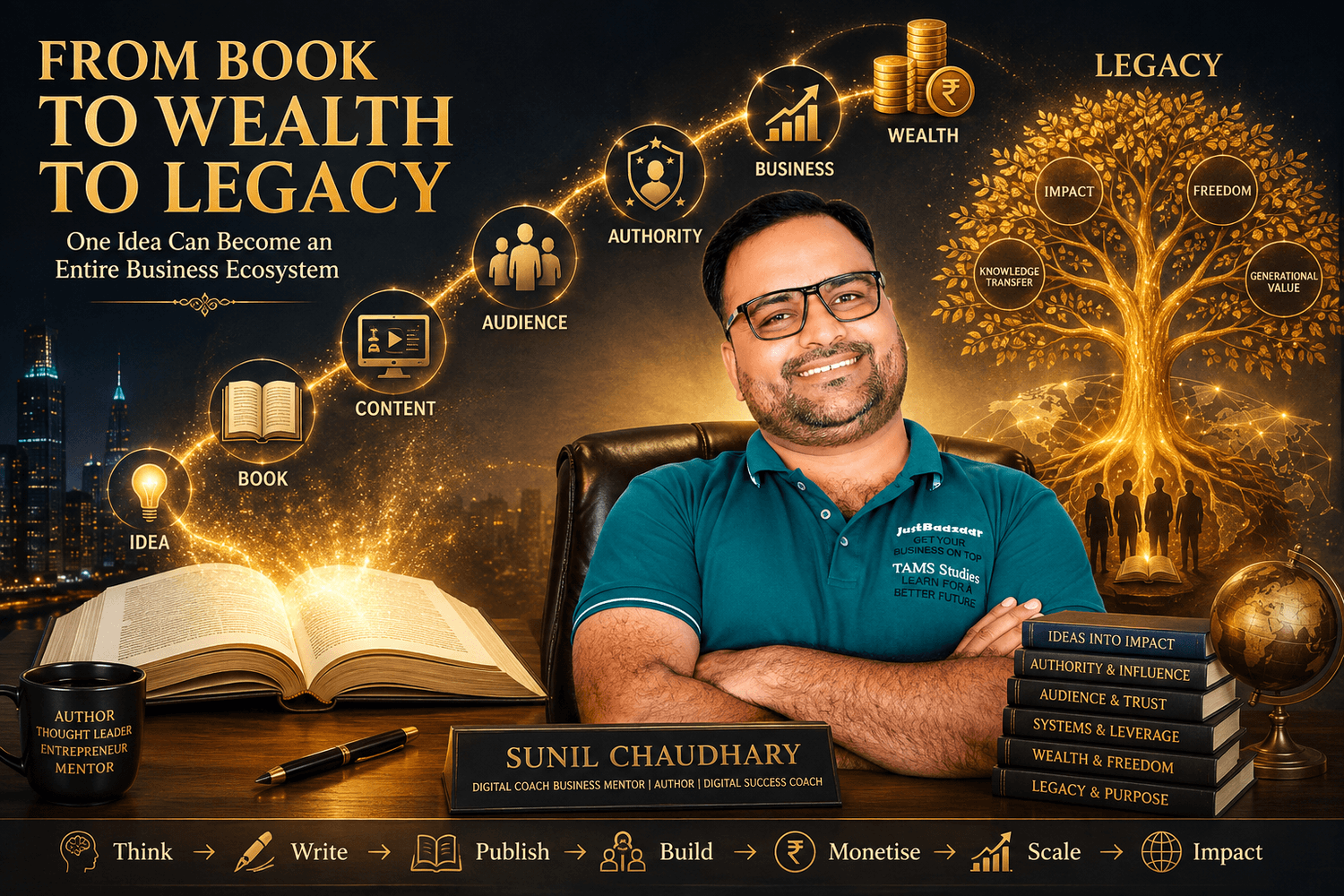
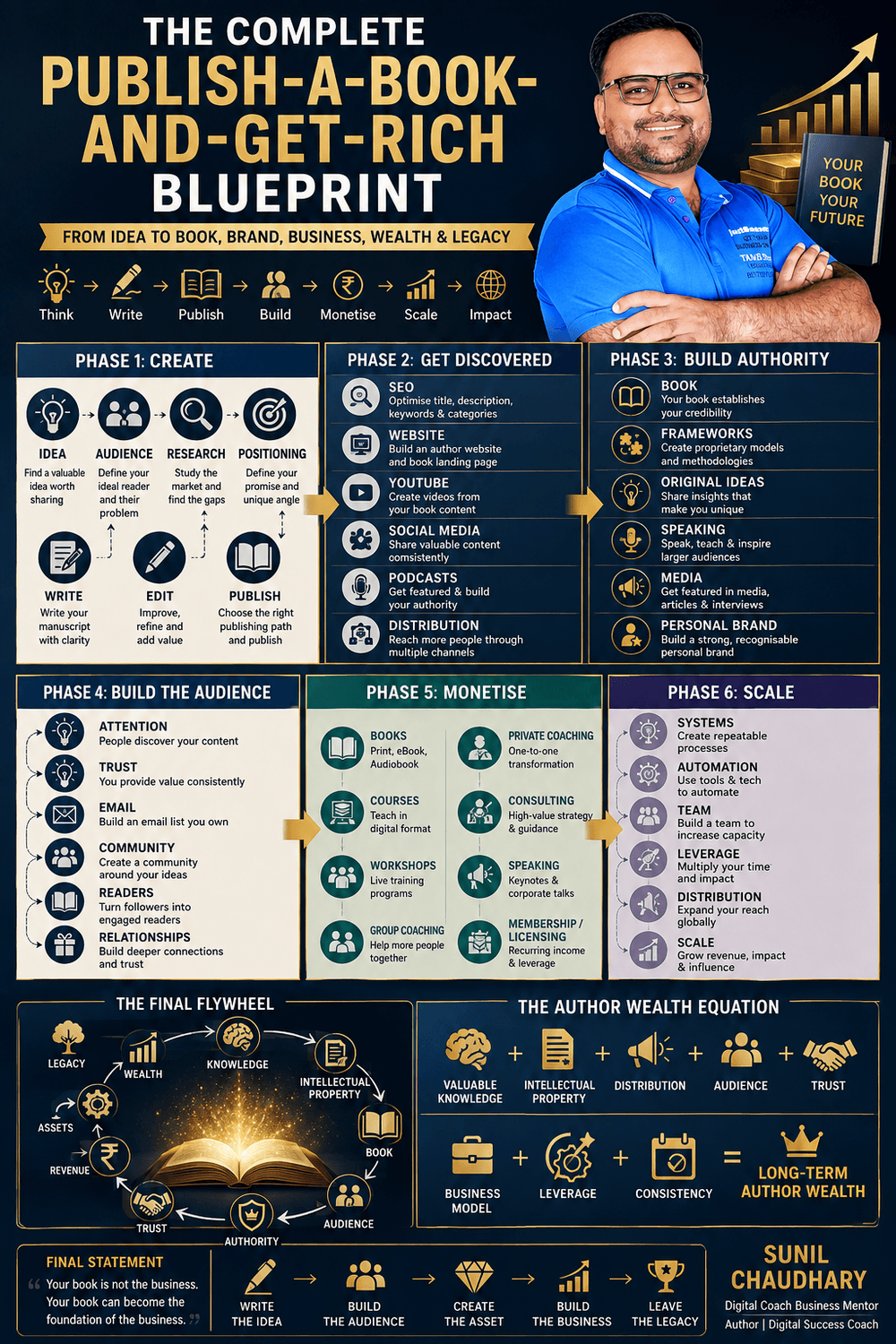

Building stronger digital visibility, smarter marketing systems and meaningful growth opportunities for businesses across industries.
BE VISIBLE. BE RELEVANT. BE REMEMBERED.