
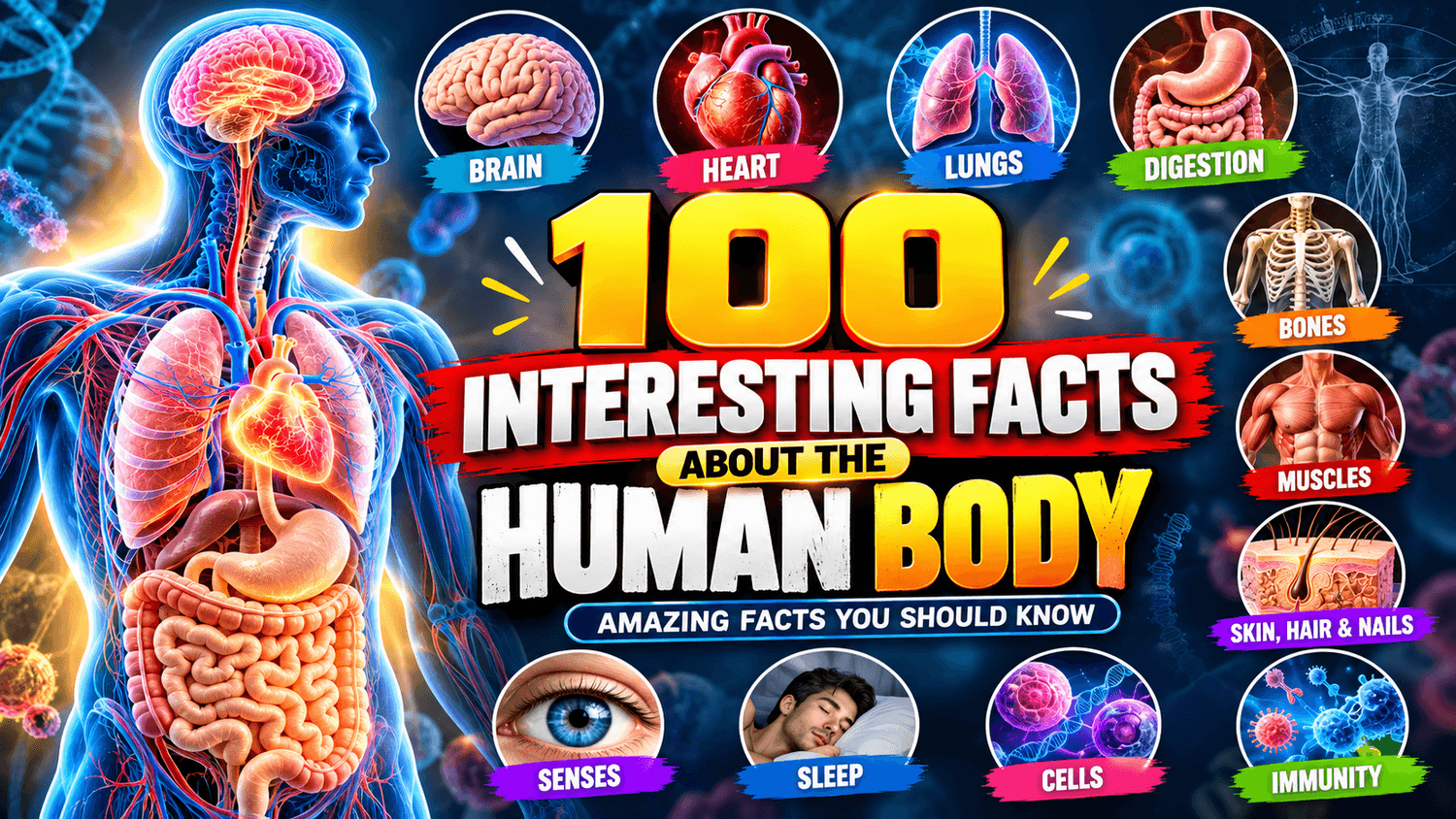
Interesting Facts About the Human Body: 100 Amazing Facts You Should Know
The human body is one of the most complex and fascinating systems in nature. Every second, countless processes take place inside us—our heart pumps blood, our lungs exchange gases, our brain processes information, and our cells continuously repair and replace themselves.
Even though we live with our bodies every day, there is still a lot we don't know about them.
In this article, you'll discover 100 interesting facts about the human body, covering the brain, heart, bones, muscles, skin, senses, digestion, sleep, immunity, and everyday body functions.
Note: These facts are intended for general education and awareness, not for diagnosing or treating medical conditions.
🧠 Facts About the Human Brain
1. The Brain Is the Body's Control Center
The brain coordinates movement, senses, memory, emotions, learning, communication, and many automatic functions.
2. The Brain Contains Billions of Neurons
Neurons are specialized cells that communicate information through electrical and chemical signals.
3. The Brain Uses a Significant Amount of Energy
Although the brain represents only a small portion of total body weight, it requires substantial energy to maintain its activity.
4. The Brain Is Protected by the Skull
The skull provides a strong protective structure around the brain.
5. The Brain Has Different Specialized Regions
Different areas of the brain contribute to functions such as movement, vision, hearing, language, memory, and decision-making.
6. The Brain Communicates Through Electrical and Chemical Signals
Neurons communicate with each other using electrical activity and chemical messengers called neurotransmitters.
7. Sleep Is Important for the Brain
Sleep supports memory, learning, emotional regulation, and many other biological processes.
8. The Brain Can Adapt
The nervous system has a capacity called neuroplasticity, through which neural connections can change in response to learning, experience, and injury.
9. Memory Is Not Stored in One Single Location
Different forms of memory involve interconnected brain systems rather than one simple storage area.
10. The Brain and Body Constantly Communicate
The nervous system and other body systems continuously exchange information to coordinate bodily functions.
❤️ Facts About the Heart and Blood
11. The Heart Is a Muscular Organ
The heart is primarily made of cardiac muscle and contracts rhythmically to pump blood.
12. The Heart Has Four Chambers
The human heart contains two atria and two ventricles.
13. The Right and Left Sides Have Different Jobs
The right side generally sends oxygen-poor blood toward the lungs, while the left side pumps oxygen-rich blood to the rest of the body.
14. Blood Carries Oxygen
Red blood cells contain hemoglobin, which helps transport oxygen.
15. Blood Also Carries Nutrients
Blood transports substances such as nutrients, hormones, gases, and metabolic waste products.
16. Blood Contains Several Major Components
Blood consists of plasma, red blood cells, white blood cells, and platelets.
17. Platelets Help Blood Clot
Platelets are important in the body's process of stopping bleeding after an injury.
18. White Blood Cells Support the Immune System
White blood cells help defend the body against infections and other threats.
19. Blood Vessels Form an Extensive Network
Arteries, veins, and smaller vessels transport blood throughout the body.
20. The Heart Works Continuously
The heart keeps pumping blood throughout life, although its rate changes depending on activity, emotions, health, and other factors.
🦴 Facts About Bones
21. The Adult Human Skeleton Usually Has 206 Bones
The commonly cited number for an adult human skeleton is 206 bones.
22. Babies Have More Bones
Babies are born with more separate bone structures, many of which gradually fuse during development.
23. Bones Are Living Tissue
Bone contains living cells and continuously undergoes remodeling.
24. Bones Provide Structural Support
The skeleton gives the body its framework and helps maintain its shape.
25. Bones Protect Important Organs
The skull protects the brain, while the rib cage helps protect organs such as the heart and lungs.
26. Bones Help With Movement
Bones work together with muscles and joints to allow the body to move.
27. Bone Marrow Is Found Inside Many Bones
Bone marrow is responsible for producing many blood cells.
28. Bones Store Minerals
Bone tissue serves as an important storage site for minerals such as calcium and phosphorus.
29. The Femur Is the Longest Major Bone
The femur, or thigh bone, is the longest and one of the strongest bones in the human body.
30. Bone Strength Depends on More Than Size
Bone strength is influenced by factors including mineral content, structure, age, nutrition, physical activity, and overall health.
💪 Facts About Muscles
31. The Human Body Has Hundreds of Muscles
Humans have more than 600 skeletal muscles, depending on how individual muscles are counted.
32. Muscles Make Movement Possible
Skeletal muscles contract and relax to move bones and body parts.
33. The Heart Is Also a Muscle
Cardiac muscle forms the muscular walls of the heart.
34. Muscles Can Work Automatically
Some muscles, including cardiac and smooth muscle, operate largely without conscious control.
35. Muscles Need Energy
Muscle contraction requires energy, primarily supplied through molecules such as ATP.
36. Exercise Can Strengthen Muscles
Resistance training can stimulate muscle adaptation and growth.
37. Muscles Work in Groups
Many movements require several muscles to coordinate their activity.
38. The Diaphragm Helps You Breathe
The diaphragm is a major muscle involved in breathing.
39. Muscles Can Become Fatigued
After prolonged or intense activity, muscles can temporarily become less capable of producing force.
40. Regular Movement Supports Muscle Health
Physical activity helps maintain muscle strength, function, and overall physical capacity.
👁️ Amazing Facts About Human Senses
41. Humans Have More Than Five Sensory Systems
The traditional five senses are sight, hearing, smell, taste, and touch, but humans also have senses related to balance, body position, temperature, pain, and internal conditions.
42. The Eyes Detect Light
The eyes contain specialized cells that respond to light and help create visual information.
43. The Retina Is Located at the Back of the Eye
The retina contains photoreceptor cells that respond to light.
44. The Brain Interprets What the Eyes Detect
Vision isn't simply produced by the eyes; the brain processes signals from the visual system to create our perception.
45. The Ear Helps With Balance
Structures in the inner ear contribute not only to hearing but also to maintaining balance.
46. The Eardrum Responds to Sound Waves
Sound waves cause vibrations in the eardrum, which are transferred through structures of the middle and inner ear.
47. The Nose Does More Than Detect Smells
The nose filters, warms, and humidifies incoming air while also housing the sensory system for smell.
48. Taste and Smell Work Together
Much of what people experience as flavor comes from a combination of taste and smell.
49. Touch Helps Protect the Body
Sensory receptors in the skin help detect pressure, temperature, pain, and other forms of stimulation.
50. The Brain Combines Information From Multiple Senses
The nervous system integrates information from different sensory systems to help us understand our surroundings.
🫁 Facts About the Respiratory System
51. Humans Need Oxygen
Cells use oxygen in important processes involved in producing energy.
52. The Lungs Are Major Respiratory Organs
The lungs allow oxygen to enter the bloodstream and carbon dioxide to leave it.
53. Humans Have Two Lungs
Most people have a right lung and a left lung, with the heart occupying space between them.
54. The Right Lung Is Slightly Larger
The right lung is generally larger because the heart occupies more space on the left side of the chest.
55. Gas Exchange Happens in Tiny Air Sacs
Alveoli are microscopic air sacs where oxygen and carbon dioxide are exchanged between the lungs and blood.
56. Breathing Is Controlled Automatically
The nervous system regulates breathing without requiring conscious attention under normal circumstances.
57. Breathing Rate Changes With Activity
Exercise, emotions, illness, altitude, and other factors can influence breathing rate.
58. The Diaphragm Plays a Major Role in Breathing
When the diaphragm contracts, it helps create the pressure changes needed to draw air into the lungs.
59. Carbon Dioxide Is a Waste Product
Cells produce carbon dioxide during metabolism, and the respiratory system helps remove it from the body.
60. The Respiratory System Works With the Circulatory System
The lungs exchange gases while the cardiovascular system transports those gases between the lungs and tissues.
🍎 Facts About Digestion
61. Digestion Begins in the Mouth
Chewing breaks food into smaller pieces, while saliva begins the chemical digestion of certain nutrients.
62. Saliva Helps With Digestion
Saliva contains substances that help moisten food and begin breaking down carbohydrates.
63. The Stomach Produces Acid
Stomach acid helps break down food and supports the digestion process.
64. The Small Intestine Is Important for Nutrient Absorption
Most digestion and absorption of nutrients takes place in the small intestine.
65. The Large Intestine Absorbs Water
The large intestine plays an important role in absorbing water and forming stool.
66. The Liver Is a Major Metabolic Organ
The liver performs numerous functions, including processing nutrients and producing bile.
67. The Gallbladder Stores Bile
The gallbladder stores and concentrates bile produced by the liver.
68. The Pancreas Has Multiple Functions
The pancreas produces digestive enzymes and hormones, including insulin.
69. The Digestive System Contains Microorganisms
The gastrointestinal tract contains trillions of microorganisms that interact with the body and contribute to digestion and other biological processes.
70. Fiber Supports Digestive Health
Dietary fiber can support normal bowel function and is an important component of a balanced diet.
🧴 Facts About Skin, Hair and Nails
71. Skin Is the Largest Organ of the Human Body
The skin forms an important protective barrier between the body and its environment.
72. Skin Helps Regulate Body Temperature
Sweating and changes in blood flow through the skin help regulate temperature.
73. Skin Contains Sensory Receptors
The skin helps us detect touch, pressure, temperature, and pain.
74. Hair Grows From Follicles
Hair develops from structures called hair follicles located within the skin.
75. Hair Growth Happens in Cycles
Individual hairs go through phases of growth, transition, and rest.
76. Nails Are Made Primarily of Keratin
Keratin is a strong structural protein also found in hair and the outer layer of skin.
77. Fingernails Usually Grow Faster Than Toenails
Fingernails generally grow more quickly than toenails, although growth rates vary among individuals.
78. Skin Produces Vitamin D Under Suitable UV Exposure
When skin is exposed to ultraviolet B radiation, it can produce vitamin D.
79. Everyone Has a Unique Combination of Skin Characteristics
Skin color, texture, thickness, oil production, and other characteristics vary from person to person.
80. The Skin Is Constantly Renewing Itself
Old skin cells are continuously shed while new cells develop.
🛡️ Facts About the Immune System
81. The Immune System Protects the Body
The immune system helps identify and respond to potentially harmful organisms and abnormal cells.
82. White Blood Cells Are Important Immune Cells
Different types of white blood cells perform different roles in immune defense.
83. Antibodies Help Recognize Specific Targets
Antibodies are proteins produced by certain immune cells that can recognize specific molecules.
84. The Immune System Has Multiple Layers of Defense
The body uses physical barriers, innate immune responses, and adaptive immune responses to defend itself.
85. Skin Is Part of the Immune Defense
The skin acts as a physical barrier that helps prevent many harmful organisms from entering the body.
86. The Immune System Can Develop Memory
Some immune responses create memory cells, allowing the body to respond more rapidly when it encounters a familiar threat again.
87. Vaccines Train the Immune System
Vaccines expose the immune system to specific information about a pathogen or disease target so that it can develop protective immune responses.
88. Fever Can Be Part of an Immune Response
An increase in body temperature can occur as part of the body's response to certain infections and other conditions.
89. The Lymphatic System Supports Immunity
The lymphatic system transports lymph and plays important roles in immune surveillance and fluid balance.
90. The Immune System Is Highly Complex
It involves many types of cells, tissues, organs, signaling molecules, and biological processes working together.
😴 Facts About Sleep and Recovery
91. Sleep Is a Biological Necessity
Sleep is essential for normal physical and mental functioning.
92. The Brain Remains Active During Sleep
Sleep is not simply a period when the brain switches off. Brain activity changes across different sleep stages.
93. Humans Experience Different Sleep Stages
Sleep includes different stages, including non-REM sleep and REM sleep.
94. Dreams Can Occur During Sleep
Dreaming can occur during different stages of sleep and is especially associated with REM sleep.
95. Sleep Supports Memory
Sleep plays an important role in learning and memory consolidation.
96. Sleep Affects Mood
Insufficient or poor-quality sleep can affect mood, attention, and cognitive performance.
97. Sleep Supports Physical Recovery
Adequate sleep supports normal physical recovery and many biological processes.
98. Sleep Needs Change With Age
The amount of sleep people need varies depending on age and individual factors.
99. A Regular Sleep Schedule Can Be Helpful
Maintaining consistent sleep and wake times can support healthy sleep habits.
100. The Human Body Never Truly Stops Working
Even when you're sleeping, your heart, lungs, brain, digestive system, immune system, and countless cellular processes continue working.
🌟 Why Learning About Your Body Matters
Understanding the human body can help you appreciate how interconnected different systems are.
Your brain communicates with your body.
Your heart and blood vessels transport oxygen and nutrients.
Your lungs exchange gases.
Your digestive system processes food.
Your immune system protects you.
Your muscles and bones allow movement.
Your skin protects you from the outside environment.
No single system works completely alone. They continuously interact to keep the body functioning.
Final Thoughts
The human body is an extraordinary biological system made up of trillions of cells, specialized tissues, organs, and interconnected systems.
From the electrical activity of the brain to the rhythmic beating of the heart, thousands of processes happen inside us every moment—many without us even noticing.
Learning about your body isn't just fascinating; it can also encourage greater awareness of sleep, nutrition, exercise, hygiene, and overall well-being.
The more you understand your body, the more you can appreciate the remarkable system you live in every day.
Frequently Asked Questions
How many organs are in the human body?
There isn't one universally agreed number because classifications differ, but the human body contains numerous major organs that perform essential functions.
What is the largest organ of the human body?
The skin is generally considered the largest organ.
How many bones does an adult human have?
A typical adult human skeleton has 206 bones.
What is the largest bone in the human body?
The femur, located in the thigh, is the longest and one of the strongest bones.
Why is sleep important?
Sleep supports brain function, memory, mood, physical recovery, and many other biological processes.
Can the human body repair itself?
Yes. The body has many repair and regeneration mechanisms, although the ability to heal varies depending on the tissue, injury, age, and other factors.

Building stronger digital visibility, smarter marketing systems and meaningful growth opportunities for businesses across industries.
BE VISIBLE. BE RELEVANT. BE REMEMBERED.