
Colombia Earthquake 2026: Powerful 7.4 Quake Strikes
Powerful Earthquake Strikes Western Colombia: What Happened and Why It Matters
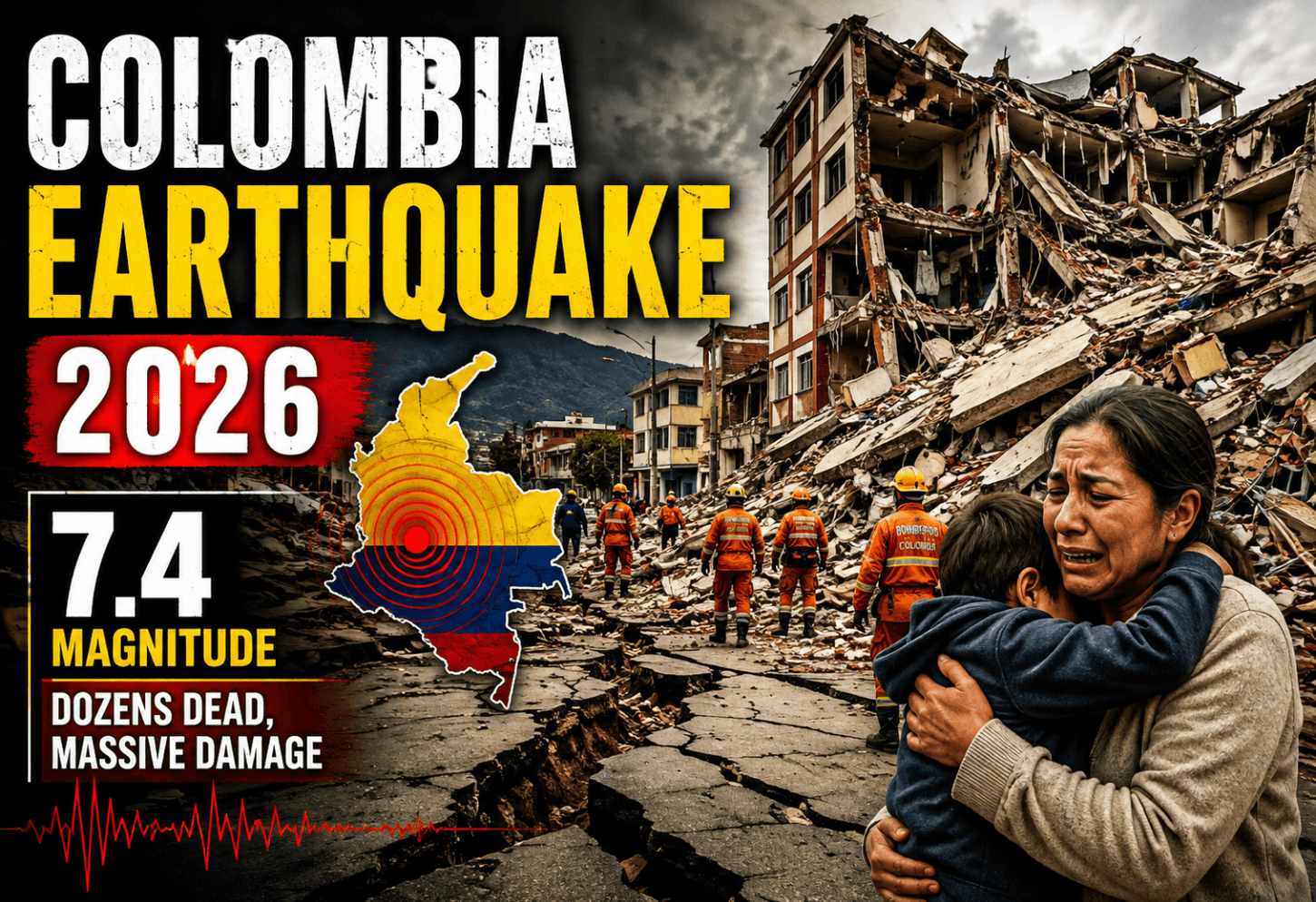
A powerful earthquake has shaken western Colombia, killing dozens of people, damaging buildings and creating fear across a large part of the country.
The earthquake measured 7.4 magnitude and struck on Monday, August 10, 2026. According to the U.S. Geological Survey, the earthquake happened near San José del Palmar in Colombia’s Chocó region, at a depth of about 107 kilometres.
The human cost is still changing. Reuters reported that at least 77 people had died, while rescue teams were still searching damaged buildings.
This is not only a story about an earthquake.
It is also a story about how a natural disaster can quickly become a national crisis.
A 7.4 Earthquake Hits Western Colombia
The earthquake struck early in the day and was felt across a wide area.
People in several Colombian cities felt strong shaking. The tremors were also felt in nearby countries, including Ecuador and Panama.
The USGS placed the earthquake about 5 kilometres east of San José del Palmar, with a depth of around 107 kilometres.
A deep earthquake can behave differently from a very shallow earthquake.
But 7.4 magnitude is still a very powerful event.
And when a strong earthquake hits areas with homes, hospitals, roads and other buildings, the real danger is not only the shaking.
The real danger is what happens after the shaking stops.
Buildings can fall.
Roads can become blocked.
Electricity can fail.
Communication can stop.
People can become trapped.
And rescue teams may struggle to reach them.
That is exactly why the hours after a major earthquake are so important.
Death Toll Is Still Rising
One of the most important points in this disaster is that the first death number may not be the final number.
Early reports gave different figures.
Some reports initially said around 20 people had died. Later reports put the number much higher.
Reuters reported at least 77 deaths, with the situation still developing.
This difference is normal during a major disaster.
Why?
Because rescue workers first have to reach damaged areas.
Some villages and towns may be difficult to reach.
Some people may still be trapped under buildings.
Hospitals may be dealing with hundreds of injured people.
Officials also need time to check reports from different locations.
So, in the first hours, the death toll can change quickly.
This is why people should be careful with social media posts claiming a final number too early.
Buildings Have Collapsed
The earthquake has caused serious damage to buildings in several areas.
Reuters reported major damage in places including Pereira, Manizales, Cali and Buenaventura. More than 25 buildings were reported to have collapsed in Cali, with people feared trapped under the rubble.
This gives us an important lesson.
An earthquake does not need to destroy an entire city to create a huge emergency.
Imagine one building collapsing.
Now imagine ten.
Now imagine dozens.
Every collapsed building can create another rescue operation.
Every trapped person needs a rescue team.
Every injured person needs medical help.
And every damaged road can slow that rescue.
That is how a natural event can become a huge human crisis within minutes.
Why Did Colombia Feel the Earthquake So Widely?
Colombia is located in a part of the world where earthquakes are common.
The western side of South America is especially active because several large tectonic plates meet in and around this region.
In simple words, the Earth's outer surface is not one solid piece.
It is made of huge pieces called tectonic plates.
These plates slowly move.
Sometimes they push against each other.
Sometimes they slide.
Sometimes one plate moves below another.
The pressure can build for years.
And then the rocks suddenly move.
That sudden movement releases a huge amount of energy.
We feel that energy as an earthquake.
The Depth of This Earthquake Matters
The USGS reported the earthquake at about 107 kilometres deep.
That is much deeper than many damaging earthquakes.
But depth does not mean that an earthquake is automatically safe.
A large earthquake can still produce strong shaking over a very wide area.
That is one reason people in distant cities felt this earthquake.
The bigger lesson is simple:
Magnitude tells us how powerful the earthquake is, but damage also depends on depth, distance, buildings, ground conditions and population.
So, saying only "7.4" does not tell the complete story.
Ecuador Also Felt the Tremors
The earthquake was not limited to Colombia.
People in neighbouring Ecuador also felt the shaking. Reports said people left buildings in fear as the earthquake spread across the region.
This is another important point about earthquakes.
Earthquakes do not care about national borders.
The ground does not stop shaking because one country ends and another begins.
That means disaster planning also needs cooperation between neighbouring countries.
Colombia and Ecuador both need strong emergency systems because earthquakes can affect both countries during the same event.
Airports and Infrastructure Also Face Problems
A major earthquake can damage much more than houses.
It can affect:
Roads
Bridges
Airports
Hospitals
Electricity systems
Water supply
Mobile networks
Schools
Government buildings
Reuters reported that some airports suspended operations for safety inspections after the earthquake.
This is extremely important.
Why?
Because airports can become important channels for emergency support.
If roads are damaged and airports are closed, moving rescue workers and medical supplies becomes harder.
So infrastructure is not only about economic activity.
During a disaster, infrastructure becomes a lifeline.
The Real Battle Has Now Started
The earthquake itself may have lasted only a short time.
But the rescue operation can continue for days.
This is where the real battle begins.
Search teams have to find people under rubble.
Doctors have to treat injured people.
Engineers have to check buildings.
Police and soldiers may need to control damaged areas.
Families need information about missing relatives.
Food and clean water may need to reach affected communities.
And governments have to coordinate everything at the same time.
Reuters reported that rescue teams were searching collapsed structures and that support was being mobilised from other Colombian cities.
This is why disaster response needs preparation before disaster strikes.
Why Building Safety Is More Important Than Earthquake Prediction
Here is perhaps the biggest lesson from Colombia.
Scientists can monitor earthquakes.
They can identify earthquake-prone regions.
They can measure shaking.
But predicting the exact time and place of a major earthquake remains extremely difficult.
So the better question is not:
"Can we stop earthquakes?"
We cannot.
The better question is:
"Can we build cities that survive earthquakes better?"
That answer is yes.
Better building codes can save lives.
Stronger construction can save lives.
Regular building inspections can save lives.
Emergency drills can save lives.
Public education can save lives.
And quick rescue systems can save lives.
In a disaster, preparation becomes protection.
Colombia's History Shows the Risk
Colombia has experienced devastating earthquakes before.
The country still remembers the 1985 Armero disaster, when volcanic activity caused a massive mudflow that killed thousands of people.
The country also suffered a major earthquake in the coffee-growing region in 1999.
These events show something important.
Natural disasters become much more dangerous when communities are not ready.
The lesson is not to live in fear.
The lesson is to live with awareness.
Could There Be More Shaking?
After a large earthquake, smaller earthquakes called aftershocks can happen.
These aftershocks can be dangerous.
A building that survived the first earthquake may already be weak.
Another strong movement could make it collapse.
That is why authorities usually tell people not to enter badly damaged buildings until experts check them.
People should also follow official emergency instructions rather than relying on rumours.
Why the Colombia Earthquake Matters Beyond Colombia
At first glance, this may look like a local disaster.
But it has a much bigger lesson for the world.
Cities are growing.
Buildings are becoming taller.
More people are living in urban areas.
More infrastructure is being built.
Climate change gets a lot of attention because of floods, storms and heat.
But earthquakes remain one of the major natural risks that cities must prepare for.
And earthquakes can happen without warning.
That makes resilience extremely important.
A resilient city is not a city where disasters never happen.
It is a city that can take a hit, protect people and recover quickly.
The Bigger Kootneeti Lesson
There is a deeper lesson here.
Countries often spend a lot of money preparing for wars, borders and national security.
Those things matter.
But national security also means protecting ordinary people from natural disasters.
A country can have strong military power.
It can have modern technology.
It can have a powerful economy.
But when an earthquake destroys homes and hospitals, the real test is simple:
Can the government reach its people quickly?
Can it rescue them?
Can it treat them?
Can it provide food and water?
Can it restore communication?
Can it rebuild?
That is also national strength.
The World Is Watching Colombia
As rescue operations continue, the most important priority is not politics.
It is people.
Every minute matters for someone trapped under rubble.
Every ambulance matters.
Every rescue worker matters.
Every hospital bed matters.
And every family waiting for news matters.
The earthquake has already caused major loss.
But the final impact will depend heavily on how quickly Colombia can rescue survivors, support injured people and rebuild damaged communities.
The world should watch this situation carefully and support humanitarian efforts where needed.
For now, the most important message is simple:
The earthquake has stopped shaking the ground. But its human impact is still unfolding.
And Colombia's biggest challenge now is not surviving the earthquake.
It is saving as many lives as possible after it.
Sources and latest update
The USGS confirms a magnitude 7.4 earthquake near San José del Palmar, Colombia, at a depth of about 107 km.
Reuters' latest report says at least 77 people had died, with rescue operations continuing and significant damage reported in several Colombian cities.
Because this is a developing disaster, casualty and damage figures may change as rescue teams reach more affected areas.

Building stronger digital visibility, smarter marketing systems and meaningful growth opportunities for businesses across industries.
BE VISIBLE. BE RELEVANT. BE REMEMBERED.