
Air India Pilot Reportedly Tests Positive for Marijuana
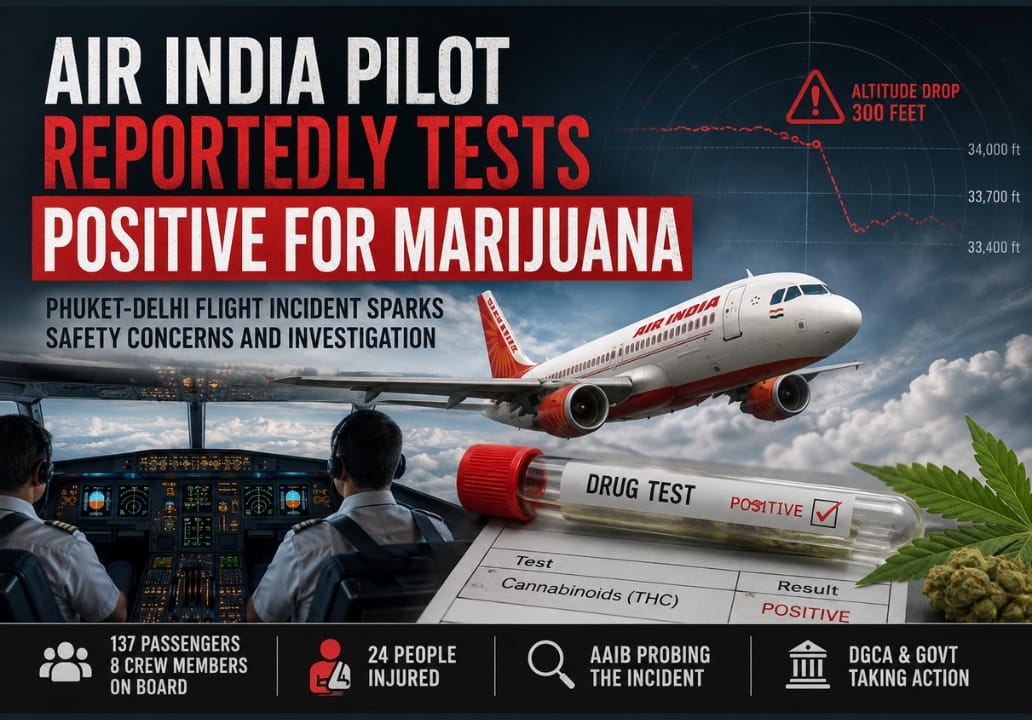
Air India Pilot Reportedly Tests Positive for Marijuana: What This Means for Aviation Safety
The latest Air India controversy has raised a very serious question: Can a pilot who tests positive for marijuana be allowed to fly a passenger aircraft?
Reports say the captain of Air India flight AI2379, operating from Phuket to Delhi, has tested positive for marijuana in a confirmatory drug test. The development comes days after the Airbus A320 experienced a sudden altitude variation of around 300 feet during the flight, leaving passengers and crew injured. Reuters reported that the confirmatory test was positive, citing a source familiar with the matter.
But there is an important point that must not be missed.
A positive marijuana test does not automatically prove that the pilot was intoxicated at the exact moment the aircraft lost altitude.
That distinction is extremely important when analysing this case.
What Happened on Air India Flight AI2379?
On August 4, 2026, Air India flight AI2379 was flying from Phuket to Delhi when the aircraft suddenly lost approximately 300 feet of altitude during cruise.
The aircraft later stabilised and landed safely in Delhi.
According to the Government of India, the Airbus A320 was carrying 137 passengers, including three infants, and eight crew members. Twenty passengers and four cabin crew members were reported injured. The Aircraft Accident Investigation Bureau, or AAIB, has taken up the investigation.
The important thing is that the investigation is still going on.
So we should not jump to the conclusion that marijuana caused the altitude loss.
There may be several possible factors involved, including aircraft systems, flight-control issues, turbulence, crew actions or a combination of factors.
Reports have mentioned possible technical issues as well, which is why the AAIB investigation is so important.
Then Why Is the Marijuana Test Such a Big Issue?
Because flying a commercial aircraft is not an ordinary job.
A pilot is responsible for hundreds of lives.
A small mistake in a car can affect a few people.
A serious mistake in an aircraft can affect more than a hundred passengers at the same time.
Indian aviation rules are therefore very strict about psychoactive substances.
DGCA regulations state that a person working as a pilot or other operating crew member must not use alcoholic drinks, sedative, narcotic or stimulant drug preparations within the prohibited period before flying, and must not operate while impaired by such substances. The rules also prohibit exercising licence privileges while under the influence of a psychoactive substance that could affect safe performance.
This is not simply about whether someone uses a particular substance in their private life.
It is about fitness to fly.
Positive Test Does Not Automatically Mean "Pilot Was High During the Flight"
This is perhaps the most important analytical point in the entire story.
A drug test can detect the presence of a substance or its metabolites.
But detection is not always the same thing as proving impairment at that exact moment.
Therefore, saying:
"The pilot tested positive for marijuana."
is different from saying:
"The pilot was intoxicated by marijuana while flying."
The second statement requires stronger evidence.
Investigators would need to examine the complete medical and toxicology evidence, the timing of the substance exposure, the type of test used, the concentration detected, the pilot's behaviour, cockpit evidence, aircraft data and other relevant information.
This is why responsible reporting should use words such as "reportedly tested positive" until the authorities officially establish all the facts.
Why the Confirmatory Test Matters
According to Reuters, the captain's initial screening had produced a result that required further laboratory testing. The confirmatory test was later reported positive for marijuana.
That makes the development more serious than an unconfirmed first screening.
However, even a confirmed positive result still needs to be properly interpreted.
The real questions are:
When was the substance consumed?
Was the pilot impaired while performing flight duties?
Was there any connection between the test result and the aircraft's sudden altitude change?
Did the pilot's condition affect cockpit decision-making?
These are questions for aviation investigators and medical experts, not social media commentators.
The 300-Foot Drop and Drug Test Are Two Different Questions
This is where public discussion can become confused.
There are actually two separate issues.
Issue 1: Why did the aircraft lose altitude?
The AAIB has to determine the technical and operational cause.
That means looking at aircraft systems, flight data, cockpit voice recordings, weather, turbulence, crew actions, flight-control systems and other evidence.
Issue 2: Was the pilot medically fit to operate the aircraft?
The drug-testing evidence is relevant to this question.
But the two investigations should not automatically be merged.
A pilot testing positive for marijuana does not by itself prove that marijuana caused the aircraft to lose altitude.
At the same time, the drug result cannot simply be ignored.
If the pilot was impaired while operating the aircraft, that would represent a major aviation safety failure.
Both possibilities need to be investigated independently and then compared with the evidence.
What Should Air India and DGCA Do Now?
The first requirement should be complete transparency within the legal limits of the investigation.
The pilot should remain away from flying duties while the authorities complete their assessment.
The airline and regulator should also review:
The complete toxicology report
The timing and circumstances of the drug test
The pilot's medical records relevant to fitness for duty
Cockpit behaviour and communication
Flight data recorder information
Cockpit voice recorder information
Aircraft technical data
Weather and turbulence conditions
Crew procedures and decision-making
Previous safety or substance-related incidents, if any
This should not become a media trial.
It should become an evidence-based safety investigation.
India's Aviation System Already Has Drug and Alcohol Safeguards
India's aviation regulations already recognise the danger of operating aircraft under the influence of substances.
For scheduled operators, crew members are subject to breath-analyser procedures around flight operations, including post-flight testing for flights arriving in India from international destinations.
This case raises a bigger question:
Are existing safeguards enough to detect every possible impairment risk before a flight?
That is worth examining.
Breath analysers are mainly designed for alcohol.
They are not a complete answer to every possible psychoactive substance.
So regulators may need to continuously review whether random or targeted testing systems are adequate for modern aviation.
The Human Factor Cannot Be Ignored
Aircraft are becoming more advanced.
Airbus and other manufacturers have sophisticated systems designed to protect aircraft and passengers.
But one factor remains extremely important:
The human being inside the cockpit.
Technology can warn pilots.
Automation can assist pilots.
Aircraft systems can provide protection.
But pilots still make important decisions, particularly when something unexpected happens.
That is why pilot fitness is one of the strongest pillars of aviation safety.
A pilot does not just need technical knowledge.
The pilot needs clear judgement, physical fitness, mental alertness and the ability to respond quickly under pressure.
This Is Also a Question of Public Trust
Air travel depends heavily on trust.
When passengers enter an aircraft, they cannot personally check the engines.
They cannot inspect the flight-control systems.
They cannot evaluate the pilot's medical condition.
They trust the airline, the regulator, the crew and the aviation system.
That trust is earned through strict standards.
Therefore, if the final investigation establishes that a pilot was impaired while operating a passenger aircraft, the matter cannot be treated as a simple employee disciplinary issue.
It would become a major aviation safety concern.
But if the investigation establishes that the drug detection was unrelated to the flight incident and there was no impairment during duty, then that distinction must also be clearly communicated.
Facts matter in both directions.
What About the Pilot's Licence?
It would be premature to say that the pilot will automatically lose his licence.
The final action will depend on the applicable DGCA rules, the confirmed evidence, the circumstances of the test and the findings of the relevant authorities.
India has previously taken strict action against pilots who violated alcohol-related aviation rules. For example, the Delhi High Court in 2026 dealt with a case involving suspension of a pilot's licence privileges after a positive breath-analyser incident.
But the present case involves a different substance and a different set of facts.
So comparisons should be made carefully.
The Bigger Lesson for Air India
Air India has been under intense public scrutiny over aviation safety, especially following several high-profile incidents.
That makes this case particularly sensitive.
The answer should not be to defend Air India blindly.
It should also not be to declare the airline guilty before the investigation is complete.
The right approach is simple:
Investigate everything. Hide nothing. Punish proven violations. Fix system failures. Protect passengers.
If the pilot violated aviation safety rules, there should be strong action.
If technical problems contributed to the altitude loss, those problems must be identified and fixed.
If there were weaknesses in testing or crew monitoring, those weaknesses must be corrected.
And if the pilot's drug test had no connection with the aircraft incident, that fact should also be clearly established.
Final Analysis
The Air India Phuket-Delhi incident is bigger than one pilot and bigger than one positive drug test.
It is a test of India's aviation safety system.
The reported marijuana-positive result is certainly serious, especially because it followed an unusual in-flight event. But we must not confuse correlation with causation.
The aircraft lost altitude.
The pilot reportedly tested positive for marijuana.
Those are facts being investigated.
But whether one caused the other is not yet established.
The AAIB investigation should therefore be allowed to examine the aircraft, the crew, the technical evidence and the medical evidence without premature conclusions.
Because when 137 passengers are sitting inside an aircraft, aviation safety cannot depend on assumptions.
It has to depend on evidence, discipline and accountability.
And perhaps the most important lesson is this:
Aviation has no room for "maybe." Before a pilot takes control of a passenger aircraft, the system must have maximum confidence that the person is fit to fly.
The public deserves the truth.
The pilots deserve a fair investigation.
And passengers deserve nothing less than the highest possible standard of safety.

Building stronger digital visibility, smarter marketing systems and meaningful growth opportunities for businesses across industries.
BE VISIBLE. BE RELEVANT. BE REMEMBERED.