
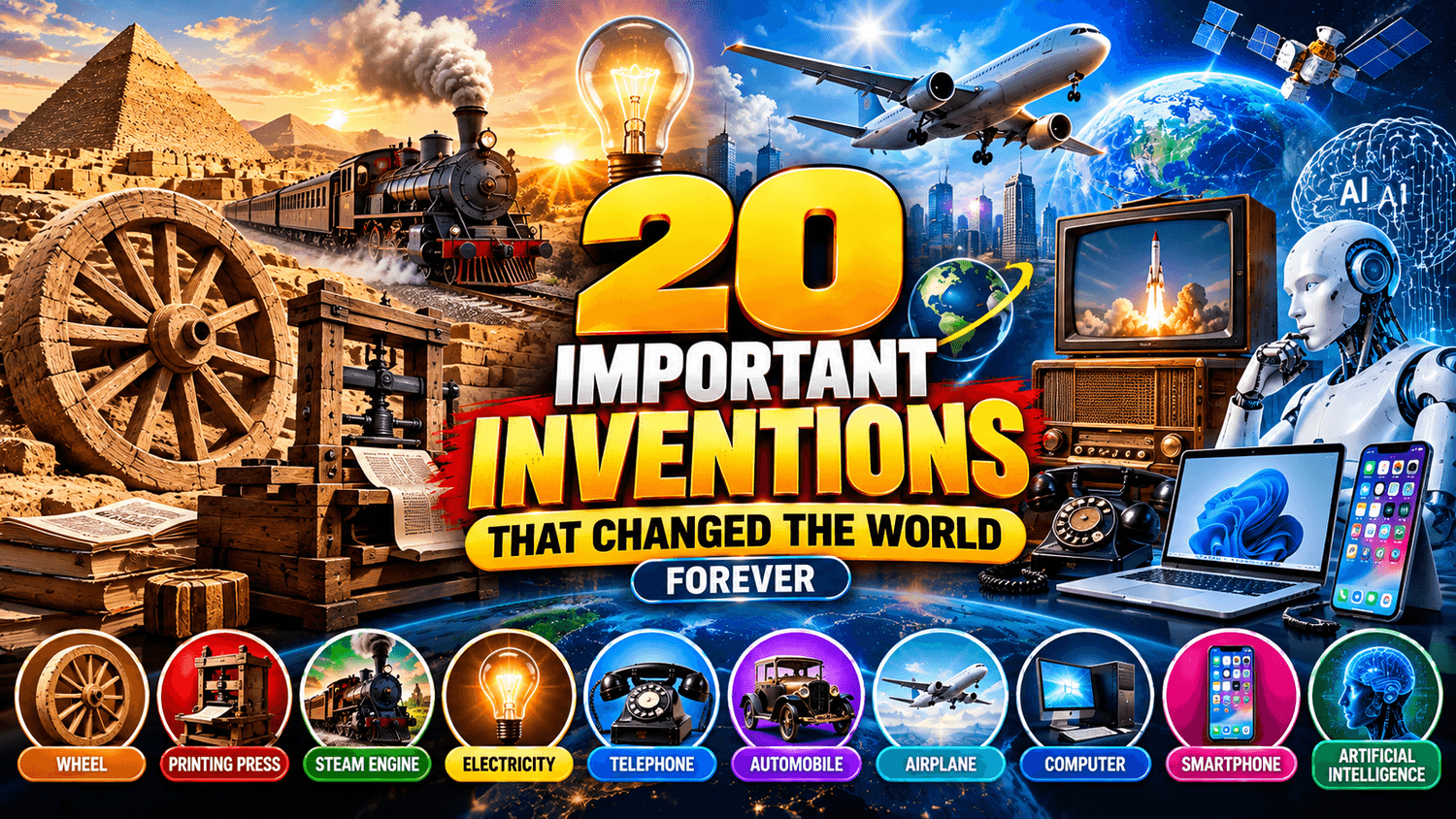
20 Important Inventions That Changed the World Forever
Throughout history, human beings have created remarkable inventions that transformed the way we live, work, communicate, travel, and understand the world. From the invention of the wheel to modern computers and the internet, every major technological breakthrough has opened new possibilities for humanity.
Some inventions made everyday life easier, while others changed entire industries, improved healthcare, connected distant communities, and accelerated scientific discoveries.
In this article, we will explore 20 important inventions that changed the world forever, discover who developed them, and understand how they continue to influence our daily lives.
What Is an Invention?
An invention is a new device, method, process, or technology created to solve a problem or perform a task in a new way. Some inventions emerge from individual discoveries, while others develop through the combined efforts of many people over generations.
It is also important to understand that many famous inventions were not created by a single person in one moment. They evolved through experimentation, improvements, and contributions from different civilizations.
Let's explore some of the most influential inventions in human history.
1. The Wheel
The wheel is one of the most important inventions in human history. Early evidence of wheeled vehicles dates back to approximately 3500 BCE in Mesopotamia.
Before wheeled transportation became widespread, moving heavy goods over long distances was difficult and time-consuming.
How the wheel changed the world:
Made transporting goods easier.
Improved the development of carts and vehicles.
Supported agriculture, trade, and construction.
Became essential to many machines and industrial systems.
Today, wheels are used in cars, bicycles, trains, industrial equipment, and countless other applications.
2. The Printing Press
The printing press transformed the way information was produced and distributed.
In Europe, Johannes Gutenberg developed a practical movable-type printing system during the 15th century. Printing technologies had already existed in East Asia, including woodblock printing and movable type.
How the printing press changed the world:
Made books easier to reproduce.
Helped expand access to education.
Supported the spread of scientific discoveries.
Contributed to the circulation of political, religious, and philosophical ideas.
The printing press helped create the foundations for mass communication and the widespread sharing of knowledge.
3. The Steam Engine
The steam engine played a major role in the Industrial Revolution.
Although early steam-powered machines existed before him, James Watt made important improvements to steam engine efficiency during the 18th century.
How the steam engine changed the world:
Powered factories and industrial machinery.
Supported the development of steam locomotives.
Improved the transportation of goods.
Reduced dependence on some traditional sources of mechanical power.
Steam technology helped transform manufacturing, mining, transport, and industrial production.
4. Electricity Generation and Distribution
The discovery and practical use of electricity developed through the work of many scientists and engineers over several centuries.
Inventors and researchers such as Michael Faraday, Thomas Edison, Nikola Tesla, and George Westinghouse contributed to different aspects of electrical generation, lighting, motors, and power distribution.
How electricity changed the world:
Made electric lighting widely possible.
Powered household appliances and industrial machines.
Supported modern communication systems.
Enabled computers, medical equipment, and electronic devices.
Electricity is now essential to modern homes, businesses, transportation systems, hospitals, and communication networks.
5. The Telephone
The telephone revolutionized communication by allowing people to transmit speech electronically over distances.
Alexander Graham Bell received a famous telephone patent in 1876, although the development of telephone technology involved contributions from several inventors.
How the telephone changed the world:
Enabled faster personal communication.
Improved business coordination.
Supported emergency communication.
Helped connect families and communities across distances.
Modern smartphones and internet-based calling systems build upon the foundations of earlier telephone technology.
6. The Automobile
The automobile transformed personal transportation and influenced the development of cities, roads, and industries.
Karl Benz developed and patented a practical gasoline-powered automobile in the 1880s. Over time, manufacturing innovations made cars more accessible to the public.
How the automobile changed the world:
Increased personal mobility.
Supported road infrastructure development.
Created millions of jobs in manufacturing and related industries.
Changed how people travel, work, and live.
Today, the automotive industry is also developing electric vehicles, autonomous driving systems, and alternative transportation technologies.
7. The Airplane
The airplane made it possible to travel through the sky and connect distant regions much faster than many traditional forms of transportation.
Orville and Wilbur Wright achieved a widely recognized milestone with their powered, controlled airplane flight in 1903.
How the airplane changed the world:
Reduced travel times between distant locations.
Enabled international tourism.
Improved the transportation of cargo.
Supported emergency medical transport and humanitarian assistance.
Aviation has made global travel and international business more accessible, although its environmental impact remains an important challenge.
8. The Light Bulb
Electric lighting changed how people illuminate homes, streets, workplaces, and public spaces.
Thomas Edison and his research team developed a commercially practical incandescent lighting system in the late 19th century, building on earlier work by other inventors.
How electric lighting changed the world:
Improved indoor illumination.
Extended working and study hours.
Supported public lighting and nighttime activities.
Contributed to safer and more flexible use of buildings.
Today, energy-efficient LED lighting is widely used because it generally consumes less electricity than traditional incandescent bulbs.
9. The Refrigerator
Refrigeration technology transformed food storage and preservation.
Modern refrigeration systems developed through contributions from numerous scientists, engineers, and inventors during the 19th and 20th centuries.
How refrigeration changed the world:
Helped keep food fresh for longer.
Reduced food spoilage.
Supported food transportation over long distances.
Improved storage of certain medicines and medical supplies.
Refrigeration is now essential in homes, supermarkets, restaurants, laboratories, and hospitals.
10. The Camera
The camera changed the way humans document life, preserve memories, and record historical events.
Early photographic processes emerged during the 19th century, with inventors such as Joseph Nicéphore Niépce and Louis Daguerre making important contributions.
How the camera changed the world:
Made it possible to preserve visual records.
Supported journalism and historical documentation.
Improved scientific observation.
Created new forms of art, entertainment, and communication.
Modern digital cameras and smartphone cameras allow billions of people to capture and share images instantly.
11. The Radio
Radio technology made wireless communication possible over long distances.
Its development involved several scientists and inventors, including Guglielmo Marconi, who played an important role in practical wireless telegraphy.
How radio changed the world:
Enabled mass broadcasting.
Improved communication with ships and remote locations.
Supported emergency alerts.
Made news, education, music, and entertainment accessible to large audiences.
Radio continues to serve communities through broadcasting, aviation communication, public safety, and other applications.
12. Television
Television brought moving images and sound into homes and public spaces.
Its development involved numerous inventors, including John Logie Baird and Philo Farnsworth, who contributed to early television systems.
How television changed the world:
Made visual news more accessible.
Changed entertainment and popular culture.
Supported educational programming.
Enabled people to witness major global events from home.
Today, television technology overlaps with streaming platforms, internet-connected displays, and digital media services.
13. The Computer
Computers are among the most influential inventions of the modern era.
Early computing systems were large machines designed for specific mathematical and scientific tasks. Over time, advances in electronics and semiconductor technology led to smaller, faster, and more affordable computers.
How computers changed the world:
Automated calculations and repetitive tasks.
Improved business operations.
Enabled digital communication and information storage.
Supported scientific research, engineering, and medical technology.
Computers are now used in education, banking, manufacturing, entertainment, healthcare, and nearly every major industry.
14. The Internet
The internet connects billions of devices and allows information to move across networks around the world.
Its development began with research into computer networking, including ARPANET in the late 1960s. The adoption of internet protocols helped create the global network used today.
How the internet changed the world:
Made global communication faster.
Enabled online education and remote work.
Supported e-commerce and digital payments.
Provided access to vast amounts of information.
The internet has also created challenges involving privacy, cybersecurity, misinformation, and unequal access to technology.
15. The World Wide Web
The World Wide Web was invented by Tim Berners-Lee at CERN and proposed in 1989.
Although the web uses the internet, the two are not the same thing. The internet is the underlying network infrastructure, while the web is a system of interconnected pages and resources accessed through that network.
How the World Wide Web changed the world:
Made online information easier to access.
Enabled websites, blogs, and digital publications.
Supported online shopping and business services.
Helped people share knowledge across borders.
The web has become a major platform for communication, education, publishing, and commerce.
16. Vaccination
Vaccination is one of the most important developments in public health.
Edward Jenner's work on smallpox vaccination in 1796 became a landmark in the history of immunization. Later scientists developed vaccines against many other infectious diseases.
How vaccination changed the world:
Helped prevent serious infectious diseases.
Reduced illness and death from several diseases.
Contributed to the eradication of smallpox.
Supported public health programs around the world.
Vaccines remain an important tool for preventing infectious diseases, with recommendations depending on age, location, health conditions, and disease risks.
17. Antibiotics
Antibiotics transformed the treatment of many bacterial infections.
Alexander Fleming discovered penicillin in 1928, and subsequent research and development made it possible to produce and use the medicine widely.
How antibiotics changed the world:
Made many bacterial infections treatable.
Improved the safety of numerous surgical procedures.
Helped treat serious infections.
Supported modern medical care.
However, the misuse and overuse of antibiotics can contribute to antimicrobial resistance, making some infections more difficult to treat.
18. The Personal Computer
Personal computers brought computing power into homes, schools, and small businesses.
During the late 20th century, improvements in microprocessors, storage, and software made computers increasingly practical for everyday use.
How personal computers changed the world:
Made digital work accessible to individuals.
Supported word processing and spreadsheets.
Enabled desktop publishing and graphic design.
Helped expand gaming, software development, and digital creativity.
Personal computers also played a major role in the growth of the internet and the digital economy.
19. The Smartphone
The smartphone combines communication, computing, photography, navigation, and internet access in a portable device.
Modern smartphones evolved from earlier mobile phones and personal digital assistants, with touchscreen devices becoming especially influential in the late 2000s.
How smartphones changed the world:
Made instant communication widely available.
Enabled mobile banking and digital payments.
Provided navigation and location services.
Supported photography, video creation, and social media.
Made learning resources accessible from almost anywhere with connectivity.
Smartphones have transformed daily routines, although excessive use and privacy concerns are important issues to consider.
20. Artificial Intelligence
Artificial intelligence, commonly known as AI, refers to computer systems designed to perform tasks that typically require human-like capabilities, such as recognizing patterns, understanding language, generating content, or making predictions.
AI research has existed for decades, while recent advances in machine learning and generative AI have expanded its capabilities and public visibility.
How artificial intelligence is changing the world:
Helps analyze large datasets.
Supports medical research and scientific discovery.
Automates certain repetitive tasks.
Assists with writing, translation, design, and programming.
Supports customer service and business decision-making.
AI also raises important questions about accuracy, privacy, employment, bias, accountability, and responsible use.
How Inventions Have Changed Everyday Life
Many inventions work together to make modern life possible.
For example, a smartphone combines computer processing, wireless communication, digital cameras, batteries, and internet connectivity. A modern hospital relies on electricity, refrigeration, computers, diagnostic imaging, medicines, and communication networks.
This demonstrates that technological progress rarely depends on one invention alone. Instead, new developments often build upon existing knowledge and technologies.
Major Areas Transformed by Inventions
Communication: Telephone, radio, television, internet, and smartphones.
Transportation: Wheel, automobile, airplane, and railway technology.
Healthcare: Vaccines, antibiotics, diagnostic equipment, and medical computing.
Education: Printing press, computers, online learning platforms, and digital libraries.
Business: Electricity, refrigeration, computers, the internet, and artificial intelligence.
Daily Life: Lighting, household appliances, cameras, and mobile devices.
What Makes an Invention Important?
An invention becomes influential when it solves a meaningful problem, creates new opportunities, or significantly changes how people live.
Several factors contribute to an invention's impact:
Practical usefulness: It solves a problem or meets a need.
Accessibility: People can adopt and use it.
Reliability: It performs its intended function consistently.
Scalability: It can be used by individuals, organizations, or entire societies.
Long-term influence: It creates opportunities for further innovation.
Not every invention immediately changes the world. Some take decades to become widely adopted, while others lead to unexpected developments that their original creators could not have predicted.
Frequently Asked Questions (FAQs)
1. What is the most important invention in human history?
There is no single universally accepted answer. The wheel, printing press, electricity, vaccines, computers, and the internet have all had major effects on different aspects of human life.
2. Who invented the wheel?
The wheel developed in ancient civilizations, with some of the earliest evidence of wheeled vehicles dating to approximately 3500 BCE in Mesopotamia. Its original inventor is unknown.
3. Who invented the printing press?
Johannes Gutenberg is widely associated with the development of a practical movable-type printing press in Europe during the 15th century. Printing technologies existed earlier in East Asia.
4. Who invented the telephone?
Alexander Graham Bell received a famous telephone patent in 1876. However, the history of telephone development includes contributions from several inventors.
5. Who invented the internet?
The internet was developed through the contributions of many researchers and engineers. Vint Cerf and Bob Kahn are especially known for their work on the TCP/IP protocols that helped establish modern internet networking.
6. Who invented the World Wide Web?
Tim Berners-Lee invented the World Wide Web at CERN and proposed it in 1989.
7. Which inventions changed healthcare the most?
Vaccination, antibiotics, anesthesia, medical imaging, refrigeration, and modern diagnostic equipment have all made significant contributions to healthcare.
8. What is the difference between an invention and an innovation?
An invention is the creation of a new device, process, or method. Innovation involves introducing or improving ideas, products, or processes in ways that create practical value.
9. How have inventions changed education?
Printing technology, computers, the internet, and digital learning platforms have expanded access to educational materials and created new ways to teach and learn.
10. What inventions may shape the future?
Artificial intelligence, renewable energy technologies, advanced robotics, biotechnology, energy storage, and new medical technologies may influence future societies. Their actual impact will depend on continued development, adoption, and responsible use.
Conclusion
From the wheel and printing press to smartphones and artificial intelligence, inventions have continually transformed human civilization.
They have improved transportation, expanded communication, advanced healthcare, increased access to education, and created entirely new industries. At the same time, every major technological change brings new responsibilities and challenges.
Understanding the history of inventions helps us appreciate the creativity, curiosity, and collaboration behind human progress.
The next world-changing invention may come from an idea that someone is exploring today.
Keep learning, stay curious, and remember that even a small idea can become the foundation of something extraordinary.

Building stronger digital visibility, smarter marketing systems and meaningful growth opportunities for businesses across industries.
BE VISIBLE. BE RELEVANT. BE REMEMBERED.