
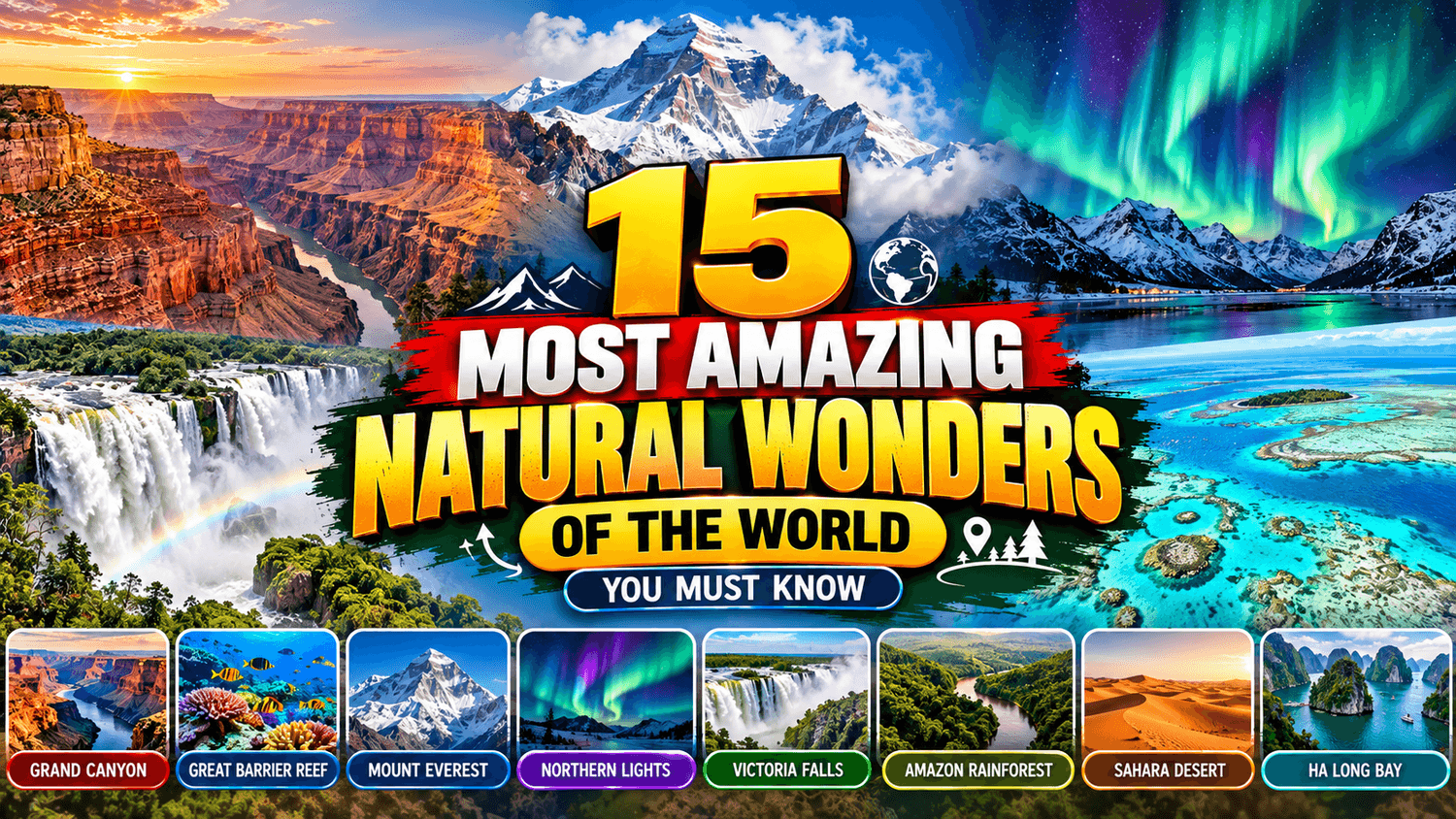
15 Most Amazing Natural Wonders of the World You Must Know
The world’s most amazing natural wonders reveal the extraordinary beauty and power of nature. From towering mountains and enormous waterfalls to colorful coral reefs, vast deserts, and mysterious glowing skies, our planet is filled with places that seem almost impossible to believe.
These natural wonders attract travelers, photographers, scientists, and nature lovers from around the world. They also remind us how important it is to protect the Earth’s ecosystems and natural landscapes.
In this article, we will explore 15 incredible natural wonders of the world, discover what makes each one special, and learn some fascinating facts about our planet.
What Are Natural Wonders?
Natural wonders are remarkable features or phenomena created primarily by natural processes rather than human construction. They include mountains, waterfalls, deserts, forests, caves, oceans, glaciers, and atmospheric displays.
Some natural wonders developed over millions of years through erosion, volcanic activity, tectonic movement, and changes in climate. Others, such as the Northern Lights, occur because of interactions between the atmosphere and charged particles from the Sun.
Let’s explore some of the most fascinating examples.
1. The Grand Canyon, United States
The Grand Canyon is one of the most recognizable natural landscapes in the world. Located in Arizona, it is famous for its enormous size, colorful rock formations, and dramatic cliffs.
The Colorado River and geological processes have shaped the canyon over millions of years, exposing layers of rock that reveal an extensive history of the Earth.
Interesting facts about the Grand Canyon:
It stretches approximately 277 miles (446 kilometers) in length.
Some sections reach more than a mile in depth.
Its exposed rock layers provide valuable information about geological history.
It is home to diverse plants, animals, and ecosystems.
The Grand Canyon is an excellent example of how water, weather, and time can transform a landscape.
2. The Great Barrier Reef, Australia
The Great Barrier Reef, located off the coast of Queensland, Australia, is the world's largest coral reef system.
It consists of thousands of individual reefs and hundreds of islands, providing habitats for a remarkable variety of marine life.
Interesting facts about the Great Barrier Reef:
It extends for more than 2,300 kilometers.
It supports corals, fish, turtles, sharks, and many other marine organisms.
Coral reefs are formed by tiny animals called coral polyps.
Rising ocean temperatures and coral bleaching pose major threats to reef ecosystems.
The Great Barrier Reef demonstrates the importance of protecting marine environments and maintaining healthy oceans.
3. Mount Everest, Nepal and China
Mount Everest is the highest mountain above sea level, rising approximately 8,849 meters (29,032 feet) above sea level.
It is part of the Himalayan mountain range and attracts climbers and adventurers from across the globe.
Interesting facts about Mount Everest:
It lies along the border between Nepal and China's Tibet Autonomous Region.
Its elevation is the highest among Earth's mountains measured from sea level.
The Himalayas formed through the collision of tectonic plates.
Extreme cold, strong winds, and low oxygen levels make climbing Everest dangerous.
Mount Everest is a powerful reminder of the immense forces that shape our planet.
4. The Northern Lights, Arctic Regions
The Northern Lights, also known as the Aurora Borealis, are colorful displays of light that appear in the night sky, particularly at high northern latitudes.
They occur when charged particles associated with the Sun interact with Earth's magnetic field and upper atmosphere.
Interesting facts about the Northern Lights:
They can appear green, red, purple, pink, or blue.
Green is among the most commonly observed colors.
Norway, Iceland, Finland, Sweden, Canada, and Alaska are popular viewing destinations.
Their visibility depends on solar activity, weather, darkness, and location.
The Northern Lights are a spectacular example of how activity in space can create beautiful natural phenomena on Earth.
5. Victoria Falls, Zambia and Zimbabwe
Victoria Falls is one of the world's most impressive waterfalls, located on the Zambezi River along the border between Zambia and Zimbabwe.
Known locally as Mosi-oa-Tunya, meaning “The Smoke That Thunders,” the waterfall is famous for its powerful flow and enormous clouds of mist.
Interesting facts about Victoria Falls:
It is approximately 1,708 meters wide.
The main waterfall has a maximum height of about 108 meters.
The volume of water changes considerably between wet and dry seasons.
Mist from the falls can be seen from a considerable distance when water flow is high.
Victoria Falls demonstrates the tremendous power of flowing water to shape landscapes.
6. The Amazon Rainforest, South America
The Amazon Rainforest is the largest tropical rainforest in the world. It stretches across several South American countries, with the largest portion located in Brazil.
The Amazon is essential to regional climate systems, biodiversity, and the global carbon cycle.
Interesting facts about the Amazon Rainforest:
It contains an extraordinary variety of plant and animal species.
The Amazon River system supports countless aquatic organisms.
Many species found there remain poorly studied.
Deforestation, habitat loss, fires, and climate change threaten parts of the ecosystem.
Protecting the Amazon is important for biodiversity, Indigenous communities, and the long-term health of the environment.
7. The Sahara Desert, Africa
The Sahara is the largest hot desert on Earth, covering much of North Africa.
Its landscape includes sand dunes, rocky plateaus, mountains, dry valleys, and occasional oases.
Interesting facts about the Sahara Desert:
It spans several countries in North Africa.
Temperatures can become extremely high during the day and fall sharply at night.
Some regions receive very little rainfall.
Despite harsh conditions, the Sahara supports plants, animals, and human communities adapted to desert life.
The Sahara illustrates how living organisms adapt to some of Earth's most challenging environments.
8. The Galápagos Islands, Ecuador
The Galápagos Islands are a volcanic archipelago in the Pacific Ocean, located west of mainland Ecuador.
These islands are famous for their unusual wildlife and their contribution to the development of scientific understanding about evolution.
Interesting facts about the Galápagos Islands:
They contain species found nowhere else in the world.
Giant tortoises are among their most famous animals.
Marine iguanas are adapted to feeding in the ocean.
The islands played an important role in Charles Darwin's observations of nature.
The Galápagos Islands show how geographic isolation can contribute to the development of unique species.
9. Ha Long Bay, Vietnam
Ha Long Bay is known for its emerald-green waters and thousands of limestone islands and rock formations.
Located in northeastern Vietnam, the bay has developed through geological processes that shaped limestone over millions of years.
Interesting facts about Ha Long Bay:
Its landscape includes limestone towers, caves, and small islands.
Weathering and erosion have helped create its distinctive formations.
The bay supports marine ecosystems and coastal communities.
It is recognized as a UNESCO World Heritage Site.
Ha Long Bay is an excellent example of how geology and water can create extraordinary scenery.
10. Salar de Uyuni, Bolivia
Salar de Uyuni is the world's largest salt flat, located in southwestern Bolivia.
During the dry season, it appears as an immense white landscape. After rainfall, a thin layer of water can create spectacular reflections of the sky.
Interesting facts about Salar de Uyuni:
It covers approximately 10,582 square kilometers.
It formed through the transformation of ancient lakes.
The salt crust can create an almost endless-looking horizon.
The region contains significant lithium resources in its brines.
Salar de Uyuni is a remarkable example of how ancient lakes and changing environmental conditions can produce unusual landscapes.
11. Iguazu Falls, Argentina and Brazil
Iguazu Falls is an enormous waterfall system located on the border between Argentina and Brazil.
It consists of numerous individual waterfalls surrounded by subtropical rainforest.
Interesting facts about Iguazu Falls:
The waterfall system contains hundreds of cascades, depending on water levels.
The Devil's Throat is one of its most famous sections.
The surrounding forests provide habitat for diverse wildlife.
Water volume varies with rainfall and seasonal conditions.
Iguazu Falls combines dramatic scenery with the ecological importance of protected rainforest environments.
12. Antarctica, The Southern Polar Region
Antarctica is the coldest, driest, and windiest continent on Earth.
Much of the continent is covered by an enormous ice sheet that stores a large proportion of the world's freshwater.
Interesting facts about Antarctica:
It contains most of Earth's land-based ice.
Temperatures can fall far below freezing for extended periods.
Penguins, seals, and seabirds live in parts of the region.
Antarctica plays an important role in global ocean circulation and climate systems.
Antarctica is especially important for scientific research because changes in its ice sheets can affect global sea levels.
13. The Dead Sea, Jordan and Israel/West Bank
The Dead Sea is a highly saline lake located in the Jordan Rift Valley.
Its water contains an exceptionally high concentration of dissolved salts, making it much easier for people to float than in ordinary freshwater.
Interesting facts about the Dead Sea:
Its shoreline is one of the lowest exposed land elevations on Earth.
The water is far saltier than typical seawater.
The lake has been shrinking due to water diversion, mineral extraction, and regional environmental pressures.
Its mineral-rich mud and waters have attracted visitors for centuries.
The Dead Sea is a fascinating example of how geology, climate, and human activity interact to shape a unique environment.
14. Pamukkale, Türkiye
Pamukkale is famous for its white terraces formed by mineral-rich thermal waters.
The terraces developed as calcium carbonate was deposited over time, creating a landscape that resembles frozen waterfalls.
Interesting facts about Pamukkale:
Its name means “Cotton Castle” in Turkish.
Mineral deposits create its distinctive white appearance.
The nearby ancient city of Hierapolis adds historical significance to the area.
It is recognized as part of a UNESCO World Heritage Site.
Pamukkale demonstrates how mineral-rich water can gradually create striking geological formations.
15. The Giant Sequoia Forests, United States
The giant sequoia trees of California are among the most massive trees on Earth by volume.
They grow naturally in particular areas of the Sierra Nevada mountain range.
Interesting facts about giant sequoias:
Some individual trees live for thousands of years.
Their thick bark provides a degree of protection against fire.
Their seeds are small despite the enormous size of mature trees.
Fire plays a natural role in the ecology of many sequoia forests.
These forests demonstrate the remarkable longevity of some living organisms and the importance of maintaining healthy forest ecosystems.
Why Are Natural Wonders Important?
Natural wonders are more than beautiful destinations. They help us understand Earth's history, climate, biodiversity, and the processes that shape the environment.
1. They Support Biodiversity
Rainforests, coral reefs, wetlands, and mountains provide habitats for countless organisms.
2. They Help Scientists Understand Earth
Rock formations, glaciers, caves, and volcanoes preserve evidence of geological and environmental changes.
3. They Support Local Communities
Many communities depend on natural landscapes for tourism, agriculture, fishing, and other livelihoods.
4. They Inspire Travel and Learning
Natural wonders encourage people to explore geography, biology, geology, and environmental science.
5. They Need Protection
Pollution, habitat destruction, climate change, unsustainable tourism, and other human activities can damage these places.
Conservation efforts, responsible tourism, scientific research, and sustainable resource management can help protect natural wonders for future generations.
How Can We Help Protect Natural Wonders?
You don't have to be a scientist or environmental expert to contribute to conservation.
Here are some simple actions you can take:
Avoid leaving litter in natural areas.
Reduce unnecessary single-use plastic.
Follow local rules when visiting protected areas.
Respect wildlife and maintain a safe distance from animals.
Support responsible tourism and conservation organizations.
Reduce unnecessary energy consumption.
Learn about local ecosystems and environmental challenges.
Share accurate information about conservation.
Small actions, when adopted by many people, can help reduce environmental pressure.
Frequently Asked Questions (FAQs)
1. What are the most famous natural wonders of the world?
Some famous natural wonders include the Grand Canyon, Great Barrier Reef, Mount Everest, Victoria Falls, the Amazon Rainforest, the Northern Lights, and Iguazu Falls.
2. What is the largest natural wonder in the world?
There is no universally accepted single largest natural wonder because the answer depends on how size is measured. The Pacific Ocean is the largest ocean, the Amazon is the largest tropical rainforest, and the Sahara is the largest hot desert.
3. Which natural wonder is the highest?
Mount Everest is the highest mountain above sea level, reaching approximately 8,849 meters.
4. What is the largest coral reef system in the world?
The Great Barrier Reef in Australia is the largest coral reef system in the world.
5. What causes the Northern Lights?
The Northern Lights occur when charged particles associated with the Sun interact with Earth's magnetic field and upper atmosphere, causing atmospheric gases to emit light.
6. Why should we protect natural wonders?
Natural wonders support biodiversity, provide ecosystem services, preserve geological history, support communities, and offer important opportunities for education and scientific research.
7. Can natural wonders disappear?
Yes. Natural landscapes can change or be damaged by erosion, climate change, pollution, habitat destruction, geological events, and human activities. Conservation can help protect many of these places.
Conclusion
The world's natural wonders reveal just how extraordinary our planet is. From the enormous cliffs of the Grand Canyon to the colorful Northern Lights, from the Great Barrier Reef to the ancient giant sequoias, each place tells a different story about nature.
These landscapes and phenomena are valuable not only because of their beauty but also because they help us understand the Earth's history, ecosystems, and changing environment.
By learning about these remarkable places and supporting responsible conservation, we can help ensure that future generations have the opportunity to appreciate them.
Nature is full of wonders. The more we explore, the more we discover how much there is still to learn.

Building stronger digital visibility, smarter marketing systems and meaningful growth opportunities for businesses across industries.
BE VISIBLE. BE RELEVANT. BE REMEMBERED.