
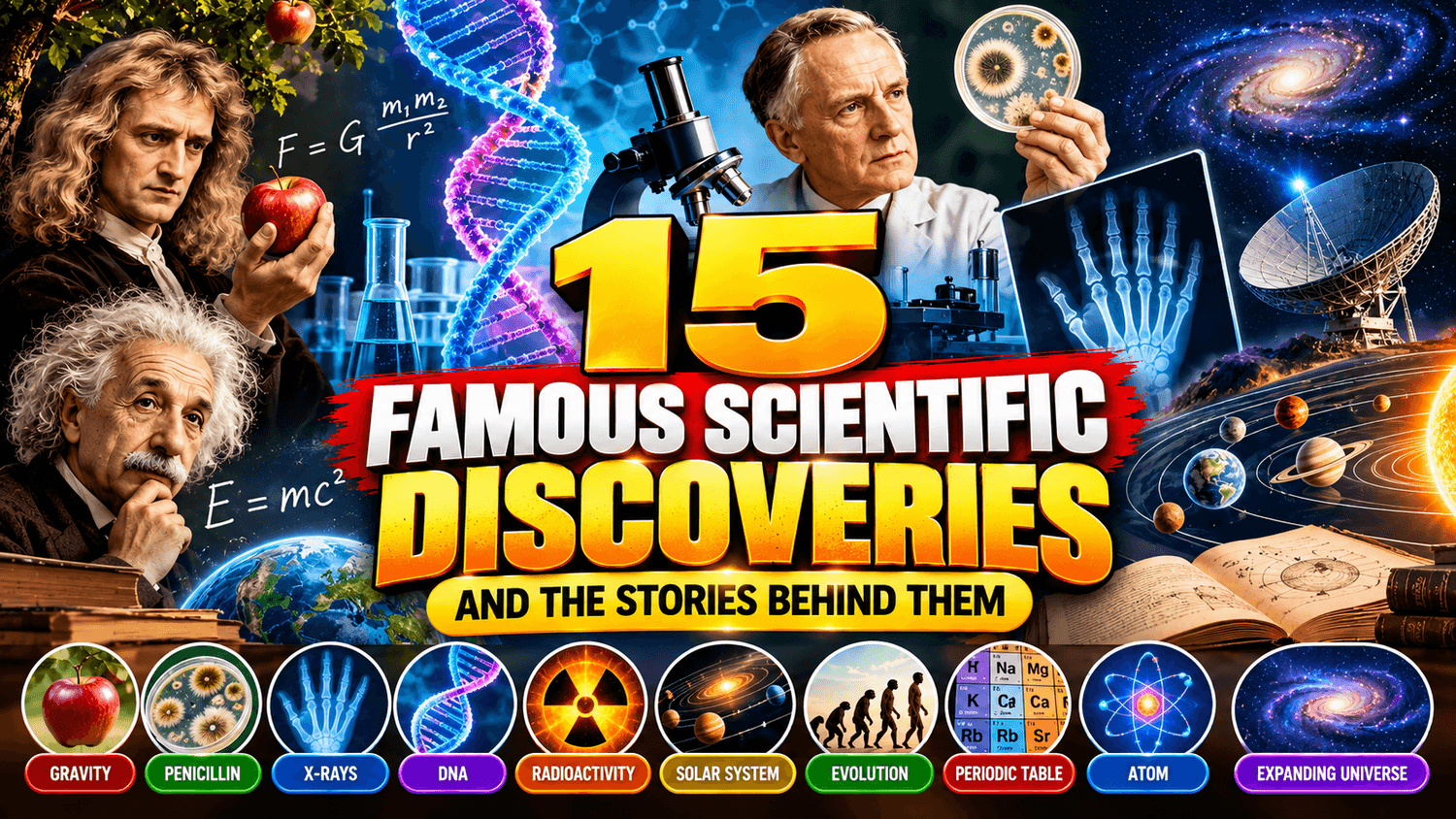
15 Famous Scientific Discoveries and the Stories Behind Them
Throughout history, scientific discoveries have changed the way humans understand the universe, nature, health, and everyday life. From understanding gravity to discovering penicillin and uncovering the structure of DNA, these breakthroughs have helped shape the modern world.
Behind every major discovery lies a story of curiosity, experimentation, observation, and sometimes unexpected results. Some scientists spent years investigating a difficult problem, while others noticed something unusual that eventually changed the course of history.
In this article, we will explore 15 famous scientific discoveries and the fascinating stories behind them, including the scientists involved, how the discoveries happened, and why they remain important today.
What Is a Scientific Discovery?
A scientific discovery occurs when researchers identify a previously unknown phenomenon, relationship, organism, structure, or explanation about the natural world.
Discoveries often develop through observation, experimentation, mathematical reasoning, and the careful analysis of evidence. They may take years to confirm, and many involve contributions from multiple researchers rather than a single individual.
Let's explore some of the most influential scientific discoveries in history.
1. The Discovery of Gravity
Scientist: Isaac Newton
Major contribution: Formulating the law of universal gravitation
Period: 17th century
Gravity is the force that attracts objects toward one another. It keeps planets in orbit around the Sun, holds the Moon near Earth, and causes objects to fall toward the ground.
Isaac Newton developed his law of universal gravitation in the 17th century, providing a mathematical explanation for the motion of objects on Earth and in space.
A famous story connects Newton's thinking about gravity with an apple falling from a tree. Although the exact details of the popular story are uncertain, Newton did reflect on why objects fall toward Earth and how the same principle might apply to the Moon.
His work helped unite terrestrial motion and celestial motion under one mathematical framework.
Why this discovery matters:
Helped explain planetary motion.
Advanced classical mechanics.
Improved calculations involving orbits and projectiles.
Influenced engineering, astronomy, and physics.
Newton's theory was later refined by Albert Einstein's theory of general relativity, which describes gravity in terms of the curvature of spacetime.
2. The Discovery of Penicillin
Scientist: Alexander Fleming
Year: 1928
Penicillin is one of the most influential discoveries in medical history because it helped transform the treatment of bacterial infections.
In 1928, Alexander Fleming noticed that a mold growing in one of his laboratory culture dishes appeared to inhibit the growth of nearby bacteria.
Instead of ignoring the unusual result, Fleming investigated it and recognized that the mold was producing a substance with antibacterial properties.
The mold was identified as belonging to the Penicillium group, and the substance became known as penicillin.
However, turning penicillin into a widely usable medicine required further research. Howard Florey, Ernst Boris Chain, and their colleagues played crucial roles in developing methods for purification, testing, and large-scale production.
Why this discovery matters:
Made many bacterial infections treatable.
Helped improve the safety of numerous medical procedures.
Contributed to major advances in modern medicine.
Inspired further research into antimicrobial drugs.
Penicillin also reminds us that an unexpected observation can become important when it is investigated carefully.
3. The Discovery of X-Rays
Scientist: Wilhelm Conrad Röntgen
Year: 1895
X-rays revolutionized medicine by allowing doctors to examine structures inside the human body without performing surgery.
In 1895, physicist Wilhelm Conrad Röntgen was experimenting with electrical discharges in vacuum tubes when he observed that a nearby fluorescent screen was glowing even though it was not directly exposed to the visible light from the experiment.
He investigated the mysterious radiation and discovered that it could pass through certain materials, including soft tissues, while being absorbed more strongly by denser materials such as bone.
One of his earliest famous X-ray images showed the bones and ring of his wife's hand.
Why this discovery matters:
Enabled non-invasive medical imaging.
Improved the diagnosis of fractures.
Supported the detection of certain diseases.
Contributed to later developments in CT scanning and other imaging technologies.
Today, X-ray technology is used in hospitals, dentistry, airport security, industrial inspection, and scientific research.
4. The Discovery of DNA's Double-Helix Structure
Key contributors: James Watson, Francis Crick, Rosalind Franklin, Maurice Wilkins, and others
Year: 1953
DNA, or deoxyribonucleic acid, carries the genetic instructions used in the development, functioning, and reproduction of living organisms.
Scientists had studied DNA long before 1953, but understanding its three-dimensional structure was a major scientific challenge.
In 1953, James Watson and Francis Crick proposed a double-helix model of DNA based on available chemical evidence and important experimental findings.
Rosalind Franklin's X-ray diffraction research, particularly an image known as Photo 51, provided crucial evidence about DNA's structure. Maurice Wilkins and other researchers also contributed to the work that helped establish the model.
Why this discovery matters:
Improved understanding of genetic inheritance.
Helped establish the foundations of molecular biology.
Supported later advances in genetic testing.
Contributed to biotechnology, forensic science, and medical research.
Understanding DNA's structure opened the door to a much deeper understanding of how biological information is stored and passed from one generation to another.
5. The Discovery of Radioactivity
Scientists: Henri Becquerel, Marie Curie, Pierre Curie, and others
Major developments: 1896 onward
Radioactivity is the process through which unstable atomic nuclei release energy and particles.
In 1896, Henri Becquerel discovered that uranium compounds could affect photographic plates even without exposure to sunlight. This demonstrated that certain materials emitted penetrating radiation spontaneously.
Marie Curie and Pierre Curie subsequently investigated the phenomenon in greater detail. Marie Curie's research helped establish the study of radioactivity as a major scientific field, and the researchers identified the elements polonium and radium.
Why this discovery matters:
Improved understanding of atomic structure.
Supported the development of nuclear physics.
Contributed to medical applications involving radiation.
Helped researchers study radioactive dating and geological processes.
Radioactivity has both beneficial applications and potential risks, making radiation safety essential in medicine, industry, and research.
6. The Heliocentric Model of the Solar System
Scientist: Nicolaus Copernicus
Major publication: 1543
For centuries, many European scholars accepted a model in which Earth was positioned at the center of the cosmos.
Nicolaus Copernicus proposed a different mathematical model in which Earth and the other planets orbit the Sun.
His work challenged established astronomical assumptions and helped initiate a major transformation in scientific thought.
The heliocentric model was subsequently developed through the observations of Tycho Brahe, the work of Johannes Kepler on planetary motion, and Galileo Galilei's telescopic observations. Later, Newton's laws of motion and gravitation provided a physical explanation for planetary orbits.
Why this discovery matters:
Changed scientific understanding of the solar system.
Helped establish modern astronomy.
Encouraged the testing of traditional assumptions.
Contributed to the development of modern physics.
The history of heliocentrism demonstrates how scientific understanding can change as mathematical models and observational evidence improve.
7. The Theory of Evolution by Natural Selection
Scientists: Charles Darwin and Alfred Russel Wallace
Major developments: 1858–1859
Evolution explains how populations of living organisms change across generations.
Charles Darwin and Alfred Russel Wallace independently developed ideas about evolution through natural selection. Their work was jointly presented in 1858, and Darwin published On the Origin of Species in 1859.
Natural selection occurs when inherited characteristics influence an organism's ability to survive and reproduce in a particular environment. Over many generations, these differences can change the characteristics of populations.
Darwin's observations of variation among organisms, including those he studied during the voyage of the HMS Beagle, helped shape his explanation.
Why this discovery matters:
Explains how species adapt over generations.
Provides a foundation for modern biology.
Helps researchers understand biodiversity.
Supports research into genetics, ecology, and infectious diseases.
Modern evolutionary biology combines natural selection with genetics, molecular biology, fossils, and other lines of evidence.
8. The Development of the Periodic Table
Scientist: Dmitri Mendeleev
Year: 1869
The periodic table organizes chemical elements according to their properties and atomic structure.
During the 19th century, scientists were discovering more chemical elements and looking for patterns that could help organize them.
In 1869, Dmitri Mendeleev developed a periodic arrangement of the known elements. One of the remarkable features of his table was that he left gaps for elements that had not yet been discovered and predicted some of their properties.
Later discoveries supported several of these predictions, strengthening the usefulness of his system.
The modern periodic table is arranged by atomic number, following developments in atomic physics during the 20th century.
Why this discovery matters:
Organizes the chemical elements systematically.
Helps predict chemical properties.
Supports chemistry education and research.
Contributes to materials science, medicine, and industrial chemistry.
The periodic table remains one of the most recognizable tools in science.
9. The Discovery of Electromagnetic Induction
Scientist: Michael Faraday
Year: 1831
Electromagnetic induction is the process by which a changing magnetic field can produce an electric current in a conductor.
In 1831, Michael Faraday conducted experiments demonstrating that changes in magnetism could generate electricity.
His work helped establish the relationship between electricity and magnetism and laid the foundations for important electrical technologies.
Why this discovery matters:
Made electrical generators possible.
Supported the development of transformers.
Helped enable large-scale electricity production.
Contributed to modern electrical engineering.
Today, electromagnetic induction is central to power generation in many hydroelectric, thermal, wind, and other power stations.
10. The Discovery of Microorganisms
Scientists: Robert Hooke and Antonie van Leeuwenhoek, among others
Period: 17th century
For much of human history, microorganisms were invisible to the unaided eye. Their existence became clearer as microscopes improved.
In 1665, Robert Hooke published observations of microscopic structures in cork and other materials. Around the same period, Antonie van Leeuwenhoek used powerful handcrafted microscopes to observe tiny living organisms in samples of water and other materials.
These observations revealed a previously unseen world of microscopic life.
Later work by scientists such as Louis Pasteur and Robert Koch helped establish the roles of microorganisms in fermentation, infection, and disease.
Why this discovery matters:
Established microbiology as a scientific field.
Improved understanding of infectious diseases.
Supported food preservation and fermentation research.
Contributed to sanitation and public health.
Microorganisms are not all harmful; many play essential roles in digestion, ecosystems, agriculture, and food production.
11. The Discovery of Insulin's Role in Diabetes Treatment
Key contributors: Frederick Banting, Charles Best, J. J. R. Macleod, James Collip, and others
Year: 1921 onward
Insulin is a hormone produced by the pancreas that helps regulate blood glucose levels.
Before insulin treatment became available, type 1 diabetes was frequently fatal. Researchers studying the pancreas discovered that extracts containing insulin could help lower blood glucose.
Frederick Banting and Charles Best conducted important early experiments at the University of Toronto in 1921. J. J. R. Macleod provided laboratory support, and James Collip contributed to the purification of insulin for medical use.
The first successful treatment of a patient with insulin in 1922 marked a turning point in diabetes care.
Why this discovery matters:
Made type 1 diabetes manageable for many patients.
Improved survival and quality of life.
Supported further research into hormone regulation.
Helped advance the treatment of metabolic diseases.
Insulin does not cure diabetes, but it remains an essential treatment for many people living with the condition.
12. The Discovery of the Expanding Universe
Key contributors: Georges Lemaître, Edwin Hubble, and many other astronomers
Major developments: 1920s onward
For centuries, scientists debated the size, structure, and behavior of the universe.
In the 1920s, astronomers gathered evidence that many distant galaxies were moving away from one another in a way consistent with an expanding universe.
Georges Lemaître developed theoretical ideas about an expanding universe and connected observations with cosmological models. Edwin Hubble's observations helped establish the relationship between a galaxy's distance and its recession velocity.
Later measurements and discoveries greatly strengthened the evidence for cosmic expansion.
Why this discovery matters:
Changed our understanding of the universe.
Supported the development of modern cosmology.
Helped scientists investigate the universe's history.
Contributed to the development of the Big Bang model.
Cosmic expansion remains a central subject in modern astronomy and cosmology.
13. The Discovery of the Cosmic Microwave Background
Scientists: Arno Penzias and Robert Wilson
Year: 1965
The cosmic microwave background is faint radiation that fills the universe and provides evidence about its early history.
In 1965, Arno Penzias and Robert Wilson detected an unexplained microwave signal using a radio antenna. After investigating possible sources of interference, they determined that the signal was not simply coming from their equipment.
Their observation matched the kind of radiation predicted by cosmological models of a hot, dense early universe.
Other researchers had previously developed theoretical predictions about this background radiation.
Why this discovery matters:
Provided strong evidence supporting the Big Bang model.
Helped scientists study the early universe.
Revealed information about the universe's large-scale structure.
Supported later cosmological measurements by satellites and other instruments.
The cosmic microwave background is still studied to learn more about the universe's composition, age, and evolution.
14. The Discovery of the Structure of the Atom
Key contributors: John Dalton, J. J. Thomson, Ernest Rutherford, Niels Bohr, and many others
Period: 19th and 20th centuries
The modern understanding of atoms developed through many scientific discoveries rather than a single experiment.
John Dalton helped establish an influential atomic theory in the early 19th century. J. J. Thomson discovered the electron in 1897, demonstrating that atoms contained smaller components.
In 1911, Ernest Rutherford's experiments provided evidence for a small, dense atomic nucleus. Niels Bohr subsequently proposed a model of atomic structure that helped explain certain features of atomic spectra.
Later developments in quantum mechanics produced the modern understanding of electrons and atomic behavior.
Why this discovery matters:
Improved understanding of matter.
Helped establish modern chemistry and physics.
Supported the development of electronics.
Contributed to nuclear science and materials research.
Our understanding of atoms continues to influence technologies ranging from semiconductors to medical imaging.
15. The Discovery of the Ozone Hole
Key contributors: Joseph Farman, Brian Gardiner, Jonathan Shanklin, and other researchers
Year: 1985
The ozone layer is a region of the stratosphere that absorbs much of the Sun's harmful ultraviolet radiation.
In the 1980s, researchers studying atmospheric measurements over Antarctica identified a dramatic seasonal decline in ozone concentrations.
Their findings helped reveal the scale of ozone depletion associated with chemicals such as chlorofluorocarbons, or CFCs.
Subsequent scientific research and international cooperation led to measures designed to reduce ozone-depleting substances.
Why this discovery matters:
Improved understanding of atmospheric chemistry.
Identified a major environmental problem.
Supported international action to phase out many ozone-depleting substances.
Demonstrated the importance of long-term environmental monitoring.
The ozone story is an important example of how scientific observations can help identify environmental risks and guide public policy.
What Can We Learn From These Scientific Discoveries?
These discoveries reveal several important lessons about science and human progress.
1. Curiosity Leads to Questions
Many breakthroughs begin when someone asks why something happens or notices something that does not fit an existing explanation.
2. Evidence Matters
Scientific explanations become more reliable when supported by careful observation, repeatable experiments, and independent evidence.
3. Unexpected Results Can Be Valuable
Penicillin and X-rays are examples of discoveries that emerged from observations researchers did not initially expect.
4. Scientific Progress Is Often Collaborative
Major discoveries frequently depend on previous research, teamwork, improved instruments, and contributions from multiple people.
5. Scientific Knowledge Changes Over Time
New evidence can improve, refine, or replace earlier explanations. This process is a strength of scientific inquiry.
Frequently Asked Questions (FAQs)
1. What is the most important scientific discovery in history?
There is no universally agreed answer. Discoveries such as gravity, DNA's structure, vaccination, penicillin, and the understanding of microorganisms have had major effects on different areas of human life.
2. Who discovered gravity?
Isaac Newton formulated the law of universal gravitation in the 17th century. Earlier thinkers had studied falling objects and planetary motion, and Einstein later developed a more comprehensive theory of gravity.
3. Who discovered penicillin?
Alexander Fleming discovered penicillin's antibacterial properties in 1928. Howard Florey, Ernst Boris Chain, and their colleagues helped develop it into a practical medicine.
4. Who discovered DNA?
DNA was identified as a substance in the 19th century, while its double-helix structure was proposed in 1953 by James Watson and Francis Crick, drawing on crucial experimental evidence from Rosalind Franklin, Maurice Wilkins, and others.
5. Who discovered X-rays?
Wilhelm Conrad Röntgen discovered X-rays in 1895 while conducting experiments with electrical discharges in vacuum tubes.
6. Why are scientific discoveries important?
Scientific discoveries help explain natural phenomena, improve technology, advance medicine, solve practical problems, and expand human knowledge.
7. Are all scientific discoveries made by accident?
No. Some discoveries result from unexpected observations, while others emerge from carefully planned experiments, mathematical analysis, and years of research.
8. How do scientific discoveries change everyday life?
Discoveries can lead to medical treatments, electricity generation, communication technologies, improved agriculture, safer transportation, and a better understanding of the environment.
9. What is the difference between an invention and a discovery?
A discovery identifies something that already exists or reveals a previously unknown fact about the world. An invention creates a new device, process, or method, often using scientific knowledge.
10. Can new scientific discoveries change what we believe today?
Yes. Scientific explanations can change as new evidence emerges, instruments improve, and researchers develop better theories.
Conclusion
The history of scientific discovery is a story of curiosity, persistence, creativity, and collaboration. From Newton's work on gravity to Fleming's discovery of penicillin and the identification of DNA's double-helix structure, these breakthroughs have transformed medicine, technology, biology, astronomy, and our understanding of the universe.
Many discoveries did not happen in isolation. They were built upon earlier research and developed through the efforts of numerous scientists over time.
The most important lesson is that asking questions, examining evidence, and remaining open to new ideas can lead to extraordinary progress.
Every great discovery begins with a question, an observation, or a desire to understand something better.

Building stronger digital visibility, smarter marketing systems and meaningful growth opportunities for businesses across industries.
BE VISIBLE. BE RELEVANT. BE REMEMBERED.